Sir Arthur Cotton
Engineer officer of the Madras army (1803–1899). He planned and built the anicut (dam) across the Godavari at Dowlaishweram (1847–1852), which turned the Godavari delta into irrigated rice land. He backed the plan for the Krishna anicut at Bezwada (built 1852–1855). At Vizagapatam he built sea groins and St John's church in 1844. He planned the upper Godavari navigation, of which the Dummagudem anicut survives.
Arthur Cotton was the engineer of the Godavari anicut (dam).1 The Godavari manual of 1878 calls it “this invaluable boon” (great gift) to the district.1 His daughter, Lady Hope, wrote his life in 1900.2 She says that he “was born on May 15, 1803”, the tenth son of Henry Calveley Cotton.2
Morris says that the idea of a dam across the Godavari went back to the astronomer Michael Topping before 1800.13 It was revived in 1844, when Sir Henry Montgomery was sent to report on the depressed district.13 Montgomery urged that “an experienced Irrigation Engineer” examine the delta.13 See East India Company.
The Godavari anicut
The Rajahmundry district had declined after the famine of 1833 and the closing of the Company’s cloth factories.4 Sir Henry Montgomery’s report of 1844 drew attention to the neglect of the Godavari water.4 Cotton, then a captain, reported on the district’s lack of irrigation works and proposed an anicut, a dam, across the river. The Board of Revenue supported the plan in April 1846, and the government sanctioned it in September.356
Work began in earnest in April 1847.7 Up to 6,500 men were at work in the seasons of 1848–50.7 In 1852 the government recorded that the anicut “may now be said to have arrived at completion”.89 It gave the credit to “the unceasing exertion and energy of Colonel Cotton and the officers associated with him”.89 By January 1853 it had sanctioned 15,34,952 rupees for the works.89 See Rajahmundry and the map of the Godavari delta works.
Other works
On the Krishna, the Kistna manual says, Captain Lake’s plan for a dam was “endorsed by Major (now Sir Arthur) Cotton”.10 The plan then went to a committee in 1849.10 The anicut at Vijayawada (then Bezwada) was built from 1852 to 1855.10
At Visakhapatnam (then Vizagapatam), loose stone groins (low sea walls) checked the sea in front of the customs office.1112 They were put down “in 1844” by “Sir Arthur (then Major) Cotton”.1112 St John’s church there “was built in 1844 by Sir Arthur Cotton and consecrated in 1846”.1112
On the upper Godavari, the Dummagudem anicut was “almost the sole relic of the great scheme conceived by Sir Arthur Cotton” for navigating the river.1314 The mission at Dummagudem was started through his influence.1314 See Visakhapatnam and Vijayawada.
Last years
Lady Hope says that “even after he had attained the age of ninety-six he suffered from no illness whatever”. He weakened in June 1899 and died after the middle of July.151617 He was buried in a cemetery near Dorking.151617 A portrait of him from a photograph of 1883 is the frontispiece of George Walch’s history of the Godavari works (1896).18
Footnotes
-
Henry Morris, A Descriptive and Historical Account of the Godavery District (1878), p. 109 (archive.org (opens in a new tab)). ↩ ↩2 ↩3 ↩4 ↩5
-
Lady Hope, General Sir Arthur Cotton, R.E., K.C.S.I.: His Life and Work (1900), p. 7 (archive.org (opens in a new tab)). ↩ ↩2
-
Morris, Godavery District (1878), p. 110 (archive.org (opens in a new tab)). ↩ ↩2 ↩3 ↩4
-
F. R. Hemingway, Madras District Gazetteers: Godavari, Vol. I (1907), p. 167 (archive.org (opens in a new tab)). ↩ ↩2
-
Morris, Godavery District (1878), p. 116 (archive.org (opens in a new tab)). ↩
-
Morris, Godavery District (1878), p. 118 (archive.org (opens in a new tab)). ↩
-
Morris, Godavery District (1878), p. 126 (archive.org (opens in a new tab)). ↩ ↩2
-
Morris, Godavery District (1878), p. 138 (archive.org (opens in a new tab)). ↩ ↩2 ↩3
-
Morris, Godavery District (1878), p. 139 (archive.org (opens in a new tab)). ↩ ↩2 ↩3
-
Gordon Mackenzie, A Manual of the Kistna District (1883), p. 254 (archive.org (opens in a new tab)). ↩ ↩2 ↩3
-
W. Francis, Madras District Gazetteers: Vizagapatam, Vol. I (1907), p. 327 (archive.org (opens in a new tab)). ↩ ↩2 ↩3
-
Francis, Vizagapatam (1907), p. 330 (archive.org (opens in a new tab)). ↩ ↩2 ↩3
-
Hemingway, Godavari (1907), p. 4 (archive.org (opens in a new tab)). ↩ ↩2
-
Hemingway, Godavari (1907), p. 41 (archive.org (opens in a new tab)). ↩ ↩2
-
Hope, Sir Arthur Cotton (1900), p. 574 (archive.org (opens in a new tab)). ↩ ↩2
-
Hope, Sir Arthur Cotton (1900), p. 575 (archive.org (opens in a new tab)). ↩ ↩2
-
Hope, Sir Arthur Cotton (1900), p. 576 (archive.org (opens in a new tab)). ↩ ↩2
-
George T. Walch, The Engineering Works of the Godavari Delta (1896), frontispiece (archive.org (opens in a new tab)). ↩
Photos
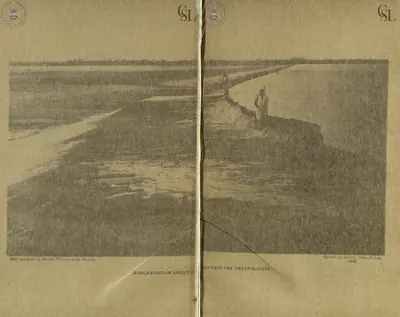 "Dowlaishveram Anicut from near the under sluices" (photograph by Messrs. Nicholas & Co., two halves joined) (Walch 1896, PDF pp. 81-82)Historic photograph · 1896
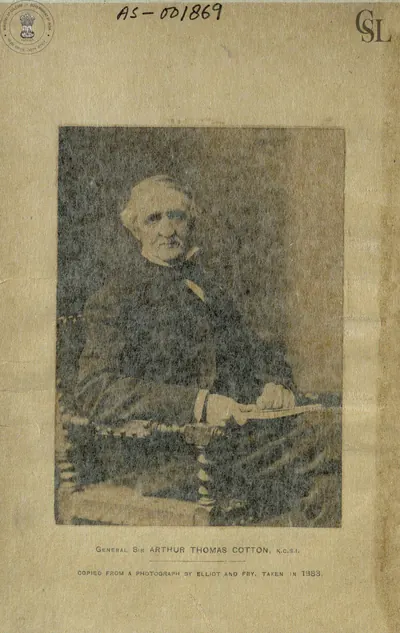 "General Sir Arthur Thomas Cotton, K.C.S.I.", copied from a photograph by Elliott and Fry taken in 1883 (Walch 1896, frontispiece (PDF p. 1))Historic photograph · 1896
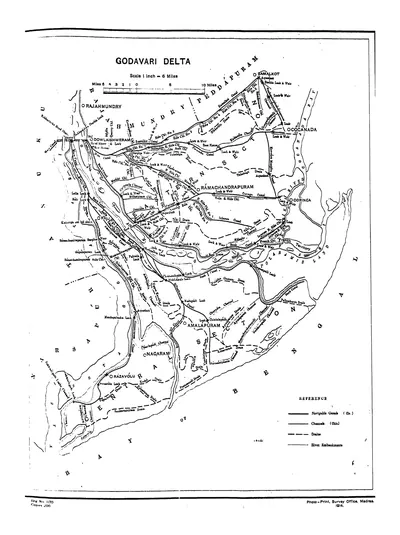 "Godavari Delta" map, with navigable canals, channels, drains and river embankments (Hemingway 1907, PDF p. 97)Map · 1907
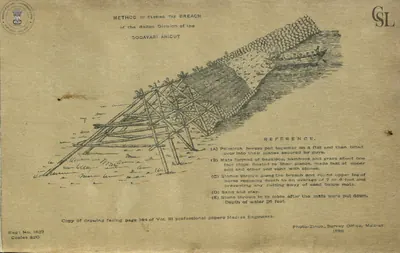 Godavari anicut: "Method of closing the breach of the Ralli division of the Godavari anicut" (Walch 1896, PDF p. 68)Drawing · 1896
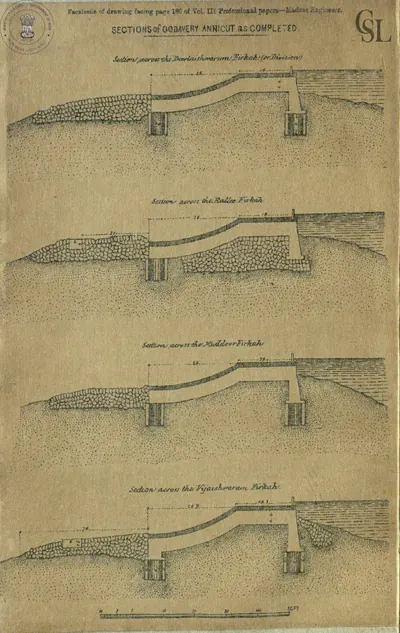 Godavari anicut: "Sections of Godavery Annicut as completed" (facsimile from Professional Papers, Madras Engineers, vol. III) (Walch 1896, facsimile, PDF p. 45)Drawing · 1896
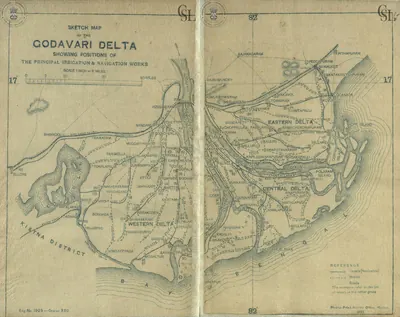 Godavari delta: "Sketch Map of the Godavari Delta showing positions of the principal irrigation & navigation works" (two halves joined) (Walch 1896, PDF pp. 17-18)Map · 1896
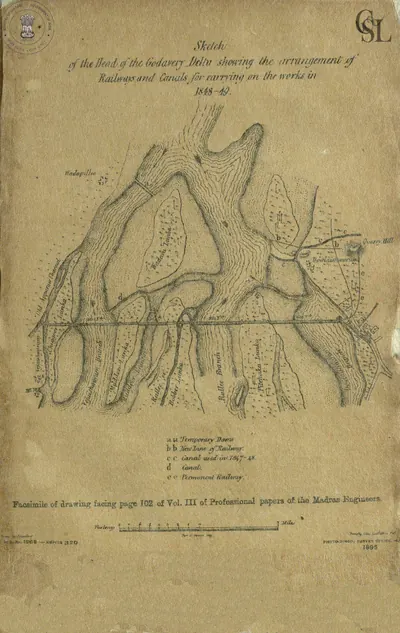 Godavari delta: "Sketch of the Head of the Godavery Delta showing the arrangement of" railways and canals for carrying on the works in 1848-49 (Walch 1896, facsimile, PDF p. 58)Map · 1896
References
Notes (0)
Sources (6)
Spotted an error on this page? Tell us
Last updated: