Karempudi
Town on the Nagileru river in the Palnadu, west of Guntur. It is remembered as the battlefield of the Palnadu heroes and the seat of their cult. Its temple of the heroes, described by Robert Sewell in 1879, has inscriptions of 1324 and 1333. A minister of the Velanati chief Gonka II built a temple of Suresvara there in 1154.
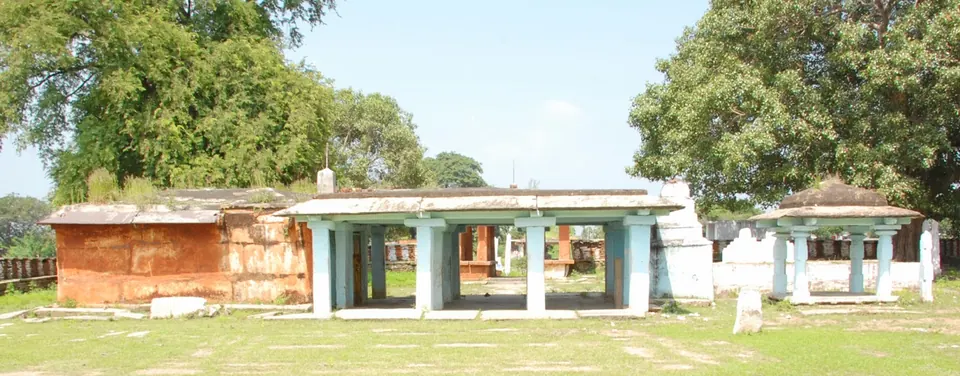
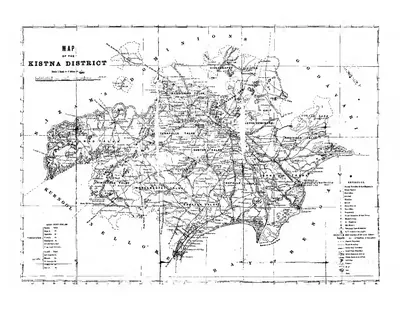
Karempudi stands on the left bank of the Nagileru, the main river of the Palnadu.1 Robert Sewell visited it in 1879.1 He placed it 11 miles south of Dachepalle and 48 miles west-north-west of Guntur.1
Gordon Mackenzie (1883) wrote that “this town is often mentioned in the legends of the Palnad heroes”.2 It “was the scene of the great cock-fights which occupy so large a space in these ballads”.2 He added that the sport still survived at Karempudi.3
According to Mackenzie, the Nagileru rises near Karempudi.4 A legend told of an embankment that once dammed its waters between two hills of the place.4 See the Haihayas of Kona and Palnadu and Brahma Nayudu.
The temple of the heroes
On the right bank of the Nagileru stands the temple dedicated to the “Palnad Heroes”.1 Sewell recorded the local tradition that it was once a small shrine.1 A Muslim of rank, warned in a dream, had enlarged it.1
The temple’s hall rests on sixteen pillars.5 One pillar records that the hall and a tope (grove) of tamarind trees were made in Saka 1255 (1333; Saka is an Indian way of counting years).5 Beside the hall are a shrine to Kanama Dasu, “the Heroes’ famous servant and warrior”, and the sanctum of the heroes.5
The sanctum has 73 stones ranged round its walls, “each supposed to represent one of the chiefs”.5 A pillar near Kanama Dasu’s shrine bears a damaged inscription, which Sewell read as Saka 1246 (1324).5
The temple keeps six iron spears “of the most extraordinary shapes”.6 The largest is called “Nayudu’s spear” and the smallest “Baludu’s”.6 An old accountant at Karempudi recited to Sewell a verse that dates the end of the war to Saka 1308 (1386), many years after these inscriptions.75
Inscriptions and worship
V. Rangacharya (1919) noted that Karempudi “figures largely in the chronicle of the Palnad heroes”.8 It was still the seat of a Brahman guru who led the community that keeps the hero cult.8 An inscription of 1154 at Karempudi records that Isana-peggada built the temple of Suresvara.9 He was a minister of the Velanati king Kulottunga-Choda-Gonkaraja, whom Rangacharya numbers Gonka II (1133–57).9
A record of 1445 marks the spot where the hero Chilama Nayudu planted his spear.10 A carved beam shows him with Pinamallidevaraju, Pedamallidevaraju and others.10
Chilukuri Veerabhadra Rao (1912) described the yearly festival held on the battlefield in the month of Kartika.11 It begins with the raising of a flag and the sending of war summonses to the villages.11 William Taylor’s catalogue of the Mackenzie manuscripts (1862) notes a record of “preparations for another fight at Karyamsi-pudi”.12
Footnotes
-
Sewell, Lists of Antiquarian Remains, Vol. I (1882), Appendix A, p. xiii and note 1 (archive.org (opens in a new tab)). ↩ ↩2 ↩3 ↩4 ↩5 ↩6
-
Mackenzie, Kistna District Manual (1883), p. 161 (archive.org (opens in a new tab)). ↩ ↩2
-
Mackenzie, Kistna District Manual (1883), p. 162 (archive.org (opens in a new tab)). ↩
-
Gordon Mackenzie, A Manual of the Kistna District (1883), p. 155 (archive.org (opens in a new tab)). ↩ ↩2
-
Sewell, Lists of Antiquarian Remains, Vol. I (1882), Appendix A, p. xiv (archive.org (opens in a new tab)). ↩ ↩2 ↩3 ↩4 ↩5 ↩6
-
Sewell, Lists of Antiquarian Remains, Vol. I (1882), Appendix A, p. xv (archive.org (opens in a new tab)). ↩ ↩2
-
Robert Sewell, Lists of the Antiquarian Remains in the Presidency of Madras, Vol. I (1882), Appendix A, p. ii (archive.org (opens in a new tab)). ↩
-
V. Rangacharya, A Topographical List of the Inscriptions of the Madras Presidency, Vol. II (1919), p. 809 (archive.org (opens in a new tab)). ↩ ↩2
-
Rangacharya, Topographical List, Vol. II (1919), p. 810, No. 522 (archive.org (opens in a new tab)). ↩ ↩2
-
Rangacharya, Topographical List, Vol. II (1919), p. 811, No. 525 (archive.org (opens in a new tab)). ↩ ↩2
-
Chilukuri Veerabhadra Rao, Andhrula Charitramu, Part II (1912), p. 232 (archive.org (opens in a new tab)). In Telugu. ↩ ↩2
-
William Taylor, A Catalogue Raisonnée of Oriental Manuscripts, Vol. III (1862), p. 625 (archive.org (opens in a new tab)). ↩
Photos
Related
People
Gonka II (Velanati)
c. 1132–1163 CE
Velanati chief, called Kulottunga Choda Gonka, who ruled from about 1132 to 1163 according to M. Rama Rao. The Pithapuram inscription says that he set a golden pinnacle on the Bhimesvara temple at Draksharama, and ruled the kings between Kalahasti and the Mahendra mountain. His minister built the Suresvara temple at Karempudi in 1154.
Brahma Nayudu
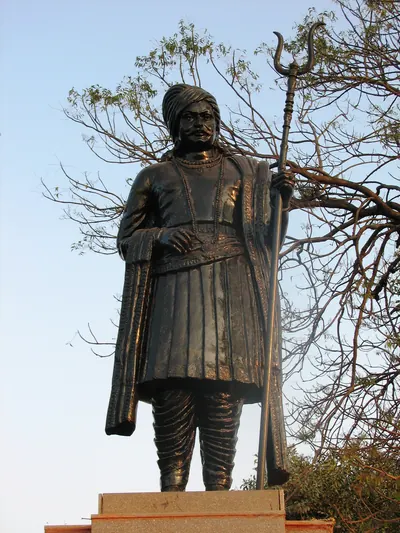
Hero of the Telugu ballad cycle of the Palnati Viralu (Heroes of Palnadu): the minister who led one side in the Palnadu war, fought out at Karempudi, and who is still honoured there as a form of Vishnu. He is known only from the ballads and the cult. No inscription names him, and the dates proposed for his war range from 1080 to 1386.
References
Notes (0)
Sources (5)
Spotted an error on this page? Tell us
Last updated: