Telugu folk arts: burrakatha, harikatha, yakshaganam and more
The performing folk arts (janapada kalalu) of the Telugu country: what burrakatha, harikatha, yakshaganam, chindu bhagavatam, the leather puppet show, oggu katha and kolatam look like, who performs them and where, and what the sources say of their history.
Download
The Telugu country has many folk arts (janapada kalalu): stories sung to drums, plays in the street, dances with sticks and shows of leather puppets. They were made for village audiences, often performed at night after the day’s work, or at festivals and fairs.12 This page describes the main performing forms, who performs them and where, and what the sources say of their past.
For ballads, see Folk songs & oral traditions. For court dance and classical music, see Music & dance.
The forms at a glance
The main source for this page is Teluguvari Janapada Kalarupalu (“folk art forms of the Telugus”), a survey by Mikkilineni Radhakrishna Murthy published by Telugu University in 1992.3 It describes these forms, among many others:
| Form | What happens | Where it is found |
|---|---|---|
| Burrakatha | a narrator with a tambura and two drummers tell a story in song4 | all over the Telugu country, under different names5 |
| Harikatha | one performer sings, speaks and acts a sacred story6 | all over the Telugu country6 |
| Yakshaganam | a story told in song and dance, later as a play7 | Andhra, the Tamil country and Karnataka8 |
| Chindu bhagavatam | dance-dramas from the epics, performed by day9 | northern Telangana9 |
| Tolubommalata | a show of leather puppets behind a lit screen10 | travelling troupes across Andhra11 |
| Oggu katha | Kuruma priests sing of their gods to a small drum12 | Telangana only12 |
| Kolatam | a ring of dancers strike sticks to songs13 | in every village2 |
Burrakatha
Burrakatha began as the jangam katha, the story-song of the Jangams. The Jangams were Saiva devotees, and families among them told these stories for generations. According to Mikkilineni, they used them to spread the Saiva faith, and were singing them by about 1150.3 Later they also told other stories: of Desingu Raja, of the Virata Parva and others.314
A burrakatha needs only three people. The narrator plays a tambura (a stringed drone instrument), keeps time with metal rings in his hand, wears bells on his ankles, and dances as he sings. Two side-singers (vantalu) beat small drums called gummetas, repeat his lines and spur him on.415 One of them is the comic, who asks the questions the audience might ask and keeps them laughing.15
The art has many names. In Krishna and Guntur districts it is called burrakatha, after the burra (gourd) of the tambura. In Rayalaseema it is tandana katha, from the side-singers’ refrain “tandana”.516 In Telangana, the Saradakandru sing similar story-songs of local heroes, such as Sarvayi Papadu.14
Village audiences heard these stories all night, in the slack season or at temple festivals. A good troupe could earn two or three sacks of grain in a single village.1
In the 20th century burrakatha took up politics. Mikkilineni lists dozens of troupes that told burrakathas through the Praja Natya Mandali, a people’s theatre movement.17 Among the writers he names is Sheik Nazar (Najar), who told the Palnadu war as a burrakatha.1819 His Palnati Yuddham was printed at Vijayawada in 1945.20 Other parties used the form too: Congress Vijayamu (“Congress victory”) called itself an “election burrakatha”.21 In 1948–50 the Hyderabad government sent out its own troupe to stage plays and burrakathas against the communist rising.22
Harikatha
In harikatha a single performer holds the stage for about three hours. He speaks the story, sings it, acts every part and dances, with small cymbals (chirutalu) in his hand and bells on his ankles.6 The stories come from the Ramayana, the Mahabharata and the Bhagavatam. A full Ramayana could run for fifteen days or a month.23 Performances are held at night, at festivals such as Dasara, the Ganesh festival and Sankranti.23
Mikkilineni credits Adibhatla Narayana Das with making harikatha a classical art.624 He was born in 1864 in Ajjada village, in the Bobbili taluk of Srikakulam district.24 He also translated Shakespeare and Kalidasa.25 In 1919 the ruler of Vizianagaram founded a music school and made him its head. He held the post for seventeen years, and died on 2 January 1945.25 Narayana Das himself called his harikathas yakshaganas.7
Yakshaganam and the street plays
The yakshaganam is one of the oldest Telugu stage forms. Mikkilineni writes that it spread through Andhra, the Tamil country and Karnataka, and that the street bhagavatams came after it.8 About four hundred yakshagana works are said to survive, printed or in manuscript.26 They flourished under the Reddi kings of Kondavidu, under Vijayanagara and at the Nayaka court of Thanjavur.26
Who performed them? S. V. Joga Rao, the historian of the yakshagana, linked the form to the Jakkula community. He noted villages named after the Jakkulas in Rayalaseema, and an inscription of 1481 at Tirumala set up by a Jakkula woman named Kannayi.27 The Kridabhiramamu, of the early 15th century, already praises the singing of a “Jakkula woman”.27
The form changed over time. At first one actress sang and acted all the parts while a sutradhara (leader) supported her. Later each actor took one part, and announced himself as he entered: “Here comes Satyabhama”.287 Yakshagana texts were still being printed in the 19th century, such as Varaganti Seshagiridasu’s Srimad Ramayana Yakshagana Vilasamu of 1878.29
Telugu also had older popular plays. Chenchiah and Bhujanga Rao name the “daylight plays” (pagati veshamulu) and street plays (vidhi natakamulu).3031 The poet Srinatha even names a famous actor of women’s parts, Butchigadu.31
In northern Telangana, the Chindu performers keep a form of yakshagana alive. They live in Nizamabad, Adilabad, Karimnagar and Medak districts, and depend on the Madiga community for support.329 Men and women act together, by day, in about fifty yakshaganas from the epics. They make their own costumes and ornaments.9
Tolubommalata: the leather puppets
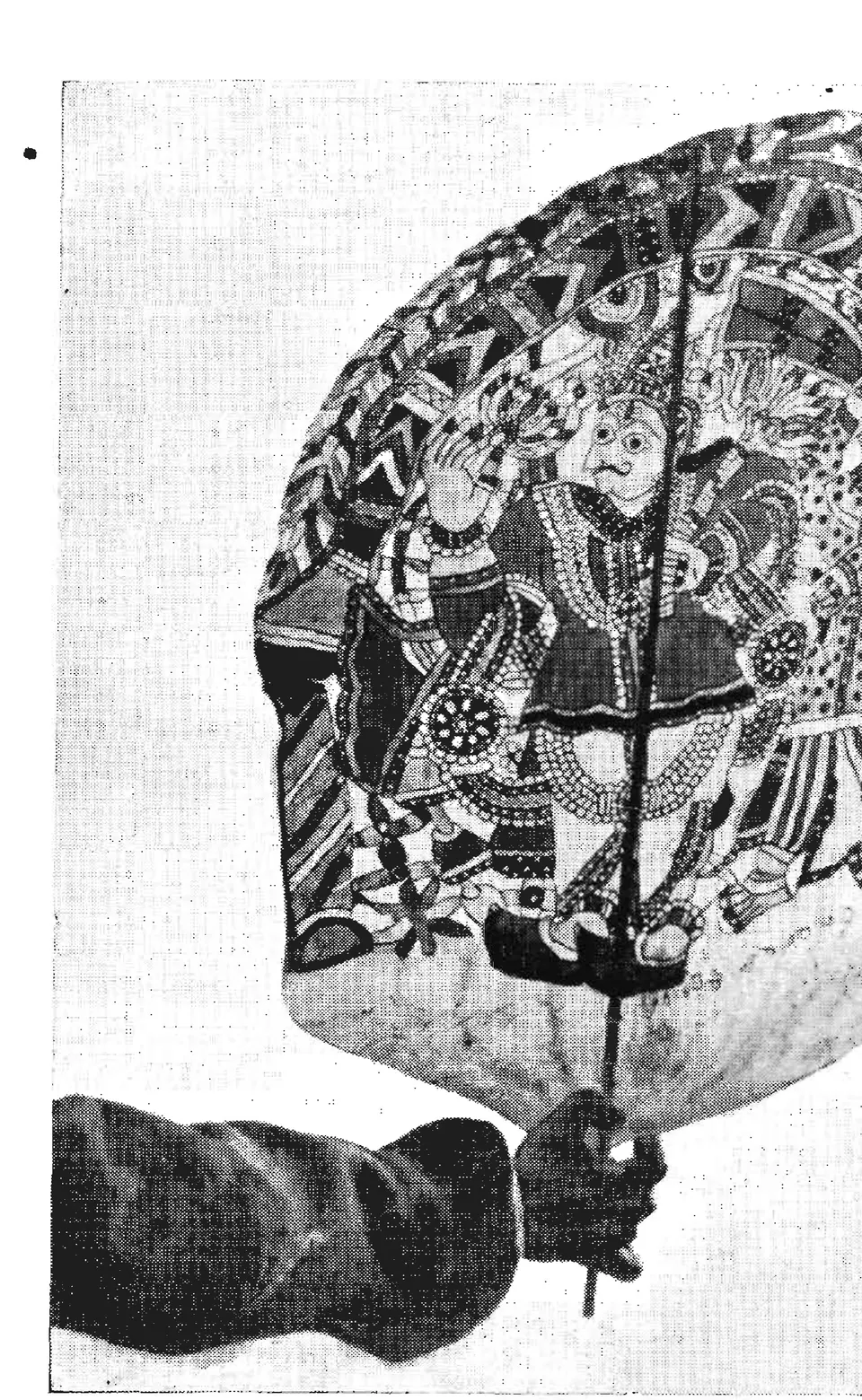
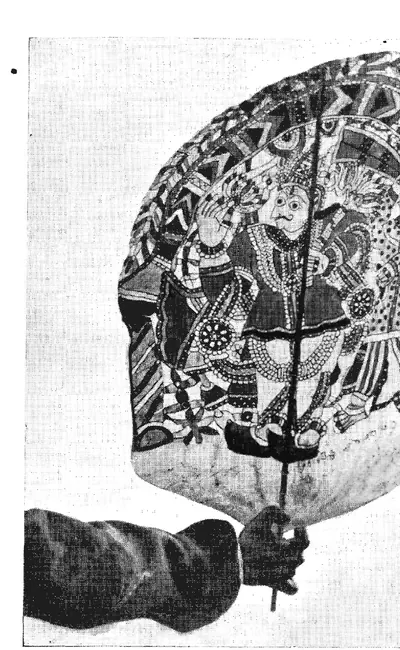
M. Nagabhushana Sarma, writing in 1984, called the Andhra leather puppets the largest many-coloured puppets in India. He found the usual figure about 5 to 6 feet tall.3310 A puppet box (ganiyam) holds 100 to 110 figures, enough for both the Ramayana and the Mahabharata.10
The art is old. Sarma points out that Palkuriki Somanatha, in the 13th century, described puppets moved behind a white curtain at the Sivaratri festival of Srisailam. He took this as proof that the shadow theatre was already well established.34 He saw a second tradition in the troupes of Maratha origin, the Are people, who still speak a Marathi dialect among themselves but perform in Telugu.35
The puppets are cut from goat or deer skin, scraped thin until light shines through. The maker punches small holes for jewellery and paints the figure in red, green and black.1133 The limbs are tied on loosely with thread, so that two sticks can move the arms.3336
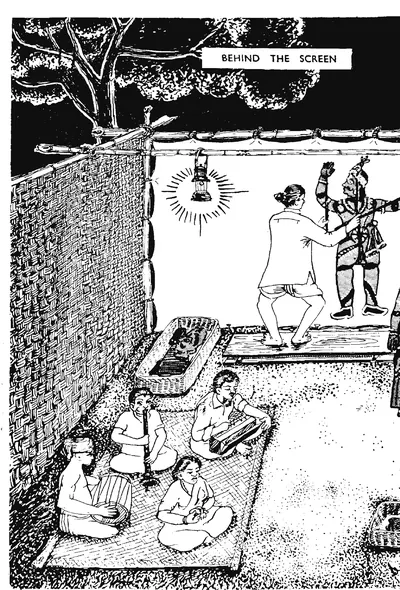
A troupe of about eight people works behind a white screen lit from behind. Men and women move the puppets and sing, to harmonium, mridangam and cymbals.103637 The Ramayana story is drawn from the Ranganatha Ramayanamu, with verses from Molla’s Ramayana.37 Audiences wait for the two clowns, Bangarakka and Kethigadu.37 By 1984 the cinema had taken most of the audience, and many puppeteers had turned to selling old clothes.38
Oggu katha
Oggu katha is found only in Telangana, chiefly in Warangal, Nalgonda and Hyderabad districts, where about fifty troupes performed when Mikkilineni wrote.12 It takes its name from the oggu, the small drum (damaru) of Shiva.12
The story-tellers are Kurumas, who live by tending sheep, and they sing of their gods Mallanna and Beerappa.39 The Kuruma priests tell the Mallanna story at Kuruma weddings, and the wedding takes place only after it.1240 The best-known modern teller was Chukka Sattaiah of Jangaon in Warangal district. He took the story out of the community and made it a stage art.40
A troupe has five to ten members. The main teller and his helper stand in front. Behind them three men play the dolu (drum), cymbals and a small frame drum, and sing the refrains. The teller even puts on a sari to play a woman’s part.39
Kolatam: the stick dance
Kolatam is danced with two short sticks. The dancers stand in a ring, sing as they step in time, and strike their sticks against their partners’ sticks.13 A leader keeps the rhythm with calls such as “tayyaku taddimi”, and the ring splits into inner and outer circles as the dance goes on.41 A group has between twenty and forty dancers, always an even number, with coloured sticks and ankle bells.42
Mikkilineni found kolatam in every village. It was danced at night after work, at fairs and festivals, and from house to house behind a sacred pole.2 He traced it back to the Panditaradhya Charitra of Palkuriki Somanatha. He also pointed to kolatam dancers carved on the walls at Vijayanagara and Srisailam.213 The kolatam of Palnadu was the subject of a whole doctoral thesis by Bittu Venkateswarlu, published by Telugu University in 1988.43
Songs and other village arts
Folk songs were also collected and written down. In 1983 the Andhra Pradesh Sangeeta Akademi published Janapada Geyalu (“folk songs”), a collection made by A. Anasuya Devi with the tunes in musical notation.44
A thesis on the folk arts of the Godavari country, by Padala Ramakrishna Reddy (1991), shows how many other forms there were.45 Its list of folk arts includes these:45
- acrobats (dommarata) and the decorated bull (gangireddu) show
- the tiger dance (puli veshalu) and the bear dance
- the Koya dance, kolatam and basket-doll shows (butta bommalata)
- several kinds of bhajana (group devotional singing)
- the street bhagavatam, the leather puppet show, pamba katha and jamukula katha45
Where the sources disagree
Where burrakatha came from. One view, which Mikkilineni reports from an essay by Srinivasa Chakravarti, is that burrakatha grew out of the old sung yakshagana, its side-singers taking the place of the sutradhara and the clown.7 Some historians held instead that burrakatha and the puppet shows came from Maharashtra, with the Chalukya kings.7 Mikkilineni rejected that view. He followed Tirumala Ramachandra, who found that burrakatha has little in common with the Marathi powada or the Kannada lavani except that the singers stand.46
One puppet tradition or two. Nagabhushana Sarma saw two traditions of shadow theatre in Andhra. The first was native and already old in Somanatha’s day. The second came with puppeteers of Maratha origin, whose names appear in inscriptions of the late 18th century.3435 Mikkilineni gives the theory of a Maharashtrian origin for puppet shows only as the opinion of “some historians”.7
Footnotes
-
Mikkilineni, Janapada Kalarupalu (1992), p. 296 (archive.org (opens in a new tab)). Paraphrased. ↩ ↩2
-
Mikkilineni, Janapada Kalarupalu (1992), p. 536 (archive.org (opens in a new tab)). Paraphrased. ↩ ↩2 ↩3 ↩4
-
Mikkilineni, Janapada Kalarupalu (1992), p. 293 (archive.org (opens in a new tab)). Paraphrased. ↩ ↩2 ↩3
-
Mikkilineni, Janapada Kalarupalu (1992), p. 297 (archive.org (opens in a new tab)). Paraphrased. ↩ ↩2
-
Mikkilineni, Janapada Kalarupalu (1992), p. 299 (archive.org (opens in a new tab)). Paraphrased. ↩ ↩2
-
Mikkilineni, Janapada Kalarupalu (1992), p. 351 (archive.org (opens in a new tab)). Paraphrased. ↩ ↩2 ↩3 ↩4
-
Mikkilineni, Janapada Kalarupalu (1992), p. 305 (archive.org (opens in a new tab)). Paraphrased. ↩ ↩2 ↩3 ↩4 ↩5 ↩6
-
Mikkilineni, Janapada Kalarupalu (1992), p. 108 (archive.org (opens in a new tab)). Paraphrased. ↩ ↩2
-
Mikkilineni, Janapada Kalarupalu (1992), p. 370 (archive.org (opens in a new tab)). Paraphrased. ↩ ↩2 ↩3 ↩4
-
Nagabhushana Sarma, “Tolu Bommalata” (1984), p. 9. Paraphrased. ↩ ↩2 ↩3 ↩4
-
Nagabhushana Sarma, “Tolu Bommalata” (1984), p. 7. Paraphrased. ↩ ↩2
-
Mikkilineni, Janapada Kalarupalu (1992), p. 527, citing Bittu Venkateswarlu (archive.org (opens in a new tab)). Paraphrased. ↩ ↩2 ↩3 ↩4 ↩5
-
Mikkilineni, Janapada Kalarupalu (1992), p. 537, following Bittu Venkateswarlu (archive.org (opens in a new tab)). Paraphrased. ↩ ↩2 ↩3
-
Mikkilineni, Janapada Kalarupalu (1992), p. 294 (archive.org (opens in a new tab)). Paraphrased. ↩ ↩2
-
Mikkilineni, Janapada Kalarupalu (1992), p. 298 (archive.org (opens in a new tab)). Paraphrased. ↩ ↩2
-
Mikkilineni, Janapada Kalarupalu (1992), p. 300 (archive.org (opens in a new tab)). Paraphrased. ↩
-
Mikkilineni, Janapada Kalarupalu (1992), p. 314 (archive.org (opens in a new tab)). Paraphrased. ↩
-
Mikkilineni, Janapada Kalarupalu (1992), p. 316 (archive.org (opens in a new tab)). Paraphrased. ↩
-
Mikkilineni, Janapada Kalarupalu (1992), p. 319 (archive.org (opens in a new tab)). Paraphrased. ↩
-
Najar, Palnati Yuddham (Vijayawada, 1945), Sundarayya Vignana Kendram record no. 101 (archive.org (opens in a new tab)). ↩
-
Jasti Venkata Narasayya and Dhulipala Venkata Subrahmanyam, Congress Vijayamu (jatiya natakamu – ennikala burrakatha) (Bezwada: Desikavita Mandali), title page (archive.org (opens in a new tab)). ↩
-
Report on the Administration of Hyderabad State, September 1948 – March 1950 (1950), p. 156 (archive.org (opens in a new tab)). ↩
-
Mikkilineni, Janapada Kalarupalu (1992), p. 352 (archive.org (opens in a new tab)). Paraphrased. ↩ ↩2
-
Mikkilineni, Janapada Kalarupalu (1992), p. 353 (archive.org (opens in a new tab)). Paraphrased. ↩ ↩2
-
Mikkilineni, Janapada Kalarupalu (1992), p. 354 (archive.org (opens in a new tab)). Paraphrased. ↩ ↩2
-
Mikkilineni Radhakrishna Murthy, Teluguvari Janapada Kalarupalu (Hyderabad: Telugu University, 1992), p. 107 (archive.org (opens in a new tab)). Paraphrased. ↩ ↩2
-
S. V. Joga Rao, Andhra Yakshagana Vangmaya Charitra, Vol. 1 (1961), pp. 17–18 (archive.org (opens in a new tab)). Paraphrased. ↩ ↩2
-
Mikkilineni, Janapada Kalarupalu (1992), p. 304 (archive.org (opens in a new tab)). Paraphrased. ↩
-
Varaganti Seshagiridasu, Srimad Ramayana Yakshagana Vilasamu (Madras, 1878), title page (archive.org (opens in a new tab)). ↩
-
P. Chenchiah and Raja M. Bhujanga Rao, A History of Telugu Literature (1928), p. 113 (archive.org (opens in a new tab)). ↩
-
Chenchiah and Bhujanga Rao (1928), p. 114 (archive.org (opens in a new tab)). ↩ ↩2
-
Mikkilineni, Janapada Kalarupalu (1992), p. 369 (archive.org (opens in a new tab)). Paraphrased. ↩
-
Nagabhushana Sarma, “Tolu Bommalata” (1984), p. 8. Paraphrased. ↩ ↩2 ↩3
-
M. Nagabhushana Sarma, “Tolu Bommalata: The Shadow Puppet Theatre of Andhra Pradesh”, Sangeet Natak (1984), p. 5 (archive.org (opens in a new tab)). Paraphrased. ↩ ↩2
-
Nagabhushana Sarma, “Tolu Bommalata” (1984), p. 6. Paraphrased. ↩ ↩2
-
Nagabhushana Sarma, “Tolu Bommalata” (1984), p. 10. Paraphrased. ↩ ↩2
-
Nagabhushana Sarma, “Tolu Bommalata” (1984), p. 11. Paraphrased. ↩ ↩2 ↩3
-
Nagabhushana Sarma, “Tolu Bommalata” (1984), p. 14. Paraphrased. ↩
-
Mikkilineni, Janapada Kalarupalu (1992), p. 530 (archive.org (opens in a new tab)). Paraphrased. ↩ ↩2
-
Mikkilineni, Janapada Kalarupalu (1992), p. 528 (archive.org (opens in a new tab)). Paraphrased. ↩ ↩2
-
Mikkilineni, Janapada Kalarupalu (1992), p. 538 (archive.org (opens in a new tab)). Paraphrased. ↩
-
Mikkilineni, Janapada Kalarupalu (1992), p. 539 (archive.org (opens in a new tab)). Paraphrased. ↩
-
Bittu Venkateswarlu, Palnati Simalo Kolatam (Hyderabad: Telugu University, 1988), title page and imprint: a Ph.D. thesis of Nagarjuna University, 1981 (archive.org (opens in a new tab)). ↩
-
A. Anasuya Devi, Janapada Geyalu (Hyderabad: Andhra Pradesh Sangeeta Akademi, publication no. 2, January 1983), imprint (archive.org (opens in a new tab)). ↩
-
Padala Ramakrishna Reddy, Godavarisima Janapada Kalalu, Kridalu, Vedukalu (Ph.D. thesis, Andhra University; 1991), contents (archive.org (opens in a new tab)). ↩ ↩2 ↩3
-
Mikkilineni, Janapada Kalarupalu (1992), p. 306 (archive.org (opens in a new tab)). Paraphrased. ↩
Photos
 "A typical single piece leather puppet figure" (courtesy Publications Division) (Census of India 1961, Selected Crafts of Andhra Pradesh, 1964, Leather Puppet Dolls, Plate 6, between pp. 20 and 21)Photograph · 1964
 "A typical temple cloth panel", Kalamkari of Kalahasti (Census of India 1961, Selected Crafts of Andhra Pradesh, 1964, Kalamkari Temple Cloth Painting of Kalahasti, Plate 3, between pp. 38 and 39)Textile · 1964
 "Behind the screen", a drawing of a shadow-puppet show (Census of India 1961, Selected Crafts of Andhra Pradesh, 1964, Leather Puppet Dolls, Plate 19, facing p. 23)Drawing · 1964
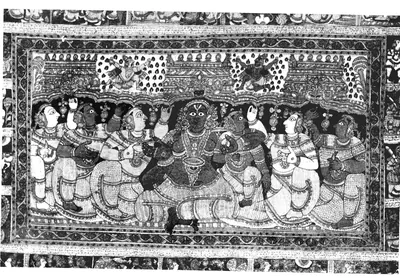 "Krishna Leela": central panel of a temple cloth hanging painted in vegetable colours at Kalahasti (courtesy National Museum, New Delhi) (Census of India 1961, Selected Crafts of Andhra Pradesh, 1964, frontispiece)Textile · 1964
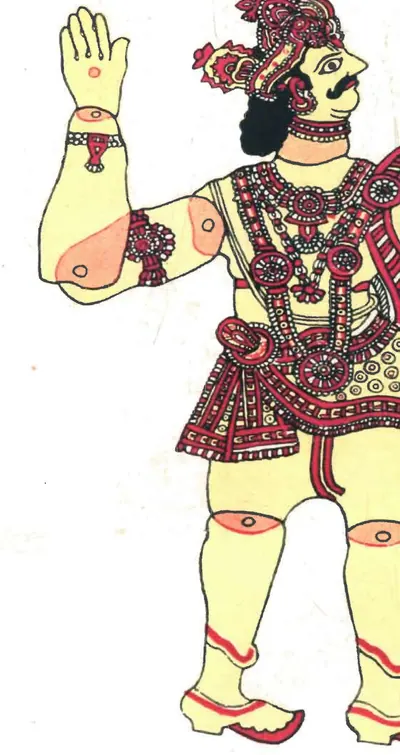 "One of the formerly produced shadow play puppets painted in only red and black", about 5 1/2 feet tall (Census of India 1961, Selected Crafts of Andhra Pradesh, 1964, Leather Puppet Dolls, Plate 1, facing p. 16)Drawing · 1964
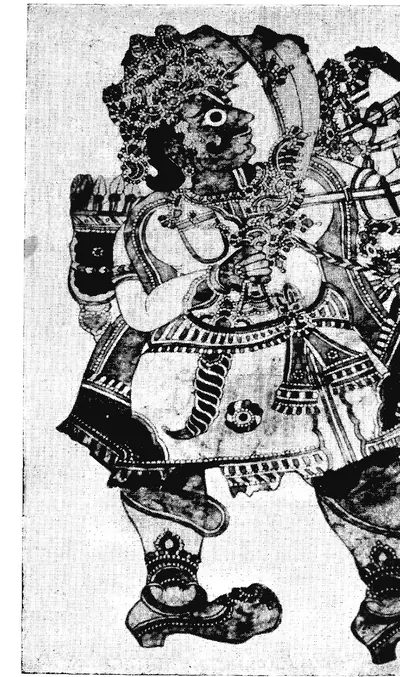 "Rama", a leather shadow puppet (courtesy Government Museum, Madras) (Census of India 1961, Selected Crafts of Andhra Pradesh, 1964, Leather Puppet Dolls, Plate 12, between pp. 22 and 23)Photograph · 1964
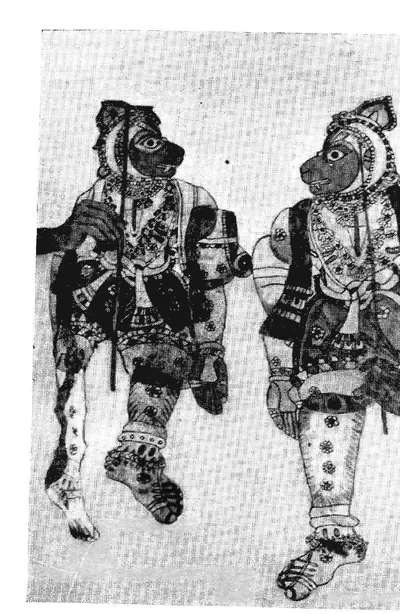 "Vali and Sugreeva", leather shadow puppets (courtesy Publications Division) (Census of India 1961, Selected Crafts of Andhra Pradesh, 1964, Leather Puppet Dolls, Plate 15, between pp. 22 and 23)Photograph · 1964
References
Notes (0)
Sources (11)
Spotted an error on this page? Tell us
Last updated: