Addanki inscription of Pandaranga
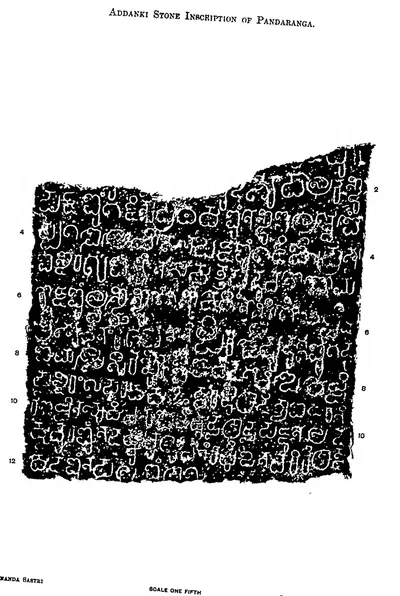
A damaged stone inscription of the mid-9th century from Addanki. Its opening Telugu verse, in the taruvoja metre, praises Pandaranga, army commander of the Eastern Chalukya king Gunaga-Vijayaditya III.
Where and how it was found
The inscription is cut on a stone that, in the 1920s, lay in a field at Addanki, then in the Ongole taluk of Guntur district.1
It was first published in 1905, in the Nellore district collection of Butterworth and Venugopaul Chetty, as “Ongole No. 3”.2 They described it as Telugu “in Chalukyan character” on a stone in a backyard.2 Their partial translation already recognised the commander’s appointment and his gift to the Sun god.2
Nobody at the time noticed that part of it was verse.1 K. V. Lakshmana Rao was studying early Telugu inscriptions for a planned encyclopaedia.1 He recognised a Telugu poem in lines 3–7 and announced the finding in Telugu.1 He then re-edited the record in Epigraphia Indica, from a fresh paper impression (estampage) supplied by the Madras epigraphy office.1
The stone and its script
The stone is broken at the top, where three or four lines are lost, and slightly at the bottom.1 Twelve lines remain, and only the ends of the first two of them can be read.1
Lakshmana Rao described the letters as the Eastern Chalukya form of the Telugu-Kannada script (the common ancestor of the modern Telugu and Kannada alphabets).1 This was the form used in the time of Gunaga-Vijayaditya III.1 He distinguished a “round hand” and a “square or angular hand” in that king’s records, and placed this inscription in the round hand.1 It uses a letter for a Dravidian sound that the Bezwada pillar inscription of Yuddhamalla had first shown to exist in early Telugu.1
Language and metre
The language is Telugu, and the first eight lines are verse and the rest prose.1 Lakshmana Rao called the language that of the 9th century, “a little archaic”.1 He noted some obsolete words whose meanings must be guessed from related languages.1
He identified the metre as taruvoja, “a group of eight Dvipadas”.3 He observed that “this long metre did not find much favour with the Telugu poets”, unlike the popular dvipada (two-line) metre.3
J. Ramayya Pantulu, commenting in the same volume, accepted the verse but proposed different readings of several words.4 From the position of the anusvara (nasal) sign, he argued that the Addanki record is older than the Bezwada inscription.4
What it records
The verse says that in the first year after his coronation the king appointed Pandaranga commander of the army and sent him out.5 It says that Pandaranga captured twelve kottams (territorial divisions) of the Boyas.5 The editor described the Boyas, from the gazetteers, as a hunting and fighting caste.6 The verse adds that Pandaranga took the hill-forts of Vengi-nadu and planted there the Tribhuvanankusa.5 He also laid bare the fort of Katte (Kattepu-durgam).5
The prose that follows records that Pandaranga, a devout worshipper of Shiva, gave land at Dammavuram to the Sun god (Aditya-Bhatara).5 The land could be sown with eighty candies (a large measure) of paddy.5 The record promises whoever protects the gift the merit of a horse sacrifice.5
The two editors disagreed on the details. Lakshmana Rao took Tribhuvanankusa to be the name of an arrow.6 He suggested that Pandaranga had won back Vengi hill-forts from foreign kings, “perhaps the Rashtrakutas”.6
Ramayya Pantulu read the passage as the capture and holding of Vengi-nadu “by means of the Tribhuvanankusa weapon”.7 He called the closing words about Kandukur and Bejavada unintelligible (impossible to understand).7 Hultzsch had earlier recorded Tribhuvanankusa as a surname (title) of Gunaga-Vijayaditya III himself, which suggests a third reading.8
Lakshmana Rao identified Dammavuram with Dharmavaram near Addanki, where two more of Pandaranga’s inscriptions exist.36 He noted that the Boyas were then concentrated in Kurnool, Anantapur and Bellary.36 For this reason he placed the twelve Boya kottams in Kurnool district.36
Date
The record carries no era date.3 Pandaranga appears as executor (ajnapti) in almost all of Gunaga-Vijayaditya III’s grants.3 Lakshmana Rao took that king’s reign as 844–888.3 On that basis he dated the inscription to 844–845, the first year of the reign.3
Sewell gives the same reign, 844–888.9 Hultzsch’s list of reigns, from a 1202 inscription, credits the king with 44 years but gives no starting year.10 Any other date for this inscription depends on a different reckoning of Eastern Chalukya chronology, which the sources consulted here do not supply.
Significance
For Lakshmana Rao, the inscription gave “positive evidence of the existence of Telugu poetry” in the middle of the 9th century.3 It took the history of Telugu verse a century earlier than the Bezwada inscription.3 The Bezwada inscription had itself pushed that history back a century before Nannaya’s Mahabharata of the 11th century.3 It is also an early record of the Boyas and of the wars that Vengi’s generals fought on its western frontier.
Editions
- Butterworth and Venugopaul Chetty, Nellore District Inscriptions, Part II (1905), Ongole No. 3, p. 896 (text and partial translation; plate).2
- K. V. Lakshmana Rao, Epigraphia Indica XIX, No. 47, pp. 271–275 (text, translation, plate), with J. Ramayya Pantulu’s note, No. 48, pp. 275–277.14
Footnotes
-
K. V. Lakshmana Rao, “The Addanki Stone Inscription of Pandaranga”, Epigraphia Indica XIX (1928), p. 272 (archive.org (opens in a new tab)). ↩ ↩2 ↩3 ↩4 ↩5 ↩6 ↩7 ↩8 ↩9 ↩10 ↩11 ↩12 ↩13 ↩14 ↩15
-
A. Butterworth and V. Venugopaul Chetty, Nellore District Inscriptions, Part II (1905), p. 896 (archive.org (opens in a new tab)). ↩ ↩2 ↩3 ↩4
-
Lakshmana Rao, “Addanki Stone Inscription”, Epigraphia Indica XIX (1928), p. 273 (archive.org (opens in a new tab)). ↩ ↩2 ↩3 ↩4 ↩5 ↩6 ↩7 ↩8 ↩9 ↩10 ↩11 ↩12
-
J. Ramayya Pantulu, “A Note on the Addanki Inscription of Pandaranga”, Epigraphia Indica XIX (1928), pp. 275–276 (archive.org (opens in a new tab)). ↩ ↩2 ↩3
-
Lakshmana Rao, “Addanki Stone Inscription”, Epigraphia Indica XIX (1928), p. 275 (archive.org (opens in a new tab)). ↩ ↩2 ↩3 ↩4 ↩5 ↩6 ↩7
-
Lakshmana Rao, “Addanki Stone Inscription”, Epigraphia Indica XIX (1928), p. 274 (archive.org (opens in a new tab)). ↩ ↩2 ↩3 ↩4 ↩5 ↩6
-
Ramayya Pantulu, “A Note on the Addanki Inscription”, Epigraphia Indica XIX (1928), pp. 276–277 (archive.org (opens in a new tab)). ↩ ↩2
-
E. Hultzsch, “Pithapuram Pillar Inscription of Mallapadeva”, Epigraphia Indica IV (1897), p. 226 (archive.org (opens in a new tab)). ↩
-
Robert Sewell, The Historical Inscriptions of Southern India (1932), p. 35 (archive.org (opens in a new tab)). ↩
-
Hultzsch, “Pithapuram Pillar Inscription”, Epigraphia Indica IV (1897), pp. 239–240 (archive.org (opens in a new tab)). ↩
Photos
References
Notes (0)
Sources (4)
Spotted an error on this page? Tell us
Last updated: