Masulipatam (?) plates of Vijayaditya III
An undated Sanskrit copper-plate grant of the Eastern Chalukya king Gunaga-Vijayaditya III (reigned about 844–888). It is known only from Sir Walter Elliot's impressions, and was perhaps received from the Collector of Masulipatam in 1846. The king gives a village in the Gudravara district to a Brahmin, apparently for his advice in the battle in which an enemy named Mangi was killed. The grant was conveyed by Pandaranga, the general praised in the Addanki inscription.
This was the only grant then known of Gunaga-Vijayaditya III himself.12 It touches on the most famous event of his reign, the killing of a king called Mangi.12 Its ajnapti, the officer who conveyed the grant, was Pandaranga.23 He was the general whose deeds are praised in the Telugu verse of the Addanki inscription.23
Where the plates came from
F. Kielhorn wrote in 1899 that “there is no definite information as to where these plates were found, or what became of them”.4 Judging from their size, he thought they might be a grant listed in a memorandum of Sir Walter Elliot.4 The entry reads “Inscription on 5 plates, received from Mr. Porter, Collector of Masulipatam, 19th December 1846”, with a boar seal and the legend Tribhuvanankusa.4
Hence the question mark in his title. Kielhorn edited the text from Elliot’s own impressions, sent to him by J. F. Fleet.4 Fleet, in 1891, had listed it as “a grant from an unknown locality; not yet published”.1
Description
There appear to be five plates, the first and last written on one side only.4 Each is about 9½ inches broad and 3⅝ inches high, with a ring-hole on the right side.4 Kielhorn judged that the writing on the original plates was well preserved, but many letters in the impressions were blocked with hard rust that had not been cleaned out.4
The writing is “well done, and carefully engraved”.4 It is of the southern class, and Kielhorn noted that the letters b and j are open on the left throughout.4 The language is Sanskrit.2
Content
According to Kielhorn’s abstract, the grant opens with the king’s grandfather Vijayaditya II, “a fire of destruction to the Ganga family”.53 He was named Chaluky-Arjuna because he broke the frenzy of the Kali age.53 The grant then praises his son, the Maharaja Vishnuvardhana, and that king’s son, the Maharaja Vijayaditya.53
Vijayaditya speaks to the cultivators of the Gudravara district (vishaya).3 On an eclipse of the moon he gives the village of Tranda[pa?]ru, free of all taxes, to Vinayadisarman.3 Vinayadisarman was a householder of the Taittiriya school, son of Damodarasarman and grandson of Turkasarman of Urputuru.3
A verse then explains the gift.3 In Kielhorn’s translation, the king killed Mangi on the battlefield.3 Mangi “had defeated the whole host of hostile chiefs and in the excess of his fury had ridiculed the king’s liberality, bravery and power”.3 Then the king “was well pleased with the marvellous advice of this best one of the twice-born”.3
The village had these boundaries:3
Kielhorn could identify none of the places.32
The ajnapti was Pandaranga, compared for his courage in war to Bibhatsu (Arjuna).3 The order was written “by the foremost of goldsmiths, Katta[y]a”, son of Madhava.3 Kielhorn noted that Pandaranga’s grandson appears as ajnapti of a grant of Chalukya-Bhima I, the Bezwada plates.2
Who was rewarded, and for what?
The two editors read the donee’s part differently. Fleet summarised the grant in 1891.1 He took Vinayadisarman to be “either the actual slayer of Mangi, or the leader of the troops on the occasion of his being slain”.1 Kielhorn, editing the full text, read the gift as “apparently” a reward for advice in the matter of the defeat of Mangi.2
Who Mangi was is not stated. Fleet suggested he may have been a Chola king.61 His reason was that a Pithapuram inscription of Saka 1124 (Saka is an Indian way of counting years) calls him Mangi-Rajendra and says that Vijayaditya “played the game of ball with his head”.61 In other grants Vijayaditya burnt the city of a Krishna.61 Fleet identified this Krishna with the Rashtrakuta king Krishna II.61
Date
The grant is not dated.2 Kielhorn headed it with Fleet’s dates for the reign, 844–888.4 Fleet noted that the records give Vijayaditya III a reign of 44 years.6
Footnotes
-
Fleet, “The Chronology of the Eastern Chalukya Kings” (1891), p. 103 (archive.org (opens in a new tab)). ↩ ↩2 ↩3 ↩4 ↩5 ↩6 ↩7 ↩8 ↩9
-
Kielhorn, “Six Eastern Chalukya Copper-plate Inscriptions” (1899), p. 123 (archive.org (opens in a new tab)). ↩ ↩2 ↩3 ↩4 ↩5 ↩6 ↩7 ↩8 ↩9
-
Kielhorn, “Six Eastern Chalukya Copper-plate Inscriptions” (1899), p. 126 (archive.org (opens in a new tab)). ↩ ↩2 ↩3 ↩4 ↩5 ↩6 ↩7 ↩8 ↩9 ↩10 ↩11 ↩12 ↩13 ↩14 ↩15 ↩16 ↩17 ↩18 ↩19
-
F. Kielhorn, “Six Eastern Chalukya Copper-plate Inscriptions”, Epigraphia Indica V (1898–99), p. 122 (archive.org (opens in a new tab)). ↩ ↩2 ↩3 ↩4 ↩5 ↩6 ↩7 ↩8 ↩9 ↩10
-
Kielhorn, “Six Eastern Chalukya Copper-plate Inscriptions” (1899), p. 125, abstract of contents (archive.org (opens in a new tab)). ↩ ↩2 ↩3
-
J. F. Fleet, “The Chronology of the Eastern Chalukya Kings”, Indian Antiquary XX (1891), p. 102 (archive.org (opens in a new tab)). ↩ ↩2 ↩3 ↩4 ↩5
Photos
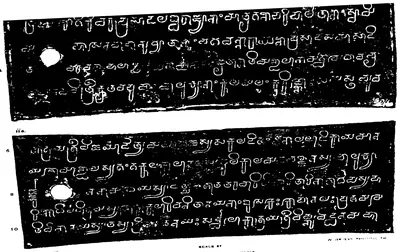 "B.—Masulipatam (?) Plates of Vijayaditya III", plates i and ii a (Epigraphia Indica V, plate between pp. 124 and 125 (PDF p. 172))Inscription rubbing · 1899
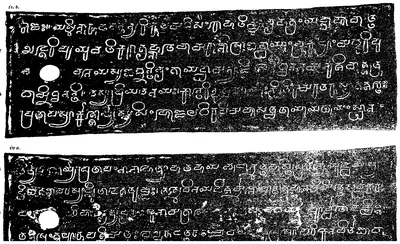 "B.—Masulipatam (?) Plates of Vijayaditya III", plates ii b and iv a (Epigraphia Indica V, plate between pp. 124 and 125 (PDF p. 173))Inscription rubbing · 1899
References
Notes (0)
Sources (2)
Spotted an error on this page? Tell us
Last updated: