Radhanpur plates of Govinda III
A Sanskrit copper-plate grant of the Rashtrakuta king Govinda III, kept in the Radhanpur State in Gujarat. It is dated at an eclipse of the sun that F. Kielhorn equated with 27 July 808. Its verses describe the king's campaigns. They say that the lord of Vengi came at Govinda's command and built an enclosure for him 'like a servant'. J. F. Fleet identified this lord of Vengi with the Eastern Chalukya Vijayaditya II. Fleet thought the place was Manyakheta (Malkhed), but Kielhorn translated it as an enclosure for the king's camp on the Tungabhadra.
The Radhanpur plates are a grant of the Rashtrakuta king Govinda III.12 Their verses on his reign include the best-known Rashtrakuta claim over the Eastern Chalukyas of Vengi.12 They say that the lord of Vengi came at Govinda’s command and built a great enclosure for him.12
The plates
G. Bühler first edited the grant in the Indian Antiquary, from the original plates.3 The Radhanpur State lent them through the Political Superintendent of Palanpur.3 F. Kielhorn edited it again in Epigraphia Indica VI (1901), from ink impressions that J. F. Fleet had received in 1884.3 By then, the owner of the plates was no longer known.3
There are two copper plates, and the first is engraved on one side only.3 A third plate, which completed the grant, is lost, and so are the ring and seal.3 The letters belong to the northern class of alphabets.4 The language is Sanskrit, with some names from the southern local languages in the formal part of the grant.4
Contents
After the opening verse, the grant has nineteen verses of praise.4 They praise Krishna I, his son Dhora (Dhruva), and Dhruva’s son Govindaraja, the donor.4 Most of these verses also occur in the Wani grant.4 All nineteen occur in the Manne grant, though often in a corrupt form.4
The prose part records a gift by Govinda, made while he was staying at Mayurakhandi.56 He gave the village of Rattajjuna, in the Rasiyana district (the modern Rasin in the Ahmadnagar district), to a Brahmin named Paramesvarabhatta.56 He made the gift on the occasion of an eclipse of the sun.56
Fleet in 1896 equated the date with 7 August 807.76 Kielhorn showed that it is 27 July 808, when there was a total eclipse of the sun that could be seen in India.76
The verses tell of Govinda’s deeds after his father’s death:1
- he defeated twelve kings who had joined against him1
- he released a captive Ganga king, and then imprisoned him again1
- he put the Gurjara king to flight1
- he received the submission of the lord of Malava and of a king named Marasarva in the Vindhyas1
- he passed the rainy season at Sribhavana1
- he then marched to the Tungabhadra, where he took tribute from the Pallavas1
The lord of Vengi
Verse 19 follows.1 In Kielhorn’s translation, it begins: “Thither the lord of Vengi repaired when (the king’s) letter-carrier had only half uttered the command”.1 The lord of Vengi, “longing for his own comfort, steadily like a servant without ceasing did such toil” that he built an enclosure for Govinda’s camp.1 This enclosure was “touching the summit of the sky”.1 At night it “seemed to assume a garland of pearls, surrounded as it was by the groups of stars above it.”1
Fleet identified the lord of Vengi with the Eastern Chalukya Vijayaditya II.2 Vijayaditya II reigned from 799 to 843.2 His own family claimed for him a hundred and eight battles against the Gangas and the Rashtrakutas.2 The walled place has been read in three ways.
- Fleet (1896) took it to be a city then being built or fortified as a capital, “the Manyakheta of subsequent records, and the modern Malkhed”.2 The event is mentioned in this Radhanpur grant, but not in the Wani grant of the April before.2 Fleet then dated the Radhanpur grant to August 807.2 So he dated the event to just before the rains of 807.2 Kielhorn later showed that the grant is of 27 July 808 (see above).6
- Fleet (1901) noted that the word “where” in the verse places the enclosure on or near the Tungabhadra.8 It might have been only the fortification of a large camp, probably near the meeting of the Tungabhadra and the Krishna.8 But Malkhed was only some eighty-five or ninety miles away.8 He still thought it “very likely” that Govinda chose it as his capital then, and had its outer walls built by the king of Vengi.8
- Kielhorn (1901) translated the word as “the enclosure constructed thereby for His camp”.1
Robert Sewell wrote that Govinda had moved his capital to Malkhed before 802.9 By then, in Sewell’s account, Govinda had ordered the Vengi king to build its fortifications.9 The year 802 is the date of the Manne plates.9 In Sewell’s summary, these plates also say that the king of Vengi built the walls of a fortress for Govinda.9
Footnotes
-
Kielhorn, “Radhanpur Plates of Govinda III” (1901), p. 250, translation of verses 13–20 (archive.org (opens in a new tab)). ↩ ↩2 ↩3 ↩4 ↩5 ↩6 ↩7 ↩8 ↩9 ↩10 ↩11 ↩12 ↩13 ↩14 ↩15 ↩16
-
J. F. Fleet, “Dynasties of the Kanarese Districts”, Gazetteer of the Bombay Presidency I, pt. II (1896), p. 396 (archive.org (opens in a new tab)). ↩ ↩2 ↩3 ↩4 ↩5 ↩6 ↩7 ↩8 ↩9 ↩10
-
F. Kielhorn, “Radhanpur Plates of Govinda III; Saka-Samvat 730”, Epigraphia Indica VI (1901), p. 239 (archive.org (opens in a new tab)). ↩ ↩2 ↩3 ↩4 ↩5 ↩6
-
Kielhorn, “Radhanpur Plates of Govinda III” (1901), p. 240 (archive.org (opens in a new tab)). ↩ ↩2 ↩3 ↩4 ↩5 ↩6
-
Kielhorn, “Radhanpur Plates of Govinda III” (1901), p. 241 (archive.org (opens in a new tab)). ↩ ↩2 ↩3
-
Kielhorn, “Radhanpur Plates of Govinda III” (1901), p. 242 (archive.org (opens in a new tab)). ↩ ↩2 ↩3 ↩4 ↩5 ↩6
-
Fleet, “Dynasties of the Kanarese Districts” (1896), p. 398 (archive.org (opens in a new tab)). ↩ ↩2
-
J. F. Fleet, “Three Western Ganga Records in the Mysore Government Museum at Bangalore”, Epigraphia Indica VI (1901), p. 64, note 3 (archive.org (opens in a new tab)). ↩ ↩2 ↩3 ↩4
-
Robert Sewell, The Historical Inscriptions of Southern India (1932), p. 33 (archive.org (opens in a new tab)). Paraphrased. ↩ ↩2 ↩3 ↩4
Photos
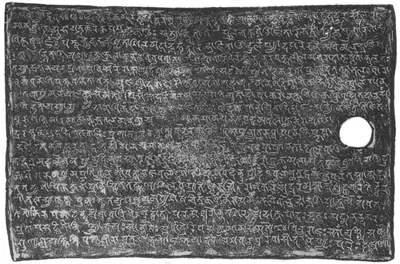 "Radhanpur Plates of Govinda III.—Saka-Samvat 730." side i (Epigraphia Indica VI, plate with No. 23; PDF p. 307 of the archive.org scan EpigraphiaIndicaVol6)Inscription rubbing · 1901
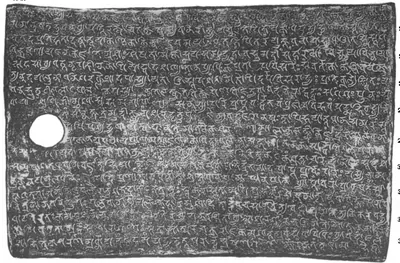 "Radhanpur Plates of Govinda III.—Saka-Samvat 730." side iia (Epigraphia Indica VI, plate with No. 23; PDF p. 307 of the archive.org scan EpigraphiaIndicaVol6)Inscription rubbing · 1901
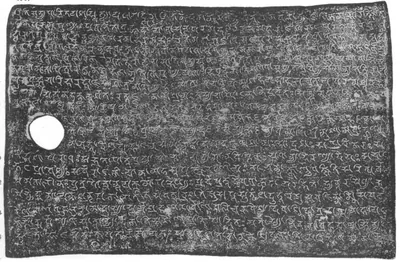 "Radhanpur Plates of Govinda III.—Saka-Samvat 730." side iib (Epigraphia Indica VI, plate with No. 23; PDF p. 308 of the archive.org scan EpigraphiaIndicaVol6)Inscription rubbing · 1901
References
Notes (0)
Sources (3)
Spotted an error on this page? Tell us
Last updated: