Amudalapadu plates of Vikramaditya I
A Sanskrit copper-plate grant of the fifth year of the Chalukya king Vikramaditya I, from Amudalapadu in the Alampur taluk (now in Telangana). D. C. Sircar dated it to 30 April 660. It records the gift of a village to the king's guru Sudarsanacharya when the king was initiated into the Shaiva faith. Its letters are early Telugu-Kannada, and the editors of Epigraphia Telanganica (2023) call it the earliest Telugu inscription in Telangana.
The Amudalapadu plates are a grant of Vikramaditya I of Badami, found in the Alampur taluk (sub-district).1 They are an early record of Chalukya rule in what is now Telangana, and of the king’s turn to the Shaiva faith.12
Discovery
Gadiyaram Ramakrishna Sarma first published the inscription in the Telugu journal Bharati in May 1957.1 He had borrowed the plates from Narayana Reddi, a pleader (lawyer) of Vanaparti.1 Narayana Reddi had obtained them about twenty years earlier from a resident of Amudalapadu in the Alampur taluk.1
The taluk was then part of the Raichur district of Hyderabad State and later of the Mahbubnagar district.1 D. C. Sircar edited the plates again in Epigraphia Indica XXXII.1
There are four plates, each about seven inches long and three inches high.1 They hang on a ring whose ends are fixed beneath a seal with the boar emblem of the Chalukyas.1 The first and last plates are written on the inner side only, and there are 48 lines in all.1
Sircar described the letters as the old Telugu-Kannada alphabet, close to those of Vikramaditya I’s other records.1 He found the language Sanskrit, and the wording close to that of the king’s other charters.1
Date
The grant is dated on the full-moon day of Vaisakha in the fifth year of the reign.1 Taking the accession as 654–55, Sircar dated it to 30 April 660.1
F. Kielhorn dated the Talamanchi plates to 13 July 660, in the king’s sixth year.1 Sircar noted that, if this date is accepted, the accession fell between 30 April and 13 July 655.1 See the Talamanchi plates.
The grant
The king gave the village of Iparumkal in the Vamguravadi district to Sudarsanacharya.2 It was the fee due to a guru at the king’s initiation into the circle of Shiva (Siva-mandala-diksha).2 The king was then staying at the village of Marrura.2
Sudarsanacharya divided the land among twenty-seven Brahmanas and kept a share for his own wife.2 Sircar took the Brahmanas to be the assistants at the ceremony.3 He saw in the rite a resemblance to the later initiation of the Virashaivas (Lingayats).3
Following Sarma, Sircar thought that Marrura may be Chinna or Pedda Marruru on the Krishna in the Kollapuram taluk.4 He thought the name of the Vamguravadi district survives in the village of Vamguru in the Kalvaparti taluk.4 Sarma was inclined to identify Iparumkal with Vipanagandla, about ten miles from those villages.4
Sircar called the king’s initiation into the Shaiva faith “a very interesting fact”.2 The earlier Chalukyas had been Vaishnavas, with leanings towards Shaivism and the Mother-goddesses.2
The genealogy (family history) in the grant repeats familiar claims.5 One is the passage on the three kings who had interrupted Pulakesin II’s fortune.5 Sircar argued that J. F. Fleet was wrong to read this as a reference to three Pallava kings.56
“The earliest Telugu inscription”
The editors of Epigraphia Telanganica (2023) call this record “the earliest Telugu inscription” of Telangana. They describe it as the earliest use of Telugu letters there.7 They note, though, that its script is old Telugu-Kannada and its language Sanskrit.7 They also call Vikramaditya I the first Badami king to patronise Shaivism.8
A later grant from the same country
In a note, Sircar mentions the Pallepadu plates of Vinayaditya, also from the Alampur taluk.9 Sarma published them in 1956.9 They are dated 27 April 682, in Vinayaditya’s second year.9 The king issued them while he was at Pangal in the Nagarkurnool taluk.9
Footnotes
-
D. C. Sircar, “Amudalapadu Plates of Vikramaditya I, Year 5”, Epigraphia Indica XXXII (1959), p. 175 (archive.org (opens in a new tab)). Paraphrased. ↩ ↩2 ↩3 ↩4 ↩5 ↩6 ↩7 ↩8 ↩9 ↩10 ↩11 ↩12 ↩13 ↩14 ↩15 ↩16
-
Sircar, “Amudalapadu Plates” (1959), p. 178 (archive.org (opens in a new tab)). Paraphrased, except for the short phrase quoted. ↩ ↩2 ↩3 ↩4 ↩5 ↩6 ↩7
-
Sircar, “Amudalapadu Plates” (1959), p. 181 (archive.org (opens in a new tab)). Paraphrased. ↩ ↩2
-
Sircar, “Amudalapadu Plates” (1959), p. 182 (archive.org (opens in a new tab)). Paraphrased. ↩ ↩2 ↩3
-
Sircar, “Amudalapadu Plates” (1959), p. 176 (archive.org (opens in a new tab)). Paraphrased. ↩ ↩2 ↩3
-
Sircar, “Amudalapadu Plates” (1959), p. 177 (archive.org (opens in a new tab)). Paraphrased. ↩
-
Gajjala Vasanta Lakshmi (ed.), Epigraphia Telanganica I: Pre-Kakatiya Telangana (2023), p. 8. Cite-only; paraphrased except for the short phrase quoted. ↩ ↩2
-
Epigraphia Telanganica I (2023), p. 26. Cite-only; paraphrased. ↩
-
Sircar, “Amudalapadu Plates” (1959), p. 175, note 1 (archive.org (opens in a new tab)). Paraphrased. ↩ ↩2 ↩3 ↩4
Photos
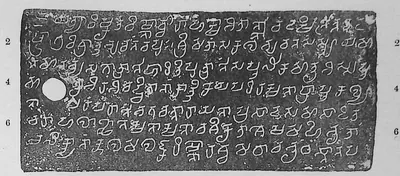 "Amudalapadu Plates of Vikramaditya I, Year 5", plate i (Epigraphia Indica XXXII, plate between pp. 182 and 183 (PDF p. 265))Inscription rubbing · 1959
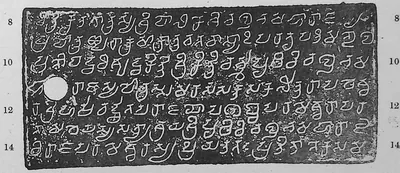 "Amudalapadu Plates of Vikramaditya I, Year 5", plate ii a (Epigraphia Indica XXXII, plate between pp. 182 and 183 (PDF p. 265))Inscription rubbing · 1959
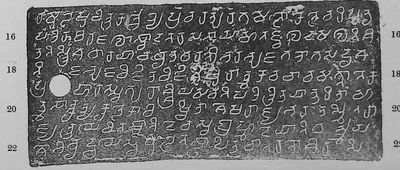 "Amudalapadu Plates of Vikramaditya I, Year 5", plate ii b (Epigraphia Indica XXXII, plate between pp. 182 and 183 (PDF p. 265))Inscription rubbing · 1959
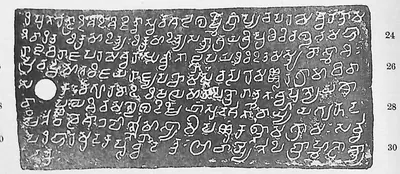 "Amudalapadu Plates of Vikramaditya I, Year 5", plate iii a (Epigraphia Indica XXXII, plate between pp. 182 and 183 (PDF p. 266))Inscription rubbing · 1959
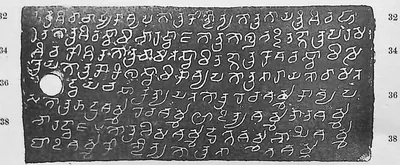 "Amudalapadu Plates of Vikramaditya I, Year 5", plate iii b (Epigraphia Indica XXXII, plate between pp. 182 and 183 (PDF p. 266))Inscription rubbing · 1959
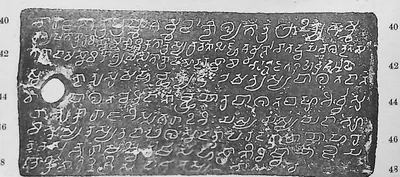 "Amudalapadu Plates of Vikramaditya I, Year 5", plate iv (Epigraphia Indica XXXII, plate between pp. 182 and 183 (PDF p. 266))Inscription rubbing · 1959
References
Notes (0)
Sources (2)
Spotted an error on this page? Tell us
Last updated: