Talamanchi plates of Vikramaditya I
A Sanskrit copper-plate grant of the sixth year of the Chalukya king Vikramaditya I, found by a ploughman at Talamanchi in the Nellore taluk and now in the Madras Museum. It gives the village of Elasatti to the king's own teacher, Srimeghacharya. F. Kielhorn dated its solar eclipse to 13 July 660, and used it to fix Vikramaditya's accession between September 654 and July 655.
The Talamanchi plates are a grant of Vikramaditya I of Badami, found near Nellore. They are valued mainly for their date, which settled the beginning of his reign, and for the name of his guru.12
Discovery
A. Butterworth and V. Venugopal Chetti first published the inscription in their Nellore District Inscriptions.3 According to them, a servant of Adapala Venkata Reddi found the plates while ploughing.31 The land was known as Talamanchipadu in Talamanchi, Nellore taluk, “where a flourishing village is said to have once stood”.31 The plates were sent to the Madras Museum.31 E. Hultzsch re-edited them in Epigraphia Indica IX from three sets of ink impressions prepared by V. Venkayya.31
Venkayya described three copper plates, the first and last written on the inner side only.1 They hang on an oval ring whose ends are fixed in an oval seal.1 The emblems on the seal are much worn but show a lump in the middle, “perhaps meant to represent a boar”.1 Plates, ring and seal weigh 80 tolas.1
Hultzsch noted that the alphabet is like that of two other grants of Vikramaditya I.1 The language is Sanskrit, with four verses in the Anushtubh metre and the rest in prose.1 Three Dravidian letters occur only in the two village names Elasatti and Kolchumko[nra].1
The grant
The king, son of Satyasraya (Pulakesin II), speaks of the sixth year of his reign.145 At an eclipse of the sun in the month of Sravana, he says, he gave the village of Elasatti, north of the village of Kolchumko[nra].145 He gave it to “Our own preceptor (guru) Srimeghacharya of the Vasishtha gotra”.145 The order was written by Vajravarman of the Vaidya family.145 Butterworth and Venugopal Chetti could not identify Elasatti.1
D. C. Sircar compared this grant with the Amudalapadu plates of the year before.6 In those plates the king gave a village to another guru, Sudarsanacharya, when he was initiated into the Shaiva faith.6 Sircar suggested that Meghacharya succeeded Sudarsanacharya as head of the same religious order.6 Or else, he suggested, Meghacharya taught the king while Sudarsana initiated him.6 See the Amudalapadu plates.
Date
F. Kielhorn worked out the date in a postscript.2 Between 635 and 685 only one solar eclipse in the month of Sravana could have been seen at Badami.2 It was the annular eclipse of Monday, 13 July 660.2 Kielhorn took this together with the Nerur plates of Vijayabhattarika (23 September 659, in the fifth year).2 It showed that Vikramaditya I began to reign between September 654 and July 655.2 J. F. Fleet had placed the accession in the autumn of 655.2
Sircar used the same date in fixing the accession between 30 April and 13 July 655.7 Robert Sewell also cites the Talamanchi plates for the accession.8 In the Nellore District Inscriptions, whose edition of the grant begins on p. 189, a plate of ink impressions headed “Copper-plate No. 24” faces that page.9
Footnotes
-
Hultzsch, “Talamanchi Plates” (1908), p. 99 (archive.org (opens in a new tab)). ↩ ↩2 ↩3 ↩4 ↩5 ↩6 ↩7 ↩8 ↩9 ↩10 ↩11 ↩12 ↩13 ↩14 ↩15 ↩16 ↩17
-
F. Kielhorn, postscript to Hultzsch, “Talamanchi Plates”, Epigraphia Indica IX (1908), p. 102 (archive.org (opens in a new tab)). ↩ ↩2 ↩3 ↩4 ↩5 ↩6 ↩7
-
E. Hultzsch, “Talamanchi Plates of Vikramaditya I; A.D. 660”, Epigraphia Indica IX (1908), p. 98 (archive.org (opens in a new tab)). ↩ ↩2 ↩3 ↩4 ↩5
-
Hultzsch, “Talamanchi Plates” (1908), p. 101 (archive.org (opens in a new tab)). ↩ ↩2 ↩3 ↩4
-
Hultzsch, “Talamanchi Plates” (1908), p. 102 (archive.org (opens in a new tab)). ↩ ↩2 ↩3 ↩4
-
Sircar, “Amudalapadu Plates” (1959), p. 179 (archive.org (opens in a new tab)). Paraphrased. ↩ ↩2 ↩3 ↩4
-
D. C. Sircar, “Amudalapadu Plates of Vikramaditya I, Year 5”, Epigraphia Indica XXXII (1959), p. 175, note 3 (archive.org (opens in a new tab)). Paraphrased. ↩
-
Robert Sewell, The Historical Inscriptions of Southern India (1932), p. 24 (archive.org (opens in a new tab)). Paraphrased. ↩
-
Alan Butterworth and V. Venugopaul Chetty, A Collection of the Inscriptions on Copper-plates and Stones in the Nellore District (1905), plate facing p. 189 (archive.org (opens in a new tab)). ↩
Photos
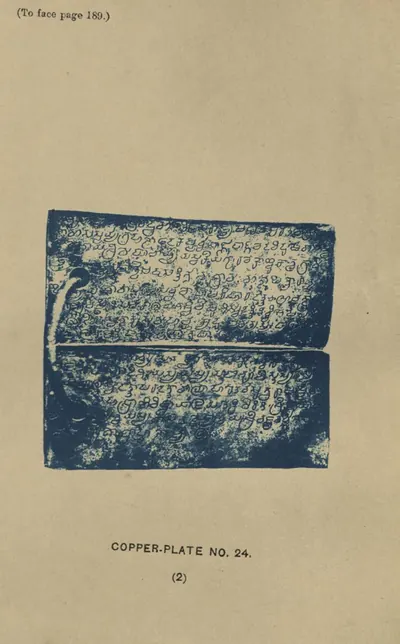 "Copper-plate No. 24" (grant of the Western Chalukya king Vikramaditya I) (Butterworth & Chetty 1905, to face p. 189 (PDF p. 250))Inscription rubbing · 1905
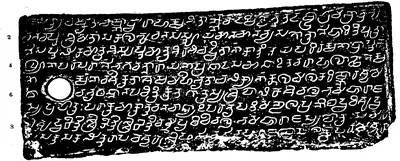 "Talamanchi plates of Vikramaditya I. — A. D. 660", plate i (Epigraphia Indica IX, plate between pp. 100 and 101 (PDF p. 128))Inscription rubbing · 1908
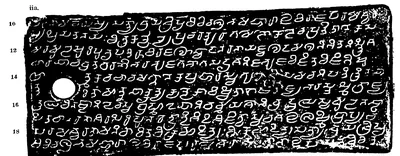 "Talamanchi plates of Vikramaditya I. — A. D. 660", plate ii a (Epigraphia Indica IX, plate between pp. 100 and 101 (PDF p. 128))Inscription rubbing · 1908
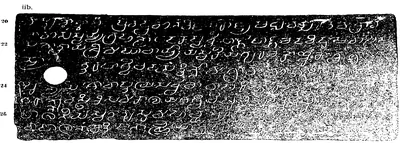 "Talamanchi plates of Vikramaditya I. — A. D. 660", plate ii b (Epigraphia Indica IX, plate between pp. 100 and 101 (PDF p. 129))Inscription rubbing · 1908
References
Notes (0)
Sources (4)
Spotted an error on this page? Tell us
Last updated: