Vikramaditya I (Chalukya of Badami)
Chalukya king of Badami (about 655–680), a son of Pulakesin II. He restored the kingdom after the Pallavas took Badami, fought three Pallava kings and took Kanchi. His copper-plate grants come from the Telugu country: Amudalapadu and Gadwal in today's Telangana, the Kurnool district, Talamanchi near Nellore, and Hyderabad. His Amudalapadu plates of 660 record his initiation into the Shaiva faith. A queen of his installed a linga at Alampur.
Vikramaditya I restored the Chalukya kingdom of Badami after thirteen years of Pallava occupation.123 Many of his grants come from the Telugu country.123 They were found at Amudalapadu and Gadwal in the Alampur country of today’s Telangana, in the Kurnool district, and at Talamanchi near Nellore.123
Family
Vikramaditya I was a son of Pulakesin II. His grants call him the “dear son” (priya-tanaya) of his father. The expression is used even in the charters of his elder brother, so J. F. Fleet thought it meant that Pulakesin had chosen him as his successor.4
Chandraditya, another son of Pulakesin II, was his elder brother, and ruled with the rank of Maharaja under him.5 A younger brother, Dharasraya-Jayasimhavarman, is named in a grant from Nausari in Gujarat, whose dignity, it says, was raised by his elder brother Vikramaditya I.6 Jayasimhavarman’s son and grandson ruled in Gujarat.6
See the Alampur entry below for a queen of Vikramaditya I who installed a linga (an emblem of Shiva) at Alampur. E. Hultzsch thought that Ganga-Mahadevi, at whose request the Gadval grant was made, “seems to have been one of the queens” of the king.7
Restoring the kingdom
The Pallavas took Badami about 642, and no Chalukya king reigned for thirteen years.8 Vikramaditya I’s grants say that he won back “the regal fortune of his father, which had been interrupted by three kings”, fighting on his charger Chitrakantha.49 The grants also say that he restored the grants to gods and Brahmanas that those kings had taken away.49
His Hyderabad grant names the three as Narasimha, Mahendra and Isvara.10 These were the Pallava kings Narasimhavarman I, Mahendravarman II and Paramesvaravarman I.10 The grant also says that he took Kanchi.10
D. C. Sircar disagreed.1112 The claim appears in grants older than the end of Narasimhavarman I’s reign, so, he argued, the three kings must have been Narasimhavarman I and two southern allies.1112
Fleet placed the formal beginning of the reign in the autumn of 655.1 F. Kielhorn reasoned from the solar eclipse named in the Talamanchi plates. He identified it with the eclipse of 13 July 660, in the king’s sixth year.13 He concluded that the reign began between September 654 and July 655.13
Wars with the Pallavas
The Pallava records say that Paramesvaravarman I put Vikramaditya to flight at Peruvalanallur, and even claim that he destroyed Vikramaditya’s city.10
Vikramaditya’s army entered the Chola province and camped at Uragapura on the south bank of the Kaveri.147 His Gadval plates of 674 were issued from this camp. Hultzsch took Uragapura to be Nagapattinam (Negapatam), but V. Venkayya proposed the old Chola capital Uraiyur near Tiruchirappalli (then Trichinopoly).147
Sewell thought that the Chalukyas entered Kanchi about 670 or 674.3 He also thought that Vikramaditya then faced a combination of Pallavas, Pandyas and Cholas in the south.3 (See Paramesvaravarman I and the Pallavas.)
Grants in the Telugu country
- Kurnool district. Fleet lists a grant of his third year, for land at Ratnagiri in the Nalavadi district, about thirteen miles south-west of Madakasira by his reckoning.16 He also lists a grant of his tenth year.16 Sewell lists three grants from Kurnool. He notes that they show that Kurnool was then ruled by the western Chalukyas, not by the Eastern Chalukyas of Vengi. He also cites grants of 680 from the Anantapur and Bellary districts.315
- Hyderabad. An undated grant from Hyderabad in the Deccan gives a village named Chintakuntha, east of the village of Kandugul. Fleet thought its authenticity “not altogether free from suspicion”.65
- Amudalapadu, 660. The Amudalapadu plates were found in the Alampur taluk. They record a village given to his guru Sudarsanacharya as the teacher’s fee for the king’s initiation into the circle of Shiva (Siva-mandala-diksha).21617 The king was then staying at Marrura, which Sircar placed on the Krishna in the Kollapuram taluk.21617
- Talamanchi, 660. The Talamanchi plates were found near Nellore. They give the village of Elasatti to “Our own preceptor” Srimeghacharya of the Vasishtha gotra (clan).18919 Sircar suggested that Meghacharya succeeded Sudarsanacharya as head of the same religious order soon after the initiation.20
- Gadwal, 674. The Gadval plates were found at Gadwal and grant land in the village of [Chedu]lli to three Brahmanas.217
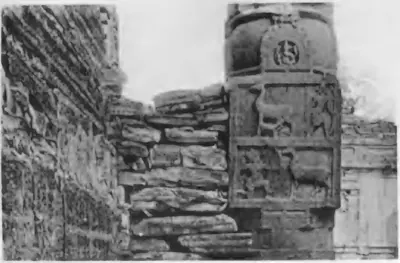
- Alampur and Ramapuram. An inscription on a pillar of the Arka Brahma temple at Alampur records that the queen of Anivarita Vikramaditya installed a linga in a temple of Mahadeva. Its editors took this king to be Vikramaditya I, on the grounds of its letters. An inscription in Telugu at Ramapuram, in the Alampur taluk, records gifts of land made in his reign by Baladitya-maharaja, apparently a feudatory (subordinate ruler).222324
Religion
Sircar wrote that the early Chalukyas were Vaishnavas with leanings towards Shaivism and the Mother-goddesses.16 He called the initiation of Vikramaditya I into the Shaiva faith “a very interesting fact”.16 The Nausari grant of 671 calls him a devout worshipper of Mahesvara (Shiva).16 The Epigraphia Telanganica editors call him the first Badami king to support Shaivism.25
Successors
His son Vinayaditya succeeded him in 680.26 Vinayaditya’s son Vijayaditya succeeded in 696.27 Vijayaditya’s son Vikramaditya II followed in 733 or 734.28 His son Kirtivarman II was the last king of the line.2930 No record of any successor of his has been found.2930
According to Sircar’s summary, Vinayaditya’s Pallepadu plates of 682 come from the Alampur taluk.2 They were issued while he was staying at Pangal in the Nagarkurnool taluk.2
Footnotes
-
Fleet, “Dynasties of the Kanarese Districts” (1896), p. 363 (archive.org (opens in a new tab)). ↩ ↩2 ↩3 ↩4 ↩5 ↩6
-
D. C. Sircar, “Amudalapadu Plates of Vikramaditya I, Year 5”, Epigraphia Indica XXXII (1959), p. 175 and note 1 (archive.org (opens in a new tab)). Paraphrased. ↩ ↩2 ↩3 ↩4 ↩5 ↩6 ↩7
-
Sewell, Historical Inscriptions (1932), p. 25 (archive.org (opens in a new tab)). Paraphrased. ↩ ↩2 ↩3 ↩4 ↩5 ↩6
-
J. F. Fleet, “Dynasties of the Kanarese Districts”, Gazetteer of the Bombay Presidency I, pt. II (1896), p. 361 (archive.org (opens in a new tab)). ↩ ↩2 ↩3
-
Fleet, “Dynasties of the Kanarese Districts” (1896), p. 365 (archive.org (opens in a new tab)). ↩ ↩2
-
Fleet, “Dynasties of the Kanarese Districts” (1896), p. 364 (archive.org (opens in a new tab)). ↩ ↩2 ↩3 ↩4 ↩5
-
Hultzsch, “Gadval Plates” (1910), p. 102 (archive.org (opens in a new tab)). ↩ ↩2 ↩3 ↩4
-
Robert Sewell, The Historical Inscriptions of Southern India (1932), p. 24 (archive.org (opens in a new tab)). Paraphrased. ↩
-
Hultzsch, “Talamanchi Plates” (1908), p. 101 (archive.org (opens in a new tab)). ↩ ↩2 ↩3
-
Fleet, “Dynasties of the Kanarese Districts” (1896), p. 362 (archive.org (opens in a new tab)). ↩ ↩2 ↩3 ↩4
-
Sircar, “Amudalapadu Plates” (1959), p. 176 (archive.org (opens in a new tab)). Paraphrased. ↩ ↩2
-
Sircar, “Amudalapadu Plates” (1959), p. 177 (archive.org (opens in a new tab)). Paraphrased. ↩ ↩2
-
F. Kielhorn, postscript to Hultzsch, “Talamanchi Plates”, Epigraphia Indica IX (1908), p. 102 (archive.org (opens in a new tab)). ↩ ↩2
-
Hultzsch, “Gadval Plates” (1910), p. 101 (archive.org (opens in a new tab)). ↩ ↩2
-
Sewell, Historical Inscriptions (1932), p. 26 (archive.org (opens in a new tab)). Paraphrased. ↩
-
Sircar, “Amudalapadu Plates” (1959), p. 178 (archive.org (opens in a new tab)). Paraphrased, except for the short phrase quoted. ↩ ↩2 ↩3 ↩4 ↩5
-
Sircar, “Amudalapadu Plates” (1959), p. 182 (archive.org (opens in a new tab)). Paraphrased. ↩ ↩2
-
E. Hultzsch, “Talamanchi Plates of Vikramaditya I”, Epigraphia Indica IX (1908), p. 99 (archive.org (opens in a new tab)). ↩
-
Hultzsch, “Talamanchi Plates” (1908), p. 102 (archive.org (opens in a new tab)). ↩
-
Sircar, “Amudalapadu Plates” (1959), p. 179 (archive.org (opens in a new tab)). Paraphrased. ↩
-
E. Hultzsch, “Gadval Plates of Vikramaditya I”, Epigraphia Indica X (1910), p. 100 (archive.org (opens in a new tab)). ↩
-
Epigraphia Telanganica I (2023), p. 38, summarising Indian Archaeology 1963-64, p. 67. Cite-only; paraphrased. ↩
-
Epigraphia Telanganica I (2023), p. 39, summarising Indian Archaeology 1976-77, p. 57, and M. D. Sampath and V. S. Subrahmanyam in Epigraphia Indica XL. Cite-only; paraphrased. ↩
-
Epigraphia Telanganica I (2023), p. 40. Cite-only; paraphrased. ↩
-
Gajjala Vasanta Lakshmi (ed.), Epigraphia Telanganica I: Pre-Kakatiya Telangana (2023), p. 26. Cite-only; paraphrased. ↩
-
Fleet, “Dynasties of the Kanarese Districts” (1896), p. 367 (archive.org (opens in a new tab)). ↩
-
Fleet, “Dynasties of the Kanarese Districts” (1896), p. 370 (archive.org (opens in a new tab)). ↩
-
Fleet, “Dynasties of the Kanarese Districts” (1896), p. 374 (archive.org (opens in a new tab)). ↩
-
Fleet, “Dynasties of the Kanarese Districts” (1896), p. 376 (archive.org (opens in a new tab)). ↩ ↩2
-
Fleet, “Dynasties of the Kanarese Districts” (1896), p. 378 (archive.org (opens in a new tab)). ↩ ↩2
Photos
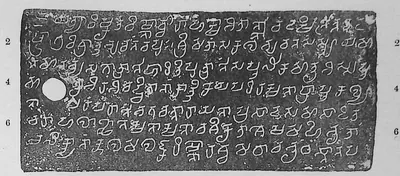 "Amudalapadu Plates of Vikramaditya I, Year 5", plate i (Epigraphia Indica XXXII, plate between pp. 182 and 183 (PDF p. 265))Inscription rubbing · 1959
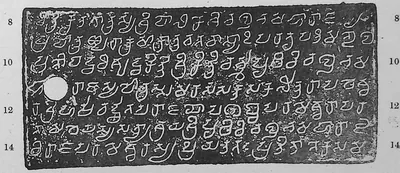 "Amudalapadu Plates of Vikramaditya I, Year 5", plate ii a (Epigraphia Indica XXXII, plate between pp. 182 and 183 (PDF p. 265))Inscription rubbing · 1959
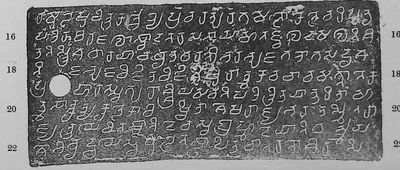 "Amudalapadu Plates of Vikramaditya I, Year 5", plate ii b (Epigraphia Indica XXXII, plate between pp. 182 and 183 (PDF p. 265))Inscription rubbing · 1959
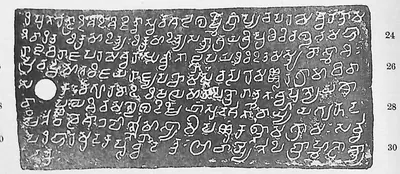 "Amudalapadu Plates of Vikramaditya I, Year 5", plate iii a (Epigraphia Indica XXXII, plate between pp. 182 and 183 (PDF p. 266))Inscription rubbing · 1959
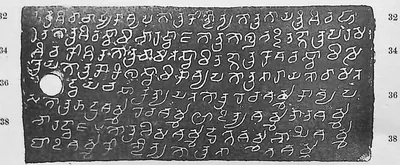 "Amudalapadu Plates of Vikramaditya I, Year 5", plate iii b (Epigraphia Indica XXXII, plate between pp. 182 and 183 (PDF p. 266))Inscription rubbing · 1959
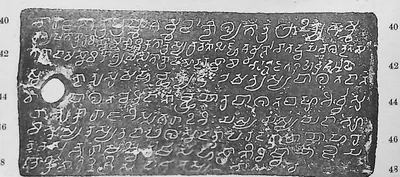 "Amudalapadu Plates of Vikramaditya I, Year 5", plate iv (Epigraphia Indica XXXII, plate between pp. 182 and 183 (PDF p. 266))Inscription rubbing · 1959
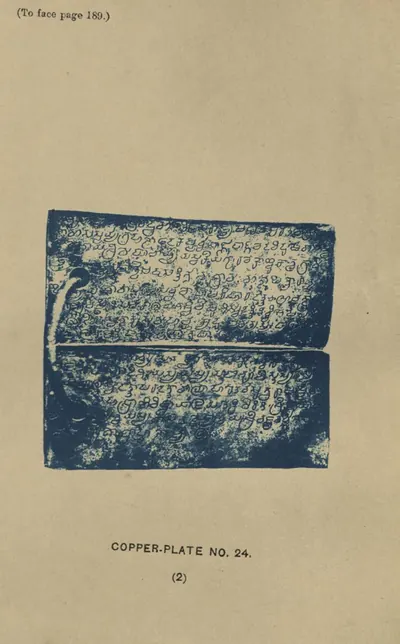 "Copper-plate No. 24" (grant of the Western Chalukya king Vikramaditya I) (Butterworth & Chetty 1905, to face p. 189 (PDF p. 250))Inscription rubbing · 1905
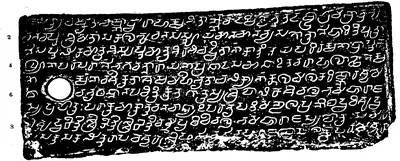 "Talamanchi plates of Vikramaditya I. — A. D. 660", plate i (Epigraphia Indica IX, plate between pp. 100 and 101 (PDF p. 128))Inscription rubbing · 1908
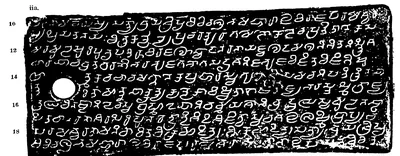 "Talamanchi plates of Vikramaditya I. — A. D. 660", plate ii a (Epigraphia Indica IX, plate between pp. 100 and 101 (PDF p. 128))Inscription rubbing · 1908
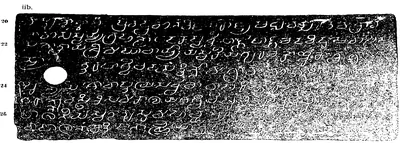 "Talamanchi plates of Vikramaditya I. — A. D. 660", plate ii b (Epigraphia Indica IX, plate between pp. 100 and 101 (PDF p. 129))Inscription rubbing · 1908
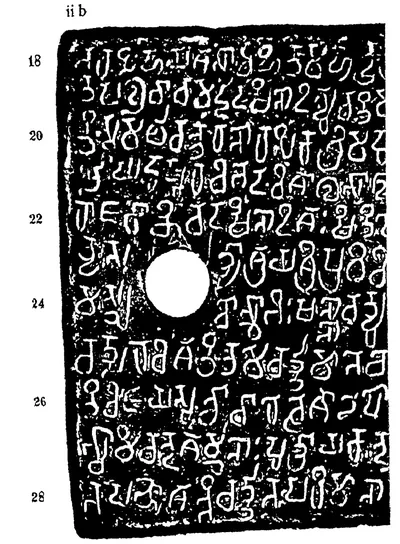 Gadval plates of Vikramaditya I, plate ii b (Epigraphia Indica X, plate between pp. 102 and 103 (PDF p. 134))Inscription rubbing · 1910
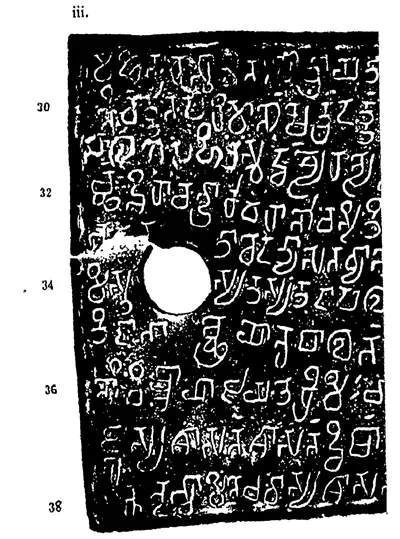 Gadval plates of Vikramaditya I, plate iii (Epigraphia Indica X, plate between pp. 102 and 103 (PDF p. 134))Inscription rubbing · 1910
Related
Dynasties
References
Notes (0)
Sources (6)
Spotted an error on this page? Tell us
Last updated: