Gudivada plates of Jayasimha I (three grants)
Three Sanskrit copper-plate grants of the second Eastern Chalukya king, Prithivi-Jayasimha-Vallabha I. They were kept by a landholding family at Gudivada in the old Sarvasiddhi taluk of Visakhapatnam district, and M. Somasekhara Sarma edited them in 1960. All concern land at or near Gudivada (Kulivataka or Kudivada) in the Plakki district. The first, of the king's 18th year, is dated by seasons and fortnights, and the editor worked it out as 12 February 659. The journal's editor doubted his conclusions and took the third grant for a later copy, perhaps a forgery.
These are three grants of Jayasimha I, the second king of the Eastern Chalukyas.1 M. Somasekhara Sarma edited them in 1960.1 He judged that the first added nothing to the known history of the dynasty, and that its interest lay in its date.1 All three concern land at or around the village now called Gudivada, and they were published together under one number in Epigraphia Indica.23
Discovery
Somasekhara Sarma wrote that the plates came from Gudivada, a village in the Sarvasiddhi taluk of Visakhapatnam district.2 They had long been kept there in the house of a landholder, Pericherla Peddiraju.2 When, how and where they were first found was not known.2
A pleader (lawyer) of Yellamanchili, G. V. Raghavarao Pantulu, borrowed them from the owner, his client.2 He sent them to the editor, who cut the rings to study them.2 The journal’s editor added that they were registered as Nos. 1, 2 and 3 of Appendix A in the epigraphical report for 1945–46.243 See Gudivada (Sarvasiddhi).
Grant No. 1, year 18
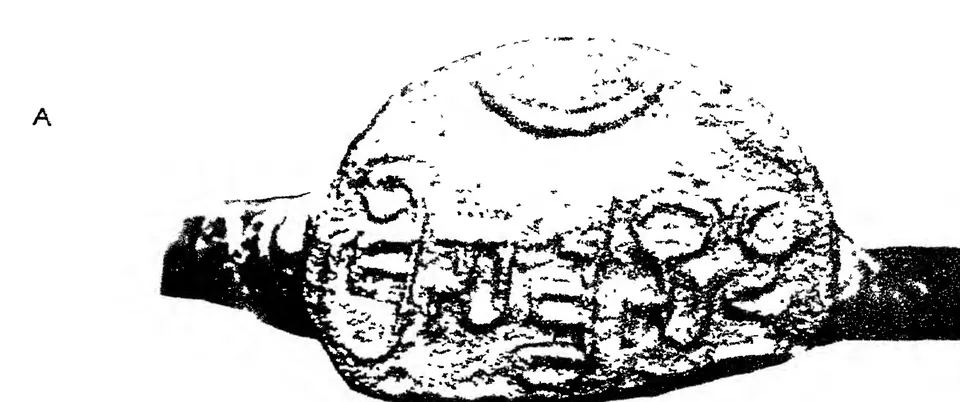
The first set has three thick plates without rims, held on a copper ring.2 Its seal, partly broken, shows a crescent above the legend Sri-Sarvasiddhi in Eastern Chalukya letters.2 The script is the early Telugu-Kannada type that the editor called the Vengi script, close to that of other early Eastern Chalukya grants.2 The language is Sanskrit prose, with two verses at the end, and the date is written with numerical symbols.2
The king, Prithivi-Jayasimha-Vallabha, son of Vishnuvardhana and grandson of Kirtivarman, issued the grant from his residence at Kallura.25 He addressed it to the householders of the Plakki district.25
On the day of a lunar eclipse he gave the western portion of the village of Adivasa as a tax-free agrahara (village granted to Brahmins), together with some fields of Kulivataka.21 The donees were two brothers, Vinayasarman and Vishnusarman of the Maudgalya gotra (clan), students of the Kauthuma branch of the Samaveda.21 The executor (ajnapti) was Paramesvaravarman.21
The journal’s editor read a difficult passage differently.24 In his reading, a hamlet of Adivasa called Punnagapadra was settled, and part of Kulivataka was added to it.24 This new western division of Adivasa was the land given.24
Grant No. 2
The second set also has three rimless plates, with a seal showing a crescent, the legend Sri-Sarvasiddhi and a lotus.4 It was issued from Asanapura to the elders and officers of the Plakki district and the ryots (cultivators) of the village of Kunduru.46
In Somasekhara Sarma’s reading, the king made a dwelling place at Kudivada.46 In this reading he also gave thirty-two nivartanas (a land measure) of land, cut off from Kunduru, as a separate agrahara.46 The donees were two brothers of the Vatsa gotra, Svamiyasas and Vishnuyasas.46 They are described as learned in the Vedas, the Itihasa, the Puranas and the Mimamsa, and as performers of the Agnishtoma.46
The brothers in turn gave a ninth share to their sister’s son Vishnusarman.6 The executor was Bhimasarman, a devotee of Vishnu and performer of the Vajapeya, who was not known from other grants of the king.6 The journal’s editor understood the passage to mean that the village itself was made an agrahara, with thirty-two nivartanas added from Kunduru.4
Grant No. 3
The third set has three rimless plates.3 Its seal shows only a spiral sign, and the letters are untidy and irregular.3 It repeats the second grant.3 From Asanapura, the king gives the village of Kudivada to the same two brothers, separated from Kunduru.3
This time the grant adds the boundaries:3
- Kunduru on the east3
- the sea on the south3
- the Golava and Naguvula tanks and other features on the west3
- Avakattu on the north3
The executor is again Bhimasarman.3
The places
Somasekhara Sarma could not identify Kallura, Adivasa, Kunduru or Asanapura.76 He identified Kulivataka with Gudivada itself.76 In the second and third grants it is called Kudivada and Kudivata.76
The Plakki district of these grants is also named in a Vishnukundin grant and in two grants of Vishnuvardhana I.75 Somasekhara Sarma argued that it covered at least the adjoining parts of the Sarvasiddhi and Anakapalli taluks.75
J. F. Fleet had tentatively identified Cherupuru with Chipurupalli town.75 On this basis Somasekhara Sarma rejected that identification.75 Vishnuvardhana I had issued his Chipurupalle grant from Cherupuru.75 Somasekhara Sarma proposed instead another Chipurupalli, in the Anakapalli taluk.75 He suggested that both grants of Vishnuvardhana I from this coast were found in the Anakapalli–Sarvasiddhi area.75
He also suggested that the Sarvasiddhi taluk took its name from Jayasimha I, whose surname it was.5 See the Chipurupalle plates and the Timmapuram plates.
He thought Asanapura must have been an important town, a centre of learning and culture.6 The donee’s grandfather in the Niduparu grant was a member of its ghatika (college).6 The donee of the Pulibumra grant had moved there from Kunduru in Karma-rashtra.6 His father had received that village from the Vishnukundin king Madhavavarman.6
The date and the chronology
The first grant is dated in the 18th regnal year, on the 15th day of the 8th fortnight of the Hemanta (winter) season.1 It was the day of a lunar eclipse.1 Somasekhara Sarma noted that this was the second grant of Jayasimha I dated by seasons and fortnights, after the Pulibumra grant.1 He traced this custom back to the Prakrit grants of the Satavahanas and Ikshvakus.1 He took the eclipse to fall on the full moon of Phalguna.1
He started from the Kopparam plates of Pulakesin II, which Hultzsch and Sewell dated to 631, when Vishnuvardhana I was still heir-apparent.17 He listed the lunar eclipses in Sravana that could fall in Vishnuvardhana’s 18th year, the year of his Chipurupalle grant.17 He also listed those on the full moon of Phalguna that could fall in Jayasimha’s 18th year.17 Only one pair fitted, and it made Vishnuvardhana’s 18th year 641–42 and the date of this grant 12 February 659.17
From this he concluded that regnal years were counted as current, and that the starting point of Eastern Chalukya chronology was 624–25.7 He noted that B. V. Krishna Rao, by a different route, had reached the same starting year.7
These results differ from the reckoning used on this site. Fleet dated Jayasimha I’s reign 633–663.89 He dated the eclipse in the Chipurupalle grant of Vishnuvardhana I’s 18th year to 632.89 The journal’s editor added a note that this dating does not solve all the problems of Eastern Chalukya chronology, citing N. Venkataramanayya.7 See When did the kingdom begin?
Disagreements about the grants
Somasekhara Sarma read the three grants as a sequence.3 In his view, the second created Gudivada as a separate village.3 The first then gave the western part of Adivasa, with land from Gudivada, to two other brothers.3 The third compensated the Vatsa brothers by granting them land from Kunduru again.3
The journal’s editor disagreed.3 He pointed out that the village granted and the donees of the first two grants are different.3 He judged the third, from its later letter forms and its seal with only a spiral, to be a later altered copy of the second.3 It adds boundaries and leaves out the sister’s son’s share.3 So he suspected that the heirs of the donees forged it, to deprive that nephew’s successors of their share.3
Footnotes
-
Somasekhara Sarma, “Three Grants of Chalukya Jayasimha I” (1960), p. 130 (archive.org (opens in a new tab)). ↩ ↩2 ↩3 ↩4 ↩5 ↩6 ↩7 ↩8 ↩9 ↩10 ↩11 ↩12 ↩13 ↩14 ↩15
-
M. Somasekhara Sarma, “Three Grants of Chalukya Jayasimha I”, Epigraphia Indica XXXI (1955–56, publ. 1960), p. 129 and editor’s notes (archive.org (opens in a new tab)). ↩ ↩2 ↩3 ↩4 ↩5 ↩6 ↩7 ↩8 ↩9 ↩10 ↩11 ↩12 ↩13 ↩14 ↩15 ↩16 ↩17 ↩18 ↩19
-
Somasekhara Sarma, “Three Grants of Chalukya Jayasimha I” (1960), p. 136 and editor’s notes (archive.org (opens in a new tab)). ↩ ↩2 ↩3 ↩4 ↩5 ↩6 ↩7 ↩8 ↩9 ↩10 ↩11 ↩12 ↩13 ↩14 ↩15 ↩16 ↩17 ↩18 ↩19 ↩20 ↩21
-
Somasekhara Sarma, “Three Grants of Chalukya Jayasimha I” (1960), p. 133 and editor’s notes (archive.org (opens in a new tab)). ↩ ↩2 ↩3 ↩4 ↩5 ↩6 ↩7 ↩8 ↩9 ↩10 ↩11
-
Somasekhara Sarma, “Three Grants of Chalukya Jayasimha I” (1960), p. 132 and note 1 (archive.org (opens in a new tab)). ↩ ↩2 ↩3 ↩4 ↩5 ↩6 ↩7 ↩8 ↩9 ↩10
-
Somasekhara Sarma, “Three Grants of Chalukya Jayasimha I” (1960), p. 134 (archive.org (opens in a new tab)). ↩ ↩2 ↩3 ↩4 ↩5 ↩6 ↩7 ↩8 ↩9 ↩10 ↩11 ↩12 ↩13 ↩14
-
Somasekhara Sarma, “Three Grants of Chalukya Jayasimha I” (1960), p. 131 and notes (archive.org (opens in a new tab)). ↩ ↩2 ↩3 ↩4 ↩5 ↩6 ↩7 ↩8 ↩9 ↩10 ↩11 ↩12 ↩13 ↩14 ↩15 ↩16 ↩17
-
J. F. Fleet, “The Chronology of the Eastern Chalukya Kings”, Indian Antiquary XX (1891), p. 97 (archive.org (opens in a new tab)). ↩ ↩2
-
J. F. Fleet, “The Chronology of the Eastern Chalukya Kings”, Indian Antiquary XX (1891), p. 96 (archive.org (opens in a new tab)). ↩ ↩2
Photos
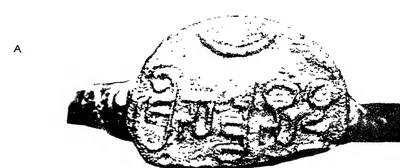 "Seals (A)", seal A, of grant No. 1 (Epigraphia Indica XXXI, Plate II, after p. 137 (PDF p. 221))Historic photograph · 1960
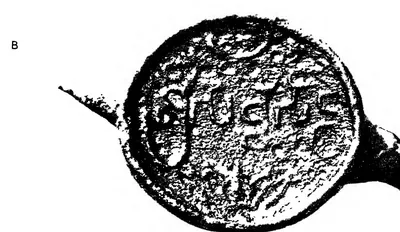 "Seals (B)", seal B, of grant No. 2 (Epigraphia Indica XXXI, Plate II, after p. 137 (PDF p. 221))Historic photograph · 1960
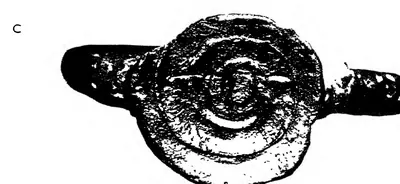 "Seals (C)", seal C, of grant No. 3 (Epigraphia Indica XXXI, Plate II, after p. 137 (PDF p. 221))Historic photograph · 1960
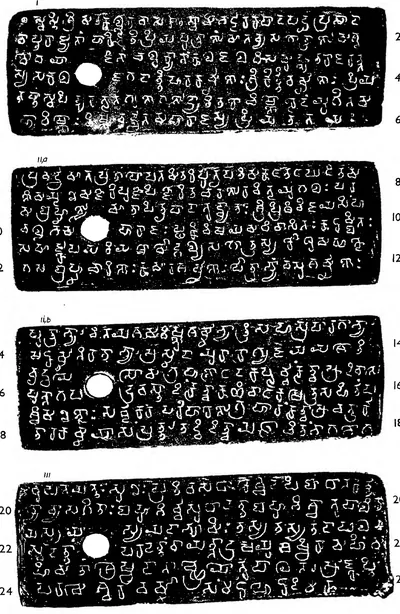 "Three Grants of Chalukya Jayasimha — A.—Grant No. 1, Year 18", plates i, ii a, ii b and iii (Epigraphia Indica XXXI, Plate I, after p. 131 (PDF p. 211))Inscription rubbing · 1960
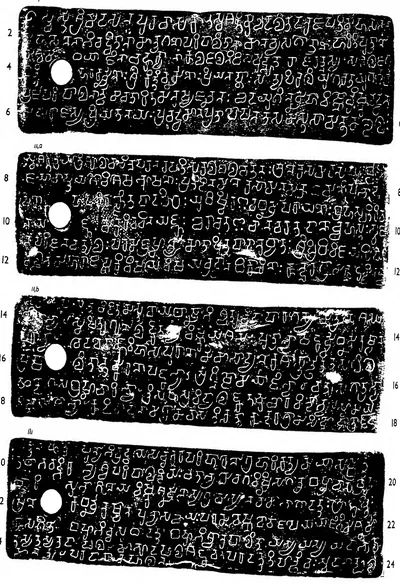 "Three Grants of Chalukya Jayasimha — B.—Grant No. 2", plates i, ii a, ii b and iii (Epigraphia Indica XXXI, Plate I, between pp. 132 and 133 (PDF p. 213))Inscription rubbing · 1960
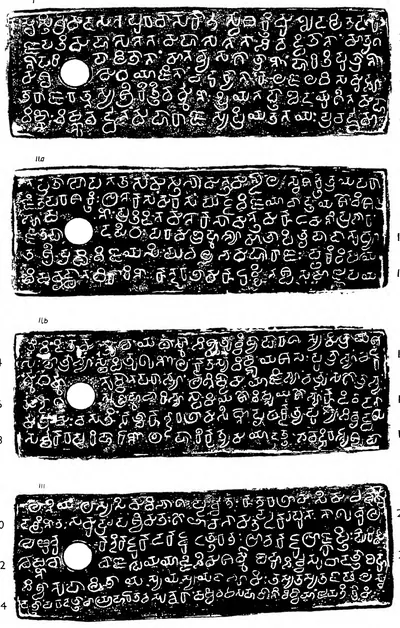 "Three Grants of Chalukya Jayasimha — C.—Grant No. 3", plates i, ii a, ii b and iii (Epigraphia Indica XXXI, Plate II, after p. 137 (PDF p. 220))Inscription rubbing · 1960
References
Notes (0)
Sources (3)
Spotted an error on this page? Tell us
Last updated: