Badami (Vatapi)
Town in northern Karnataka, the ancient Vatapi. It was the capital of the Chalukyas of Badami from the 6th to the 8th century. Pulakesin I acquired it, and Kirtivarman I adorned it with temples and finished its great Vaishnava cave temple. The Pallava Narasimhavarman I captured and ruined it about 642.
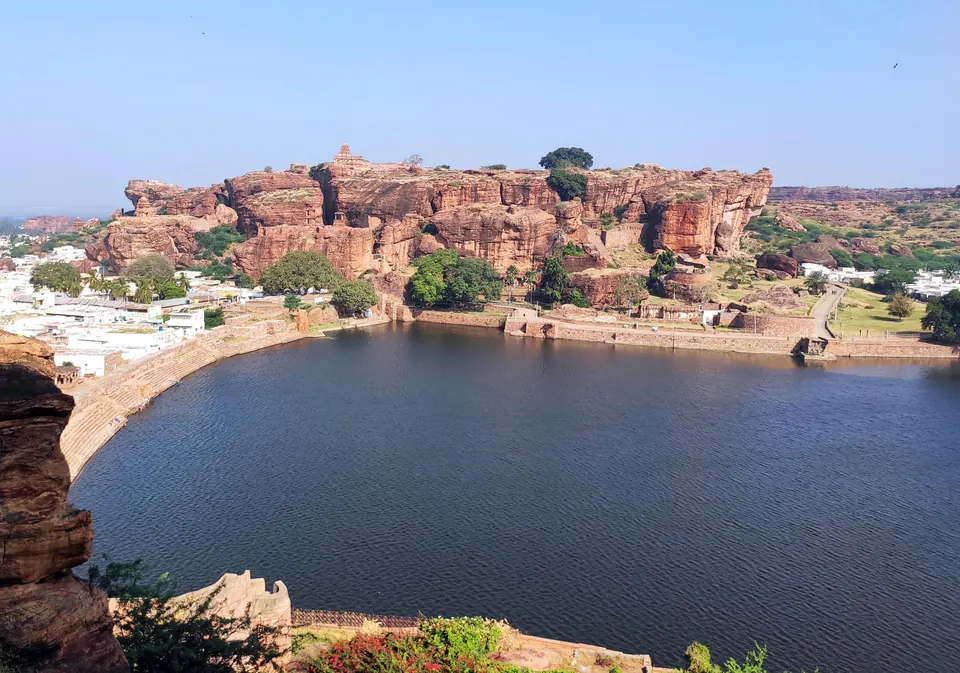
Badami, the ancient Vatapi, was the capital of the Chalukyas of Badami. Under Pulakesin II this dynasty conquered the Telugu coast, and he gave Vengi to his brother. The Aihole inscription calls Pulakesin I “the bridegroom of Vatapipuri”.1 It ends Pulakesin II’s conquests with his entry into “the city of Vatapi”.2
The Chalukya city
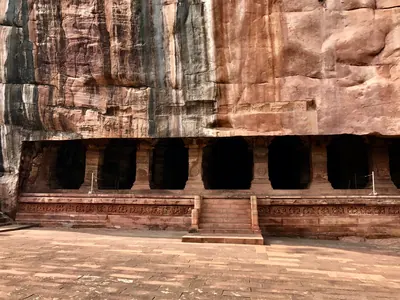
J. F. Fleet wrote that Pulakesin I acquired Vatapi.3 A later grant calls Kirtivarman I its “first maker”.3 Fleet took this to mean that Kirtivarman began to adorn the city with temples.3 The large Vaishnava cave temple there was finished in his time and under his orders.3
A Kanarese inscription on the rock outside the Vaishnava cave dates from the time of Mangalesa.4 In Fleet’s view it was the earliest Kanarese record to which a definite date can be given.4
Hiuen Tsang and the Pallavas
Fleet noted that the Chinese pilgrim Hiuen Tsang’s description of the capital of Pulakesin II does not fit Badami, which is 435 miles from Broach.5 He argued that the pilgrim was describing a northern town of the kingdom.5
The Pallava king Narasimhavarman I captured and ruined Badami, probably in 642.67 Fleet thought that the “destruction” meant above all the desecration of its Vaishnava temples.67 Robert Sewell adds that Narasimhavarman took the title Vatapikonda, “capturer of Vatapi”.8
Footnotes
-
F. Kielhorn, “Aihole Inscription of Pulikesin II”, Epigraphia Indica VI (1901), p. 8, verse 7 (archive.org (opens in a new tab)). ↩
-
Kielhorn, “Aihole Inscription” (1901), p. 11, verse 32 (archive.org (opens in a new tab)). ↩
-
J. F. Fleet, “Dynasties of the Kanarese Districts”, Gazetteer of the Bombay Presidency I, pt. II (1896), p. 345 (archive.org (opens in a new tab)). ↩ ↩2 ↩3 ↩4
-
Fleet, “Dynasties of the Kanarese Districts” (1896), p. 348 and note 1 (archive.org (opens in a new tab)). ↩ ↩2
-
Fleet, “Dynasties of the Kanarese Districts” (1896), p. 354 (archive.org (opens in a new tab)). ↩ ↩2
-
Fleet, “Dynasties of the Kanarese Districts” (1896), p. 358 (archive.org (opens in a new tab)). ↩ ↩2
-
Fleet, “Dynasties of the Kanarese Districts” (1896), p. 359 (archive.org (opens in a new tab)). ↩ ↩2
-
Robert Sewell, The Historical Inscriptions of Southern India (1932), p. 24 (archive.org (opens in a new tab)). Paraphrased, except for the short phrase quoted. ↩
Photos
Related
Dynasties
People
Pulakesin II
c. 609–642 CE
Chalukya king of Badami (609–642), the son of Kirtivarman I. His Aihole inscription of 634–35 says that he humbled the Kalingas and Kosalas, took the fortress of Pishtapura (Pithapuram), ravaged 'the water of Kunala' (taken to be the Kolleru lake) and drove the Pallava king behind the walls of Kanchi. He gave the conquered Vengi country to his younger brother Vishnuvardhana, the founder of the Eastern Chalukyas. His Kopparam plates of about 631 grant land in the Guntur country. He died when the Pallava Narasimhavarman I took Badami, probably in 642.
Vikramaditya I (Chalukya of Badami)
c. 655–680 CE
Chalukya king of Badami (about 655–680), a son of Pulakesin II. He restored the kingdom after the Pallavas took Badami, fought three Pallava kings and took Kanchi. His copper-plate grants come from the Telugu country: Amudalapadu and Gadwal in today's Telangana, the Kurnool district, Talamanchi near Nellore, and Hyderabad. His Amudalapadu plates of 660 record his initiation into the Shaiva faith. A queen of his installed a linga at Alampur.
Dantidurga
c. 753–756 CE
Rashtrakuta king (about 753–756) who overthrew the Chalukyas of Badami and founded the Rashtrakuta supremacy of the Deccan. His Samangad grant of January 754 says that he won the sovereignty by conquering the Chalukya 'Vallabha'. An inscription at Ellora lists among the rulers he subdued those of Kalinga, Kosala and the Srisaila country, which J. F. Fleet took to be the Kurnool country.
References
Notes (0)
Sources (3)
Spotted an error on this page? Tell us
Last updated: