Bhattiprolu stupa
Large brick Buddhist stupa in the Krishna delta, about 148 feet across at its base. Most of it was pulled down for road material and canal works in the 1870s. In 1892 A. Rea found three inscribed relic caskets of about 200 BCE in its core.
The stupa (relic mound) at Bhattiprolu stood in the Krishna delta, about four miles from the river’s main channel. Locally its mound was called Lanja dibba.1 It was one of a chain of Buddhist sites along the lower Krishna, including Amaravati, Jaggayyapeta, Ghantasala and Nagarjunakonda.2 A. H. Longhurst thought that the river, then larger and navigable to the sea, connected them.2 Little of the building survives, but the relic deposit at its centre is one of the best-documented finds of early Buddhist South India.
Terms
A stupa is a solid dome raised over relics of the Buddha. Around its base ran a raised procession path, and beyond that stood a stone railing. At Bhattiprolu, as at Amaravati, the base had projecting platforms facing the four cardinal points (north, south, east and west).3 The relics were sealed inside the brickwork in relic caskets, nested containers of stone and crystal.4
Destruction in the 19th century
The mound attracted official attention in 1870–71.1 Boswell reported on it to the Madras Government, and Walter Elliot wrote about it.1 By then it was being dug up for materials.1 Its large, good bricks went into road-making.1 Its marble slabs went into a sluice on the Krishna canal, where Rea could still see some built into the floor.1
An Assistant Engineer, Norris, inspected what was left.1 He found a solid but very irregular mass of brick, about 14 feet high, made of bricks about 1 ft 6 in by 2 ft.1 A narrow shaft ran down its centre.1 From the slope of the sides he estimated that the original cone had been about 66 feet high.1
Sewell’s visit
Robert Sewell visited a few years later and found the mound “absolutely demolished”.1 Villagers told him it had recently been a lofty dome with a procession path and a marble railing or wall about four feet high.1 A Public Works employee also described a detached carved pillar about 15 feet tall.1
The officer who supervised the demolition told Sewell that the mound had been 30 to 40 feet high.5 He had found inside it a stone box made of six dovetailed (interlocking) slabs.5 It held a clay pot, a “soapstone” casket and a crystal phial with a pearl, gold leaf and ashes.5 The stone box and pot were broken, and the soapstone casket was smashed on the voyage to England.5 The crystal phial was given to Dr. Burnell.5
Boswell recorded a local belief that the mound hid treasure worth “five crores”.5 Rea blamed such treasure stories for the destruction of many stupas.6
Rea’s excavation of 1892
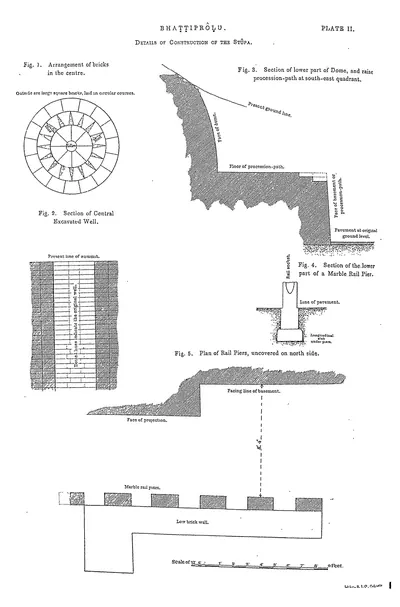
Because of the demolition, Rea found that the true centre of the building now lay well to the north of the mound’s middle.7 The central courses were whole.7 Eight large bricks radiated around a small central well.7 A ring of sixteen wedge-shaped bricks surrounded them, with clay filling between.7 Rea thought this plan resembled, perhaps on purpose, a lotus flower.7
Following this well downward, he found three inscribed relic caskets.8910 They lay at depths of 14½, 17 and 18 feet below the summit.8910 The foundations lay at 23 feet.8910
The three caskets
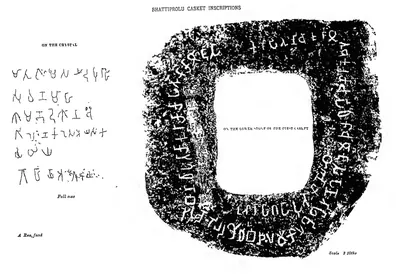
The first casket contained a round stone box with a crystal phial inside it, which held a small piece of bone.84 Around the phial lay gold flowers, pearls, beads and twenty-four small silver coins arranged in a svastika.84
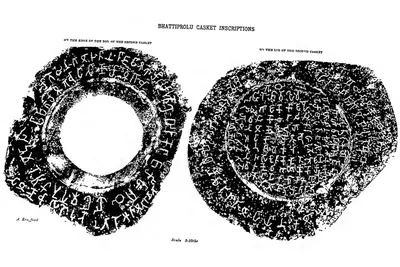
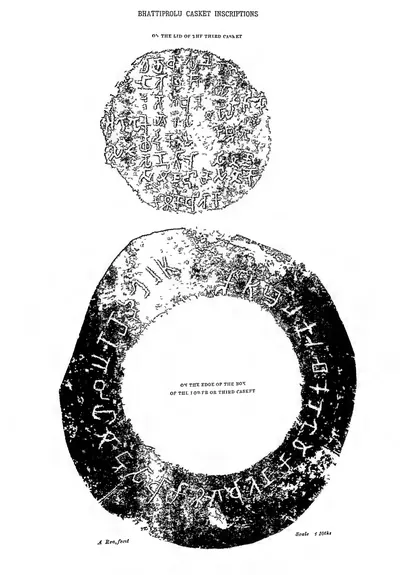
The second contained a crystal phial without any visible relic.9 It also held many gold flowers, beads, and a rolled strip of silver with three lines of pricked letters.9 In the third, a tiny casket of beryl inside a crystal phial held three small fragments of bone.1011 All the finds went to the Madras Museum.12
Rea argued that inscriptions sealed in the core of a stupa must date its foundation.13 Inscriptions carved on its outer parts, by contrast, might be added later.13
Size and plan
At the south-east, trenches exposed the unbroken face of the dome and its brick basement.14 The dome measured 132 feet across.14 With the 8-foot basement or raised path, the total was 148 feet.14 This was larger than Burgess’s estimate of about 138 feet for the base of the Amaravati stupa.14
Eight feet beyond the basement, Rea found six marble rail bases still in position.143 They were closer together than the rail posts at Amaravati.143 He guessed that the rail had plain lens-shaped bars like those at Sanchi.143
Men who had removed the marbles for the canal described them as plain slabs about four feet square, set against the basement wall.3 Rea concluded that, as at Jaggayyapeta, only the panels on the four projections had been carved.3
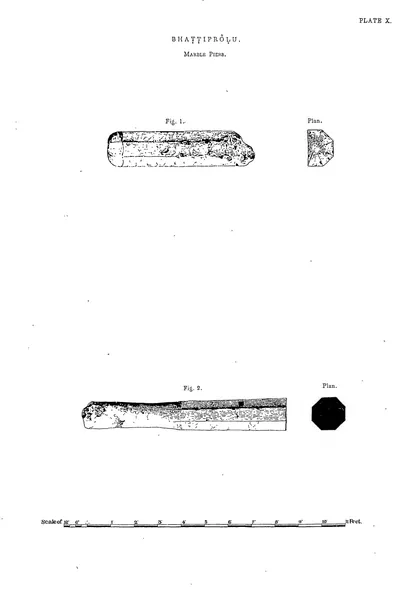
The few carved pieces he recovered include fragments of a marble umbrella, a pilaster capital with horses and riders, and half of a slab with a draped figure.14 He compared the old style of these pieces with the sculpture at Jaggayyapeta.14
Date
The date comes from the casket inscriptions.15 G. Bühler judged from their letter forms that they cannot be later than about 200 BCE and may be somewhat earlier.15 Their script is an otherwise unknown variety of Brahmi (see Bhattiprolu relic-casket inscriptions).15
Later reports of the Archaeological Survey cited the deposits as evidence of Buddha relics enshrined in the delta by about 200 BCE.16 By 1908 the Imperial Gazetteer described the stupa as largely destroyed.1718 It noted that its caskets were kept in the Madras Museum.1718
Footnotes
-
Alexander Rea, South Indian Buddhist Antiquities (1894), p. 7 (archive.org (opens in a new tab)). ↩ ↩2 ↩3 ↩4 ↩5 ↩6 ↩7 ↩8 ↩9 ↩10 ↩11 ↩12 ↩13
-
A. H. Longhurst, The Buddhist Antiquities of Nagarjunakonda (1938), p. 3 (archive.org (opens in a new tab)). ↩ ↩2
-
Rea, South Indian Buddhist Antiquities (1894), p. 16 (archive.org (opens in a new tab)). ↩ ↩2 ↩3 ↩4 ↩5 ↩6
-
Rea, South Indian Buddhist Antiquities (1894), p. 12 (archive.org (opens in a new tab)). ↩ ↩2 ↩3
-
Rea, South Indian Buddhist Antiquities (1894), p. 8, quoting Sewell and Boswell (archive.org (opens in a new tab)). ↩ ↩2 ↩3 ↩4 ↩5 ↩6
-
Rea, South Indian Buddhist Antiquities (1894), p. 44 (archive.org (opens in a new tab)). ↩
-
Rea, South Indian Buddhist Antiquities (1894), p. 9 (archive.org (opens in a new tab)). ↩ ↩2 ↩3 ↩4 ↩5
-
Rea, South Indian Buddhist Antiquities (1894), p. 11 (archive.org (opens in a new tab)). ↩ ↩2 ↩3 ↩4 ↩5
-
Rea, South Indian Buddhist Antiquities (1894), p. 13 (archive.org (opens in a new tab)). ↩ ↩2 ↩3 ↩4 ↩5
-
Rea, South Indian Buddhist Antiquities (1894), p. 14 (archive.org (opens in a new tab)). ↩ ↩2 ↩3 ↩4
-
Rea, South Indian Buddhist Antiquities (1894), p. 51, note by Dr. Warth of the Madras Museum (archive.org (opens in a new tab)). ↩
-
Rea, South Indian Buddhist Antiquities (1894), p. 10 (archive.org (opens in a new tab)). ↩
-
Rea, South Indian Buddhist Antiquities (1894), Preface, p. iii (archive.org (opens in a new tab)). ↩ ↩2
-
Rea, South Indian Buddhist Antiquities (1894), p. 15 (archive.org (opens in a new tab)). ↩ ↩2 ↩3 ↩4 ↩5 ↩6 ↩7 ↩8 ↩9
-
G. Bühler, “The Bhattiprolu Inscriptions”, Epigraphia Indica II (1894), p. 325 (archive.org (opens in a new tab)). ↩ ↩2 ↩3
-
H. Hargreaves (ed.), Annual Report of the Archaeological Survey of India, 1927–28 (1931), p. 115 (archive.org (opens in a new tab)). ↩
-
Imperial Gazetteer of India: Madras, Vol. I (1908), p. 334 (archive.org (opens in a new tab)); see also p. 303 (archive.org (opens in a new tab)). ↩ ↩2
-
Imperial Gazetteer of India: Madras, Vol. I (1908), p. 508 (archive.org (opens in a new tab)). ↩ ↩2
Photos
 Bhattiprolu casket inscriptions: on the crystal, and on the lower stone of the first casket (Epigraphia Indica II)Inscription rubbing · 1894
 Bhattiprolu casket inscriptions: on the edge of the box and on the lid of the second casket (Epigraphia Indica II)Inscription rubbing · 1894
 Bhattiprolu casket inscriptions: on the lid of the third casket, and on the edge of the box of the lower or third casket (Epigraphia Indica II)Inscription rubbing · 1894
 Bhattiprolu: details of construction (Rea 1894, Pl. II)Plan · 1894
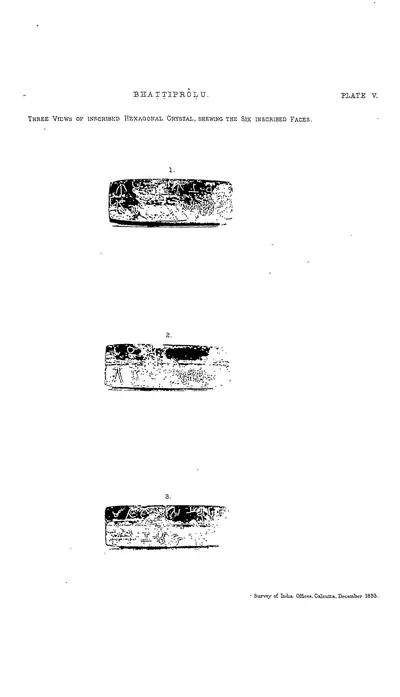 Bhattiprolu: inscribed crystal hexagon ("Three views of inscribed hexagonal crystal, shewing the six inscribed faces") (Rea 1894, Pl. V)Drawing · 1894
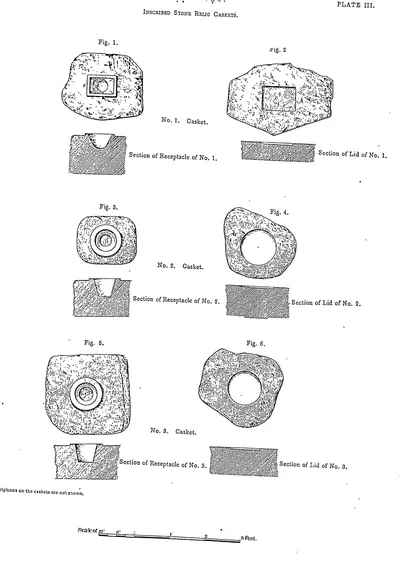 Bhattiprolu: large stone caskets (Rea 1894, Pl. III)Drawing · 1894
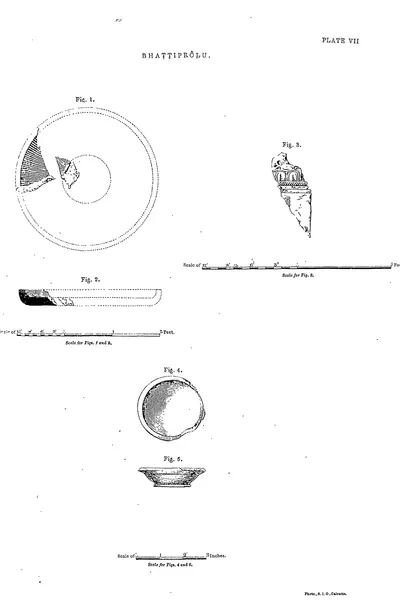 Bhattiprolu: marble umbrella, and pilaster base (Rea 1894, Pl. VII)Drawing · 1894
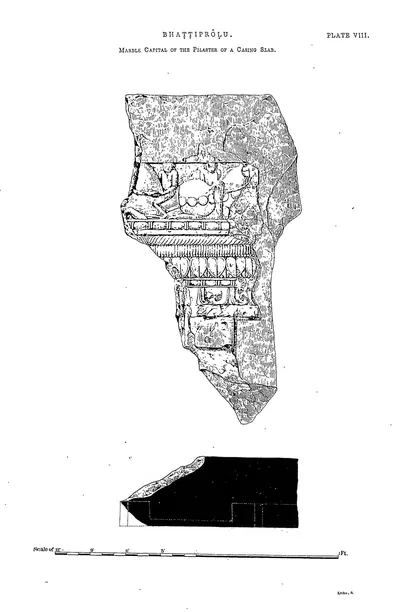 Bhattiprolu: pilaster capital (Rea 1894, Pl. VIII)Drawing · 1894
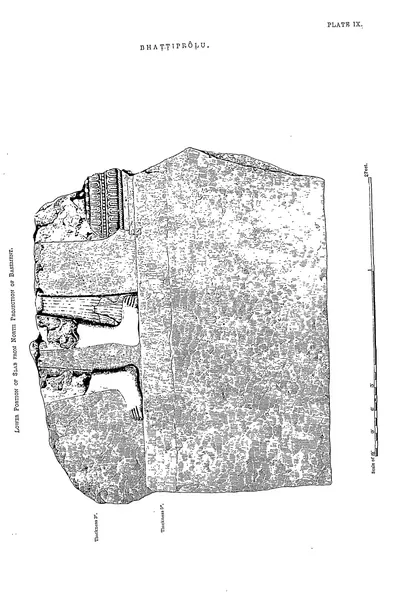 Bhattiprolu: portion of a slab from the stupa (Rea 1894, Pl. IX)Drawing · 1894
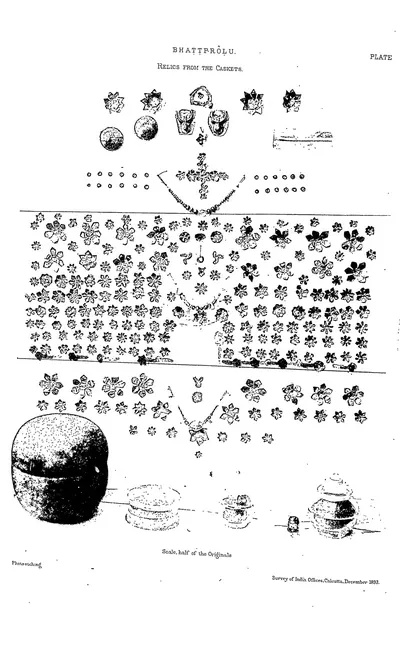 Bhattiprolu: relics and crystal caskets ("Relics from the caskets") (Rea 1894, Pl. I)Drawing · 1894
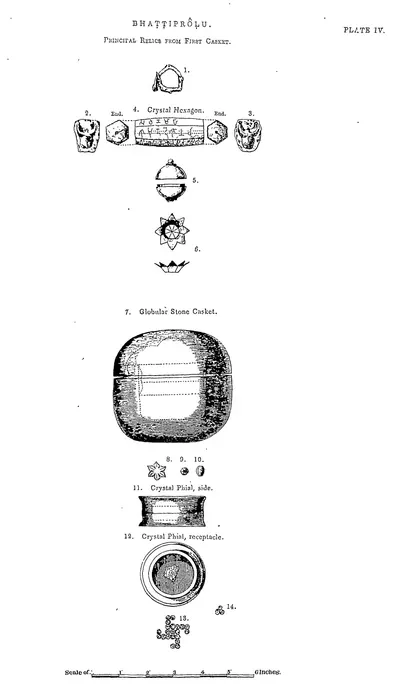 Bhattiprolu: relics of first casket (Rea 1894, Pl. IV)Drawing · 1894
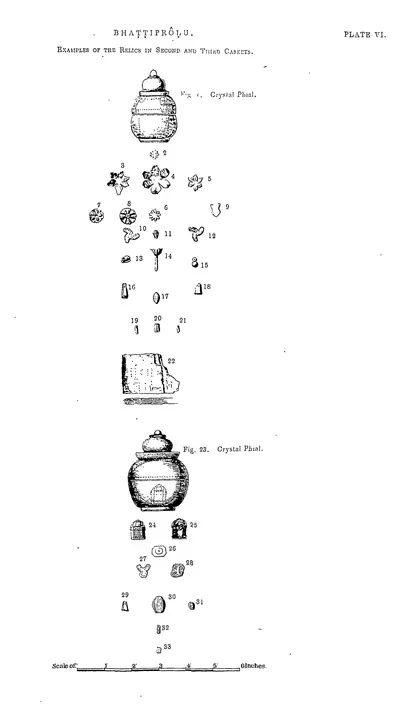 Bhattiprolu: relics of second and third caskets (Rea 1894, Pl. VI)Drawing · 1894
References
Notes (0)
Sources (5)
Spotted an error on this page? Tell us
Last updated: