Achyutapuram plates of Indravarman
Three small copper plates, found near Mukhalingam in the Srikakulam country. They record a gift of land made at Kalinganagara by the Ganga king Indravarman, alias Rajasimha, at the consecration of a tank in honour of his mother. The grant is dated in the 87th year of a reckoning that most later scholars took to be the Ganga era. The plates are among the best-preserved early Ganga grants and show the box-headed Kalinga script.
The plates
E. Hultzsch edited this grant in Epigraphia Indica III (1894–95).1 The plates then belonged to Mallapragada Surya Prakasa Rao of Achyutapuram, “near Mukhalingam, in the Ganjam district”.1 The owner had agreed to deposit them in the Madras Museum.1
There are three small plates, strung on a ring that had not been cut.1 The ends of the ring are secured in a small oval seal with “some indistinct emblem or emblems”.1 The plates were “in a state of nearly perfect preservation”.1
The language is nearly correct Sanskrit.1 It is in prose, apart from three imprecatory verses (curses) and a closing verse.1 See Mukhalingam.
The grant
The order is issued “from the victorious (city of) Kalinganagara, which is pleasant in all seasons”.21 It is issued by “the devout worshipper of Mahesvara, the glorious Maharaja Indravarman”.21 Hultzsch noted that the king is styled “the establisher of the spotless family of the Gangas”, an epithet not found in other Ganga grants.21 The king claims “the sovereignty over the whole (country) of Kalinga by the quivering of the edge of his own sword”.21 Like other Ganga kings, he bows to the god Gokarnasvamin.21
The gift was made “at the consecration of a tank (in honour) of the feet of the lady (our) mother”.23 One plough (a land measure) of land was given to Durgasarman of the Gautama gotra (clan), a student of the Chhandoga school.23 The land was in a field near the Rajatataka, the King’s Tank, in the village of Siddharthaka in the district of Varahavartani.23 Durgasarman also got the right to open the sluice of the tank for irrigation.23
The edict is called that of Rajasimha.3 Vinayachandra, son of Bhanuchandra, wrote it at the king’s own command.3
Date
The grant has two dates.13 The gift was made during the sun’s progress to the north.13 The edict is dated in “the eighty-seventh year (in words and numerical symbols) of the reign, on the new-moon of Chaitra”.13 Hultzsch took this to be the day on which the edict was engrossed (written out) and issued.13
Hultzsch did not attempt to convert the year.1 J. F. Fleet had published a grant of Indravarman alias Rajasimha dated in the year 91.1 Both grants were drafted by the same Vinayachandra.1 So Hultzsch took the two to belong to one king, whom he called Indravarman I.1
Later writers counted the year in a Ganga era and differed widely on its starting point. Robert Sewell placed the epoch (starting point) in the late 9th century, and he dated the year 87 to about 964–65.4
V. V. Mirashi fixed the epoch in 498.5 He placed an Indravarman ruling in the years 87 to 91 between 585 and 598, and called him Indravarman II.5 He kept the name Indravarman I for the king of the Jirjingi plates of the year 39.5 The date on this page follows Mirashi. See the Eastern Gangas for the dispute over the era.
Script
G. H. Ojha took letters from these plates for his Plate 57 of the Kalinga script.6 In this script the heads of the letters are filled boxes, and several letters are right-angled.6 The plate published with Hultzsch’s edition is printed full size.7 See the lesson Kalinga script and Odia, which reads the first line of this grant.7
Other notices
V. Rangacharya summarised the grant in 1919 under Achyutapuram in the Parlakimedi taluk of the Ganjam district.8
Footnotes
-
E. Hultzsch, “Achyutapuram Plates of Indravarman; the Year 87”, Epigraphia Indica III (1894–95), p. 127 (archive.org (opens in a new tab)). ↩ ↩2 ↩3 ↩4 ↩5 ↩6 ↩7 ↩8 ↩9 ↩10 ↩11 ↩12 ↩13 ↩14 ↩15 ↩16 ↩17 ↩18 ↩19 ↩20 ↩21
-
Hultzsch, “Achyutapuram Plates of Indravarman” (1895), p. 129, translation (archive.org (opens in a new tab)). ↩ ↩2 ↩3 ↩4 ↩5 ↩6 ↩7 ↩8 ↩9
-
Hultzsch, “Achyutapuram Plates of Indravarman” (1895), p. 130, translation (archive.org (opens in a new tab)). ↩ ↩2 ↩3 ↩4 ↩5 ↩6 ↩7 ↩8 ↩9 ↩10
-
Robert Sewell, The Historical Inscriptions of Southern India (1932), p. 50 (archive.org (opens in a new tab)). Paraphrased. ↩
-
V. V. Mirashi, “Epoch of the Ganga Era”, Epigraphia Indica XXVI (1941–42), p. 334 (archive.org (opens in a new tab)). Paraphrased. ↩ ↩2 ↩3
-
Gaurishankar Hirachand Ojha, Bharatiya Prachin Lipimala (2nd ed., 1918), p. 93 and Plate 57 (archive.org (opens in a new tab)). In Hindi; paraphrased. ↩ ↩2
-
Hultzsch, “Achyutapuram Plates of Indravarman” (1895), p. 128 and plate (archive.org (opens in a new tab)). ↩ ↩2
-
V. Rangacharya, A Topographical List of the Inscriptions of the Madras Presidency, Vol. I (1919), p. 699, Ganjam No. 290 (archive.org (opens in a new tab)). ↩
Photos
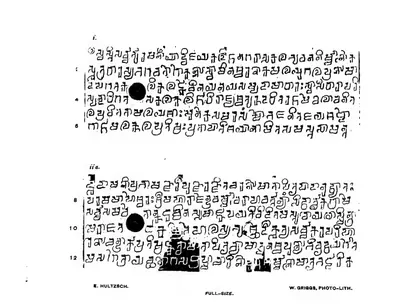 "Achyutapuram Plates of Indravarman. The Year 87": first plate and first side of the second plate, full size (Epigraphia Indica III)Inscription rubbing · 1895
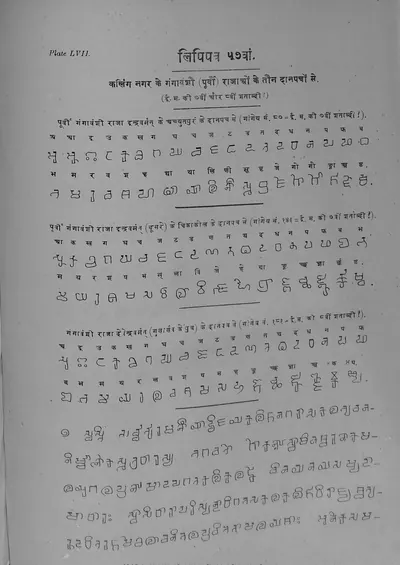 Kalinga script: grants of the Eastern Ganga kings Indravarman (Achyutapuram, Chicacole) and Devendravarman (Ojha 1918, Plate 57)Book plate · 1918
References
Notes (0)
Sources (5)
Spotted an error on this page? Tell us
Last updated: