Gadval plates of Vikramaditya I
A Sanskrit copper-plate grant of the 20th year of the Chalukya king Vikramaditya I, dated 25 April 674. It was kept at Gadwal (then in Hyderabad State, now in Telangana) and is said to have been found in the fields there. Issued from a camp at Uragapura on the south bank of the Kaveri, it names the three Pallava kings whom Vikramaditya defeated. E. Hultzsch noted two Telugu terms for measures of grain in it.
The Gadval plates are a grant of Vikramaditya I of Badami. They were issued in the far south during his wars with the Pallavas, but kept at Gadwal in the Telangana country.12 They are the main record of his claim to have overthrown three Pallava kings and taken Kanchi.12
Discovery
The plates belonged to a schoolboy at Kurnool.1 He said that they had been in his house at Gadval in Hyderabad territory, and that “some old woman was saying that they were found in the fields”.1 C. V. Doraswami Aiyar, a clerk in the Settlement Office at Kurnool, brought them to the notice of the Archaeological Department.1 They were obtained on loan through the Collector.1 E. Hultzsch edited them in Epigraphia Indica X from ink impressions supplied by V. Venkayya.1
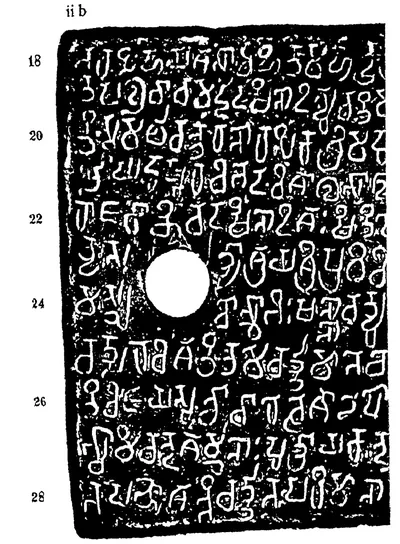
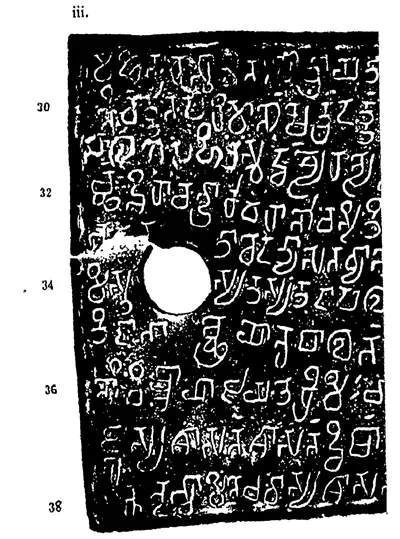
Venkayya described three copper plates with slightly raised rims, nine inches long, the first and last written on the inner side only.1 They are strung on an oval copper ring.1 Its ends are fixed in a mass of copper bearing an almost round seal, about an inch across, with “the rude figure of a boar in a running posture”.1 A slit in the last plate suggested that someone had tried to take it off the ring without cutting the ring.1 The plates, ring and seal together weigh 160 tolas.1
Language
Hultzsch found the writing in excellent condition, in an alphabet like that of other grants of the same period and dynasty.2 The language is Sanskrit, in prose and verse.2 Two expressions, khanduga vadla and salage, were in his words “taken over from the Telugu vernacular of the donee”.2 Of the private names, three are Prakrit and three Dravidian.2
Vikramaditya and the Pallavas
After the usual family line, the grant adds four verses already known from the king’s Hyderabad plates.2 They give his surnames Anivarita (“the unopposed”), Srivallabha, Ranarasika (“fond of fighting”) and Rajamalla.2 They say that he defeated Narasimha, Mahendra and Isvara.2 Hultzsch identified these as the successive Pallava kings Narasimhavarman I, Mahendravarman II and Paramesvaravarman I.2
A further verse names Isvara-Potaraja of Kanchi, and the conquest of Kanchi is mentioned too.2 Following F. Kielhorn, Hultzsch read the claim to have destroyed the Mahamalla family as another reference to the Pallavas.2 (See Paramesvaravarman I.)
Date and camp
The grant was made on the full-moon day of Vaisakha in the 20th year of the reign, after 596 Saka years had passed.2 J. F. Fleet gave the equivalent as Tuesday, 25 April 674.2 The king’s army had then entered the Chola province and was camped at Uragapura on the south bank of the Kaveri.2
Venkayya proposed that Uragapura was the old Chola capital Uraiyur near Tiruchirappalli (then Trichinopoly).23 Hultzsch thought it more likely a poetic form of Nagapattanam (Negapatam).23 Robert Sewell used the grant to place Vikramaditya south of the Kaveri on that day, after his capture of Kanchi.4
The grant
The grant was made at the request of Ganga-Mahadevi, who Hultzsch thought “seems to have been one of the queens” of the king.3 Three Brahmanas each received fifty nivartanas (land measures) of land in a village named [Chedu]lli.3 The last verse praises Vikramaditya as the destroyer of the Pallava line.3
The Epigraphia Telanganica (2023) prints the Gadval plates. Under the heading “Velnalli (Gadwal Plates)”, it gives a summary taken from Inscriptions of Andhra Pradesh, Mahabubnagar District (2003). That summary describes a pillar inscription in the Arka Brahma temple at Alampur. The inscription records a gift made at the request of Gangamahadevi to men with similar names. It gives the land as 25 nivartanas and the date as 15 April 675. Whether this is a separate record or a confused description of the plates is not clear from the summary.56
Footnotes
-
E. Hultzsch, “Gadval Plates of Vikramaditya I; A.D. 674”, Epigraphia Indica X (1910), p. 100 (archive.org (opens in a new tab)). ↩ ↩2 ↩3 ↩4 ↩5 ↩6 ↩7 ↩8 ↩9 ↩10 ↩11 ↩12
-
Hultzsch, “Gadval Plates” (1910), p. 101 (archive.org (opens in a new tab)). ↩ ↩2 ↩3 ↩4 ↩5 ↩6 ↩7 ↩8 ↩9 ↩10 ↩11 ↩12 ↩13 ↩14 ↩15 ↩16 ↩17
-
Hultzsch, “Gadval Plates” (1910), p. 102 (archive.org (opens in a new tab)). ↩ ↩2 ↩3 ↩4 ↩5
-
Robert Sewell, The Historical Inscriptions of Southern India (1932), p. 26 (archive.org (opens in a new tab)). Paraphrased. ↩
-
Gajjala Vasanta Lakshmi (ed.), Epigraphia Telanganica I: Pre-Kakatiya Telangana (2023), p. 37. Cite-only; paraphrased. ↩
-
Epigraphia Telanganica I (2023), p. 38. Cite-only; paraphrased. ↩
Photos
References
Notes (0)
Sources (3)
Spotted an error on this page? Tell us
Last updated: