Malepadu plates of Punyakumara
Three Sanskrit copper plates with a lion seal, found at Malepadu in the Cuddapah district and given to the Madras Museum. They record a grant of land by the Telugu Chola king Punyakumara in the fifth year of his reign. Published in 1912, they gave the first family tree of the Telugu Cholas, from Nandivarman through Dhananjaya and Mahendravikrama. Their date has been put near 800, about 625 and about 750.
By these copper plates, the Telugu Chola king Punyakumara granted fifty nivartanas of land in the fifth year of his reign.1 They were the first record to reveal the family tree of the Telugu Cholas of Renandu.23 Scholars have dated them very differently, from about 625 to about the end of the 8th century.345
Discovery
In 1904 J. Ramayya Pantulu brought a set of copper plates and several stone inscriptions to the Madras epigraphy department.6 He was the Deputy Collector in charge of the Jammalamadugu division of the Kadapa (then Cuddapah) district.6 The records were of “a family of kings whose existence was not known till then”.6
He reported that a man named Varadappa had found the plates “while digging foundations for a mutt at Mālēpāḍu”.6 (A mutt is a religious house.) Varadappa had kept them in a temple at Velpucharla, and there he gave them to Ramayya Pantulu.6 H. Krishna Sastri published them in Epigraphia Indica XI in 1912, and noted that they had been given to the Madras Museum.6
The plates and the seal
There are three plates, and the first and last are written on the inner side only.6 They are held by a ring whose ends are fixed in an oval seal.6 With the seal and ring, they weigh 93 tolas.6
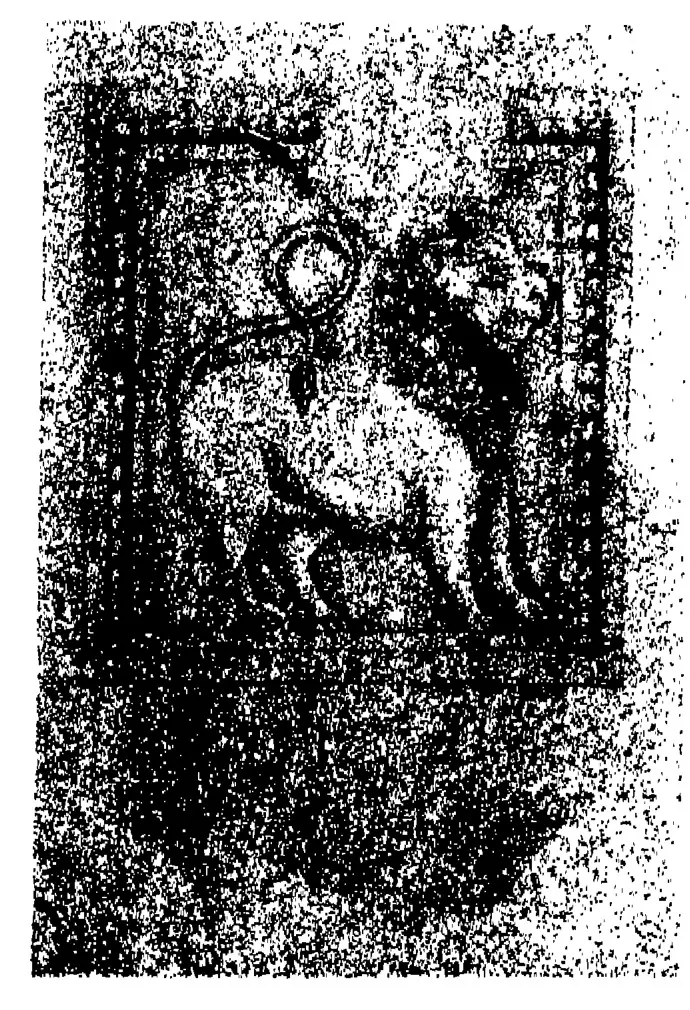
V. Venkayya, and then Ramayya Pantulu, took the animal on the seal for a tiger.67 Krishna Sastri noted “the profuse mane round its neck”, and thought it was more like a lion.67 He compared it with lions on stones at Peddamudiyam and Muddanur, and on the Pallava cave temple at Siyamangalam.67
Script and language
The letters belong to the southern class of alphabets.7 In Krishna Sastri’s judgement, they closely resemble those of the Ederu plates of the Eastern Chalukya Vijayaditya II (799–843).7 They also show features of an even earlier stage.7 The language is Sanskrit prose, with an opening verse in praise of Siva and two closing verses that curse anyone who breaks the grant.1
Contents
After the opening prayer, the plates introduce “a king Nandivarman of the Kāśyapa-gōtra”, born in the family of Karikala.1 They name his three sons, Simhavishnu, Sundarananda and Dhananjayavarman.1 Dhananjayavarman’s son Mahendravikramavarman “acquired the title Chōḷa-Mahārāja”.1 His sons were Gunamudita and Punyakumara.1
Punyakumara was “otherwise known as Pōrmukharāma, Purushaśārdūla, Mārdavachitta, Madanavilāsa, etc.”1 He made an announcement to “the inhabitants of his own dominion as well as those of Hiraṇya-rāshṭra”.1 In the fifth year of his reign, on the full-moon day of Karttika, he had granted fifty nivartanas (a land measure) of land, free of taxes.1
The land was in the village of Biraparu in Hiranyarashtra, “on the southern bank of the river Suprayōga”.1 It went to Chiruvanahala-Kesavasarman of the Atreya-gotra.1 The gift was made at the request of a chief whose name Krishna Sastri read as Kottikuldaraja.1 H. K. Narasimhaswami later showed from the Dommara-Nandyala plates that the name should be read Kottikuntaraja.8
Where the land lay
Krishna Sastri found the Suprayoga named among the boundaries of Uruvupalli, near Kandukur, in the plates of the Pallava Vishnugopavarman.9 He concluded that Punyakumara’s rule “appears to have extended beyond Cuddapah, even into Nellore”.9
K. A. Nilakanta Sastri and M. Venkataramayya (1956) read the village’s name as Biriparu.10 They identified the Suprayoga with the Penner, and Hiranyarashtra with the country round Kamalapuram and Kadapa.10 Stone records at Malepadu also mention Biriparu, and they thought it was perhaps Malepadu itself.10 They observed that both names refer to jasmine.10
Date
- H. Krishna Sastri (1912): about the end of the 8th century, from the letters and from about a century for five generations after Nandivarman3
- Nilakanta Sastri and Venkataramayya (1956): Punyakumara about 625, on the strength of his stone records and the Pallava names in the family; they rejected Krishna Sastri’s date4
- Narasimhaswami (1956): the middle of the 8th century, comparing these plates and the Dommara-Nandyala plates with the Kendur and Vakkaleri plates of the Chalukya Kirtivarman II5
Significance
These plates were the first record to reveal the family tree of the Telugu Cholas of Renandu.23 Krishna Sastri used them to argue that the family took names and titles from the Pallava kings of the Simhavishnu line.23 See Punyakumara, the Dommara-Nandyala plates and the Telugu Cholas of Renadu.
Footnotes
-
Krishna Sastri, “Malepadu Plates” (1912), p. 339 (archive.org (opens in a new tab)). ↩ ↩2 ↩3 ↩4 ↩5 ↩6 ↩7 ↩8 ↩9 ↩10 ↩11 ↩12
-
Krishna Sastri, “Malepadu Plates” (1912), p. 341 (archive.org (opens in a new tab)). ↩ ↩2 ↩3
-
Krishna Sastri, “Malepadu Plates” (1912), p. 344 (archive.org (opens in a new tab)). ↩ ↩2 ↩3 ↩4 ↩5
-
Nilakanta Sastri and Venkataramayya, “Telugu Chola Records” (1956), p. 251 and note 4 (archive.org (opens in a new tab)). Paraphrased. ↩ ↩2
-
Narasimhaswami, “Dommara-Nandyala Plates” (1956), p. 270 (archive.org (opens in a new tab)). Paraphrased. ↩ ↩2
-
H. Krishna Sastri, “Malepadu Plates of Punyakumara; the Fifth Year”, Epigraphia Indica XI (1912), p. 337 (archive.org (opens in a new tab)). ↩ ↩2 ↩3 ↩4 ↩5 ↩6 ↩7 ↩8 ↩9 ↩10 ↩11 ↩12
-
Krishna Sastri, “Malepadu Plates” (1912), p. 338 (archive.org (opens in a new tab)). ↩ ↩2 ↩3 ↩4 ↩5 ↩6
-
H. K. Narasimhaswami, “Dommara-Nandyala Plates of Punyakumara; 10th Year”, Epigraphia Indica XXVII (1956), p. 269 and note (archive.org (opens in a new tab)). Paraphrased. ↩
-
Krishna Sastri, “Malepadu Plates” (1912), p. 342 (archive.org (opens in a new tab)). ↩ ↩2
-
K. A. Nilakanta Sastri and M. Venkataramayya, “Telugu Chola Records from Anantapur and Cuddapah”, Epigraphia Indica XXVII (1956), p. 235 and notes (archive.org (opens in a new tab)). Paraphrased. ↩ ↩2 ↩3 ↩4
Photos
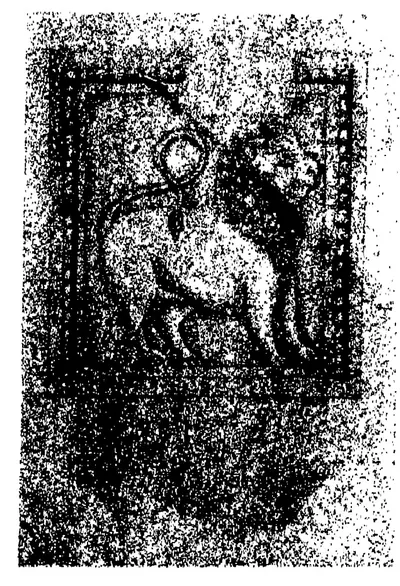 "Lion seal and sculptures of about the Seventh Century A.D.", D: "Sculpture on the rock-cut temple, Siyamangalam" (a Pallava lion, shown for comparison with the seal of the Malepadu plates) (Epigraphia Indica XI, plate to face p. 338, panel D (PDF p. 400))Historic photograph · 1912
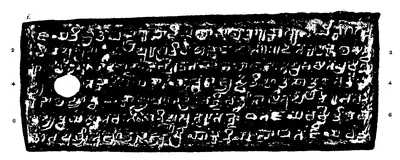 "Malepadu plates of Punyakumara; the fifth year", plate i (lines 1-7) (Epigraphia Indica XI, plate between pp. 344 and 345, plate i (PDF p. 408, printed sideways, turned here))Inscription rubbing · 1912
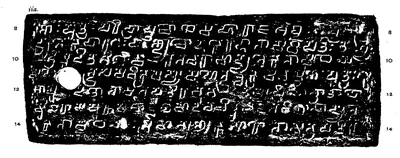 "Malepadu plates of Punyakumara; the fifth year", plate ii a (lines 8-14) (Epigraphia Indica XI, plate between pp. 344 and 345, plate ii a (PDF p. 408, printed sideways, turned here))Inscription rubbing · 1912
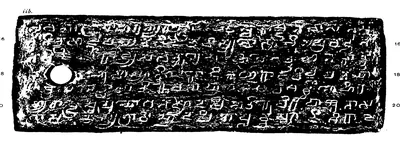 "Malepadu plates of Punyakumara; the fifth year", plate ii b (lines 15-21) (Epigraphia Indica XI, plate between pp. 344 and 345, plate ii b (PDF p. 409, printed sideways, turned here))Inscription rubbing · 1912
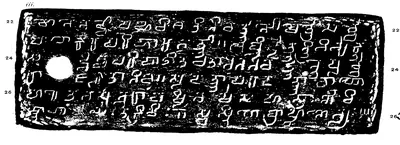 "Malepadu plates of Punyakumara; the fifth year", plate iii (lines 22-27) (Epigraphia Indica XI, plate between pp. 344 and 345, plate iii (PDF p. 409, printed sideways, turned here))Inscription rubbing · 1912
References
Notes (0)
Sources (2)
Spotted an error on this page? Tell us
Last updated: