Draksharama inscriptions of Kulottunga I (1107)
Two lamp-gift inscriptions, in Telugu and in Sanskrit and Telugu, on a wall of the Bhimesvara temple at Draksharama, dated both in the 37th year of the Chalukya-Chola king Kulottunga I and in Saka 1029 (1107). Because they give the regnal year and the Saka year together, they helped fix the beginning of Kulottunga's reign as Chola king in 1070. The same wall carries an inscription of the Western Chalukya Vikramaditya VI, recognised at Draksharama after 1118.
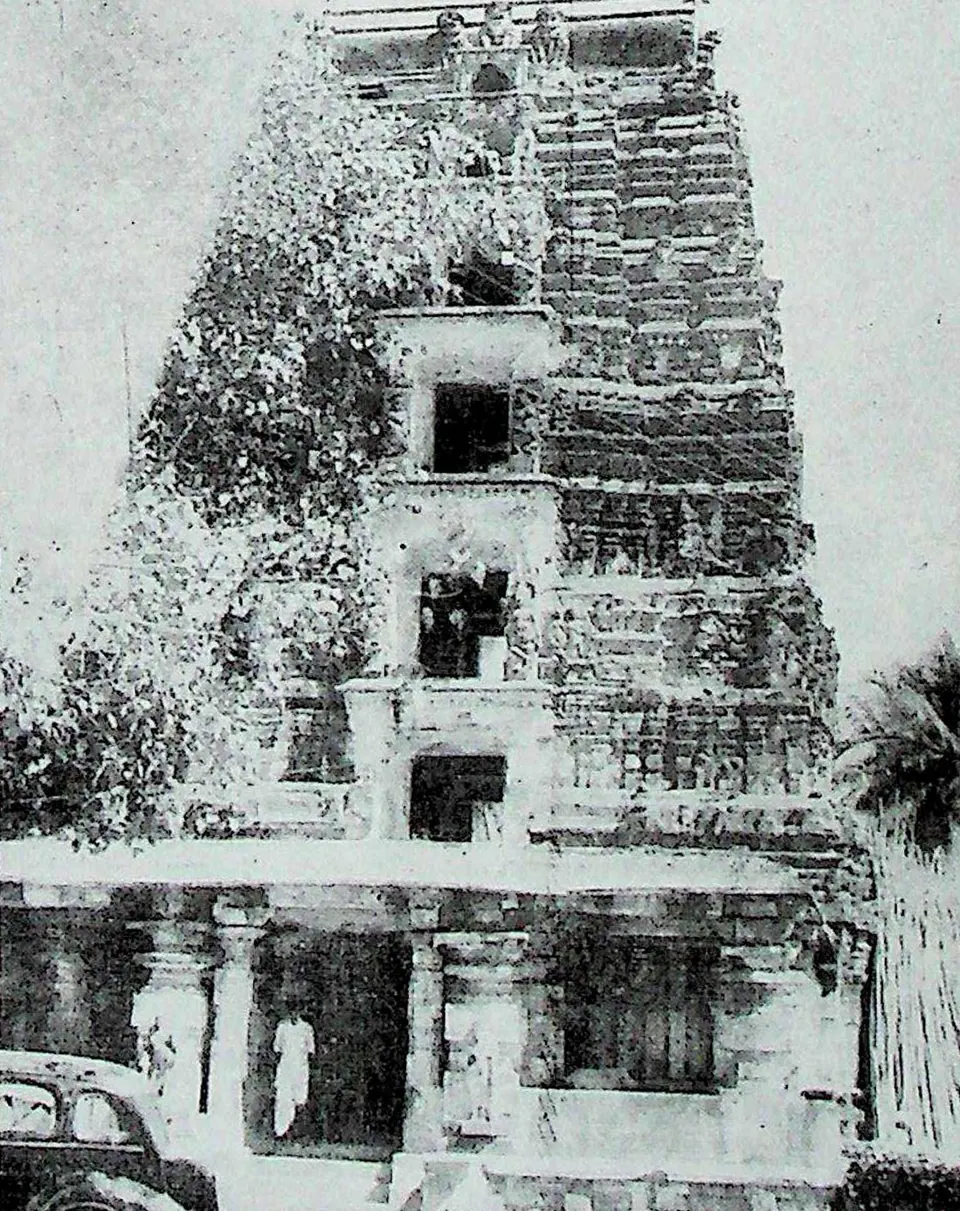
These two short inscriptions at Draksharama record gifts of lamps in the reign of Kulottunga I.1 Each gives both the king’s 37th year and the Saka year 1029, which is 1107.1 Records like these helped scholars fix the year in which Kulottunga became Chola king.2
The records
The Bhimesvara temple at Draksharama is covered with inscriptions.34 V. Rangacharya wrote in 1919 that 271 of them had been copied.3 The Godavari District Gazetteer (1907) gave the same number, the earliest dated 1055.4 See the Bhimesvara temple.
Two of them, Nos. 386 and 389 of 1893, are on the same wall.1 Rangacharya described the first, in Telugu, as a record of “Saptama-Vishnuvardhana alias Kulottunga-Chodadeva (I)”.1 It records the gift of a lamp in his 37th year and Saka 1029 (Saka is an Indian way of counting years).1 The second, in Sanskrit and Telugu, has the same date and also records a lamp.1 Their texts were printed in South-Indian Inscriptions IV in 1923.56
Between them on the wall is a record of the Western Chalukya king Tribhuvanamalladeva, dated in his own era.1 It too records a lamp.1 See Vikramaditya VI.
When Kulottunga came to the throne
A record that gives both a regnal year and a Saka year lets one work out when the reign began.7 E. Hultzsch noted in 1903 that Kulottunga’s Telugu inscriptions place his accession in Saka 991–92, which is 1069–71.7 F. Kielhorn’s calculations showed that it began between March and October 1070.78
Robert Sewell cited these two Draksharama records, with Kielhorn’s work, to fix the day as 9 June 1070.2 His own table of the Chola kings, however, gives 28 June 1070 for the coronation.9
Footnotes
-
Rangacharya, Topographical List II (1919), p. 739, Godavari Nos. 292–295 (archive.org (opens in a new tab)). ↩ ↩2 ↩3 ↩4 ↩5 ↩6 ↩7 ↩8
-
Robert Sewell and S. Krishnaswami Aiyangar, The Historical Inscriptions of Southern India (1932), p. 83 (archive.org (opens in a new tab)). Paraphrased. ↩ ↩2
-
V. Rangacharya, A Topographical List of the Inscriptions of the Madras Presidency, Vol. II (1919), pp. 723–724 (archive.org (opens in a new tab)). ↩ ↩2
-
F. R. Hemingway, Madras District Gazetteers: Godavari, Vol. I (1907), p. 251 (archive.org (opens in a new tab)). ↩ ↩2
-
H. Krishna Sastri (ed.), South-Indian Inscriptions (Texts), Vol. IV (1923), p. 452, No. 1295 (archive.org (opens in a new tab)). ↩
-
South-Indian Inscriptions (Texts) IV (1923), p. 455, No. 1302 (archive.org (opens in a new tab)). ↩
-
E. Hultzsch, South-Indian Inscriptions, Vol. III, pt. II (1903), p. 127 (archive.org (opens in a new tab)). ↩ ↩2 ↩3
-
F. Kielhorn, “Dates of Chola Kings”, Epigraphia Indica IX (1907–08), p. 218 (archive.org (opens in a new tab)). ↩
-
Sewell and Aiyangar, Historical Inscriptions of Southern India (1932), p. 341 (archive.org (opens in a new tab)). Paraphrased. ↩
Photos
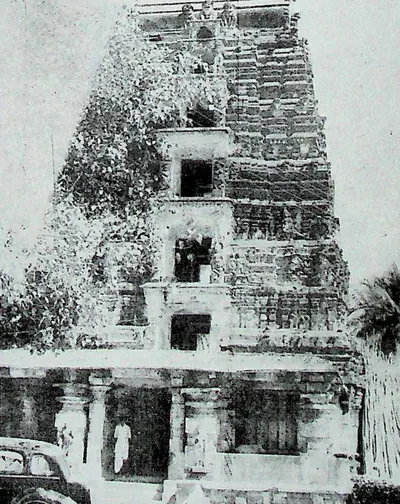 "22. West Gōpuram - Bhīmēśvara Temple - Drākshārāma" (M. Rama Rao, Eastern Calukyan Temples of Andhra Desa, 1964, Fig. 22 (PDF p. 77))Historic photograph · 1964
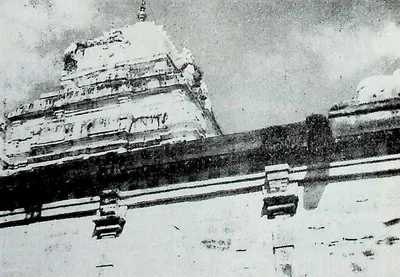 "31. Vimāna - Bhīmēśvara Temple - Drākshārāma" (M. Rama Rao, Eastern Calukyan Temples of Andhra Desa, 1964, Fig. 31 (PDF p. 93))Historic photograph · 1964
References
Notes (0)
Sources (6)
Spotted an error on this page? Tell us
Last updated: