Bhimesvara temple, Draksharama
Two-storeyed Shiva temple at Draksharama in the Godavari delta, one of the five Pancharama shrines and the most famous temple of the coastal Telugu country. Its walls carry some 270 inscriptions dated from 1055. Popular tradition in 1907 gave it to an unknown Chola king. M. Rama Rao (1964) gave it to the Eastern Chalukya king Chalukya-Bhima I, after whom he took the god to be named.
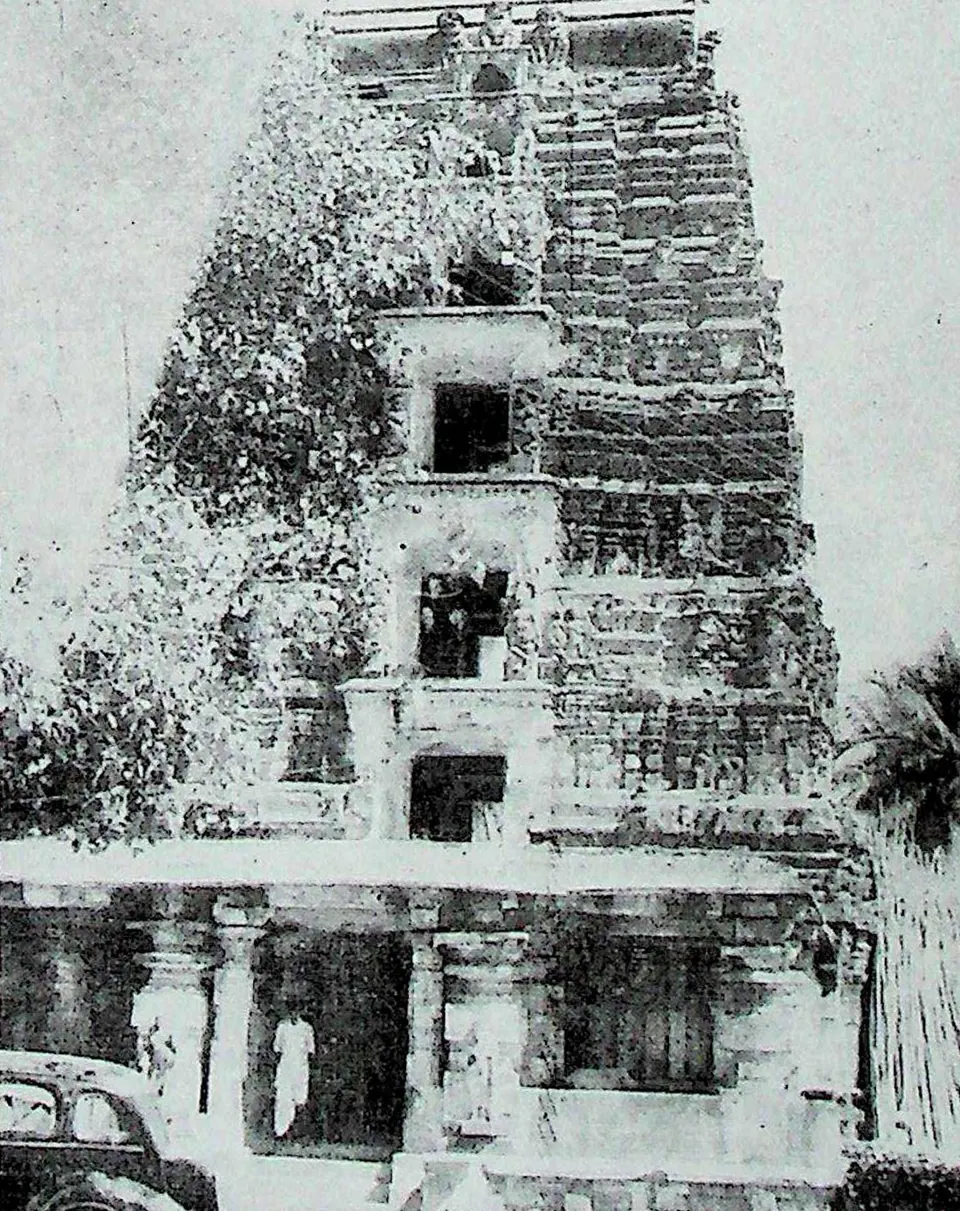
The temple of Bhimesvara is the centre of Draksharama, and its god gave the town its fame as the “Southern Benares”. M. Rama Rao surveyed it in 1956–58.12 He called it one of the most celebrated temples of the Telugu country.12 Its linga is counted among the five Pancharama lingas.3 Tradition says these were pieces of a single great linga that fell or were set up at five places in the Godavari and Krishna country.3
Who built it?
The sources used here disagree about the builder. The Godavari district gazetteer of 1907 reported that “its erection is ascribed by popular tradition to an unknown Chola king”.4
Rama Rao, in 1964, gave it to the Eastern Chalukya king Chalukya-Bhima I, together with the Bhimesvara temples at Chalukya-Bhimavaram and Chebrolu.52 He held that this king built all three and that their gods were named after him.52 In his preface he credited the same king with the Shiva shrines of all five Pancharamas.52
For the Bhimavaram temple there is a medieval statement.6 The Pithapuram pillar inscription of 1202 says that Chalukya-Bhima founded a temple called Chalukya-Bhimesvara after his own name.6 E. Hultzsch identified that temple with the one at Bhimavaram, not with Draksharama.6 Rama Rao found that the Bhimavaram temple “resembles in all respects” the one at Draksharama.7 See Bhimesvara temple, Chalukya-Bhimavaram.
Inscriptions
The gazetteer counted 271 inscriptions copied by the Government Epigraphist in 1893 (Nos. 181 to 451 of that year’s collection).4 The earliest it found, No. 185, was dated 1055, “during the reign of the Rajaraja whose capital was at Rajahmundry”.4 The latest, No. 426, was of the Reddi period and dated 1447.4 See Rajaraja Narendra.
Sewell made his list of 1882 from copies he thought “very untrustworthy”.8 It begins with grants of the 1130s by chiefs titled Mahamandalesvara (great feudal lord), among them a Velanati chief.8
Building work in the records
Rama Rao summarised the building work these records describe:9
- The Velanadu chief Kulottunga-Choda Gonka built a storehouse and a mantapa (pillared hall).9
- A certain Salava built the compound wall in 1092.9
- In 1381 the Kondavidu Reddi king Anavema built the Nandi, dance and marriage mantapas, the compound wall, shrines, treasuries, granaries and kitchens, and set doors in the four gateways.9
- A minister of king Vema of Rajahmundry built a twelve-pillared mantapa below the eastern gopura (gate tower).9
Several mathas (religious houses) and choultries (rest houses) near the shrine fed pilgrims and Brahmins.9
He also noted two poets connected with the temple.10 Mallikarjuna Panditaradhya, a Saiva teacher of the 12th century, was the son of the temple’s priest.10 Vemulavada Bhimakavi, the son of a Brahmin widow of Draksharama, called Bhimesvara his father.10
The temple in literature
Rama Rao drew on the Bhimesvara Puranamu of the Telugu poet Srinatha.1 Srinatha lived for a time at the Reddi court of Rajahmundry and wrote, in Rama Rao’s words, as an eyewitness.1 He describes the temple within a high wall with four gopuras, guarded by goddesses.1 The goddess Manikyadevi is the god’s chief consort, and a marriage mantapa stands to the west of the shrine.1
Rama Rao also summarised the 9th-century Prakrit poem Lilavai by Kutuhala.19 Its story is set near “Sapta-Godavari-Bhimam”.19 At its close the Satavahana king Hala and the princess Lilavati worship the god Bhimesa and the goddess Bhavani there.19 Rama Rao treated this among the literary sources for the Draksharama temple.19
The building
The gazetteer described “a rather handsome two-storeyed building” that was “not in particularly good repair”.4 It noted black granite Chalukyan pillars in the porch round the shrine on the upper storey, “a great rarity in this district”.4 It also noted a seated Jain tirthankara carved on a slab on the north side.4 It recorded a well with a mouth shaped like a strung bow.4 The linga is very large: the gazetteer gives some fourteen or fifteen feet.3
Rama Rao describes two enclosures.111213 The outer one has high plain walls of large fitted stone blocks and four gateways with gopuras.111213 Within the inner one is a two-storeyed pillared cloister with fourteen small shrines.111213
In the centre stands the main shrine, also of two storeys.111213 Its long shaft-like linga rises from the ground-floor sanctum into the upper floor, where its top is worshipped.111213 The tower above is a two-storeyed vimana (tower over the shrine) of the Nagara order.111213
Footnotes
-
Rama Rao, Eastern Calukyan Temples (1964), p. 11 (archive.org (opens in a new tab)). ↩ ↩2 ↩3 ↩4 ↩5 ↩6 ↩7 ↩8 ↩9 ↩10
-
M. Rama Rao, Eastern Calukyan Temples of Andhra Desa (1964), preface (unnumbered) (archive.org (opens in a new tab)). ↩ ↩2 ↩3 ↩4 ↩5
-
F. R. Hemingway, Madras District Gazetteers: Godavari (1907), p. 250 (archive.org (opens in a new tab)). ↩ ↩2 ↩3
-
Hemingway, Godavari (1907), p. 251 (archive.org (opens in a new tab)). ↩ ↩2 ↩3 ↩4 ↩5 ↩6 ↩7 ↩8
-
Rama Rao, Eastern Calukyan Temples (1964), p. 2 (archive.org (opens in a new tab)). ↩ ↩2 ↩3
-
E. Hultzsch, “Pithapuram Pillar Inscription of Mallapadeva”, Epigraphia Indica IV (1896–97), p. 227 (archive.org (opens in a new tab)). ↩ ↩2 ↩3
-
Rama Rao, Eastern Calukyan Temples (1964), p. 31 (archive.org (opens in a new tab)). ↩
-
Robert Sewell, Lists of the Antiquarian Remains in the Presidency of Madras, Vol. I (1882), p. 25, s.v. Drakshārāmam (archive.org (opens in a new tab)). ↩ ↩2
-
Rama Rao, Eastern Calukyan Temples (1964), p. 14 (archive.org (opens in a new tab)). ↩ ↩2 ↩3 ↩4 ↩5 ↩6 ↩7 ↩8 ↩9 ↩10
-
Rama Rao, Eastern Calukyan Temples (1964), p. 15 (archive.org (opens in a new tab)). ↩ ↩2 ↩3
-
Rama Rao, Eastern Calukyan Temples (1964), p. 18 (archive.org (opens in a new tab)). ↩ ↩2 ↩3 ↩4 ↩5 ↩6
-
Rama Rao, Eastern Calukyan Temples (1964), p. 20 (archive.org (opens in a new tab)). ↩ ↩2 ↩3 ↩4 ↩5 ↩6
-
Rama Rao, Eastern Calukyan Temples (1964), p. 21 (archive.org (opens in a new tab)). ↩ ↩2 ↩3 ↩4 ↩5 ↩6
Photos
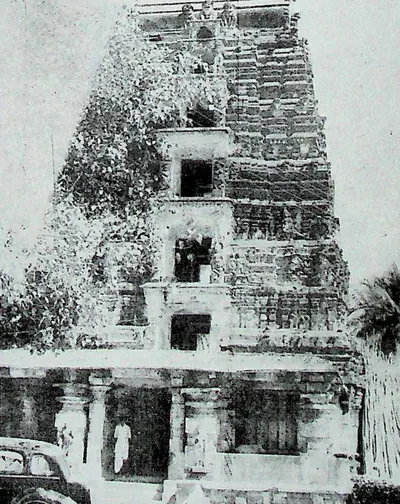 "22. West Gōpuram - Bhīmēśvara Temple - Drākshārāma" (M. Rama Rao, Eastern Calukyan Temples of Andhra Desa, 1964, Fig. 22 (PDF p. 77))Historic photograph · 1964
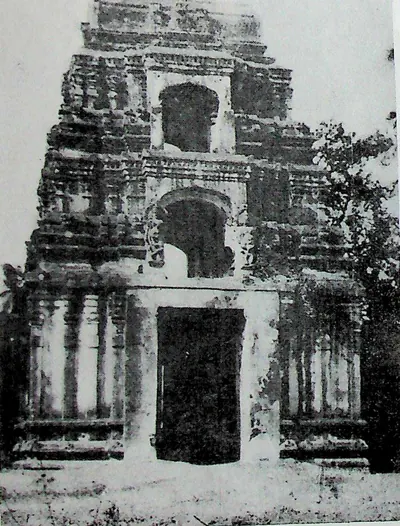 "23. North Gōpura - Bhīmēśvara Temple - Drākshārāma" (M. Rama Rao, Eastern Calukyan Temples of Andhra Desa, 1964, Fig. 23 (PDF p. 79))Historic photograph · 1964
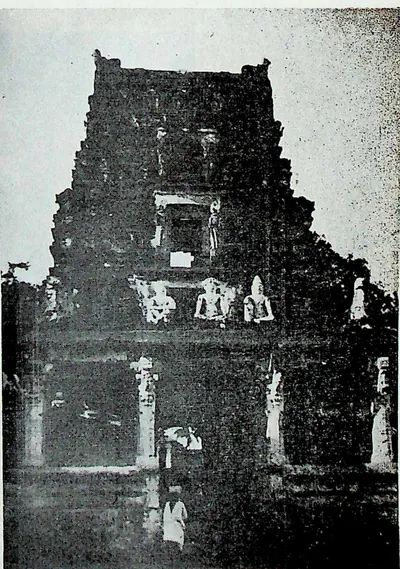 "24. South Gōpura - Bhīmēśvara Temple - Drākshārāma" (M. Rama Rao, Eastern Calukyan Temples of Andhra Desa, 1964, Fig. 24 (PDF p. 79))Historic photograph · 1964
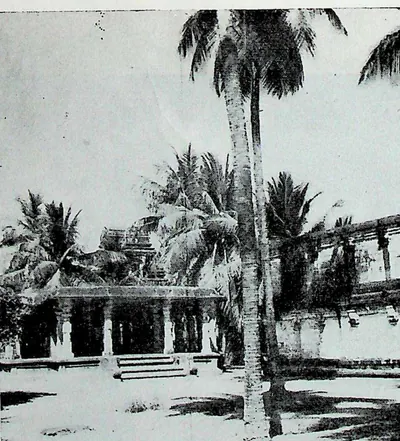 "25. Maṇṭapa in the North-east Corner of outer enclosure - Bhīmēśvara Temple, Drākshārāma" (M. Rama Rao, Eastern Calukyan Temples of Andhra Desa, 1964, Fig. 25 (PDF p. 81))Historic photograph · 1964
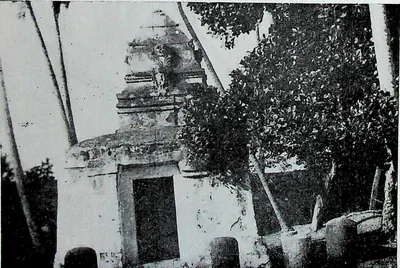 "26. Kālabhairava Shrine - Bhīmēśvara Temple, Drākshārāma" (M. Rama Rao, Eastern Calukyan Temples of Andhra Desa, 1964, Fig. 26 (PDF p. 83))Historic photograph · 1964
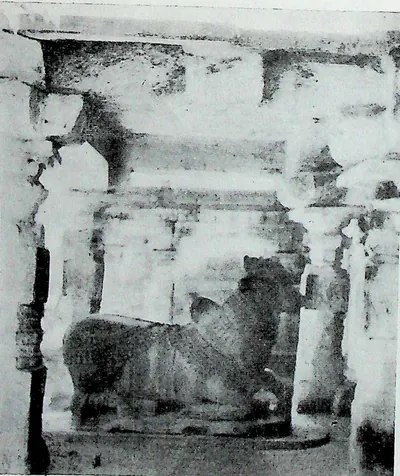 "27. Nandi Maṇṭapa - Bhīmēśvara Temple, Drākshārāma" (M. Rama Rao, Eastern Calukyan Temples of Andhra Desa, 1964, Fig. 27 (PDF p. 85))Historic photograph · 1964
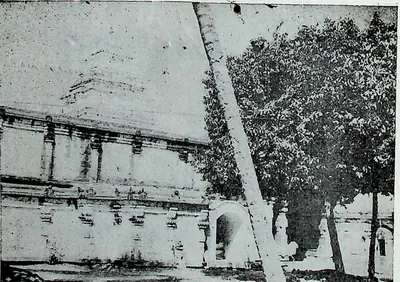 "28. Southern entrance to inner enclosure - Bhīmēśvara Temple - Drākshārāma" (M. Rama Rao, Eastern Calukyan Temples of Andhra Desa, 1964, Fig. 28 (PDF p. 87))Historic photograph · 1964
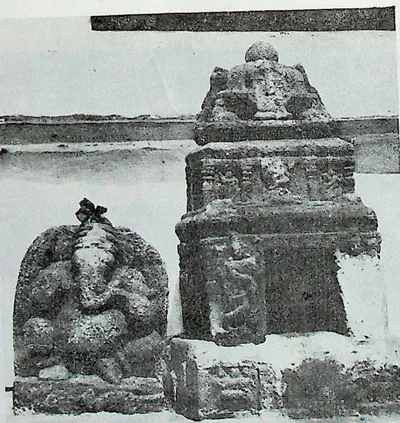 "29. Miniature Shrine - Bhīmēśvara Temple - Drākshārāma" (M. Rama Rao, Eastern Calukyan Temples of Andhra Desa, 1964, Fig. 29 (PDF p. 89))Historic photograph · 1964
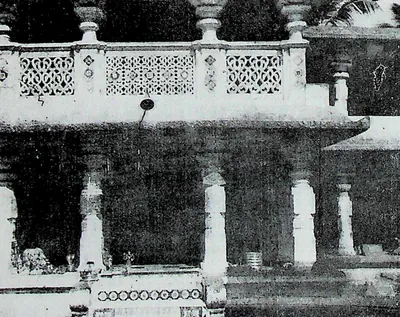 "30. Māṇikyāmba Shrine - Bhīmēśvara Temple, Drākshārāma" (M. Rama Rao, Eastern Calukyan Temples of Andhra Desa, 1964, Fig. 30 (PDF p. 91))Historic photograph · 1964
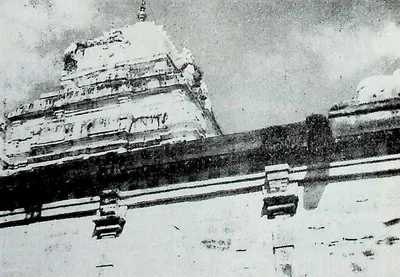 "31. Vimāna - Bhīmēśvara Temple - Drākshārāma" (M. Rama Rao, Eastern Calukyan Temples of Andhra Desa, 1964, Fig. 31 (PDF p. 93))Historic photograph · 1964
Related
Inscriptions
Draksharama inscription of Kulottunga I (1103)
1103 CE
Sanskrit inscription in Telugu characters on the south wall of the Bhimesvara temple at Draksharama, dated in the 33rd year of the Chola king Kulottunga I (1103). It records the deeds of his general Vanduvaraja, also called Pallavaraja, who burnt the Kalinga country, defeated the Ganga king and Devendravarman and set up a pillar of victory on the borders of the Odra country, and his gifts in the Vengi country, including a pavilion at Draksharama. K. V. Subrahmanya Aiyer identified him with Karunakara Tondaiman, the hero of the Kalingattupparani.
Draksharama inscriptions of Kulottunga I (1107)
1107 CE
Two lamp-gift inscriptions, in Telugu and in Sanskrit and Telugu, on a wall of the Bhimesvara temple at Draksharama, dated both in the 37th year of the Chalukya-Chola king Kulottunga I and in Saka 1029 (1107). Because they give the regnal year and the Saka year together, they helped fix the beginning of Kulottunga's reign as Chola king in 1070. The same wall carries an inscription of the Western Chalukya Vikramaditya VI, recognised at Draksharama after 1118.
References
Notes (0)
Sources (4)
Spotted an error on this page? Tell us
Last updated: