Bahmanis
Sultans of the Deccan (1347–1527) who ruled from Gulbarga and, from the 1420s, from Bidar. Their founder won his throne with troops sent by the ruler of Warangal. His successors took Kaulas, Bhongir and Golconda from the Telugu chiefs, sacked Warangal (in 1422, 1424 or 1425, by different accounts) and held western Telangana as the province of Bidar. They fought the Musunuri and Recherla nayakas, the Reddis, Vijayanagara and the Gajapatis of Orissa, and held the coast from Rajahmundry to Kondapalli and Kondavidu in the 1470s. Mahmud Gawan split the province of Telingana between Rajahmundry and Warangal. Its last governor, Sultan Quli, founded the Qutb Shahi kingdom of Golconda.
Swipe sideways to see the whole chart; tap a bar for details.
Each bar is a ruling power in its region; time runs left to right. Dashed = approximate dates. Select a bar for details.
Show as a list
Kakatiyas 1163–1323 CE
- Telangana
- Kakatiyas (c. 1163–1323 CE)
- Coastal Andhra
- Eastern Gangas of Kalinga (c. 537–1434 CE) · Haihayas of Kona and Palnadu (c. 1073–1364 CE) · Kotas of Dharanikota (c. 1100–1276 CE) · Telugu Chodas of Pottapi and Nellore (c. 1106–1316 CE) · Kakatiyas (c. 1185–1323 CE)
Nayakas, Reddis & Bahmanis 1323–1518 CE
- Telangana
- Musunuri Nayakas (c. 1336–1368 CE) · Gajapatis of Orissa (c. 1459–1461 CE) · Adil Shahis of Bijapur (c. 1489–1686 CE) · Delhi Sultanate (Tughluqs) (c. 1323–1336 CE) · Bahmani Sultanate (c. 1347–1518 CE) · Recherla Velamas (Padmanayakas) (c. 1361–1475 CE) · Shitab Khan (Sitapati) of Warangal (c. 1504–1516 CE)
- Coastal Andhra
- Eastern Gangas of Kalinga (c. 537–1434 CE) · Gajapatis of Orissa (c. 1446–1571 CE) · Haihayas of Kona and Palnadu (c. 1073–1364 CE) · Reddis of Rajahmundry (c. 1386–1448 CE) · Bahmani Sultanate (c. 1471–1489 CE) · Delhi Sultanate (Tughluqs) (c. 1323–1326 CE) · Vijayanagara Empire (c. 1350–1579 CE) · Reddis of Kondaveedu (c. 1325–1424 CE) · Musunuri Nayakas (c. 1325–1346 CE)
- Rayalaseema
- Hoysalas (c. 1178–1342 CE) · Reddis of Kondaveedu (c. 1346–1386 CE) · Vijayanagara Empire (c. 1336–1646 CE)
Vijayanagara & the Qutb Shahis 1336–1687 CE
- Telangana
- Musunuri Nayakas (c. 1336–1368 CE) · Gajapatis of Orissa (c. 1459–1461 CE) · Adil Shahis of Bijapur (c. 1489–1686 CE) · Bahmani Sultanate (c. 1347–1518 CE) · Vijayanagara Empire (c. 1563–1565 CE) · Recherla Velamas (Padmanayakas) (c. 1361–1475 CE) · Qutb Shahis of Golconda (c. 1518–1687 CE) · Shitab Khan (Sitapati) of Warangal (c. 1504–1516 CE)
- Coastal Andhra
- Eastern Gangas of Kalinga (c. 537–1434 CE) · Gajapatis of Orissa (c. 1446–1571 CE) · Haihayas of Kona and Palnadu (c. 1073–1364 CE) · Reddis of Rajahmundry (c. 1386–1448 CE) · Bahmani Sultanate (c. 1471–1489 CE) · Qutb Shahis of Golconda (c. 1524–1687 CE) · Vijayanagara Empire (c. 1350–1579 CE) · Reddis of Kondaveedu (c. 1325–1424 CE) · Musunuri Nayakas (c. 1325–1346 CE)
- Rayalaseema
- Hoysalas (c. 1178–1342 CE) · Reddis of Kondaveedu (c. 1346–1386 CE) · Adil Shahis of Bijapur (c. 1568–1686 CE) · Vijayanagara Empire (c. 1336–1646 CE) · Qutb Shahis of Golconda (c. 1579–1687 CE)
Kingdoms and empires
Kakatiyas
Open page- Telangana: c. 1052–1162 CE (c. 110 years)
Partial: feudatory chiefs of Anumakonda (Hanamkonda) under the Chalukyas of Kalyani. Prola I received the Anumakonda district as a permanent fief from Someshvara I (record of 1053); Prola II's last record as a subordinate is of 1149; Rudradeva subdued the other Telangana chiefs c. 1157–62 (Parabrahma Sastry). Earlier members served the Rashtrakutas (Mangallu grant, c. 956) according to Parabrahma Sastry, a link rejected by Venkataramanayya and Somasekhara Sarma (1960).
- Telangana: c. 1163–1323 CE (c. 160 years)
Sovereign from Rudradeva's Anumakonda inscription of January 1163; capital moved to Orugallu (Warangal) under Ganapatideva. Warangal taken by Ulugh Khan in 1323 (Parabrahma Sastry, after Isami); Barani and the Imperial Gazetteer give 1321.
- Coastal Andhra: c. 1185–1323 CE (c. 138 years)
Rudradeva subdued the Kotas of Dharanikota and the Kondapadumatis (Tripurantakam grant 1185); Ganapatideva annexed Divi (1203) and Velanadu (records from 1209; Jaya governor 1213) and held the coast from the Godavari to the Penna; Kakatiya records at Draksharama from 1212, but the Eastern Gangas held the region north of the Godavari c. 1230–33 and again c. 1262–78; the Telugu Chodas of Nellore were allies; Nellore was lost to the Pandyas c. 1263 and recovered under Prataparudra.
- Rayalaseema: c. 1250–1323 CE (c. 73 years)
Through the Kayastha chiefs (Gangaya Sahini, bahattara-niyogadhipati c. 1250, capital Valluru in Cuddapah); Ambadeva independent c. 1272–1291, until Prataparudra's armies retook Tripurantakam (between 13 June and 11 August 1291) and the Kayastha lands within about eight years.
Rulers (11)
Capitals
Monuments (16)
Inscriptions (36)
- Kazipet Dargah pillar inscription
- Matedu inscription of Vemabola Malle-nayaka
- Gudur pillar inscriptions of the Viriyala family
- Thousand Pillar Temple inscription of Rudradeva
- Karimnagar inscription of Gangadhara
- Warangal fort inscription of Rudradeva
… and 30 more
- Pillalamarri inscription of Recherla Nami-reddi
- Kondaparti inscription of Malyala Chaunda
- Inugurti pillar inscription of Natavadi Rudra
- Bayyaram tank inscription of Mailama
- Chebrolu inscription of Jaya
- Palampet pillar inscription of Recherla Rudra
- Ganapavaram inscription of Devapala
- Warangal toll inscription of Ganapatideva
- Ganapesvaram inscription of Jaya
- Upparapalli pillar inscription of Kataya
- Motupalli pillar inscription of Ganapatideva
- Pakhal lake inscription of Jagadala Mummadi
- Rayaparti fragment of Saka 1169
- Ekamranatha temple inscription of Ganapati
- Nayanapalle inscription of Ganapatideva
- Durgi inscription of Gangaya-sahini
- Sarngapuram plates of Sarngadhara
- Bothpur tank inscription of Malyala Gunda
- Garavapadu plates of Ganapatideva
- Malkapuram pillar inscription of Rudramadevi
- Kotagiri plates of Viryala Sura
- Kolanupaka inscription of Rudramadevi's reign
- Chandupatla inscription
- Panugallu inscription of Immadi Mallikarjuna-nayaka
- Tripurantakam inscription of Ambadeva
- Raichur fort inscription of Gona Vithala
- Mellacheruvu inscription of Prataparudra's reign
- Srirangam inscription of Prataparudra
- Dharmasagar inscription of the minister Malla
- Hanamkonda inscription of Gangadhara
Sources (7)
Kingdoms and empires
Musunuri Nayakas
Open page- Coastal Andhra: c. 1325–1346 CE (c. 21 years)
Prolaya Nayaka recovered the coast from Delhi in 1325-26 and ruled from Rekapalli on the Godavari (Vilasa grant, about 1330); latest dated Musunuri records on the coast are Kapaya's Guraja grant (February 1346) and his Ganapesvaram inscription (1346-47). Partial: the Reddis of Addanki and the Korukonda chiefs held parts of the coast as Kapaya's kinsmen and subordinates
- Telangana: c. 1336–1368 CE (c. 32 years)
Kapaya Nayaka took Warangal about 1336-37 (Ferishta: 1343-44) and ruled as "lord of the Andhra country" (Pillalamarri inscription, 1357); ceded Kaulas and then Golconda (1364-65) to the Bahmanis; overthrown by the Recherla chief Anapota about 1368 (Kapaya named in the Akkalapundi grant of 1368; Anapota ruling Orugallu in July 1369)
Rulers
Capitals
Inscriptions
Sources (9)
Kingdoms and empires
Gajapatis of Orissa
Open page- Coastal Andhra: c. 1446–1571 CE (c. 125 years)
Kapilendra (Kapilesvara, r. 1434-35 to 1469-70) took the Reddi kingdom of Rajahmundry between 1444 and 1448 and held Kondavidu by 1454 through his kinsman Ganadeva; the Bahmanis took Rajahmundry and Kondapalli or Kondavidu in 1470-71 and Purushottama had recovered the Godavari-Krishna country and the Ongole taluk by 1489; the country south of the Krishna passed to Saluva Narasimha after 1470 and, with Udayagiri, Kondavidu and Kondapalli, to Krishnadeva Raya in 1513-16; Golconda took the Godavari-Krishna doab from about 1522 and Rajahmundry in 1571-72. The northern coast (Srikurmam, Simhachalam) stayed Gajapati throughout.
- Telangana: c. 1459–1461 CE (c. 2 years)
Brief: Orissan troops relieved Devarakonda from the Bahmanis in 1459, and Kapilendra's son Hamvira and nephew Raghudeva took Warangal on 2 February 1460 (two gateway inscriptions); in 1461-62 the Orissan army and the zemindars of Telangana marched on Bidar. How long Warangal was held is not recorded
- Telangana: c. 1497–1516 CE (c. 19 years)
Partial: the uplands of Khammam and the Kondapalli-Nelakondapalli country, held by Prataparudra until Krishnadeva Raya's campaigns (Banerji; Nizam's Archaeological Department)
Rulers
- Kapilendra (Kapilesvara) (c. 1434–1470 CE)
- Purushottama (Gajapati) (c. 1470–1497 CE)
- Prataparudra (Gajapati) (c. 1497–1540 CE)
- Kalua Deva (c. 1540–1541 CE)
- Kakharua Deva (c. 1541 CE)
Inscriptions (8)
Sources (10)
Sultanates
Adil Shahis of Bijapur
Open page- Telangana: c. 1489–1686 CE (c. 197 years)
After the Bahmani break-up part of Mahbubnagar district went to Bijapur (the rest to Golconda) and stayed with it until Aurangzeb annexed Bijapur in 1686; the Raichur district article likewise passes Raichur (which then included the Alampur taluk and Gadwal) from the Bahmanis to the Adil Shahis.
- Rayalaseema: c. 1568–1686 CE (c. 118 years)
Partial, the western uplands only. Adoni taken by Ali Adil Shah's general Ankus Khan in 1568 after a failed siege in 1535-37; Penukonda besieged in the 1570s (dates disputed) and taken in 1652 (Mackenzie MS); Kurnool taken from Gopala Raja early in the 17th century and governed by Abdul Wahab (d. 1618) and later deputies, Siddi Jauhar holding it as his jagir about 1660; the Bellary and Anantapur uplands held through governors and tributary poligars; Bijapur's rights there passed to Shivaji in 1677-80 (Francis); Bijapur fell to Aurangzeb on 12 September 1686, but Siddi Masud held Adoni until 1688 (Sarkar) or 1687 (Bellary gazetteer)
Rulers (9)
Capitals
Monuments
Sources (11)
Sultanates
Delhi Sultanate (Tughluqs)
Open page- Telangana: c. 1323–1336 CE (c. 13 years)
Province of Tilang after Ulugh Khan (Muhammad bin Tughluq) took Warangal and renamed it Sultanpur (1321 by Barani's date for the campaign, 1323 in Haig and the editors of the Vilasa grant). Earlier Khalji campaigns (1303, 1309-10, 1318) ended in failure or tribute and are not drawn. Lost to a Hindu rising under Kanya Naik (Kapaya Nayaka) soon after the cholera of 1335 (Barani), about 1336-37 (modern historians) or in 1343-44 (Ferishta)
- Coastal Andhra: c. 1323–1326 CE (c. 3 years)
Brief hold on the Godavari delta and the coast: mosque at Rajahmundry built in 1324 by Ulugh Khan's servant Salar Ulwi; the coast retaken by Prolaya Nayaka and his allies between 1325 and 1326
Rulers
- Ala-ud-din Khalji (1296–1316 CE)
- Qutb-ud-din Mubarak Shah (1316–1320 CE)
- Ghiyas-ud-din Tughluq (1320–1325 CE)
- Muhammad bin Tughluq (1325–1351 CE)
Sources (7)
Sultanates
Bahmani Sultanate
Open page- Telangana: c. 1347–1518 CE (c. 171 years)
Western Telangana from 1347 (Kaulas taken or ceded; Bhongir taken late in Bahman Shah's reign, the province of Bidar reaching east to Bhongir); Golconda ceded under Muhammad Shah I (1362 Bilgrami; 1364-65 Haig, IG); Warangal taken in AH 828 (end of 1424 per Haig, 1422 per IG, 1425 per the Kistna Manual) and the rayas of Devarakonda and Rachakonda made tributary. Partial afterwards (Telugu chiefs regained districts under Ahmad I; Devarakonda relieved by Orissa 1459; Warangal held by the Gajapatis 1460 and by Shitab Khan from 1504). Governed for Mahmud Shah by Sultan Quli from 1495-96 until his independence (1512 per Haig; 1518 per Bilgrami, from the Golconda mosque inscription of AH 924)
- Coastal Andhra: c. 1471–1489 CE (c. 18 years)
Rajahmundry and Kondapalli (Ferishta) or Kondavidu (Haig, Burhan-i Ma'asir) taken by Malik Hasan Bahri in AH 876 (1471-72), on the invitation of a claimant to the Orissan throne (the Godavari gazetteer says Purushottama ceded the two districts); Muhammad Shah III at Rajahmundry for nearly three years after his Orissa campaign of 1478, and raided Masulipatam and Kanchi in 1481; Telingana split into the provinces of Rajahmundry and Warangal; Rajahmundry still Bahmani in 1486; the Godavari-Krishna country recovered by the Gajapati Purushottama by 1489
Rulers (18)
- Ala-ud-din Hasan Bahman Shah (1347–1358 CE)
- Muhammad Shah I (1358–1375 CE)
- Mujahid Shah (1375–1378 CE)
- Daud Shah (1378 CE)
- Muhammad Shah II (1378–1397 CE)
- Ghiyas-ud-din (1397 CE)
… and 12 more
- Shams-ud-din Daud (1397 CE)
- Firuz Shah (1397–1422 CE)
- Ahmad Shah I (1422–1435 CE)
- Ala-ud-din Ahmad Shah II (1435–1458 CE)
- Humayun Shah (1458–1461 CE)
- Nizam Shah (1461–1463 CE)
- Muhammad Shah III (1463–1482 CE)
- Mahmud Shah Bahmani (1482–1518 CE)
- Ahmad Shah (c. 1518–1521 CE)
- Ala-ud-din (c. 1521–1523 CE)
- Wali-ullah Shah (c. 1523–1525 CE)
- Kalim-ullah Shah (c. 1525–1527 CE)
Inscriptions
Sources (12)
Kingdoms and empires
Vijayanagara Empire
Open page- Rayalaseema: c. 1336–1646 CE (c. 310 years)
Founded c. 1335-36; Bukka I held Penukonda and Gooty (records of 1352 and a Gooty rock inscription) and his minister built the Bukkarayasamudram tank near Anantapur in 1364; Cuddapah in the 14th century; Kurnool wholly annexed under Krishnadeva Raya. After Talikota (1565) the kings ruled from Penukonda, which held out against Bijapur in 1577 and Golconda in 1589; the country north of Penukonda was lost after Sriranga I's capture (c. 1579-80); Venkatapati II moved to Chandragiri c. 1592; Golconda held the Cuddapah district and took Chandragiri (Chittoor) in 1646. Bijapur and Golconda took most of the region piecemeal after 1565
- Coastal Andhra: c. 1350–1579 CE (c. 229 years)
Vijayanagara officers kept Guntur (Kondavidu, Vinukonda, Bellamkonda) and the governor of Udayagiri kept Nellore after Talikota; Golconda took Kondavidu in April 1579 (Kistna Manual) or 1580 (a Guntur record of 1592 cited by Sewell), though Sewell thinks Guntur was already under Muslim rule by 1576 and the Nellore Manual says the Muslims held Nellore from 1565.
- Telangana: c. 1563–1565 CE (c. 2 years)
To end the confederate invasion of Golconda, Ibrahim Qutb Shah let Rama Raja keep the forts of Ghanpur and Panagal (Mahbubnagar) until Talikota; Ferishta places this after the Kalyani campaign of the early 1560s, the Kistna Manual dates it to 1557.
Rulers (24)
- Harihara I (Vijayanagara) (c. 1336–1355 CE)
- Bukka I (Vijayanagara) (1355–1377 CE)
- Harihara II (1377–1404 CE)
- Bukka II (1404–1406 CE)
- Deva Raya I (1406–1422 CE)
- Vijaya (Bukka III) (1422 CE)
… and 18 more
- Deva Raya II (Vijayanagara) (1422–1446 CE)
- Mallikarjuna (1446–1465 CE)
- Virupaksha (1465–1485 CE)
- Saluva Narasimha (1485–1492 CE)
- Immadi Narasimha (1492–1505 CE)
- Narasa Nayaka (c. 1505 CE)
- Vira Narasimha (1505–1509 CE)
- Krishnadeva Raya (1509–1529 CE)
- Achyuta Raya (1529–1542 CE)
- Venkata I (1542 CE)
- Sadasiva (c. 1542–1569 CE)
- Tirumala (Aravidu) (c. 1569–1572 CE)
- Sriranga I (1572–1586 CE)
- Venkatapati II (Vijayanagara) (1586–1614 CE)
- Sriranga II (1614 CE)
- Rama Deva (1614–1630 CE)
- Pedda Venkata (1630–1642 CE)
- Sriranga III (c. 1642–1670 CE)
Monuments (7)
- Penukonda fort and Gagan Mahal
- Kalahastisvara temple, Srikalahasti
- Virabhadra temple, Lepakshi
- Chandragiri fort and Raja Mahal
- Gooty fort
- Narasimha temples, Ahobilam
… and 1 more
Inscriptions (14)
- Penukonda fort inscription (1354)
- Gooty rock inscription of Bukka I
- Bitragunta grant of Sangama II (1356)
- Bukkarayasamudram tank inscription (1364)
- Tirumala inscriptions of Krishnadeva Raya and his queens (1513–1514)
- Amaravati inscription of Krishnadeva Raya (1515)
… and 8 more
- Mangalagiri and Kaza pillar inscriptions (1515–1518)
- Simhachalam inscriptions of Krishnadeva Raya (1516–1519)
- Srikalahasti inscription of Krishnadeva Raya (1516)
- Kondavidu pillar inscription of Nadindla Gopa (1520)
- Lepakshi temple inscriptions of Achyuta Raya's reign (1533–1538)
- Kanuma grant of Sadasiva (1548)
- Penukonda inscription of Channappa Nayudu (1577)
- Ahobilam inscription of Sriranga I (1584)
Sources (20)
Kingdoms and empires
Recherla Velamas (Padmanayakas)
Open page- Telangana: c. 1361–1475 CE (c. 114 years)
Anapota at Rachakonda (Rajukonda) and Mada at Devarakonda after their victories of 1361 (family chronicle); Rachakonda fortified in August 1365; Warangal, Bhongir and Rachakonda ruled by July 1369 (Inavolu inscription). The rayas of Devarakonda and Rachakonda paid tribute to Ahmad Shah Bahmani after his capture of Warangal (end of 1424); Devarakonda routed a Bahmani army with Orissan help in 1459; last dated record of the Rachakonda line 1464. End about 1475 per the list of rulers in Epigraphia Telanganica; no source dates the annexation
Rulers (7)
- Singama Nayaka (Recherla) (c. 1336–1361 CE)
- Anapota Nayaka (Recherla) (c. 1361–1384 CE)
- Mada Nayaka (Recherla) (c. 1361–1384 CE)
- Singabhupala (Recherla) (c. 1384–1399 CE)
- Peda Vedagiri (Recherla) (c. 1384–1410 CE)
- Lingama Nayaka (Recherla) (c. 1427–1475 CE)
… and 1 more
- Singama Nayaka, 'Sarvajna' (Rachakonda) (c. 1430–1475 CE)
Capitals
Monuments
Inscriptions
Sources (7)
Sultanates
Qutb Shahis of Golconda
Open page- Telangana: c. 1518–1687 CE (c. 169 years)
Sultan Quli governed Telingana for the Bahmanis from 1493-95 and declared independence in 1512 (Ferishta, Haig, IG Hyderabad) or 1518 (Bilgrami, from the Golconda mosque inscription of AH 924); he took the forts of the Telugu chiefs, among them Rachakonda, Devarakonda and, from Shitab Khan, Warangal and Khammam (1519-1525 per Bilgrami). Tributary to the Mughals from 1635-36 (khutba and coins in Shah Jahan's name; two lakhs of huns a year). Hyderabad taken by the Mughals in 1656 and 1685; Golconda surrendered on 21 September 1687 (Old Style) and was annexed
- Coastal Andhra: c. 1524–1687 CE (c. 163 years)
Sultan Quli took Kondapalli and fixed the Godavari as his frontier with Orissa (Ellore ceded) some time before his 1530 campaign, and a 1524 record shows him granting villages near Kondapalli and Bezwada; the Godavari gazetteer and IG Madras date the Krishna-Godavari doab to c. 1540 or 'before 1543', and the IG Madras Kistna article to after 1565.
- Rayalaseema: c. 1579–1687 CE (c. 108 years)
Partial; the sources disagree on when Golconda's hold began. IG Madras says Kurnool and Cuddapah were overrun soon after 1565. The Kurnool Manual dates the campaigns that took Gurramkonda (1579) and Gandikota, Nandyal and Musalimadugu (c. 1590). The Cuddapah gazetteer says Golconda only turned to Cuddapah in the early 17th century and never really conquered it. Chandragiri fell to Golconda in 1646.
Rulers (8)
Capitals
Monuments (13)
Inscriptions (7)
- Epitaph of Sultan Quli, Golconda (1543)
- Makka Darwaza inscription, Golconda (1559)
- Jami Masjid inscription, Hyderabad
- Epitaph of Muhammad Quli Qutb Shah, Golconda (1612)
- Ma Saheba tank inscriptions (1625)
- Musa Burj inscription, Golconda fort (1666–67)
… and 1 more
Sources (23)
Kingdoms and empires
Shitab Khan (Sitapati) of Warangal
Open page- Telangana: c. 1504–1516 CE (c. 12 years)
Partial (Warangal, Khammam and other hill forts, with Bellamkonda south of the Krishna; probably Nalgonda). A former Bahmani officer, Shitab Khan or Sitapati, took Warangal fort from the Muslims on 21 January 1504 by his pillar inscription, and held it until Sultan Quli Qutb Shah defeated him and his Gajapati allies; the Kistna manual calls him apparently a vassal of Orissa. The end is uncertain: Sastri allows him six or seven years (to 1512), the Hyderabad archaeological report of 1925-26 dates the loss of Warangal to 1513-1516, the Kistna manual places the war after 1516, and Bilgrami gives 1519-1525
Rulers
Capitals
Monuments
Inscriptions
Sources (6)
Kingdoms and empires
Eastern Gangas of Kalinga
Open page- Coastal Andhra: c. 537–1434 CE (c. 897 years)
Partial: only the far north coast (the old Ganjam and Vizagapatam districts, now Srikakulam-Vizianagaram- Visakhapatnam), capital Kalinganagara (Mukhalingam). Earliest dated grant: Jirjingi, near Tekkali, Ganga year 39 (c. 537 on Mirashi's epoch of 498; Fleet put the early grants in the 7th century and Sewell used an epoch of 877-78; the Imperial Gazetteer, the 7th century). Later line in power from the end of the 9th century (Vizagapatam gazetteer): Vajrahasta III crowned 1038; Anantavarman Chodaganga 1078-1146, with records at Mukhalingam, Srikurmam, Simhachalam and Visakhapatnam. South of the Godavari only records and raids (Draksharama 1128-1274; Bendapudi). Ended 1434, when the minister Kapilesvara founded the Gajapati line
Rulers (15)
- Vajrahasta III (Eastern Ganga) (1038–1070 CE)
- Rajaraja I (Eastern Ganga) (1070–1078 CE)
- Anantavarman Chodaganga (c. 1078–1146 CE)
- Madhu-Kamarnava (c. 1146–1152 CE)
- Raghava (c. 1152–1166 CE)
- Rajaraja II (c. 1166–1192 CE)
… and 9 more
- Aniyanka-Bhima (c. 1192–1202 CE)
- Anangabhima III (c. 1219–1253 CE)
- Narasimha I (Eastern Ganga) (c. 1253–1256 CE)
- Bhanudeva I (c. 1256–1275 CE)
- Narasimha II (c. 1275–1306 CE)
- Bhanudeva II (c. 1306–1323 CE)
- Narasimha III (c. 1323–1346 CE)
- Bhanudeva III (c. 1346–1378 CE)
- Narasimha IV (c. 1378–1397 CE)
Capitals
Monuments
Inscriptions (8)
Sources (10)
Kingdoms and empires
Haihayas of Kona and Palnadu
Open page- Coastal Andhra: c. 1073–1364 CE (c. 291 years)
Partial. Kona chiefs of Konamandala (the Godavari delta, Amalapuram taluk), with records at Draksharama and Palakol from Saka 995 (1073) to 1364–65, dependent on the Chola–Chalukya kings and the Velanati Chodas, later on the Kakatiyas; Haihaya chiefs of the Chagi family in the Palnadu (Macherla 1111, Gurazala 1129) as feudatories of the Chalukyas of Kalyani; the Palnadu war of the ballads is undated (proposals 1080–1386).
Rulers
- Rajendra Choda I of Kona (1128 CE)
- Mummadi-Bhima II and Satya I (1135 CE)
- Bhima III (c. 1153–1168 CE)
- Mallideva of Kona (c. 1155–1207 CE)
- Ganapatideva of Kona (c. 1262–1300 CE)
- Bhima-Vallabha (1318 CE)
Inscriptions
Sources (5)
Kingdoms and empires
Reddis of Rajahmundry
Open page- Coastal Andhra: c. 1386–1448 CE (c. 62 years)
Partial: the Godavari delta and the coast north to Simhachalam, capital Rajahmundry. Kataya Vema, minister of Kumaragiri, received "the eastern country" by 1386 (Ramayya; Sewell c. 1380); after his death (c. 1414-16) Allada Reddi, then Allada's sons Allaya Vema and Virabhadra (records 1423-1437, a record of 1444). Godavari gazetteer: family in the Draksharama inscriptions until 1447; a Gajapati record of 1448 at Penugonda marks the end (Somasekhara Sarma); Kapilesvara's minister ruling at Rajahmundry in 1458
Rulers
- Kataya Vema (c. 1386–1415 CE)
- Allada Reddi (c. 1416–1420 CE)
- Allaya Vema and Virabhadra (c. 1423–1448 CE)
Capitals
Inscriptions
Sources (6)
Kingdoms and empires
Kotas of Dharanikota
Open page- Coastal Andhra: c. 1100–1276 CE (c. 176 years)
Partial (the Six-thousand country, Konnatavadi, south of the Krishna about Amaravati–Dharanikota and the Sattenapalle taluk). Line from Bhima I (c. 1100, Sewell); Keta II from about 1182; subdued by the Kakatiya Rudradeva about 1185 and thereafter Kakatiya subordinates and relatives by marriage (Ganapamba, widow of Kota Beta, ruled in the 1250s); last record of a Kota Rudra 1275–76.
Rulers
- Kota Keta II (c. 1182–1209 CE)
- Manma-Keta (Keta III) (c. 1234–1240 CE)
- Kota Beta (c. 1250–1251 CE)
- Ganapamba (c. 1251–1257 CE)
- Bhima IV (1265 CE)
Capitals
Inscriptions
Sources (5)
Kingdoms and empires
Telugu Chodas of Pottapi and Nellore
Open page- Coastal Andhra: c. 1106–1316 CE (c. 210 years)
Konidena branch in the Guntur country from 1106 to about 1150; the main line at Nellore (Vikramasimhapura) from Tammusiddhi's anointment in 1205-06, under the Cholas and then the Kakatiyas, who restored Manumasiddhi II; held Kanchi under Tikka I (1209/1223-1248/1250) and Manmasiddhi III. Last date 1316 (Sewell); the Nellore gazetteer finds no Telugu Choda record in Nellore after 1305.
- Rayalaseema: c. 1120–1268 CE (c. 148 years)
Pottapinadu (Pullampet country of Cuddapah), seat of the Madhurantaka Pottapi-Cholas under the Chola emperors: Betta 1120-21, Vimaladitya c. 1125; Pottapi remained their seat until Tikka I moved to Nellore; Manumasiddhi II recorded at Pottapi 1258-59; the country passed to the Kayastha Ambadeva after 1268.
Rulers
- Tammusiddhi (c. 1205–1209 CE)
- Tikka I (Telugu Choda of Nellore) (c. 1209–1248 CE)
- Manumasiddhi II (c. 1248–1290 CE)
- Manmasiddhi III (c. 1290–1316 CE)
Capitals
Inscriptions
Sources (5)
Kingdoms and empires
Reddis of Kondaveedu
Open page- Coastal Andhra: c. 1325–1424 CE (c. 99 years)
Capital Addanki, then (from Anavema, after 1361) Kondavidu. Coast south of the Krishna and at times the Godavari delta (Anavema's grants at Vanapalli, Nadupuru, Palivela, Draksharama 1374-81). Start: Mallavaram record of 1325 (Somasekhara Sarma); the Kistna manual says 1328, the Godavari gazetteer has the earliest record in 1344. End disputed: Vijayanagara conquest by 1424 (Somasekhara Sarma), Racha Vema killed 1428 (Kistna manual), overthrown 1427 (Sewell 1884), a Gajapati conquest c. 1420 (village chronicles). From c. 1386 the Godavari country belonged to the separate Rajahmundry kingdom
- Rayalaseema: c. 1346–1386 CE (c. 40 years)
Partial: the Srisailam plateau and the Markapur taluk (records at Tripurantakam, 1346 and 1347; Anavema's Viramantapa at Srisailam, 1378); Prolaya Vema's steps at Srisailam and Ahobilam
Rulers
Capitals
Monuments
Inscriptions (8)
Sources (8)
Kingdoms and empires
Hoysalas
Open page- Rayalaseema: c. 1178–1342 CE (c. 164 years)
Partial (south and west Anantapur: Hemavati, Madakasira, Penukonda, Gooty claim; Rayachoti taluk in the later 13th century). A record at Parigi (Hindupur taluk) of Saka 1100 (1178) shows Ballala II ruling at Dorasamudra; he took Nolambavadi, and his inscription of 1205-06 is at Hemavati. A record at Kodigepalle of 1328 shows Ballala III's minister ruling at Penugonda. Ballala III's inscriptions in Anantapur district run from 1317 through 1320 and 1323 to 1340. He was killed fighting the Sultan of Madurai on 8 September 1342.
Rulers
- Ballala II (Hoysala) (1173–1220 CE)
- Narasimha II (1220–1235 CE)
- Somesvara (1233–1254 CE)
- Narasimha III (1254–1291 CE)
- Ballala III (Hoysala) (1291–1342 CE)
- Ballala IV (Virupaksha) (1342–1343 CE)
Capitals
Sources (6)
Kingdoms and empires
Pandyas
Open page- Coastal Andhra: c. 1260–1264 CE (c. 4 years)
Partial (Nellore). Jatavarman Sundara Pandya I beat the Telugus at Mudugur, drove them to the Krishna and was crowned at Nellore (Aiyangar, from his records); Sewell dates the march to 1260, Parabrahma Sastry the battle to 1263. Aiyangar says the conquest was not permanent and the Nellore gazetteer says Ganapati recovered Nellore almost at once, so the span is short. A later Jatavarman Sundara Pandya, crowned at Nellore after 1276 (Nellore gazetteer), endowed a hall in the Ranganayaka temple there; no source gives the length of this second hold, so it has no span.
- Rayalaseema: 1285–1293 CE (8 years)
Partial (Nandalur, east Cuddapah). Jatavarman Sundara Pandya II has dated records at Nandalur in 1285, 1286 and 1293, six in all from 1286-1293, as Pandya power spread north after the Chola collapse.
Rulers
- Jatavarman Sundara Pandya I (c. 1251–1268 CE)
- Maravarman Kulasekhara I (1268–1311 CE)
- Jatavarman Sundara Pandya (crowned at Nellore) (c. 1276–1293 CE)
Inscriptions
Sources (5)
Reigns
Each bar is one ruler’s reign; time runs left to right. c. = approximate date.
- Ala-ud-din Hasan Bahman Shah1347–1358 CE · 11 yrs
- Muhammad Shah I1358–1375 CE · 17 yrs
- Mujahid Shah1375–1378 CE · 3 yrs
- Daud Shah1378 CE
- Muhammad Shah II1378–1397 CE · 19 yrs
- Ghiyas-ud-din1397 CE
- Shams-ud-din Daud1397 CE
- Firuz Shah1397–1422 CE · 25 yrs
- Ahmad Shah I1422–1435 CE · 13 yrs
- Ala-ud-din Ahmad Shah II1435–1458 CE · 23 yrs
- Humayun Shah1458–1461 CE · 3 yrs
- Nizam Shah1461–1463 CE · 2 yrs
- Muhammad Shah III1463–1482 CE · 19 yrs
- Mahmud Shah Bahmani1482–1518 CE · 36 yrs
- Ahmad Shahc. 1518–1521 CE · c. 3 yrs
- Ala-ud-dinc. 1521–1523 CE · c. 2 yrs
- Wali-ullah Shahc. 1523–1525 CE · c. 2 yrs
- Kalim-ullah Shahc. 1525–1527 CE · c. 2 yrs
Reign years after Sewell (1932); the last four are approximate. The sources differ by up to two years for several kings: Ferishta has Muhammad Shah I die in March 1375, the Burhan-i Ma'asir in 1373 and the Cambridge History in 1377. Ala-ud-din II reigned as Ahmad Shah, so Wright (1907) and Haig (1904) number the king of 1518 Ahmad Shah III. Ferishta calls the fifth king Mahmud; his coins and the other histories call him Muhammad.
Family tree
The rulers and the relatives who explain the succession. Every line rests on a cited statement on a person page; the sources are listed below the tree. Select a card to open that page.
- parent and child
- marriage
- adoption
- the sources disagree (see below)
- order of succession
Generation 1
- 1Ala-ud-din Hasan Bahman Shah1347–1358 CE
Generation 2
- 2Muhammad Shah I1358–1375 CESon of Ala-ud-din Hasan Bahman Shah
- Ahmad KhanSon of Bahman Shah; father of Firuz and Ahmad (Burhan-i Ma'asir)Son of Ala-ud-din Hasan Bahman Shah
- Mahmud KhanYoungest son of Bahman ShahSon of Ala-ud-din Hasan Bahman Shah
- 4Daud Shah1378 CE
Generation 3
- 3Mujahid Shah1375–1378 CESon of Muhammad Shah I
- 8Firuz Shah1397–1422 CE
- 9Ahmad Shah I1422–1435 CE
- 5Muhammad Shah II1378–1397 CE
Generation 4
- Hasan KhanEldest son of Firuz; set aside in 1422Son of Firuz Shah
- Mubarak KhanA younger son of FiruzSon of Firuz Shah
- 10Ala-ud-din Ahmad Shah II1435–1458 CESon of Ahmad Shah I
- Daud KhanSon of Ahmad I; sent to Telingana with royal insignia (Ferishta)Son of Ahmad Shah I
- Jalal KhanSayyid; rebel in Telingana, 1455–58Husband of A daughter of Ahmad I
- A daughter of Ahmad IDaughter of Ahmad Shah IWife of Jalal Khan
- 6Ghiyas-ud-din1397 CESon of Muhammad Shah II
- 7Shams-ud-din Daud1397 CESon of Muhammad Shah II
Generation 5
- Makhduma-i-JahanQueen of Humayun; regent for her sonsDaughter of Mubarak KhanWife of Humayun Shah
- 11Humayun Shah1458–1461 CEHusband of Makhduma-i-JahanSon of Ala-ud-din Ahmad Shah II
- Sikandar KhanClaimed Telingana; killed in battle, 1458Son of A daughter of Ahmad I and Jalal Khan
Generation 6
- 12Nizam Shah1461–1463 CESon of Humayun Shah and Makhduma-i-Jahan
- 13Muhammad Shah III1463–1482 CESon of Humayun Shah and Makhduma-i-Jahan
Generation 7
- 14Mahmud Shah1482–1518 CESon of Muhammad Shah III
Generation 8
- 15Ahmad Shahc. 1518–1521 CESon of Mahmud Shah
- 16Ala-ud-dinc. 1521–1523 CESon of Mahmud Shah
- 17Wali-ullah Shahc. 1523–1525 CESon of Mahmud Shah
- 18Kalim-ullah Shahc. 1525–1527 CE
Where the sources disagree
Daud Shah's parentage
Son of Bahman Shah and uncle of Mujahid (Ferishta; Haig 1904)
- Ferishta names three of his sons, Muhammad, the eldest, Daud and Mahmud, the youngest, and makes Daud the fourth king. →
- Ferishta, tr. Briggs, Vol. II (1829), p. 296 (archive.org (opens in a new tab)).
- Haig, "Some Notes on the Bahmani Dynasty" (1904), p. 4 (archive.org (opens in a new tab)).
- Ferishta calls Daud the late king's uncle, a son of Bahman Shah. →
- Ferishta, tr. Briggs, Vol. II (1829), p. 341 (archive.org (opens in a new tab)).
Son of Mahmud Khan, Bahman Shah's son, and cousin of Mujahid (Burhan-i Ma'asir)
- The Burhan-i Ma'asir first calls Daud "a younger brother, or—according to one history—a cousin" of Mujahid. →
- King, History of the Bahmani Dynasty (1900), p. 29 (archive.org (opens in a new tab)).
- King, History of the Bahmani Dynasty (1900), p. 31 (archive.org (opens in a new tab)).
Parentage of Muhammad Shah II
Muhammad, son of Mahmud Khan (Burhan-i Ma'asir, Tabaqat-i Akbari, coins)
- The fifth king, Muhammad Shah II, was a son of Mahmud Khan, Bahman Shah's son, according to the Burhan-i Ma'asir and the Tabaqat-i Akbari. →
- T. W. Haig, "Some Notes on the Bahmani Dynasty", Journal of the Asiatic Society of Bengal LXXIII, Part I, extra number (1904), p. 6 (archive.org (opens in a new tab)).
- Haig, "Some Notes on the Bahmani Dynasty" (1904), p. 7 (archive.org (opens in a new tab)).
- O. Codrington, "On the Coins of the Bahmani Dynasty", Numismatic Chronicle, 3rd series, XVIII (1898), pp. 260–261 (archive.org (opens in a new tab)).
Mahmud, himself the youngest son of Bahman Shah (Ferishta)
- Ferishta calls this king Mahmud and makes him the youngest son of Bahman Shah. →
- Muhammad Qasim Ferishta, tr. John Briggs, History of the Rise of the Mahomedan Power in India, Vol. II (1829), p. 345 (archive.org (opens in a new tab)).
- T. W. Haig, "Some Notes on the Bahmani Dynasty", Journal of the Asiatic Society of Bengal LXXIII, Part I, extra number (1904), p. 6 (archive.org (opens in a new tab)).
Parentage of Firuz and Ahmad
Sons of Ahmad Khan, son of Bahman Shah (Burhan-i Ma'asir, Tazkirat-ul-Muluk, Haig 1904)
- According to the Burhan-i Ma'asir, Firuz and his younger brother Ahmad were sons of Ahmad Khan, a son of the founder Ala-ud-din Bahman Shah. →
- J. S. King, The History of the Bahmani Dynasty, founded on the Burhan-i Ma'asir (1900), p. 36 and note 47 (archive.org (opens in a new tab)).
- Haig, "Some Notes on the Bahmani Dynasty" (1904), p. 8 (archive.org (opens in a new tab)).
- Ahmad was the younger brother of Firuz Shah. →
- J. S. King, The History of the Bahmani Dynasty, founded on the Burhan-i Ma'asir (1900), p. 49 and note 60 (archive.org (opens in a new tab)).
- T. W. Haig, "Some Notes on the Bahmani Dynasty", Journal of the Asiatic Society of Bengal LXXIII, Part I, extra number (1904), p. 8 (archive.org (opens in a new tab)).
Sons of Daud Shah, the fourth king (Ferishta)
- Ferishta makes them sons of Daud Shah, the fourth king. →
- Ferishta, tr. Briggs, Vol. II (1829), p. 357 (archive.org (opens in a new tab)).
Kalim-ullah's parentage
Son of Mahmud Shah, brother of the three before him (Ferishta's and Nizam-ud-din's chapter headings; Cambridge History)
- Ferishta and Nizam-ud-din Ahmad head their chapters on the last king as the son of Mahmud. →
- Haig, "Some Notes on the Bahmani Dynasty" (1904), p. 12 (archive.org (opens in a new tab)).
- Haig, Cambridge History of India, Vol. III (1928), p. 431 (archive.org (opens in a new tab)).
Son of Ahmad Shah, perhaps (Haig 1904, from Ferishta's remark that Ismail Adil Shah was his maternal uncle; Codrington's heading for his coins)
- Haig pointed out in 1904 that Ferishta himself calls Ismail Adil Shah of Bijapur Kalim-ullah's maternal uncle. →
- Haig, "Some Notes on the Bahmani Dynasty" (1904), p. 12 (archive.org (opens in a new tab)).
Sources for every line of the tree
- Ala-ud-din Hasan Bahman Shah → Muhammad Shah I, Ahmad Khan and Mahmud Khan (parent and child)
- According to the Burhan-i Ma'asir, Bahman Shah had four sons, of whom it names Muhammad, the eldest, Mahmud and Ahmad. →
- Haig, "Some Notes on the Bahmani Dynasty" (1904), p. 4 (archive.org (opens in a new tab)).
- King, History of the Bahmani Dynasty (1900), p. 22 (archive.org (opens in a new tab)).
- Muhammad Shah I was the eldest son of Ala-ud-din Bahman Shah. →
- J. S. King, The History of the Bahmani Dynasty, founded on the Burhan-i Ma'asir (1900), p. 22 (archive.org (opens in a new tab)).
- King, History of the Bahmani Dynasty (1900), p. 23 (archive.org (opens in a new tab)).
- According to the Burhan-i Ma'asir, Bahman Shah had four sons, of whom it names Muhammad, the eldest, Mahmud and Ahmad. →
- Ala-ud-din Hasan Bahman Shah → Daud Shah (parent and child) · sources disagree
- Ferishta names three of his sons, Muhammad, the eldest, Daud and Mahmud, the youngest, and makes Daud the fourth king. →
- Ferishta, tr. Briggs, Vol. II (1829), p. 296 (archive.org (opens in a new tab)).
- Haig, "Some Notes on the Bahmani Dynasty" (1904), p. 4 (archive.org (opens in a new tab)).
- Ferishta names three of his sons, Muhammad, the eldest, Daud and Mahmud, the youngest, and makes Daud the fourth king. →
- Muhammad Shah I → Mujahid Shah (parent and child)
- His elder son Mujahid succeeded him. →
- King, History of the Bahmani Dynasty (1900), p. 28 (archive.org (opens in a new tab)).
- T. W. Haig, "Some Notes on the Bahmani Dynasty", Journal of the Asiatic Society of Bengal LXXIII, Part I, extra number (1904), pp. 5–6 (archive.org (opens in a new tab)).
- His elder son Mujahid succeeded him. →
- Mahmud Khan → Muhammad Shah II (parent and child) · sources disagree
- The fifth king, Muhammad Shah II, was a son of Mahmud Khan, Bahman Shah's son, according to the Burhan-i Ma'asir and the Tabaqat-i Akbari. →
- T. W. Haig, "Some Notes on the Bahmani Dynasty", Journal of the Asiatic Society of Bengal LXXIII, Part I, extra number (1904), p. 6 (archive.org (opens in a new tab)).
- Haig, "Some Notes on the Bahmani Dynasty" (1904), p. 7 (archive.org (opens in a new tab)).
- O. Codrington, "On the Coins of the Bahmani Dynasty", Numismatic Chronicle, 3rd series, XVIII (1898), pp. 260–261 (archive.org (opens in a new tab)).
- The fifth king, Muhammad Shah II, was a son of Mahmud Khan, Bahman Shah's son, according to the Burhan-i Ma'asir and the Tabaqat-i Akbari. →
- Muhammad Shah II → Ghiyas-ud-din and Shams-ud-din Daud (parent and child)
- Muhammad II's two sons reigned after him in 1397. →
- Wolseley Haig (ed.), The Cambridge History of India, Vol. III (1928), p. 386 (archive.org (opens in a new tab)).
- Haig, "Some Notes on the Bahmani Dynasty" (1904), p. 7 (archive.org (opens in a new tab)).
- Muhammad II's two sons reigned after him in 1397. →
- Ahmad Khan → Firuz Shah and Ahmad Shah I (parent and child) · sources disagree
- According to the Burhan-i Ma'asir, Firuz and his younger brother Ahmad were sons of Ahmad Khan, a son of the founder Ala-ud-din Bahman Shah. →
- J. S. King, The History of the Bahmani Dynasty, founded on the Burhan-i Ma'asir (1900), p. 36 and note 47 (archive.org (opens in a new tab)).
- Haig, "Some Notes on the Bahmani Dynasty" (1904), p. 8 (archive.org (opens in a new tab)).
- According to the Burhan-i Ma'asir, Firuz and his younger brother Ahmad were sons of Ahmad Khan, a son of the founder Ala-ud-din Bahman Shah. →
- Firuz Shah → Hasan Khan and Mubarak Khan (parent and child)
- Firuz left several sons. →
- King, History of the Bahmani Dynasty (1900), p. 47 (archive.org (opens in a new tab)).
- Haig, "Some Notes on the Bahmani Dynasty" (1904), pp. 9–10 (archive.org (opens in a new tab)).
- Firuz left several sons. →
- Mubarak Khan → Makhduma-i-Jahan (parent and child)
- His chief queen, Makhduma-i-Jahan, was a daughter of Mubarak Khan, a younger son of Firuz Shah. →
- Haig, "Some Notes on the Bahmani Dynasty" (1904), p. 11 (archive.org (opens in a new tab)).
- King, History of the Bahmani Dynasty (1900), p. 89 (archive.org (opens in a new tab)).
- She was the mother of his sons Nizam Shah and Muhammad Shah, who both reigned after him, and of a third son, Jamshid. →
- Haig, "Some Notes on the Bahmani Dynasty" (1904), p. 11 (archive.org (opens in a new tab)).
- King, History of the Bahmani Dynasty (1900), p. 89 (archive.org (opens in a new tab)).
- His chief queen, Makhduma-i-Jahan, was a daughter of Mubarak Khan, a younger son of Firuz Shah. →
- Humayun Shah · Makhduma-i-Jahan (marriage)
- His chief queen, Makhduma-i-Jahan, was a daughter of Mubarak Khan, a younger son of Firuz Shah. →
- Haig, "Some Notes on the Bahmani Dynasty" (1904), p. 11 (archive.org (opens in a new tab)).
- King, History of the Bahmani Dynasty (1900), p. 89 (archive.org (opens in a new tab)).
- She was the mother of his sons Nizam Shah and Muhammad Shah, who both reigned after him, and of a third son, Jamshid. →
- Haig, "Some Notes on the Bahmani Dynasty" (1904), p. 11 (archive.org (opens in a new tab)).
- King, History of the Bahmani Dynasty (1900), p. 89 (archive.org (opens in a new tab)).
- His chief queen, Makhduma-i-Jahan, was a daughter of Mubarak Khan, a younger son of Firuz Shah. →
- Ahmad Shah I → Ala-ud-din Ahmad Shah II, Daud Khan and A daughter of Ahmad I (parent and child)
- The Burhan-i Ma'asir says Ahmad Shah had seven sons. →
- King, History of the Bahmani Dynasty (1900), p. 50 (archive.org (opens in a new tab)).
- King, History of the Bahmani Dynasty (1900), p. 63 (archive.org (opens in a new tab)).
- Haig, "Some Notes on the Bahmani Dynasty" (1904), p. 10 (archive.org (opens in a new tab)).
- It names the eldest, Zafar Khan, his heir, and Mahmud Khan and Muhammad Khan. →
- King, History of the Bahmani Dynasty (1900), p. 50 (archive.org (opens in a new tab)).
- King, History of the Bahmani Dynasty (1900), p. 63 (archive.org (opens in a new tab)).
- Haig, "Some Notes on the Bahmani Dynasty" (1904), p. 10 (archive.org (opens in a new tab)).
- One of his daughters married Jalal Khan, a Sayyid. →
- Haig, "Some Notes on the Bahmani Dynasty" (1904), p. 10 (archive.org (opens in a new tab)).
- Ferishta, tr. Briggs, Vol. II (1829), p. 447 and note (archive.org (opens in a new tab)).
- Haig, Cambridge History of India, Vol. III (1928), p. 409 (archive.org (opens in a new tab)).
- Haig, Cambridge History of India, Vol. III (1928), p. 410 (archive.org (opens in a new tab)).
- She was the mother of Sikandar Khan, who later claimed Telingana as Ahmad's grandson. →
- Haig, "Some Notes on the Bahmani Dynasty" (1904), p. 10 (archive.org (opens in a new tab)).
- Ferishta, tr. Briggs, Vol. II (1829), p. 447 and note (archive.org (opens in a new tab)).
- Haig, Cambridge History of India, Vol. III (1928), p. 409 (archive.org (opens in a new tab)).
- Haig, Cambridge History of India, Vol. III (1928), p. 410 (archive.org (opens in a new tab)).
- The Burhan-i Ma'asir says Ahmad Shah had seven sons. →
- A daughter of Ahmad I · Jalal Khan (marriage)
- One of his daughters married Jalal Khan, a Sayyid. →
- Haig, "Some Notes on the Bahmani Dynasty" (1904), p. 10 (archive.org (opens in a new tab)).
- Ferishta, tr. Briggs, Vol. II (1829), p. 447 and note (archive.org (opens in a new tab)).
- Haig, Cambridge History of India, Vol. III (1928), p. 409 (archive.org (opens in a new tab)).
- Haig, Cambridge History of India, Vol. III (1928), p. 410 (archive.org (opens in a new tab)).
- She was the mother of Sikandar Khan, who later claimed Telingana as Ahmad's grandson. →
- Haig, "Some Notes on the Bahmani Dynasty" (1904), p. 10 (archive.org (opens in a new tab)).
- Ferishta, tr. Briggs, Vol. II (1829), p. 447 and note (archive.org (opens in a new tab)).
- Haig, Cambridge History of India, Vol. III (1928), p. 409 (archive.org (opens in a new tab)).
- Haig, Cambridge History of India, Vol. III (1928), p. 410 (archive.org (opens in a new tab)).
- One of his daughters married Jalal Khan, a Sayyid. →
- A daughter of Ahmad I and Jalal Khan → Sikandar Khan (parent and child)
- One of his daughters married Jalal Khan, a Sayyid. →
- Haig, "Some Notes on the Bahmani Dynasty" (1904), p. 10 (archive.org (opens in a new tab)).
- Ferishta, tr. Briggs, Vol. II (1829), p. 447 and note (archive.org (opens in a new tab)).
- Haig, Cambridge History of India, Vol. III (1928), p. 409 (archive.org (opens in a new tab)).
- Haig, Cambridge History of India, Vol. III (1928), p. 410 (archive.org (opens in a new tab)).
- She was the mother of Sikandar Khan, who later claimed Telingana as Ahmad's grandson. →
- Haig, "Some Notes on the Bahmani Dynasty" (1904), p. 10 (archive.org (opens in a new tab)).
- Ferishta, tr. Briggs, Vol. II (1829), p. 447 and note (archive.org (opens in a new tab)).
- Haig, Cambridge History of India, Vol. III (1928), p. 409 (archive.org (opens in a new tab)).
- Haig, Cambridge History of India, Vol. III (1928), p. 410 (archive.org (opens in a new tab)).
- One of his daughters married Jalal Khan, a Sayyid. →
- Ala-ud-din Ahmad Shah II → Humayun Shah (parent and child)
- Humayun was the eldest son of Ala-ud-din Ahmad Shah II, who named him heir despite his evil reputation. →
- T. W. Haig, "Some Notes on the Bahmani Dynasty", Journal of the Asiatic Society of Bengal LXXIII, Part I, extra number (1904), p. 10 (archive.org (opens in a new tab)).
- Wolseley Haig (ed.), The Cambridge History of India, Vol. III (1928), p. 410 (archive.org (opens in a new tab)).
- Humayun was the eldest son of Ala-ud-din Ahmad Shah II, who named him heir despite his evil reputation. →
- Humayun Shah and Makhduma-i-Jahan → Nizam Shah and Muhammad Shah III (parent and child)
- His chief queen, Makhduma-i-Jahan, was a daughter of Mubarak Khan, a younger son of Firuz Shah. →
- Haig, "Some Notes on the Bahmani Dynasty" (1904), p. 11 (archive.org (opens in a new tab)).
- King, History of the Bahmani Dynasty (1900), p. 89 (archive.org (opens in a new tab)).
- She was the mother of his sons Nizam Shah and Muhammad Shah, who both reigned after him, and of a third son, Jamshid. →
- Haig, "Some Notes on the Bahmani Dynasty" (1904), p. 11 (archive.org (opens in a new tab)).
- King, History of the Bahmani Dynasty (1900), p. 89 (archive.org (opens in a new tab)).
- He was a son of Humayun Shah, "the Cruel", and succeeded his brother Nizam Shah, who died in July 1463. →
- Ferishta, tr. Briggs, Vol. II (1829), p. 476 (archive.org (opens in a new tab)).
- His chief queen, Makhduma-i-Jahan, was a daughter of Mubarak Khan, a younger son of Firuz Shah. →
- Muhammad Shah III → Mahmud Shah (parent and child)
- Mahmud was the son of Muhammad Shah III. →
- Wolseley Haig (ed.), The Cambridge History of India, Vol. III (1928), p. 421 (archive.org (opens in a new tab)).
- T. W. Haig, "Some Notes on the Bahmani Dynasty", Journal of the Asiatic Society of Bengal LXXIII, Part I, extra number (1904), pp. 11–12 (archive.org (opens in a new tab)).
- Mahmud was the son of Muhammad Shah III. →
- Mahmud Shah → Ahmad Shah, Ala-ud-din and Wali-ullah Shah (parent and child)
- Three of Mahmud's sons, Ahmad, Ala-ud-din and Wali-ullah, were raised to the throne in turn by Amir Ali Barid. →
- T. W. Haig, "Some Notes on the Bahmani Dynasty", Journal of the Asiatic Society of Bengal LXXIII, Part I, extra number (1904), pp. 11–12 (archive.org (opens in a new tab)).
- Haig, Cambridge History of India, Vol. III (1928), p. 431 (archive.org (opens in a new tab)).
- Three of Mahmud's sons, Ahmad, Ala-ud-din and Wali-ullah, were raised to the throne in turn by Amir Ali Barid. →
- Mahmud Shah → Kalim-ullah Shah (parent and child) · sources disagree
- Ferishta and Nizam-ud-din Ahmad head their chapters on the last king as the son of Mahmud. →
- Haig, "Some Notes on the Bahmani Dynasty" (1904), p. 12 (archive.org (opens in a new tab)).
- Haig, Cambridge History of India, Vol. III (1928), p. 431 (archive.org (opens in a new tab)).
- Ferishta and Nizam-ud-din Ahmad head their chapters on the last king as the son of Mahmud. →
A line from one parent only means that the cited sources name no other parent.
The Bahmanis were the first independent Muslim kings of the Deccan. Their kingdom began in 1347 with a revolt of the Delhi sultan’s officers in the Deccan, and lasted until 1527.12 They ruled first from Gulbarga and, from the 1420s, from Bidar, both now in Karnataka.12
For the Telugu country they matter in four ways.34 The founder won his throne with help from the ruler of Warangal.34 His successors took the western half of Telangana, then Golconda and Warangal, from the Telugu chiefs who had succeeded the Kakatiyas.34 In the 1470s they carried their rule to the coast at Rajahmundry, Kondapalli and Kondavidu.34
When the kingdom fell apart, its governor of Telangana, Sultan Quli, founded the Qutb Shahi kingdom of Golconda.34 This page tells the Bahmani side of their dealings with their Telugu neighbours: the Musunuri Nayakas, the Recherla Velamas of Rachakonda and Devarakonda, the Reddis of Kondavidu and Rajahmundry, Vijayanagara and the Gajapatis of Orissa.
The sources
The fullest history is that of Muhammad Qasim Ferishta.5 Jonathan Scott wrote that Ferishta was “high in office at the court of Ibrahim Adil Shaw, of Beejapore”.5 Scott translated the Deccan part of the history in 1794.5 John Briggs translated the whole in 1829, under a title that carries it to 1612.6 Ferishta used older chronicles that are now lost.7 Among them was the Tuhfat-us-Salatin of Mulla Daud of Bidar, who said he had been page and seal-bearer to Muhammad Shah I.7
The second main history is the Burhan-i Ma’asir of Ali ibn Aziz-ullah Tabataba.89 It was written about 1591 for the Nizam Shahi kings of Ahmadnagar, whose founder’s father was a Bahmani minister.89 J. S. King translated its Bahmani part in 1900.89 He noted that it was “essentially a history of the Nizam Shahi dynasty”, which explains its flattering words for that family.89 King added passages from a third history, the Tazkirat-ul-Muluk, which he thought “not of much historical value”.10
The two main histories often disagree, and on the Telugu country more than anywhere.1112 Ferishta gives long accounts of wars with Warangal that the Burhan-i Ma’asir passes over in a sentence.1112 The two also name different places and enemies in the coastal wars of the 1470s.1112
T. W. Haig compared the two in 1904, and wrote the Bahmani chapters of the Cambridge History of India in 1928.1112 He generally preferred the Burhan-i Ma’asir on the family of the kings, and checked both against the coins and inscriptions.1112 This page gives each side with its source. The Telugu side of the same events comes from the inscriptions and family chronicles used on the pages of the Musunuri, Recherla and Reddi families. Those pages show how far the Telugu records support the Persian histories.
Telugu help and the founding of the kingdom
In the 1340s Muhammad bin Tughluq’s officers in the Deccan rose against him. They first chose an Afghan, Ismail Mukh, as king. Ferishta says that their leader Zafar Khan, the future Bahman Shah, dared not attack the Sultan’s general Imad-ul-Mulk near Bidar at first.1314 He waited until he was joined by “fifteen thousand infantry, sent by the Raja of Tulingana”.1314 After the victory, Ferishta says, Ismail stood down in his favour.1314
The Kistna District Manual names the Warangal ruler as Virabhadraya, a son of Prataparudra.15 Haig names him as Kanhayya Naik of eastern Telingana, “who claimed to represent the Kakatiya dynasty”.2 Haig says Kanhayya readily helped the rebels against the king of Delhi, but would not accept Bahman Shah as his master.2 On him, see Kapaya Nayaka and the Musunuri Nayakas.
The Burhan-i Ma’asir does not mention the Telugu troops at Bidar.1617 It records instead that soon after the accession Bahman Shah’s general Sikandar Khan wrote to “Kanabayand, who was wali of Telingana”, asking for elephants.1617 Kanabayand sent a written promise of submission and met Sikandar Khan with rich offerings.1617 He sent two elephants and other presents to the king.1617
King noted that his manuscripts spell the name in several ways.16 Haig, telling the same episode, calls him Kanhayya.12 Haig adds that Sikandar Khan “compelled Kanhayya Naik of Warangal to cede the fortress of Kaulas and to pay tribute for the territory which he was permitted to retain”.12
The Burhan-i Ma’asir dates the accession to Friday 28 Sha’ban AH 748 (AH is the Islamic way of counting years).18 King converts this to 3 December 1347, “or—according to one writer—on the 24th Rabi’ II” (3 August 1347).18 Ferishta gives 24 Rabi-ul-Akhir 748.14 The Hyderabad archaeologist Syed Ali Asgar Bilgrami wrote in 1927 that Hasan was crowned in the mosque of Qutbuddin Mubarak at Daulatabad.19
The king made Gulbarga his capital and renamed it Ahsanabad.2021 This is the name that appears as the mint on his successors’ silver coins.2021
The name Bahmani
Ferishta tells how Hasan had once worked for a Brahman of Delhi named Gangu, who foretold his rise.2223 He says the title Bahmani was a compliment to this master, Gangu “the bramin, a word often pronounced bahmun”.2223
Haig rejected the story in 1904.242526 He pointed to a broken inscription of AH 754 (1353) outside a gate of Gulbarga fort, cut during the founder’s lifetime.242526 It calls the king “‘Ala’u-‘d-dunya wa’d-din Bahman Shah”.242526 Haig argued that the name was the old Persian Bahman, after the hero from whom the king claimed descent.242526 In his view the dynasty’s name had “no connection with the caste-name ‘Brahman’”.242526
G. Yazdani, in charge of the Nizam’s Archaeological Department, disagreed in its report for 1919–20.27 He thought that Persian historians agreed on the story of Gangu.27 In his view the courtiers had chosen Bahman because the Persian king’s name matched the Persianised form of “Brahman”, and so honoured both.27
Western Telangana and the frontier at Kaulas and Bhongir
Ferishta says the first king “wrested Kowlas, also, with its dependencies, from the Raja of Wurungole, with whom he formed a treaty of alliance”.2829 Later the raja stopped his tribute.2829 He was treated gently because of his help in the revolt, and agreed to pay what he had once paid to Delhi.2829 See Kaulas.
Late in his reign, the Burhan-i Ma’asir says, the king spent nearly a year in Telingana and took the district of Bhonagir.30 There he overthrew temples and built mosques and schools.30 By then, it says, his kingdom reached “from the east side of Daulatabad to Bhonagir and the river Godavari”.30 Haig calls Bhongir “the frontier post of the Bahmani kingdom”.31 He thought that it was later allowed to pass back to the Hindus, perhaps in exchange for Kaulas.31
The founder divided his kingdom into four provinces, each called a taraf, under a governor (tarafdar).3233 Ferishta gives “Bidur, Indour, Kowlas, and the districts in Tulingana” to Azim-i-Humayun, son of the minister Saif-ud-din Ghori.3233
Haig calls this province “Bidar, or Muhammadan Telingana”.34 He lists in it Bidar, Kandhar, Indur (Nizamabad), Kaulas, Kotagir and Medak.34 It also took in as much of Telingana as the Bahmanis held, “extending eastward, at the end of Bahman’s reign, as far as Bhongir”.34 Haig notes that its eastern border moved with the fortunes of war.34 In his earlier book he had put the border on a line running north and south a little east of Indur.31
Muhammad Shah I: the war with Warangal and the turquoise throne
Under Muhammad Shah I (1358–1375) the alliance ended. Ferishta says the Hindu bankers melted down the new Bahmani coins “at the instigation of the Rajas of Beejanuggur and Tulingana”.35 He says the king put many of them to death.35
The rajas then demanded the lands taken by his father.36 The Raja of Telingana sent his son Vinaik Dew to recover Kaulas.36 The Bahmani general Bahadur Khan defeated him, and forced the raja to pay a large sum and twenty-five elephants.36 Haig calls the prince Venayek Deva, and says Kanhayya had demanded “the retrocession of Kaulas” (its return).37
The next episode is told very differently. In Ferishta’s account, Vinaik Dew seized horses meant for the king at a town called Velumputtun.383940 The king rode there with four thousand horse in a week and took the town.383940 He had the prince’s tongue cut out and his body thrown from a catapult into a fire.383940 On the way back the Telugu forces harassed his army badly.383940 Of four thousand men, Ferishta says, only fifteen hundred returned.383940
Briggs could not identify Velumputtun, and wondered whether Bellamkonda was meant.38 Haig calls it Vailampallam, Venayek Deva’s fief “on the sea coast”.37 The Burhan-i Ma’asir has only a raid on “Fllampatan (?)”, which it places after a war with Vijayanagara.41 It says nothing about a Telugu prince.41
A last campaign followed. Ferishta says the king sent the troops of Bidar against Golconda and those of Berar against Warangal.42434415 He stayed nearly two years in Telingana.42434415 The raja retired to the woods.42434415 At last he bought peace with three hundred elephants, two hundred horses and thirty-three lakhs of rupees.42434415 He also gave up “in perpetuity the hill-fort of Golconda, with its dependencies”.42434415
A treaty fixed Golconda as the boundary.42434415 The raja’s envoys presented a jewelled throne first made for Muhammad bin Tughluq.42434415 At Gulbarga it was named the Takht-i-Feroza.42434415 Briggs renders the name the “cerulean throne”, and the Kistna Manual the Azure Throne.42434415 Haig calls it the “turquoise throne”, and dates the king’s first sitting on it to 21 March 1365.45 See Golconda and Golconda Fort.
The dates do not agree. Briggs’s Ferishta dates the horse affair to the end of AH 773 (1371), which would put it after the cession of Golconda.36 Haig dates it to 1362.37 Bilgrami dates the cession of Golconda to 1362.46 The Imperial Gazetteer gives a war with Warangal in 1371.47 The Burhan-i Ma’asir says only that “in the latter days of his reign” the king conquered Telingana.48
Who ruled Telangana in these wars is also disputed.3745 Haig names the raja as Kanhayya throughout.3745 The page on the Recherla Velamas sets out the case for the Recherla chief Anapota. V. Yashoda Devi writes that he overthrew Kapaya about 1368.49
Firuz Shah and the defeat at Pangal
Firuz Shah (1397–1422) fought mostly against Vijayanagara. Ferishta credits him with twenty-four campaigns.50 He says Firuz “subjected the greater part of Tulingana to the yoke of Islam”.50
The Burhan-i Ma’asir says that he marched into Telingana as far as the neighbourhood of Rajahmundry.51 He took many forts and put the whole territory in the hands of his officers.51 So “from Telingana to Rajamundri … the whole country was conquered by his army”.51 Ferishta’s account of the Telugu country under Firuz is narrower.52 In AH 820 (1417), he says, the king sent to the Ray of Telingana for several years’ arrears of tribute.52 The Ray paid them, with presents besides.52
The same year Firuz besieged Pangal.5354 Haig places this fortress about twenty-five miles north of the meeting of the Krishna and the Tungabhadra.5354 He says it had been part of the district of Golconda ceded under Muhammad I.5354
The siege dragged on for two years until disease broke out in the camp.525556 The king of Vijayanagara then marched to its relief with help from the surrounding princes, “including the Raja of Tulingana”.525556 Firuz gave battle against advice.525556 His general Mir Fazlullah was killed by one of his own men, and the Bahmani army fled.525556 The victors chased it into the kingdom and laid the country waste.525556
The Imperial Gazetteer calls the relieving force “the Rajas of Vijayanagar and Warangal and other chiefs”.47 The Burhan-i Ma’asir puts the defeat down to a night attack by the garrison.5157 It says the people of the time blamed the saint Gisu Daraz, with whom Firuz had quarrelled.5157
Ahmad Shah I and the fall of Warangal
Ahmad Shah I (1422–1435) took the throne from his brother. Ferishta says that when he marched against Vijayanagara its king called in the Ray of Warangal.5859 The Ray joined him and then withdrew his troops before the battle.5859
To punish the Ray for this, Ahmad marched into Telingana in AH 828 “with the intention of conquering” it.60 He halted at Golconda and sent his general Khan Azim ahead.60 Khan Azim defeated the Telugu army, killed seven thousand men and took Warangal, “the Ray having been slain in the action”.60
The king came to Warangal and took “those treasures, the accumulation of ages”.60 Khan Azim conquered the rest of Telingana in four months.60 He was left to take the last forts held by the dead Ray’s heirs.60
Haig dates the capture to the end of 1424.61 He says Ahmad, “having extended his eastern frontier to the sea”, left Abd-ul-Latif, governor of Bidar, to finish the work.61 Other works give these dates:47624615
- 1422 (the Imperial Gazetteer)47
- 1424 (Gribble and Bilgrami)6246
- AH 828, 1425 (the Kistna Manual, which corrects Elphinstone’s 1421)15
The Burhan-i Ma’asir tells it more briefly. Ahmad “penetrated to the farthest limits of Tilang” and took the forts of Mandal and Warangal.63 Also “the Rayas of Devarkonda and Rajkonda” sent envoys with presents and agreed to pay tribute.63 On these rayas, see the Recherla Velamas, Devarakonda and Rachakonda. Neither history names the ruler of Warangal who was killed.6063 Gribble writes that from this time Warangal was never again a royal city.62
The conquest did not hold. The Burhan-i Ma’asir says that while Ahmad was at war with Gujarat and Malwa “the infidels … had succeeded in getting possession of various districts of Telingana”.6465 He marched back and took many forts, “the strongest of which was the fort of Ramgir”.6465 The ruler of Warangal fort sent envoys and agreed to pay tribute.6465 Ahmad then made Ibrahim Sanjar Khan commander of the army in Telingana, with the fort of Bhonagir as his estate.6465
Haig says Telingana, “though nominally under the government of one of his sons, was in a condition approaching rebellion”.66 He says Ahmad put some of its chiefs to death.66 Ferishta names that son as Daud Khan, sent “with a number of the nobility to establish himself in Tulingana”.67 The Burhan-i Ma’asir gives Daud Khan Raichur instead.68
Rebels, Devarakonda and the Gajapatis, 1435–1463
Under Ala-ud-din Ahmad Shah II (1435–1458) the province of Telingana was held by Khan Azim.6970 When he died, the king was thought to be dying too.6970 The officers of the province then accepted the authority of Sikandar Khan.6970 He was the son of a Sayyid named Jalal Khan, and a grandson through his mother of Ahmad Shah I.6970
Father and son were besieged in their fort.717072 Briggs’s Ferishta calls the fort Nowlgoond, and Haig and the Burhan-i Ma’asir call it Balkonda.717072 They surrendered to Mahmud Gawan and were pardoned.717072
Under Humayun Shah Sikandar rebelled again, because he had not been given the government of Telingana.737475 Haig says he demanded “the cession of the eastern half of the kingdom” as Ahmad Shah’s daughter’s son.73 The Burhan-i Ma’asir says he was advancing on Golconda.7475 He was killed in battle in 1458.737475
The Telugu chiefs had backed Sikandar. Humayun then turned on Devarakonda, which Ferishta says belonged to “a zemindar of Tulingana”.767775787379 The king camped at Warangal and sent Khwaja Jahan Turk and Nizam-ul-Mulk Ghori against the fort.767775787379 The garrison bought the help of the Ray of Orissa, whose army arrived as the defenders came out to fight.767775787379 The Bahmani force was routed and chased, Ferishta says, for eighty miles.7677 Humayun executed Nizam-ul-Mulk on Khwaja Jahan’s false report.767775787379
The Imperial Gazetteer says Humayun marched “to Nalgonda to quell a rebellion which had broken out in his Telingana provinces”.80 News of a revolt at Bidar called him back, and he left Mahmud Gawan to hold Telingana.81 In February 1460 the Gajapati princes Hamvira and Raghudeva took Warangal. See the Gajapatis and the Warangal inscription of 1460.
Humayun died in 1461, leaving a boy king, Nizam Shah.8283 Then “the rays of Orissa, in conjunction with the zemindars of Tulingana, invaded the kingdom by the route of Rajmundry”.8283 Ferishta says they came within ten miles of Bidar and demanded the return of Telingana.8283 A night attack by a small band of Bahmani cavalry put them to flight.8283
The Burhan-i Ma’asir puts the battle ten farsakhs, some thirty-four miles, from Bidar.84 Haig puts it within twenty miles.85 The page on Kapilendra Gajapati tells the Orissan side.
The coast: Rajahmundry, Kondapalli and Kondavidu
Under Muhammad Shah III (1463–1482) the Bahmanis reached the eastern sea. About 1471, a disputed succession in Orissa gave them their chance. Ferishta says a cousin of the late king, Ambur Ray, asked for help against a usurper (one who had seized the throne).8687
Muhammad Shah “had a great desire to possess the territory of Oorea, including Rajmundry and Condapilly”.8687 So he sent Malik Hasan Bahri with the title Nizam-ul-Mulk.8687 Malik Hasan restored the claimant, took Kondapalli and Rajahmundry, and was made governor of all Telingana.8687
Haig calls the claimant Hambar, and names the second fort as Kondavir, Kondavidu.883 The Burhan-i Ma’asir says simply that the king of Orissa had died, and that Malik Hasan took “Rajamundari” and “Kondavir”.8 The Godavari District Gazetteer says instead that the Gajapati king Purushottama asked for help against a rival and paid for it with the two districts.89 Haig adds that the Hindu ruler of Rajahmundry had kept his independence until then.88 On the Orissan side, see Hamvira and Purushottama.
A famine followed.90 Ferishta says that no grain was sown in Telingana or Maharashtra for two years.90
Then the three histories part ways.909192 In Ferishta’s account the garrison of Kondapalli murdered its governor and gave the fort to a Hindu, Bhimraj.9093 Bhimraj called in the Ray of Orissa.9093 The Ray besieged Malik Hasan in Rajahmundry until Muhammad Shah marched in person.9093 Haig places the rising at Kondavir, given to Hambar, who called in the raja of Jajpur in Orissa.91
The Burhan-i Ma’asir says the Raya of Orissa invaded, and Malik Hasan fell back.9294 When the king reached Rajahmundry he found a Raya called Narsinha with a great army dug in beyond the river.9294 Narsinha fled, and the fort then surrendered.9294
All agree that the king followed the enemy into Orissa.9395919294 Ferishta and Haig date this to AH 882, February 1478.939591 They say he came back only after the raja gave up twenty-five of his best elephants.939591
On his return the king besieged Kondapalli in Ferishta’s account, or Kondavidu in Haig’s.959697 When it surrendered he destroyed its temple and built a mosque on the site.959697 He killed some of its Brahman priests with his own hand and took the title Ghazi (holy warrior).959697 Ferishta says the people of the Deccan held this, the first killing of a Brahman by a king of the line, to be the cause of the dynasty’s troubles.9596
The Burhan-i Ma’asir has no temple and no Brahmans.9899 It dates the rising at Kondavir to AH 885 (1480).9899 It says the people of the fort surrendered and were pardoned.9899 They had complained that the king’s ministers had set “disreputable, tyrannical oppressors” over them.9899 See Kondapalli and Kondapalli Fort, and Kondaveedu and Kondaveedu Fort.
The king stayed nearly three years at Rajahmundry, drove out the zamindars (local landholders) and set up military posts.96100101102 Then he marched south against Narsing Ray.96100101102 Ferishta calls him “a powerful raja possessing the country lying between the Carnatic and Tulingana”.96100101102
The king made Kondapalli his base and rode with a picked band to Kanchipuram, where he sacked the temple.96100101102 He also took Machilipatnam (then Masulipatam).96100101102 The Burhan-i Ma’asir dates the sack of Kanchi to 12 March 1481.103
Mahmud Gawan’s reforms and the eight tarafs
The kingdom had now outgrown the four provinces of the founder. On the advice of the minister Mahmud Gawan, Telingana was split first. Ferishta says that “Rajmundry, Muchly-puttun, Bilconda, Oorea, &c.” stayed under Malik Hasan, while Warangal went to Azim Khan.104 Haig calls these the eastern or Rajamundry division and the western division, with Warangal as its capital.97 He says Azim Khan was a son of the rebel Sikandar.97
The other three provinces were divided in the same way, making eight in all.105104106 The plan was completed at Kondapalli.105104106 Each governor now kept only one fortress in his own hands.105104106 The king took back the others, and many sub-districts, as crown land.105104106 The pay of troops was raised but tied to strict musters (roll-calls).105104106
Stanley Lane-Poole lists the new provinces as “Bijapur and Ahsanabad, Daulatabad and Junair, Rajamundri and Warangol, Gawel and Mahur”.107
Malik Hasan had hoped to keep the whole of Telingana, and he resented the division.97108 With other leaders of the Deccani party he had a letter forged above Mahmud Gawan’s seal.97108 It was shown to the king when he was drunk, and the minister was executed on 5 April 1481.97108
Ferishta and Haig say the letter invited the Raja of Orissa to invade.109108 Ferishta has the forgers write that “on the Rajmundry frontier, there is no officer of any character”.109 The Burhan-i Ma’asir addresses the letter to Narsinha Raya.99110 It adds that the complaints of the people of Kondavir had already turned the king against his minister.99110
Ferishta places these events after the king’s return to Kondapalli.102 The Burhan-i Ma’asir has the king’s camp in Narsinha’s country when the minister was killed.99103
Telangana under the later Bahmanis
After the murder Malik Hasan became lieutenant of the kingdom as Malik Naib.111 Haig says two Turkish nobles who had joined his party, both called Qivam-ul-Mulk, were given Warangal and Rajahmundry.111 Ferishta describes the share-out of offices when Mahmud Shah came to the throne in 1482.112 He gives Warangal to the younger Qivam-ul-Mulk and Rajahmundry to an Abyssinian, Dilawar Khan.112
In AH 891 (1486) Adil Khan Deccani, deputy at Warangal, died, and the younger Qivam-ul-Mulk seized the province.113114115116117 Malik Naib took the young king Mahmud Shah to Warangal, where the nobles turned against the minister.113114115116117 He fled to Bidar and was strangled there by the commander of the citadel.113114115116117 Ferishta says the king appointed Qutb-ul-Mulk, whom Haig calls “the Deccani”, governor of Telingana.115118
The king’s own power faded, but Telangana stayed his. Ferishta says that apart from “the province of Tulingana, and the districts adjacent to Ahmudabad Bidur, no parts of the kingdom in reality remained in the King’s possession”.119 The Burhan-i Ma’asir says Mahmud gave the fort of Medak, “situate in the country of Telingana on a piece of solid rock”, to the husband of his sister Fatimah as a wedding gift.120
In 1484 a Bahmani governor, Malik An-Ni’mat, son of Mubarak, built a mosque at Rachakonda.121 Yazdani thought the building had been a Hindu temple.121 See the Rachakonda mosque inscription.
The last governor was Sultan Quli. The Deccani Qutb-ul-Mulk was killed at the siege of Jamkhandi in 1493.118122 His title then passed to Sultan Quli, “a Turk of Hamadan, who held fiefs in Telingana”.118122 Ferishta says Sultan Quli was made tarafdar (governor) of Telingana in AH 901 (1495–96), with Golconda and Warangal added to his estate.123
The Burhan-i Ma’asir says he was first given Kotagir and another town.124125126 In AH 903 (1497) he gained “suzerainty over all the feudatory chiefs of Telingana”.124125126 He added Warangal and “Kovilakonda” to his lands, and later settled at Golconda.124125126
An inscription at Warangal records that a chief called Shitab Khan took the fort on 21 January 1504.127128129130 Hirananda Sastri, who edited it, says he took it “from the Musalmans”.127128129 Sastri identified him with an officer of Humayun Shah.127128129130 The Burhan-i Ma’asir says this officer had fled for his life about 1461.130
When Sultan Quli became independent is disputed. Gribble gives 1510.131 Haig gives 1512, noting that his epitaph shows he never used the royal title.1324 Bilgrami argued for 1518 from the inscription over the Jami Masjid that Sultan Quli built in Golconda fort.13346 It is dated AH 924, and still names “Mahmood Shah son of Muhammad Shah Bahmani” as king.13346 See the Golconda Jami Masjid inscription and the Qutb Shahis.
The end of the kingdom
From about 1490 the governors of Ahmadnagar, Bijapur and Berar ruled as kings in all but name.132134 The Barid ministers held Mahmud Shah and his sons in Bidar.132134 Mahmud died on 7 December 1518.13513680 Amir Ali Barid raised three of his sons to the throne in turn.13513680 The last king, Kalim-ullah, fled from Bidar in 1527 and died soon after at Ahmadnagar.13513680
Five kingdoms took the Bahmani lands:1344
- the Adil Shahis of Bijapur
- the Nizam Shahis of Ahmadnagar
- the Imad Shahis of Berar
- the Barid Shahis of Bidar
- the Qutb Shahis of Golconda, who took Telingana1344
In Lane-Poole’s words, “from the breaking up of the Bahmani kingdom rose the five dynasties of the Dekhan”.107
Coins
Ferishta describes Bahmani coins as “of a square form”.3515 He says they had the Muslim creed and the names of the first four caliphs on one side, and the king’s title and the year on the other.3515 The Kistna Manual repeats this.15
The coin catalogues disagree.21137 Lane-Poole wrote in 1885 that “all the Bahmani coins are round”.21 In H. Nelson Wright’s catalogue of 1907 the gold and silver pieces carry their legends “in square” on a round flan (blank).137
The mints named on them are Ahsanabad (Gulbarga) and, from Ahmad Shah I, Muhammadabad (Bidar).13813921 The copper is mostly without a mint.13813921 No source read for this page attributes a Bahmani coin to a mint in the Telugu country. Haig noted that Bahman Shah called himself “the Second Alexander” on his coins.34 He also noted that the copper coins disproved Ferishta’s name for the fifth king.140
Buildings in the Telugu country
Few buildings in the Telugu districts are dated to the Bahmani period by a source. The Golconda Jami Masjid is dated to 1518 by its inscription.133 The Rachakonda mosque is dated by its inscription of 1484.121
At Bhongir the Archaeological Department, in its report for 1925–26, described a first gateway “of Muslim style”.141142 Beside it were walls of the Muslim period next to older Hindu masonry.141142 The report did not date them more closely.141142
Yazdani found that the dome of Humayun Shah’s tomb at Bidar used light bricks of the kind used in Kakatiya temple towers at Ramappa.143 He thought that the masons who built the Bahmani tombs were mostly Hindus.143
Where the sources disagree
- Telugu help at the founding. Ferishta has fifteen thousand infantry from the Raja of Telingana.13 The Burhan-i Ma’asir has two elephants and a promise of submission from “Kanabayand”.16 Haig has the cession of Kaulas forced by Sikandar Khan.12
- The name. Ferishta and Yazdani take it from a Brahman master, Gangu.2327 The inscription of 1353 and Haig take it from the Persian hero Bahman.2426
- Muhammad Shah I’s wars. Ferishta has a long war with Warangal, the Velumputtun raid and the cession of Golconda.42 The Burhan-i Ma’asir has a raid on “Fllampatan” after a war with Vijayanagara, and a late conquest of Telingana in one sentence.4148 Golconda was ceded in 1362 (Bilgrami) or by 1365 (Haig’s date for the throne).4645
- Warangal. It was taken in 1422, 1424 or 1425.476115 Ferishta has its raja killed.60 The Burhan-i Ma’asir has its forts taken and the rayas of Devarakonda and Rachakonda made to pay tribute.63
- Sikandar Khan’s fort. Briggs’s Ferishta calls it Nowlgoond, and Haig and the Burhan-i Ma’asir call it Balkonda.7170 The Burhan-i Ma’asir says that in 1458 he marched on Golconda.74
- The coast, 1471–1481. Ferishta has Kondapalli, and Haig and the Burhan-i Ma’asir have Kondavidu.909192 Ferishta and Haig make the enemy the Raja of Orissa, and the Burhan-i Ma’asir makes him Narsinha Raya.909192 Ferishta and Haig have the king destroy a temple and kill Brahmans, but the Burhan-i Ma’asir has him pardon oppressed subjects.9598 Ferishta and Haig have the forged letter addressed to Orissa, and the Burhan-i Ma’asir to Narsinha.109110
- Telingana after 1481. Haig gives Warangal and Rajahmundry to the two Qivam-ul-Mulks after the minister’s murder.111 Ferishta gives Warangal to the younger Qivam-ul-Mulk and Rajahmundry to Dilawar Khan at Mahmud Shah’s accession.112
- Sultan Quli’s independence. The dates given are 1510, 1512 and 1518.1314133
- Coins. Ferishta says square.35 Lane-Poole and Wright say round, with square legends.21137
Footnotes
-
Imperial Gazetteer of India: Hyderabad State (1909), p. 11 (archive.org (opens in a new tab)). ↩ ↩2
-
Wolseley Haig (ed.), The Cambridge History of India, Vol. III (1928), p. 372 (archive.org (opens in a new tab)). ↩ ↩2 ↩3 ↩4
-
Haig, Cambridge History of India, Vol. III (1928), p. 416 (archive.org (opens in a new tab)). ↩ ↩2 ↩3 ↩4 ↩5 ↩6
-
Haig, Cambridge History of India, Vol. III (1928), p. 430 (archive.org (opens in a new tab)). ↩ ↩2 ↩3 ↩4 ↩5 ↩6 ↩7 ↩8 ↩9
-
Jonathan Scott (tr.), Ferishta’s History of Dekkan, Vol. I (1794), preface (archive.org (opens in a new tab)). ↩ ↩2 ↩3
-
Muhammad Qasim Ferishta, tr. John Briggs, History of the Rise of the Mahomedan Power in India, Vol. II (1829), p. 283 (archive.org (opens in a new tab)). ↩
-
Ferishta, tr. Briggs, Vol. II (1829), p. 308 (archive.org (opens in a new tab)). ↩ ↩2
-
King, History of the Bahmani Dynasty (1900), p. 104 (archive.org (opens in a new tab)). ↩ ↩2 ↩3 ↩4 ↩5
-
King, History of the Bahmani Dynasty (1900), p. 118 and note 44 (archive.org (opens in a new tab)). ↩ ↩2 ↩3 ↩4
-
King, History of the Bahmani Dynasty (1900), p. 23 (archive.org (opens in a new tab)). ↩
-
Haig, “Some Notes on the Bahmani Dynasty” (1904), p. 8 (archive.org (opens in a new tab)). ↩ ↩2 ↩3 ↩4 ↩5
-
Haig, Cambridge History of India, Vol. III (1928), p. 373 (archive.org (opens in a new tab)). ↩ ↩2 ↩3 ↩4 ↩5 ↩6 ↩7 ↩8
-
Ferishta, tr. Briggs, Vol. II (1829), p. 289 (archive.org (opens in a new tab)). ↩ ↩2 ↩3 ↩4
-
Ferishta, tr. Briggs, Vol. II (1829), p. 290 (archive.org (opens in a new tab)). ↩ ↩2 ↩3 ↩4
-
Gordon Mackenzie, A Manual of the Kistna District (1883), p. 16 and notes (archive.org (opens in a new tab)). ↩ ↩2 ↩3 ↩4 ↩5 ↩6 ↩7 ↩8 ↩9 ↩10 ↩11 ↩12 ↩13 ↩14 ↩15 ↩16
-
King, History of the Bahmani Dynasty (1900), p. 9 and notes 15–17 (archive.org (opens in a new tab)). ↩ ↩2 ↩3 ↩4 ↩5 ↩6
-
King, History of the Bahmani Dynasty (1900), p. 10 (archive.org (opens in a new tab)). ↩ ↩2 ↩3 ↩4
-
J. S. King, The History of the Bahmani Dynasty, founded on the Burhan-i Ma’asir (1900), p. 5 (archive.org (opens in a new tab)). ↩ ↩2
-
Bilgrami, Landmarks of the Deccan (1927), p. 191 (archive.org (opens in a new tab)). ↩
-
King, History of the Bahmani Dynasty (1900), p. 20 (archive.org (opens in a new tab)). ↩ ↩2
-
Lane-Poole, Coins of the Muhammadan States (1885), p. lxv (archive.org (opens in a new tab)). ↩ ↩2 ↩3 ↩4 ↩5 ↩6 ↩7
-
Ferishta, tr. Briggs, Vol. II (1829), pp. 284–285 (archive.org (opens in a new tab)). ↩ ↩2
-
Ferishta, tr. Briggs, Vol. II (1829), p. 297 (archive.org (opens in a new tab)). ↩ ↩2 ↩3
-
T. W. Haig, “Inscriptions in Gulbarga”, Epigraphia Indo-Moslemica 1907–08 (1909), p. 1 (archive.org (opens in a new tab)). ↩ ↩2 ↩3 ↩4 ↩5 ↩6
-
T. W. Haig, “Some Notes on the Bahmani Dynasty”, Journal of the Asiatic Society of Bengal LXXIII, Part I, extra number (1904), p. 2 (archive.org (opens in a new tab)). ↩ ↩2 ↩3 ↩4 ↩5
-
Haig, “Some Notes on the Bahmani Dynasty” (1904), p. 4 (archive.org (opens in a new tab)). ↩ ↩2 ↩3 ↩4 ↩5 ↩6
-
Annual Report of the Archaeological Department of H.E.H. the Nizam’s Dominions, 1919–20 (1922), p. 2, note (archive.org (opens in a new tab)). ↩ ↩2 ↩3 ↩4
-
Ferishta, tr. Briggs, Vol. II (1829), p. 293 (archive.org (opens in a new tab)). ↩ ↩2 ↩3
-
Ferishta, tr. Briggs, Vol. II (1829), p. 294 (archive.org (opens in a new tab)). ↩ ↩2 ↩3
-
King, History of the Bahmani Dynasty (1900), p. 21 (archive.org (opens in a new tab)). ↩ ↩2 ↩3
-
T. W. Haig, Historic Landmarks of the Deccan (1907), p. 73 (archive.org (opens in a new tab)). ↩ ↩2 ↩3
-
Ferishta, tr. Briggs, Vol. II (1829), p. 295 (archive.org (opens in a new tab)). ↩ ↩2
-
Ferishta, tr. Briggs, Vol. II (1829), p. 296 (archive.org (opens in a new tab)). ↩ ↩2
-
Haig, Cambridge History of India, Vol. III (1928), p. 375 (archive.org (opens in a new tab)). ↩ ↩2 ↩3 ↩4 ↩5
-
Ferishta, tr. Briggs, Vol. II (1829), p. 300 (archive.org (opens in a new tab)). ↩ ↩2 ↩3 ↩4 ↩5
-
Ferishta, tr. Briggs, Vol. II (1829), p. 301 (archive.org (opens in a new tab)). ↩ ↩2 ↩3 ↩4
-
Haig, Cambridge History of India, Vol. III (1928), p. 379 (archive.org (opens in a new tab)). ↩ ↩2 ↩3 ↩4 ↩5
-
Ferishta, tr. Briggs, Vol. II (1829), p. 302 and note (archive.org (opens in a new tab)). ↩ ↩2 ↩3 ↩4 ↩5 ↩6
-
Ferishta, tr. Briggs, Vol. II (1829), p. 303 (archive.org (opens in a new tab)). ↩ ↩2 ↩3 ↩4 ↩5
-
Ferishta, tr. Briggs, Vol. II (1829), p. 304 (archive.org (opens in a new tab)). ↩ ↩2 ↩3 ↩4 ↩5
-
King, History of the Bahmani Dynasty (1900), p. 27 (archive.org (opens in a new tab)). ↩ ↩2 ↩3
-
Ferishta, tr. Briggs, Vol. II (1829), p. 305 (archive.org (opens in a new tab)). ↩ ↩2 ↩3 ↩4 ↩5 ↩6 ↩7 ↩8 ↩9 ↩10
-
Ferishta, tr. Briggs, Vol. II (1829), p. 306 (archive.org (opens in a new tab)). ↩ ↩2 ↩3 ↩4 ↩5 ↩6 ↩7 ↩8 ↩9
-
Ferishta, tr. Briggs, Vol. II (1829), p. 307 (archive.org (opens in a new tab)). ↩ ↩2 ↩3 ↩4 ↩5 ↩6 ↩7 ↩8 ↩9
-
Haig, Cambridge History of India, Vol. III (1928), p. 380 (archive.org (opens in a new tab)). ↩ ↩2 ↩3 ↩4
-
Bilgrami, Landmarks of the Deccan (1927), p. 192 (archive.org (opens in a new tab)). ↩ ↩2 ↩3 ↩4 ↩5 ↩6
-
Imperial Gazetteer: Hyderabad (1909), p. 12 (archive.org (opens in a new tab)). ↩ ↩2 ↩3 ↩4 ↩5
-
King, History of the Bahmani Dynasty (1900), p. 28 (archive.org (opens in a new tab)). ↩ ↩2
-
Yashoda Devi, After the Kakatiyas (1975), p. 65. Cite-only; paraphrased. ↩
-
Ferishta, tr. Briggs, Vol. II (1829), p. 364 (archive.org (opens in a new tab)). ↩ ↩2
-
King, History of the Bahmani Dynasty (1900), p. 40 (archive.org (opens in a new tab)). ↩ ↩2 ↩3 ↩4 ↩5
-
Ferishta, tr. Briggs, Vol. II (1829), p. 389 (archive.org (opens in a new tab)). ↩ ↩2 ↩3 ↩4 ↩5 ↩6 ↩7 ↩8
-
Haig, Cambridge History of India, Vol. III (1928), p. 393 (archive.org (opens in a new tab)). ↩ ↩2 ↩3
-
Haig, Cambridge History of India, Vol. III (1928), p. 394 (archive.org (opens in a new tab)). ↩ ↩2 ↩3
-
Ferishta, tr. Briggs, Vol. II (1829), p. 390 (archive.org (opens in a new tab)). ↩ ↩2 ↩3 ↩4 ↩5
-
Ferishta, tr. Briggs, Vol. II (1829), p. 391 (archive.org (opens in a new tab)). ↩ ↩2 ↩3 ↩4 ↩5
-
King, History of the Bahmani Dynasty (1900), p. 41 (archive.org (opens in a new tab)). ↩ ↩2
-
Ferishta, tr. Briggs, Vol. II (1829), p. 400 (archive.org (opens in a new tab)). ↩ ↩2
-
Ferishta, tr. Briggs, Vol. II (1829), p. 401 (archive.org (opens in a new tab)). ↩ ↩2
-
Ferishta, tr. Briggs, Vol. II (1829), p. 406 (archive.org (opens in a new tab)). ↩ ↩2 ↩3 ↩4 ↩5 ↩6 ↩7 ↩8
-
Haig, Cambridge History of India, Vol. III (1928), p. 399 (archive.org (opens in a new tab)). ↩ ↩2 ↩3
-
J. D. B. Gribble, A History of the Deccan, Vol. I (1896), p. 86 (archive.org (opens in a new tab)). ↩ ↩2 ↩3
-
King, History of the Bahmani Dynasty (1900), p. 52 and note 65 (archive.org (opens in a new tab)). ↩ ↩2 ↩3 ↩4
-
King, History of the Bahmani Dynasty (1900), p. 61 (archive.org (opens in a new tab)). ↩ ↩2 ↩3 ↩4
-
King, History of the Bahmani Dynasty (1900), p. 62 (archive.org (opens in a new tab)). ↩ ↩2 ↩3 ↩4
-
Haig, Cambridge History of India, Vol. III (1928), p. 402 (archive.org (opens in a new tab)). ↩ ↩2
-
Ferishta, tr. Briggs, Vol. II (1829), p. 412 (archive.org (opens in a new tab)). ↩
-
King, History of the Bahmani Dynasty (1900), p. 63 (archive.org (opens in a new tab)). ↩
-
Ferishta, tr. Briggs, Vol. II (1829), p. 447 (archive.org (opens in a new tab)). ↩ ↩2 ↩3 ↩4
-
Haig, Cambridge History of India, Vol. III (1928), p. 409 (archive.org (opens in a new tab)). ↩ ↩2 ↩3 ↩4 ↩5 ↩6 ↩7 ↩8
-
Ferishta, tr. Briggs, Vol. II (1829), p. 448 (archive.org (opens in a new tab)). ↩ ↩2 ↩3 ↩4
-
King, History of the Bahmani Dynasty (1900), p. 78 (archive.org (opens in a new tab)). ↩ ↩2 ↩3
-
Haig, Cambridge History of India, Vol. III (1928), p. 410 (archive.org (opens in a new tab)). ↩ ↩2 ↩3 ↩4 ↩5 ↩6 ↩7
-
King, History of the Bahmani Dynasty (1900), p. 82 (archive.org (opens in a new tab)). ↩ ↩2 ↩3 ↩4
-
King, History of the Bahmani Dynasty (1900), p. 83 and note 1 (archive.org (opens in a new tab)). ↩ ↩2 ↩3 ↩4 ↩5 ↩6 ↩7
-
Ferishta, tr. Briggs, Vol. II (1829), p. 456 (archive.org (opens in a new tab)). ↩ ↩2 ↩3 ↩4 ↩5
-
Ferishta, tr. Briggs, Vol. II (1829), p. 457 (archive.org (opens in a new tab)). ↩ ↩2 ↩3 ↩4 ↩5
-
King, History of the Bahmani Dynasty (1900), p. 84 (archive.org (opens in a new tab)). ↩ ↩2 ↩3 ↩4
-
Haig, Cambridge History of India, Vol. III (1928), p. 411 (archive.org (opens in a new tab)). ↩ ↩2 ↩3 ↩4
-
Imperial Gazetteer: Hyderabad (1909), p. 13 (archive.org (opens in a new tab)). ↩ ↩2 ↩3 ↩4
-
Ferishta, tr. Briggs, Vol. II (1829), p. 458 (archive.org (opens in a new tab)). ↩
-
Ferishta, tr. Briggs, Vol. II (1829), p. 466 (archive.org (opens in a new tab)). ↩ ↩2 ↩3 ↩4
-
Ferishta, tr. Briggs, Vol. II (1829), p. 467 (archive.org (opens in a new tab)). ↩ ↩2 ↩3 ↩4
-
King, History of the Bahmani Dynasty (1900), p. 90 and note 11 (archive.org (opens in a new tab)). ↩
-
Haig, Cambridge History of India, Vol. III (1928), p. 412 (archive.org (opens in a new tab)). ↩
-
Ferishta, tr. Briggs, Vol. II (1829), p. 487 (archive.org (opens in a new tab)). ↩ ↩2 ↩3 ↩4
-
Ferishta, tr. Briggs, Vol. II (1829), p. 488 (archive.org (opens in a new tab)). ↩ ↩2 ↩3 ↩4
-
Haig, Cambridge History of India, Vol. III (1928), p. 415 (archive.org (opens in a new tab)). ↩ ↩2
-
F. R. Hemingway, Madras District Gazetteers: Godavari, Vol. I (1907), p. 26 (archive.org (opens in a new tab)). ↩
-
Ferishta, tr. Briggs, Vol. II (1829), p. 494 (archive.org (opens in a new tab)). ↩ ↩2 ↩3 ↩4 ↩5 ↩6 ↩7 ↩8
-
Haig, Cambridge History of India, Vol. III (1928), p. 417 (archive.org (opens in a new tab)). ↩ ↩2 ↩3 ↩4 ↩5 ↩6 ↩7
-
King, History of the Bahmani Dynasty (1900), p. 108 (archive.org (opens in a new tab)). ↩ ↩2 ↩3 ↩4 ↩5 ↩6 ↩7
-
Ferishta, tr. Briggs, Vol. II (1829), p. 495 (archive.org (opens in a new tab)). ↩ ↩2 ↩3 ↩4 ↩5 ↩6
-
King, History of the Bahmani Dynasty (1900), p. 109 (archive.org (opens in a new tab)). ↩ ↩2 ↩3 ↩4
-
Ferishta, tr. Briggs, Vol. II (1829), p. 496 (archive.org (opens in a new tab)). ↩ ↩2 ↩3 ↩4 ↩5 ↩6 ↩7 ↩8
-
Ferishta, tr. Briggs, Vol. II (1829), p. 497 (archive.org (opens in a new tab)). ↩ ↩2 ↩3 ↩4 ↩5 ↩6 ↩7 ↩8 ↩9
-
Haig, Cambridge History of India, Vol. III (1928), p. 418 (archive.org (opens in a new tab)). ↩ ↩2 ↩3 ↩4 ↩5 ↩6 ↩7 ↩8
-
King, History of the Bahmani Dynasty (1900), p. 110 (archive.org (opens in a new tab)). ↩ ↩2 ↩3 ↩4 ↩5
-
King, History of the Bahmani Dynasty (1900), p. 111 (archive.org (opens in a new tab)). ↩ ↩2 ↩3 ↩4 ↩5 ↩6 ↩7
-
Ferishta, tr. Briggs, Vol. II (1829), p. 498 (archive.org (opens in a new tab)). ↩ ↩2 ↩3 ↩4 ↩5
-
Ferishta, tr. Briggs, Vol. II (1829), p. 500 (archive.org (opens in a new tab)). ↩ ↩2 ↩3 ↩4 ↩5
-
Ferishta, tr. Briggs, Vol. II (1829), p. 501 (archive.org (opens in a new tab)). ↩ ↩2 ↩3 ↩4 ↩5 ↩6
-
King, History of the Bahmani Dynasty (1900), p. 112 (archive.org (opens in a new tab)). ↩ ↩2
-
Ferishta, tr. Briggs, Vol. II (1829), p. 503 (archive.org (opens in a new tab)). ↩ ↩2 ↩3 ↩4 ↩5 ↩6
-
Haig, Cambridge History of India, Vol. III (1928), p. 419 (archive.org (opens in a new tab)). ↩ ↩2 ↩3 ↩4 ↩5
-
Ferishta, tr. Briggs, Vol. II (1829), p. 504 (archive.org (opens in a new tab)). ↩ ↩2 ↩3 ↩4 ↩5
-
Stanley Lane-Poole, The Coins of the Muhammadan States of India in the British Museum (1885), p. lxiv (archive.org (opens in a new tab)). ↩ ↩2
-
Haig, Cambridge History of India, Vol. III (1928), p. 420 (archive.org (opens in a new tab)). ↩ ↩2 ↩3 ↩4
-
Ferishta, tr. Briggs, Vol. II (1829), p. 506 (archive.org (opens in a new tab)). ↩ ↩2 ↩3
-
King, History of the Bahmani Dynasty (1900), p. 113 (archive.org (opens in a new tab)). ↩ ↩2 ↩3
-
Haig, Cambridge History of India, Vol. III (1928), p. 421 (archive.org (opens in a new tab)). ↩ ↩2 ↩3
-
Ferishta, tr. Briggs, Vol. II (1829), p. 524 (archive.org (opens in a new tab)). ↩ ↩2 ↩3
-
Ferishta, tr. Briggs, Vol. II (1829), p. 529 (archive.org (opens in a new tab)). ↩ ↩2 ↩3
-
Ferishta, tr. Briggs, Vol. II (1829), p. 530 (archive.org (opens in a new tab)). ↩ ↩2 ↩3
-
Ferishta, tr. Briggs, Vol. II (1829), pp. 531–532 (archive.org (opens in a new tab)). ↩ ↩2 ↩3 ↩4
-
Haig, Cambridge History of India, Vol. III (1928), p. 424 (archive.org (opens in a new tab)). ↩ ↩2 ↩3
-
King, History of the Bahmani Dynasty (1900), p. 119 (archive.org (opens in a new tab)). ↩ ↩2 ↩3
-
Haig, Cambridge History of India, Vol. III (1928), p. 427 (archive.org (opens in a new tab)). ↩ ↩2 ↩3
-
Ferishta, tr. Briggs, Vol. II (1829), p. 535 (archive.org (opens in a new tab)). ↩
-
King, History of the Bahmani Dynasty (1900), p. 120 (archive.org (opens in a new tab)). ↩
-
Annual Report of the Archaeological Department of His Highness the Nizam’s Dominions, 1915–16 (1917), p. 4 (archive.org (opens in a new tab)). ↩ ↩2 ↩3
-
Ferishta, tr. Briggs, Vol. II (1829), p. 540 and note (archive.org (opens in a new tab)). ↩ ↩2
-
Ferishta, tr. Briggs, Vol. II (1829), p. 544 (archive.org (opens in a new tab)). ↩
-
King, History of the Bahmani Dynasty (1900), p. 130 (archive.org (opens in a new tab)). ↩ ↩2 ↩3
-
King, History of the Bahmani Dynasty (1900), p. 135 (archive.org (opens in a new tab)). ↩ ↩2 ↩3
-
King, History of the Bahmani Dynasty (1900), p. 137 (archive.org (opens in a new tab)). ↩ ↩2 ↩3
-
Sastri, Shitab Khan of Warangal (1932), p. 13 (archive.org (opens in a new tab)). ↩ ↩2 ↩3
-
Sastri, Shitab Khan of Warangal (1932), p. 15 (archive.org (opens in a new tab)). ↩ ↩2 ↩3
-
Hirananda Sastri, Shitab Khan of Warangal (1932), p. 3 (archive.org (opens in a new tab)). ↩ ↩2 ↩3
-
King, History of the Bahmani Dynasty (1900), p. 88 (archive.org (opens in a new tab)). ↩ ↩2 ↩3
-
Gribble, History of the Deccan (1896), p. 129 (archive.org (opens in a new tab)). ↩ ↩2
-
Haig, Cambridge History of India, Vol. III (1928), p. 425 and note (archive.org (opens in a new tab)). ↩ ↩2 ↩3
-
Syed Ali Asgar Bilgrami, Landmarks of the Deccan (1927), p. 111 (archive.org (opens in a new tab)). ↩ ↩2 ↩3 ↩4
-
Haig, Cambridge History of India, Vol. III (1928), p. 426 (archive.org (opens in a new tab)). ↩ ↩2 ↩3 ↩4
-
Haig, Cambridge History of India, Vol. III (1928), p. 431 (archive.org (opens in a new tab)). ↩ ↩2 ↩3
-
Haig, Cambridge History of India, Vol. III (1928), p. 432 (archive.org (opens in a new tab)). ↩ ↩2 ↩3
-
Wright, Coins in the Indian Museum, Vol. II (1907), p. 199 (archive.org (opens in a new tab)). ↩ ↩2 ↩3
-
H. Nelson Wright, Catalogue of the Coins in the Indian Museum, Calcutta, Vol. II (1907), p. 197 (archive.org (opens in a new tab)). ↩ ↩2
-
O. Codrington, “On the Coins of the Bahmani Dynasty”, Numismatic Chronicle, 3rd series, XVIII (1898), p. 267 (archive.org (opens in a new tab)). ↩ ↩2
-
Haig, “Some Notes on the Bahmani Dynasty” (1904), p. 7 (archive.org (opens in a new tab)). ↩
-
Annual Report of the Archaeological Department of H.E.H. the Nizam’s Dominions, 1925–26 (1928), p. 9 (archive.org (opens in a new tab)). ↩ ↩2 ↩3
-
Annual Report … 1925–26 (1928), p. 10 (archive.org (opens in a new tab)). ↩ ↩2 ↩3
-
G. Yazdani, Bidar: Its History and Monuments (1947), p. 133 and note 4 (archive.org (opens in a new tab)). ↩ ↩2
Photos
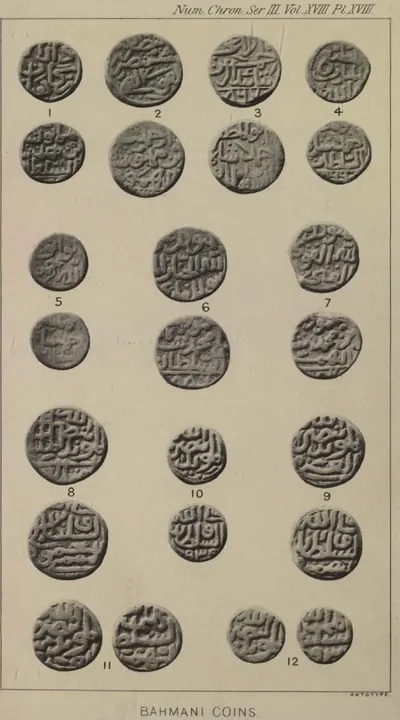 "Bahmani Coins": copper of the later Bahmani kings (O. Codrington, Numismatic Chronicle, 3rd series, Vol. XVIII (1898), Plate XVIII)Coin · 1898
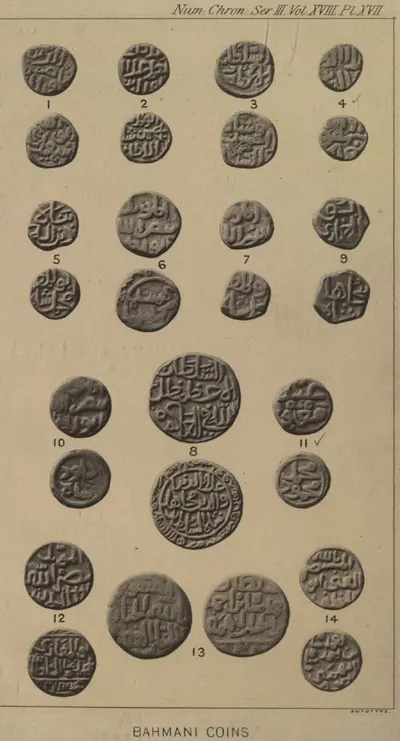 "Bahmani Coins": copper, silver and gold of the first ten Bahmani kings (O. Codrington, Numismatic Chronicle, 3rd series, Vol. XVIII (1898), Plate XVII)Coin · 1898
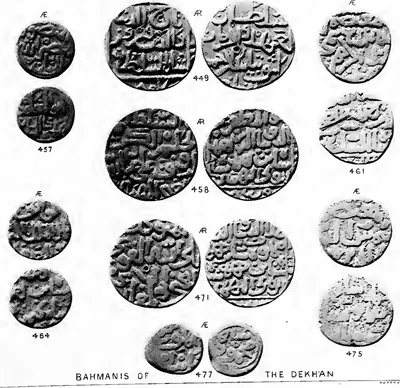 "Bahmanis of the Dekhan": coins of the Bahmani kings in the British Museum (Stanley Lane-Poole, The Coins of the Muhammadan States of India (1885), Plate XI, lower part)Coin · 1885
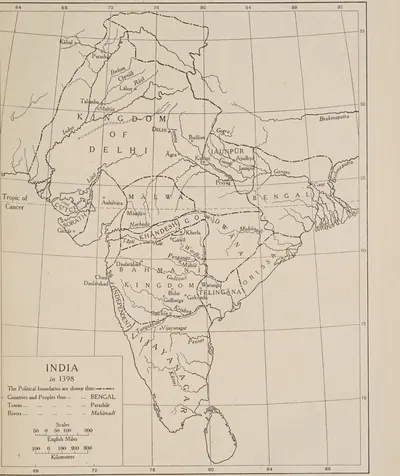 "India in 1398", showing Telingana between the Bahmani kingdom, Orissa and Vijayanagar (The Cambridge History of India, Vol. III, Map 4, between pp. 192 and 193, PDF p. 235 of the archive.org scan cambridgehistory03wols)Map · 1928
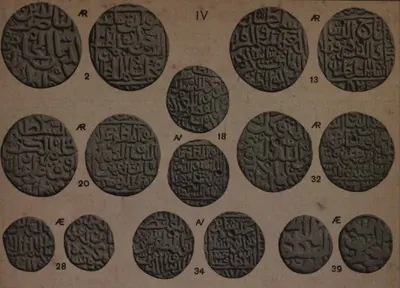 "IV. Bahmanis of Kulbarga": coins of the Bahmani kings in the Indian Museum, Calcutta (H. Nelson Wright, Catalogue of the Coins in the Indian Museum, Vol. II (1907), Plate VIII, upper part)Coin · 1907
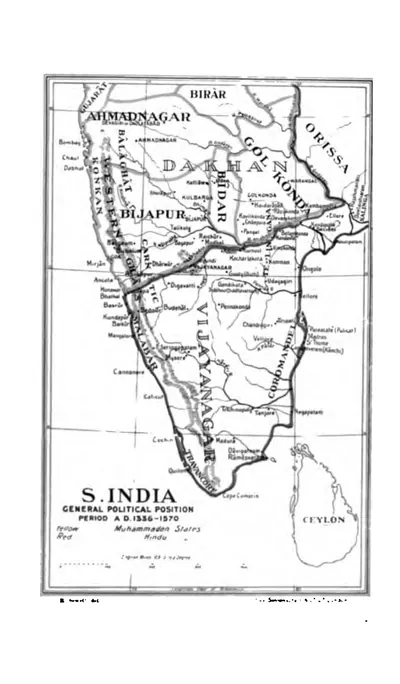 "S. India, General Political Position, Period A.D. 1336-1570" (Sewell 1900, to face p. 1 (PDF p. 38))Map · 1900
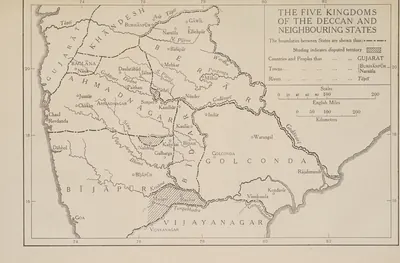 "The Five Kingdoms of the Deccan and Neighbouring States", with Golconda holding Telingana from Warangal to Rajahmundry and Kondavir (The Cambridge History of India, Vol. III (1928), Map 6)Map · 1928
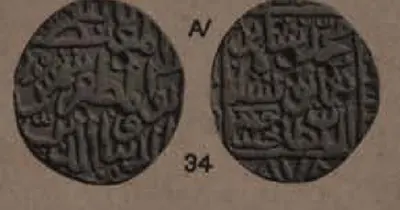 Gold coin of Muhammad Shah III Bahmani struck at Muhammadabad (Bidar), AH 878 (1473-74), obverse and reverse (Wright, Coins in the Indian Museum, Vol. II (1907), Plate VIII, No. 34)Coin · 1907
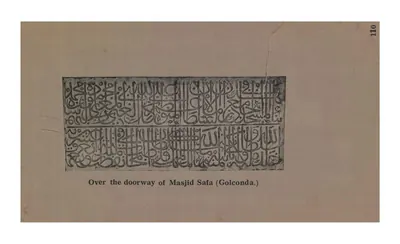 Inscription over the doorway of Masjid Safa, Golconda Fort (Bilgrami 1927, p. 110)Inscription rubbing · 1927
Related
People
Ala-ud-din Hasan Bahman Shah
1347–1358 CE
Officer of the Delhi sultanate who led the Deccan revolt against Muhammad bin Tughluq, with help from the ruler of Warangal. In 1347 he founded the Bahmani sultanate at Gulbarga. He took Kaulas from Warangal and made western Telangana a province of his kingdom.
Muhammad Shah I
1358–1375 CE
Second Bahmani sultan (1358–1375), son of the founder. He organised the court, the army and the four provinces, struck the dynasty's own gold coin, and fought the first great wars with Warangal and Vijayanagara. In Ferishta's account the ruler of Warangal ceded Golconda to him and gave up a jewelled throne, the Takht-i-Feroza or turquoise throne. The Burhan-i Ma'asir tells of the Telingana war in a single sentence.
Firuz Shah
1397–1422 CE
Eighth Bahmani sultan (1397–1422), a grandson of the founder. A learned and tolerant king in his early years, he fought Vijayanagara for most of his reign. The Burhan-i Ma'asir credits him with conquering Telingana as far as Rajahmundry. In 1417 he took tribute from the raja of Telingana, but then lost a two-year siege of Pangal to Vijayanagara and the raja of Telingana together. He gave up the throne to his brother Ahmad in 1422 and died days later.
Ahmad Shah I
1422–1435 CE
Ninth Bahmani sultan (1422–1435), called Wali, 'the Saint'. He took the throne from his brother Firuz and defeated Vijayanagara. In 1424 or 1425 he took Warangal, killing its raja, and the Velama rayas of Devarakonda and Rachakonda then paid him tribute. He moved the capital from Gulbarga to Bidar. He had to march into Telangana again to put down the chiefs who rose while he fought Gujarat and Malwa.
Humayun Shah
1458–1461 CE
Eleventh Bahmani sultan (1458–1461), remembered as Zalim, 'the Cruel'. In Telangana he put down the revolt of his cousin Sikandar Khan, who claimed the province. He sent an army against the Velama fort of Devarakonda, which was routed by its defenders and an Orissan relief force in 1459. He camped at Warangal, left Mahmud Gawan to hold Telangana, and returned to Bidar to take a savage revenge on a rising there.
Muhammad Shah III
1463–1482 CE
Bahmani sultan (1463–1482) who came to the throne as a boy. He brought Rajahmundry, Kondapalli and the Krishna–Godavari coast under Bahmani rule, and spent three years settling Telangana. In 1481 he had his great minister Mahmud Gawan executed because of a forged letter, a deed the sources blame for the break-up of the kingdom.
Mahmud Shah Bahmani
1482–1518 CE
Fourteenth Bahmani sultan (1482–1518). He came to the throne at twelve and spent his reign as the puppet of his ministers, while the governors became kings. Telangana stayed loyal longest. He campaigned at Warangal in 1486 and gave the province to Sultan Quli Qutb-ul-Mulk in the 1490s. Bahmani mosques of his reign stand at Rachakonda (1484) and Golconda (1518), the latter still naming him as sovereign.
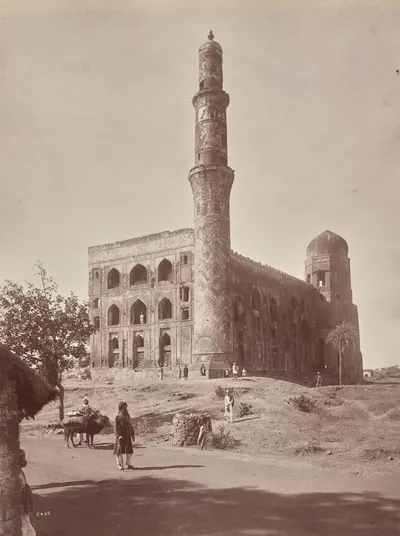
Mahmud Gawan
before 1481 CE
Persian merchant who became chief minister of the Bahmani sultanate (c. 1461–1481). He was regent for two boy kings, fought in Telangana and on the west coast, reorganised the provinces and the army, and founded a great college at Bidar. Muhammad Shah III had him executed on a forged charge of treason in 1481.
Malik Hasan Bahri
before 1486 CE
Bahmani noble, born a Brahman and brought up as a Muslim. As Nizam-ul-Mulk he took Rajahmundry and Kondapalli or Kondavidu for Muhammad Shah III in about 1471, and governed all of Telingana. He resented its division by Mahmud Gawan and led the plot that had the minister executed in 1481. He then ruled the kingdom as Malik Naib until he was killed in 1486 after a campaign at Warangal. His son Ahmad founded the Nizam Shahi kingdom of Ahmadnagar.
Inscriptions
Rachakonda mosque inscription
1484 CE
An Arabic inscription of AH 889 (1484), in the reign of the Bahmani king Mahmud Shah, recording the building of a mosque at Rachakonda by Malik An-Ni'mat, son of Mubarak. G. Yazdani, who translated it, took Malik An-Ni'mat to be the Bahmani governor and the mosque to have been a Hindu temple. Rachakonda had earlier been held by the rayas (chiefs) of Rajkonda, who paid tribute to Ahmad Shah I.
Jami Masjid inscription, Golconda fort
1518 CE
An inscription of AH 924 (1518) over the doorway of the congregational mosque (Masjid Safa) in Golconda fort. It records that Sultan Quli Qutb-ul-Mulk built the mosque in the reign of the Bahmani king Mahmud Shah, son of Muhammad Shah. Syed Ali Asgar Bilgrami used it to argue that Sultan Quli stayed loyal to the Bahmanis until 1518, and became independent only after Mahmud Shah's death.
References
Notes (0)
Sources (22)
Spotted an error on this page? Tell us
Last updated: