Mahmud Shah Bahmani
Fourteenth Bahmani sultan (1482–1518). He came to the throne at twelve and spent his reign as the puppet of his ministers, while the governors became kings. Telangana stayed loyal longest. He campaigned at Warangal in 1486 and gave the province to Sultan Quli Qutb-ul-Mulk in the 1490s. Bahmani mosques of his reign stand at Rachakonda (1484) and Golconda (1518), the latter still naming him as sovereign.
Mahmud Shah was the fourteenth Bahmani king. Haig counted his father as the last real king of the line.1 He wrote that none of the five who followed “was more than a state prisoner in the hands of ambitious and unscrupulous ministers”.1
During his thirty-six years on the throne the governors of the provinces made themselves kings one after another.2 The province of Telangana (then Telingana), ruled from Warangal and Golconda, stayed in his name longest. Its last governor, Sultan Quli, went on calling him sovereign until the year of his death. Sultan Quli’s mosque inscription of AH 924 (1518; AH is the Islamic way of counting years) in Golconda fort still names Mahmud as king.3
Coming to the throne
Mahmud was the son of Muhammad Shah III.45 His father named him heir shortly before his death in March 1482.45 Ferishta says he came to the throne “in the twelfth year of his age”.6 Malik Hasan Bahri, the Malik Naib (the king’s deputy), and the Turkish nobles Qivam-ul-Mulk and Qasim Barid took the oaths.6
Haig says the Foreign party (the nobles of foreign birth) stayed away from the ceremony.1 He says the people took the poor show of the occasion as an ill omen (a bad sign).1 Haig noted that the Burhan-i Ma’asir calls him Ahmad before his accession, without explaining the change of name.5
Telingana and the fall of Malik Naib
Offices were shared out at the start of the reign.7 Ferishta says that Warangal went to the younger Qivam-ul-Mulk, and Rajahmundry to an Abyssinian, Dilawar Khan.7
Adil Khan, the deputy at Warangal, died in AH 891 (1486).8 The younger Qivam-ul-Mulk then marched from Rajahmundry and seized the province.8 Malik Naib took the young king to Warangal.8 There Qivam-ul-Mulk wrote secretly to the king against the minister, and the king handed the letter to Malik Naib.8
News of rebellion in the west weakened the minister.9 The king “earnestly wished for his destruction” and let the nobles plot against him.91011 Malik Naib fled to Bidar and was killed there.91011 The Burhan-i Ma’asir tells the same story of the camp at Warangal.12 Ferishta says the king then made Qutb-ul-Mulk governor of Telangana, a man Haig calls “the Deccani”.1013
Ferishta says that for the rest of the reign, “no parts of the kingdom in reality remained in the King’s possession”.14 The only exceptions were “the province of Tulingana, and the districts adjacent to Ahmudabad Bidur” (Telangana and the lands around Bidar).14 The Imperial Gazetteer says the same.15
The Burhan-i Ma’asir says that the king married his sister Fatimah to a descendant of the saint Shah Ni’matullah.16 He gave the couple the fort of Medak as a wedding gift, “situate in the country of Telingana on a piece of solid rock”.16 Ferishta adds that Mahmud took the jewels from the turquoise throne of his ancestors.17 He set them in salvers (trays), vases and drinking cups.17
Two inscriptions of the reign survive in Telangana. One, dated AH 889 (1484), records the building of a mosque at Rachakonda by Malik An-Ni’mat, son of Mubarak.18 Yazdani took this man to be the Bahmani governor.18 See the Rachakonda mosque inscription.
The other, dated AH 924 (1518), is over the Jami Masjid in Golconda fort.3 It says the mosque was built “during the reign of the great King … Abil Maghazi Mahmood Shah son of Muhammad Shah Bahmani” by Sultan Quli, Qutb-ul-Mulk.3 See the Golconda Jami Masjid inscription.
Sultan Quli
The Burhan-i Ma’asir says that Sultan Quli, then called Khawass Khan, was given the title Qutb-ul-Mulk with Kotagir and another town as his estate.19205 This happened during the campaign against the rebel Bahadur Gilani, who was killed in AH 900 (1494–95).19205 King noted another account that gave him the title for his part in the fighting against Qasim Barid.19205
Haig says the title had belonged to the Deccani governor of Telangana, who was killed at the siege of Jamkhandi in that campaign.13 It was then given to Sultan Quli, “a Turk of Hamadan, who held fiefs in Telingana” (estates held for service).13
Ferishta says that in AH 901 (1495–96) Sultan Quli was made tarafdar (provincial governor) of Telangana.21 He adds that Golconda and Warangal (Wurungole in Briggs’s spelling) “with their dependencies were added to his jageer” (land grant).21
The Burhan-i Ma’asir gives more steps:222324
- In AH 903 (1497) he gained “suzerainty over all the feudatory chiefs of Telingana” (overlordship of all the chiefs under the king there).222324
- He added Warangal and “Kovilakonda” to his lands.222324
- He was made amir-ul-umara (chief of the nobles) of the whole of Telangana.222324
- Some years later he settled at Golconda.222324
Haig says that Sultan Quli obeyed the king’s call to war against Yusuf Adil Shah of Bijapur in 1504.2526 He did so because “he still regarded orders from Bidar, from whatever source they emanated, as binding on him”.2526 Haig dates his independence to 1512.2526 Bilgrami dated it to 1518, after Mahmud’s death, from the Golconda mosque inscription.27
The end of the reign
By 1490 the governors of Ahmadnagar, Bijapur and Berar were kings in all but name.2 Mahmud passed from the control of one minister to another, ending as a prisoner of the Barids in a villa outside Bidar. He died on 7 December 1518.2628
Three of Mahmud’s sons, Ahmad, Ala-ud-din and Wali-ullah, were raised to the throne in turn by Amir Ali Barid.528 The last two were put to death when they tried to free themselves.528
The fourth and last king, Kalim-ullah, is a puzzle.29 Ferishta and Nizam-ud-din Ahmad head their chapters on the last king as the son of Mahmud.2928 Haig’s Cambridge History makes him the brother of the three kings before him.2928
Haig pointed out in 1904 that Ferishta himself calls Ismail Adil Shah of Bijapur Kalim-ullah’s maternal uncle.29 He also pointed out that Ismail’s sister was married to Ahmad.29 So, in Haig’s view, Kalim-ullah may have been Ahmad’s son, but he left the question open.29
Codrington, in 1898, headed the coins of the last king “Kalim Ullah Shah bin Ahmad Shah”.30 Kalim-ullah fled from Bidar in 1527 and died soon after at Ahmadnagar.2831
Coins
Codrington lists a gold coin of Mahmud dated AH 898.32 He also lists silver coins like it with the reverse (back) in a square, and several kinds of copper of AH 887 to 894.32 Wright’s catalogue has a gold and a silver coin of his.33 The gold one was perhaps struck at Muhammadabad (Bidar).33
Footnotes
-
Haig, Cambridge History of India, Vol. III (1928), p. 422 (archive.org (opens in a new tab)). ↩ ↩2 ↩3 ↩4
-
Haig, Cambridge History of India, Vol. III (1928), p. 425 (archive.org (opens in a new tab)). ↩ ↩2
-
Syed Ali Asgar Bilgrami, Landmarks of the Deccan (1927), p. 111 (archive.org (opens in a new tab)). ↩ ↩2 ↩3
-
Wolseley Haig (ed.), The Cambridge History of India, Vol. III (1928), p. 421 (archive.org (opens in a new tab)). ↩ ↩2
-
T. W. Haig, “Some Notes on the Bahmani Dynasty”, Journal of the Asiatic Society of Bengal LXXIII, Part I, extra number (1904), pp. 11–12 (archive.org (opens in a new tab)). ↩ ↩2 ↩3 ↩4 ↩5 ↩6 ↩7 ↩8
-
Muhammad Qasim Ferishta, tr. John Briggs, History of the Rise of the Mahomedan Power in India, Vol. II (1829), p. 519 (archive.org (opens in a new tab)). ↩ ↩2
-
Ferishta, tr. Briggs, Vol. II (1829), p. 524 (archive.org (opens in a new tab)). ↩ ↩2
-
Ferishta, tr. Briggs, Vol. II (1829), p. 529 (archive.org (opens in a new tab)). ↩ ↩2 ↩3 ↩4
-
Ferishta, tr. Briggs, Vol. II (1829), p. 530 (archive.org (opens in a new tab)). ↩ ↩2 ↩3
-
Ferishta, tr. Briggs, Vol. II (1829), pp. 531–532 (archive.org (opens in a new tab)). ↩ ↩2 ↩3
-
Haig, Cambridge History of India, Vol. III (1928), p. 424 (archive.org (opens in a new tab)). ↩ ↩2
-
J. S. King, The History of the Bahmani Dynasty, founded on the Burhan-i Ma’asir (1900), p. 119 (archive.org (opens in a new tab)). ↩
-
Haig, Cambridge History of India, Vol. III (1928), p. 427 (archive.org (opens in a new tab)). ↩ ↩2 ↩3
-
Ferishta, tr. Briggs, Vol. II (1829), p. 535 (archive.org (opens in a new tab)). ↩ ↩2
-
Imperial Gazetteer of India: Hyderabad State (1909), p. 13 (archive.org (opens in a new tab)). ↩
-
King, History of the Bahmani Dynasty (1900), p. 120 (archive.org (opens in a new tab)). ↩ ↩2
-
Ferishta, tr. Briggs, Vol. II (1829), p. 532 (archive.org (opens in a new tab)). ↩ ↩2
-
Annual Report of the Archaeological Department of His Highness the Nizam’s Dominions, 1915–16 (1917), p. 4 (archive.org (opens in a new tab)). ↩ ↩2
-
King, History of the Bahmani Dynasty (1900), p. 130 (archive.org (opens in a new tab)). ↩ ↩2 ↩3
-
King, History of the Bahmani Dynasty (1900), p. 122 and note 46 (archive.org (opens in a new tab)). ↩ ↩2 ↩3
-
Ferishta, tr. Briggs, Vol. II (1829), p. 544 (archive.org (opens in a new tab)). ↩ ↩2
-
King, History of the Bahmani Dynasty (1900), p. 135 (archive.org (opens in a new tab)). ↩ ↩2 ↩3 ↩4 ↩5
-
King, History of the Bahmani Dynasty (1900), p. 136 (archive.org (opens in a new tab)). ↩ ↩2 ↩3 ↩4 ↩5
-
King, History of the Bahmani Dynasty (1900), p. 137 (archive.org (opens in a new tab)). ↩ ↩2 ↩3 ↩4 ↩5
-
Haig, Cambridge History of India, Vol. III (1928), p. 429 (archive.org (opens in a new tab)). ↩ ↩2 ↩3
-
Haig, Cambridge History of India, Vol. III (1928), p. 430 (archive.org (opens in a new tab)). ↩ ↩2 ↩3 ↩4
-
Bilgrami, Landmarks of the Deccan (1927), p. 192 (archive.org (opens in a new tab)). ↩
-
Haig, Cambridge History of India, Vol. III (1928), p. 431 (archive.org (opens in a new tab)). ↩ ↩2 ↩3 ↩4 ↩5 ↩6
-
Haig, “Some Notes on the Bahmani Dynasty” (1904), p. 12 (archive.org (opens in a new tab)). ↩ ↩2 ↩3 ↩4 ↩5 ↩6
-
Codrington, “Coins of the Bahmani Dynasty” (1898), p. 272 (archive.org (opens in a new tab)). ↩
-
Haig, Cambridge History of India, Vol. III (1928), p. 432 (archive.org (opens in a new tab)). ↩
-
O. Codrington, “On the Coins of the Bahmani Dynasty”, Numismatic Chronicle, 3rd series, XVIII (1898), pp. 270–271 (archive.org (opens in a new tab)). ↩ ↩2
-
H. Nelson Wright, Catalogue of the Coins in the Indian Museum, Calcutta, Vol. II (1907), p. 204 (archive.org (opens in a new tab)). ↩ ↩2
Photos
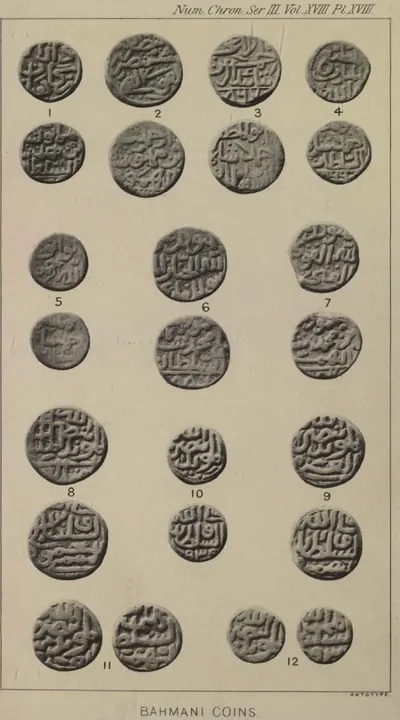 "Bahmani Coins": copper of the later Bahmani kings (O. Codrington, Numismatic Chronicle, 3rd series, Vol. XVIII (1898), Plate XVIII)Coin · 1898
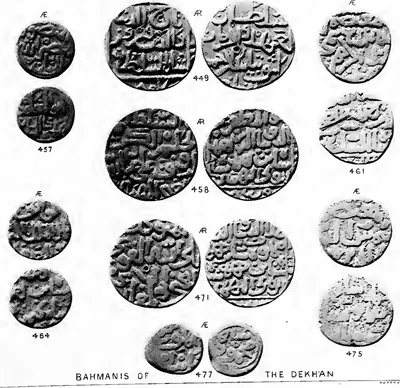 "Bahmanis of the Dekhan": coins of the Bahmani kings in the British Museum (Stanley Lane-Poole, The Coins of the Muhammadan States of India (1885), Plate XI, lower part)Coin · 1885
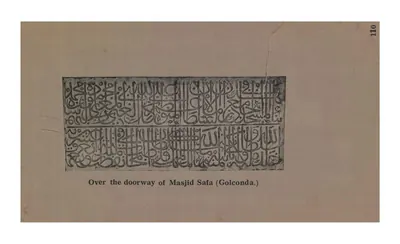 Inscription over the doorway of Masjid Safa, Golconda Fort (Bilgrami 1927, p. 110)Inscription rubbing · 1927
References
Notes (0)
Sources (9)
Spotted an error on this page? Tell us
Last updated: