Srikalahasti inscription of Krishnadeva Raya (1516)
A Telugu inscription on the west wall of the second enclosure of the Kalahastisvara temple at Srikalahasti. It is dated Saka 1438, Dhatri (1516), in the reign of Krishnadeva Raya. As V. Rangacharya summarised it in 1919, it refers to the king's conquests, his visit to Kalahasti and his building of the hundred-pillared mandapa (hall) and the big gopura (gate tower) of the temple. The Telugu Rayavachakamu instead dates the king's grants at Kalahasti to the cyclic year Srimukha.
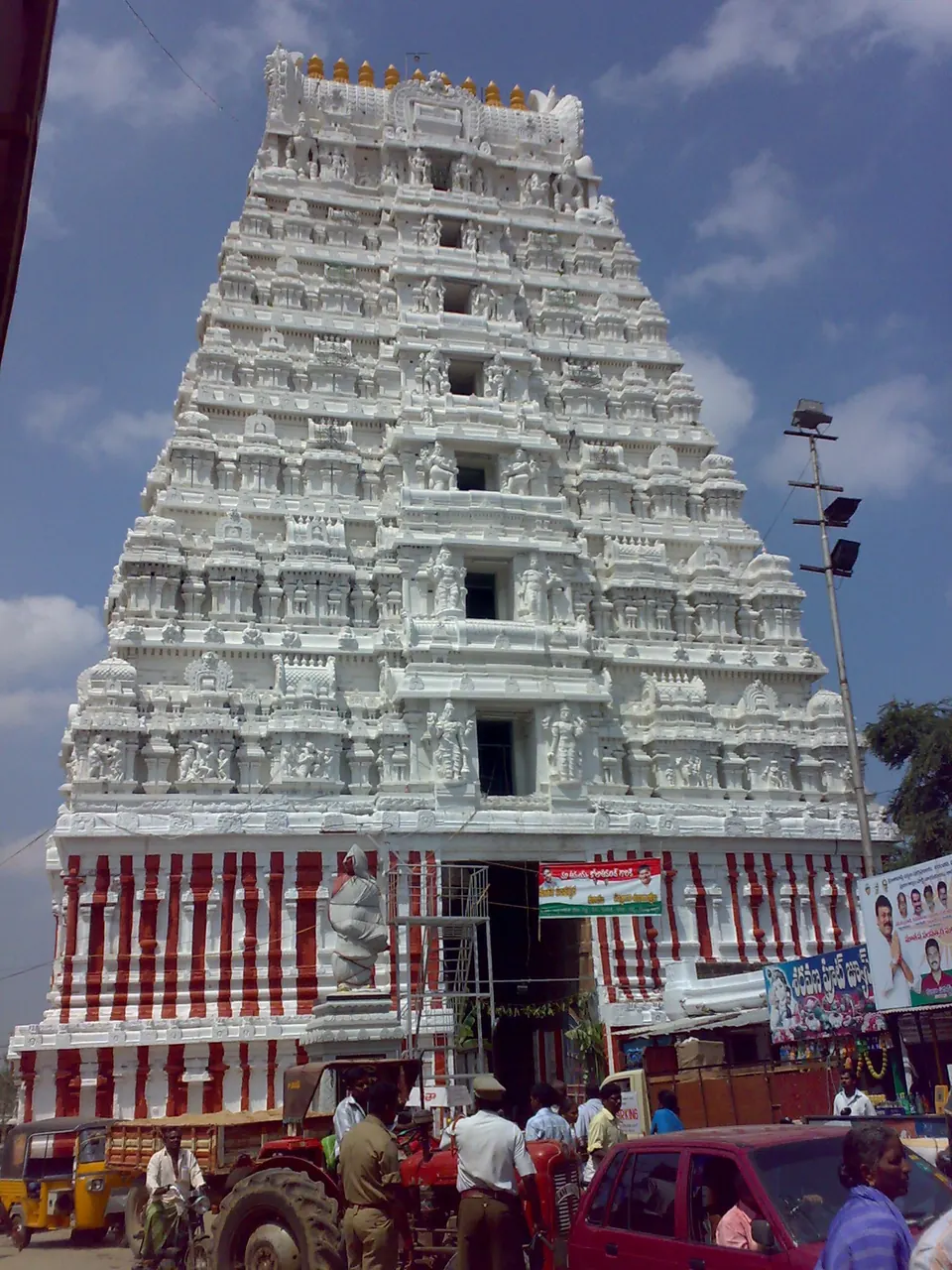
This Telugu inscription in the Kalahastisvara temple at Srikalahasti is dated in 1516, in the reign of Krishnadeva Raya.1 It credits him with the temple’s hundred-pillared hall and its big gate tower.1
The record
V. Rangacharya’s list of 1919 has this entry: “196 of 1903.—(Telugu.) On the west wall of the second prakara of the same temple.”1 “A record of the Vijayanagara king Virapratapa-Vira-Krishnadeva Maharaya in S. 1438, Dhatri.”1 “Refers to the king’s conquests, his visit to Kalahasti and his building the 100-pillared mantapa and the big gopura.”1
He added that an inscription of the same date at Tiruvannamalai, in the North Arcot district, gives the same information.1 Saka 1438 (Saka is an Indian way of counting years), Dhatri, corresponds to 1516–17.1 In the same year, by the Simhachalam inscriptions, the king made gifts at Simhachalam after his first campaign in the east.23 See Krishnadeva Raya and the Simhachalam inscriptions.
The older temple
The temple is far older than this record.4 Rangacharya notes that from the time of the Chola king Rajaraja I the town was called Mummudi-Cholapuram, a name it kept until the middle of the sixteenth century.4 He also notes that the temple “existed in his reign while it was renovated by Kulottunga III”.4
Among the other Vijayanagara records in the temple he lists Tamil inscriptions of Krishnaraya of Saka 1432 (1510) and Saka 1450 (1528), and of Sadasiva of 1553.56
See Srikalahasti.
The temple and the chronicle
The North Arcot manual of 1894 describes the temple as standing “at the base of the southern hill”.78 It says that “it was extended and improved by the Chola kings and by Krishnadeva Rayalu of Vijayanagar”.78 Europeans could not enter it, “but it is said to contain good sculptures”.78 “There are several mantapams, one called the hall of a hundred pillars.”78 See the Srikalahasti temple.
S. Krishnaswami Aiyangar summarised the Telugu chronicle Rayavachakamu.9 According to it, after Tirupati the king “moved to Kalahasti where he also made large grants to the god”.9 The chronicle dates these grants “on the twelfth day of the bright fortnight of Asvayuja in the year Srimukha”.9 He also built several choultries (rest houses) there.9 The chronicle names a different cyclic year from the inscription’s Dhatri and does not mention the gopura (gateway tower) or the hall.91
Footnotes
-
Rangacharya, Topographical List, Vol. I (1919), p. 487, Chittoor No. 135 (archive.org (opens in a new tab)). ↩ ↩2 ↩3 ↩4 ↩5 ↩6 ↩7 ↩8
-
V. Rangacharya, A Topographical List of the Inscriptions of the Madras Presidency, Vol. III (1919), p. 1675, Vizagapatam Nos. 71–73 (archive.org (opens in a new tab)). ↩
-
G. R. Subramiah Pantulu, “Discursive Remarks on the Augustan Age of Telugu Literature”, Indian Antiquary XXVII (1898), p. 296 (archive.org (opens in a new tab)). ↩
-
V. Rangacharya, A Topographical List of the Inscriptions of the Madras Presidency, Vol. I (1919), p. 480, Chittoor district, Kalahasti (archive.org (opens in a new tab)). ↩ ↩2 ↩3
-
Rangacharya, Topographical List, Vol. I (1919), p. 485, Chittoor No. 116 (archive.org (opens in a new tab)). ↩
-
Rangacharya, Topographical List, Vol. I (1919), p. 486, Chittoor Nos. 125 and 125-A (archive.org (opens in a new tab)). ↩
-
Arthur F. Cox, rev. Harold A. Stuart, Madras District Manuals: North Arcot, Vol. II (1894), p. 364 (archive.org (opens in a new tab)). ↩ ↩2 ↩3 ↩4
-
Cox and Stuart, North Arcot Manual, Vol. II (1894), p. 365 (archive.org (opens in a new tab)). ↩ ↩2 ↩3 ↩4
-
S. Krishnaswami Aiyangar (ed.), Sources of Vijayanagar History (1919), p. 117, extract from the Rayavachakamu (archive.org (opens in a new tab)). ↩ ↩2 ↩3 ↩4 ↩5
Photos
References
Notes (0)
Sources (5)
Spotted an error on this page? Tell us
Last updated: