Ma Saheba tank inscriptions (1625)
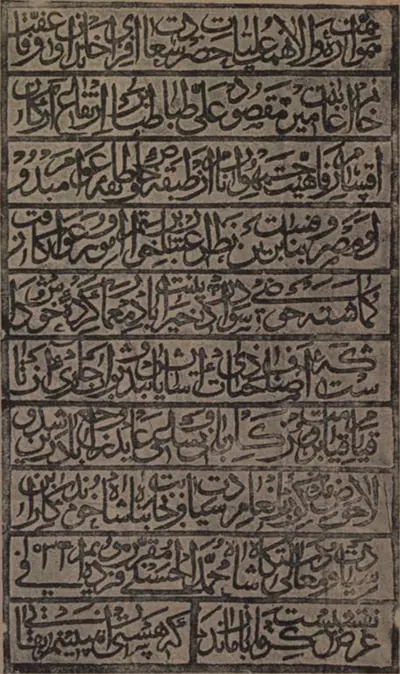
Two nearly identical Persian inscriptions in Naskh script on black stone tablets. They are in the towers at either end of the dam of the Ma Saheba tank, on the old road from Khairatabad to Golconda. They record that the tank was built by Khanum Agha, daughter of Mir Maqsud Ali Tabataba, wife of Prince Mirza Muhammad Amin and mother of Sultan Muhammad Qutb Shah. In AH 1034 (1624–25) the king granted the tank to Shah Khundkar.
The tank of Ma Saheba lay on the road from Khairatabad to Golconda, about half a mile from Khairatabad.1 G. Yazdani described it in 1921 as about a mile and three quarters round, and largely silted up.1 Rocky hills closed it on three sides.1 On the fourth side was a masonry dam (bund) about three furlongs long.1
At either end of the dam stood a rectangular tower of solid masonry, with a sluice below and a pavilion above.1 The pavilion was “apparently resorted to as a pleasure pavilion in the rainy season”.1 In the top storey of each tower is a tablet of black stone that carries the inscription.2 The two texts are almost the same, but the tablet in the south-western tower lacks two lines.2
The record
In Yazdani’s translation, the inscription speaks of Her Highness Khanum Agha, “daughter of Mir ‘Ali Tabataba”.3 She was always ready to meet the needs of the public.3 She had built “the tank which is situated in the vicinity of the market of Khairabad”.3 She built it so that “living beings of various classes may be convenienced thereby”.3
The inscription then records the king’s grant of the tank.3 It goes on: “Now, in 1034 A.H. the above tank has been awarded by us (King Muhammad Qutb Shah—1020-35 A.H.) to the refuge of Sayyids and persons of noble birth, Shah Khundkar”.3 Shah Khundkar was the “son of the noble and exalted Shah Muhammad al-Husaini.”3
Yazdani identified Khanum Agha as the wife of Prince Mirza Muhammad Amin, youngest son of Ibrahim Qutb Shah.2 He also identified her as the mother of Sultan Muhammad, and her father as Mir Maqsud Ali Tabataba.2 Yazdani took the record as evidence of the influence of the Tabataba Sayyids at the court under Ibrahim, Muhammad Quli and Muhammad.2
The editors
T. W. Haig first published the text in 1909, with a translation dated AH 1034 (AH is the Islamic way of counting years), “A.D. 1625”.4 Yazdani corrected several of Haig’s readings.2 Haig had not made out the word for “market”, “a Hindi term”, and had joined it to the next word.2
Syed Ali Asgar Bilgrami, in 1927, preferred to translate the same word as “road”.5 He followed Duncan Forbes’s Hindustani dictionary on this.5 He gave the father’s name as Mir Maqsud Ali Tabataba, “the maternal grand-father of Muhammad Qutbshah”.5 He published a plate of the inscription.5
Ma Saheba
Bilgrami wrote that the name of the tank came from “Ma Saheba”.6 This was the by-name of Hayat Bakhsh Begum, wife of Sultan Muhammad and mother of Abdullah Qutb Shah, who built Hayatnagar.6 He added: “It appears to have been the practice to give this name to all the Queen-mothers of the Qutbshahi Kings.”6 On this reading, the tank was built by one queen mother, Khanum Agha, and named after another.6
Bilgrami also identified Shah Khundkar as the son of Shah Muhammad, peshwa (chief minister) of Abdullah.678 In Bilgrami’s account, Shah Khundkar was a grandson of Khanum Agha through his mother, and so a cousin of Abdullah.678 Khanum Agha and Shah Khundkar are both buried in the tomb of Sultan Muhammad at Golconda.678 See Hayathnagar and Qutb Shahi Tombs.
Footnotes
-
G. Yazdani, “Inscriptions of the Qutb Shahi Kings in Hyderabad City and Suburbs”, Epigraphia Indo-Moslemica 1917–18 (1921), p. 46 (archive.org (opens in a new tab)). ↩ ↩2 ↩3 ↩4 ↩5 ↩6
-
Yazdani, Epigraphia Indo-Moslemica 1917–18 (1921), p. 47 and pl. XVIII (b) (archive.org (opens in a new tab)). ↩ ↩2 ↩3 ↩4 ↩5 ↩6 ↩7
-
Yazdani, Epigraphia Indo-Moslemica 1917–18 (1921), p. 48 (archive.org (opens in a new tab)). ↩ ↩2 ↩3 ↩4 ↩5 ↩6 ↩7
-
T. W. Haig, “Inscriptions in Hyderabad and Golconda”, Epigraphia Indo-Moslemica 1907–08 (1909), pp. 27–28 (archive.org (opens in a new tab)). ↩
-
Syed Ali Asgar Bilgrami, Landmarks of the Deccan (1927), p. 51, notes and plate (archive.org (opens in a new tab)). ↩ ↩2 ↩3 ↩4
-
Bilgrami, Landmarks of the Deccan (1927), p. 52 (archive.org (opens in a new tab)). ↩ ↩2 ↩3 ↩4 ↩5 ↩6 ↩7
-
Bilgrami, Landmarks of the Deccan (1927), p. 53 (archive.org (opens in a new tab)). ↩ ↩2 ↩3
-
Bilgrami, Landmarks of the Deccan (1927), p. 136 (archive.org (opens in a new tab)). ↩ ↩2 ↩3
Photos
References
Notes (0)
Sources (3)
Spotted an error on this page? Tell us
Last updated: