Ipur plates (set II) of Madhavavarman II
A damaged Sanskrit copper-plate grant of the Vishnukundin king Madhavavarman II, son of Devavarman and grandson of Madhavavarman I, issued from [Ama]rapura. It calls the king lord of the Trikuta and Malaya mountains. It was found at Ipur in Tenali taluk, and E. Hultzsch edited it in 1924. It is in the most archaic script of all the Vishnukundin grants, and its regnal year has been read as 47, 37 and 17.
The second set of Ipur plates is the only grant of the Vishnukundin king Madhavavarman II.12 It names three generations:12
- Madhavavarman I, the performer of eleven horse sacrifices12
- his son Devavarman12
- the donor, Devavarman’s son12
Discovery and description
The plates were secured, with the first Ipur set, from the house of Brindavanam Gopalacharlu of Ipur, in the Tenali taluk of Guntur district.3 They were registered as No. 12 of Appendix A in the epigraphical report for 1919–20.3
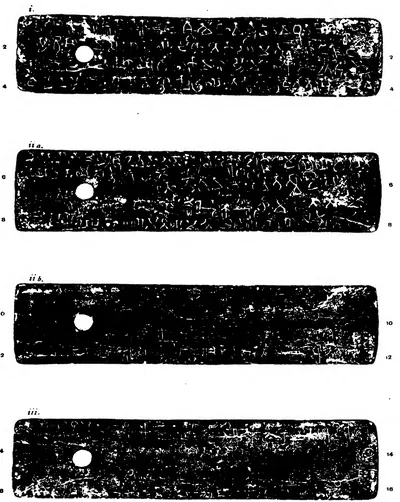
There are three thin plates without rims, with four inscribed faces.43 They hang on a ring about 3 inches across, which had not been cut when they arrived.43 The writing is much injured, especially on the last two faces.43
The worn circular seal is divided by a line into two sections.13 Below the line the legend Śrī-Mādhava[varmmā] is just visible.13 The symbols above it cannot be made out.13 The report for 1919–20 thought they might have been the lion of the Chikkulla and Ramatirtham seals, or a figure of Lakshmi or a svastika.13 With ring and seal the plates weigh 30 tolas.13
Script and language
The report for 1919–20 found the faint and worn letters “almost similar in script to those of the early Pallava inscriptions”.3 It held that they could not be later than the 5th century.3
E. Hultzsch compared them with the British Museum plates of the Pallava queen Charudevi, and judged them earlier than the first Ipur set.1 The language is Sanskrit prose with two quoted verses.1 The abbreviation va in the date presupposes the Prakrit form of the word for “rainy season”.1
Content
In Hultzsch’s translation, the grant is issued “From [Ama]rapura”.2 The donor is first called “the dear grandson of the glorious Mahārāja Mādhavavarman”.2 This grandfather “had removed the stains of the world by bathing at the end of eleven Aśvamēdhas” (horse sacrifices).2 This grandfather had also performed thousands of agnishtoma sacrifices, and his feet were studded with the jewels of bowing vassals.2
The donor was also “the dear son of glorious Dēvavarman, who displayed matchless, well-known valour in attacking warriors”.2 He is “the glorious Mādhavavarman, the lord of the Trikūṭa and Malaya (mountains)”.2 He meditates on the feet of the holy lord of Sriparvata, and belongs to the family of the Vishnukundins.2
The name of the village granted is lost.2 Hultzsch thought the grant referred to two donees, Agnisarman and Indrasarman.2 D. C. Sircar read the village’s name as Murotukaliki.5
The executor’s clause says the command was ennobled by the attention (?) of “the overlord of the Vishnukundins”.2 The date is the 7th day of the 7th fortnight of the rainy season.2
The date
The year is the most uncertain part of the grant. Hultzsch read it as [4]7, but noted that its first figure was injured and uncertain.1 The report for 1919–20 gave a possible reading of [30]7.3 It called this reading “extremely doubtful” because of the damage.3
Sircar read the figure as 10, giving the year 17.6 He argued that a king who had performed great sacrifices would not have left them out of his own grant.7 He pointed out that the grant itself attaches the sacrifices to the grandfather, not to the donor.7
Places and claims
Hultzsch identified Trikuta as a mountain on the Bombay side, and Malaya as the Western Ghats.1 He thought both lay at a safe distance from the king’s dominions, however much he claimed to rule them.1 He could not identify the other places named.1
The report for 1919–20 looked for Trikuta-Malaya north of the Godavari, perhaps in the Trikuta of the Vakataka Balaghat plates.8 K. R. Subramanian placed Trikuta, Malaya and [Ama]rapura in the hills of the Srisailam region.9 Sircar thought [Ama]rapura could probably be Amaravati.10
V. V. Mirashi took the title as evidence that Maharashtra was part of the empire of Madhavavarman I.1112 In his view this grandson inherited it.1112 See Madhavavarman II for the other views.
Edition
- E. Hultzsch, “Ipur Plates of Madhavavarman II”, Epigraphia Indica XVII (1923–24), No. 21, pp. 337–339, with a plate.4
Footnotes
-
Hultzsch, “Ipur Plates of Madhavavarman II” (1924), p. 338 (archive.org (opens in a new tab)). ↩ ↩2 ↩3 ↩4 ↩5 ↩6 ↩7 ↩8 ↩9 ↩10 ↩11 ↩12 ↩13 ↩14 ↩15 ↩16 ↩17
-
Hultzsch, “Ipur Plates of Madhavavarman II” (1924), p. 339, translation (archive.org (opens in a new tab)). ↩ ↩2 ↩3 ↩4 ↩5 ↩6 ↩7 ↩8 ↩9 ↩10 ↩11 ↩12 ↩13 ↩14 ↩15 ↩16
-
Annual Report on Epigraphy, Madras, for 1919–20 (1920), Part II, para. 7, p. 97 (archive.org (opens in a new tab)). ↩ ↩2 ↩3 ↩4 ↩5 ↩6 ↩7 ↩8 ↩9 ↩10 ↩11 ↩12 ↩13 ↩14
-
E. Hultzsch, “Ipur Plates of Madhavavarman II”, Epigraphia Indica XVII (1924), p. 337 (archive.org (opens in a new tab)). ↩ ↩2 ↩3 ↩4
-
Sircar, Successors of the Satavahanas (1939), p. 134 (archive.org (opens in a new tab)). ↩
-
Sircar, Successors of the Satavahanas (1939), p. 107 (archive.org (opens in a new tab)). ↩
-
D. C. Sircar, The Successors of the Satavahanas in Lower Deccan (1939), p. 103 (archive.org (opens in a new tab)). ↩ ↩2
-
Annual Report on Epigraphy, Madras, for 1919–20 (1920), Part II, para. 10, p. 99 (archive.org (opens in a new tab)). ↩
-
K. R. Subramanian, Buddhist Remains in Andhra and the History of Andhra between 225 and 610 A.D. (1932), p. 112 (archive.org (opens in a new tab)). ↩
-
Sircar, Successors of the Satavahanas (1939), p. 133 (archive.org (opens in a new tab)). ↩
-
V. V. Mirashi and Y. R. Gupte, “Khanapur Plates of Madhavavarman”, Epigraphia Indica XXVII (1956), p. 315 (archive.org (opens in a new tab)). ↩ ↩2
-
Mirashi and Gupte, “Khanapur Plates” (1956), p. 316 (archive.org (opens in a new tab)). ↩ ↩2
Photos
References
Notes (0)
Sources (5)
Spotted an error on this page? Tell us
Last updated: