Ipur
Village in the former Tenali taluk of Guntur district. Two sets of Vishnukundin copper plates, kept as heirlooms in a Brahmin household, were secured here in 1919–20. One is a grant of Govindavarman's son Madhavavarman, the other of Madhavavarman II. With them were two early Eastern Chalukya grants.
Ipur is a village in what was the Tenali taluk of Guntur district. It is known to history for the copper plates once kept in the house of Brindavanam Gopalacharlu.12
The find
A. Rangaswamy Sarasvati was touring the Tenali taluk, and he persuaded the owners to bring out a number of old copper-plate grants.1 Some had been locked up in a Vishnu temple at Kodi-Tadiparru, others in Gopalacharlu’s house at Ipur.1 The epigraphy report for 1919–20 gave him credit for bringing to light documents “often deposited as heirlooms in orthodox families”.1
Two of the Ipur sets were grants of the Vishnukundin kings.123 They are the Ipur plates (set I) of Govindavarman’s son Madhavavarman and the Ipur plates (set II) of Madhavavarman II.123 E. Hultzsch edited both in 1924.123 Two more sets from the same collection were grants of the early Eastern Chalukya kings, Jayasimha I and a Vishnuvardhana.4
The village and the grants
Neither Vishnukundin grant concerns Ipur itself. The first was issued from a camp at Kudavada and gives a village in the Guddadi district.2 The second was issued from [Ama]rapura, and the name of the village it grants is lost.3
Footnotes
-
Annual Report on Epigraphy, Madras, for 1919–20 (1920), Part II, paras. 6–7, p. 97 (archive.org (opens in a new tab)). ↩ ↩2 ↩3 ↩4 ↩5 ↩6 ↩7
-
E. Hultzsch, “Ipur Plates of Govindavarman’s Son Madhavavarman”, Epigraphia Indica XVII (1924), pp. 334–335 (archive.org (opens in a new tab)). ↩ ↩2 ↩3 ↩4 ↩5
-
E. Hultzsch, “Ipur Plates of Madhavavarman II”, Epigraphia Indica XVII (1924), pp. 337–338 (archive.org (opens in a new tab)). ↩ ↩2 ↩3 ↩4
-
Annual Report on Epigraphy, Madras, for 1919–20 (1920), Part II, para. 11, p. 99 (archive.org (opens in a new tab)). ↩
Photos
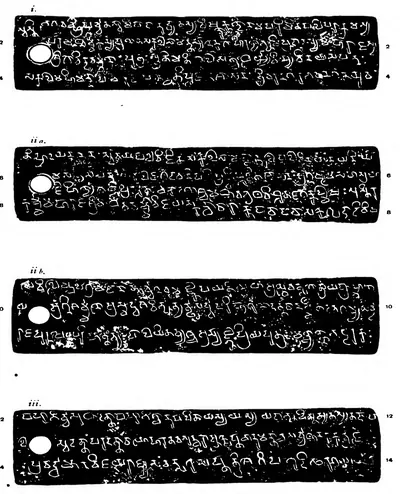 "Ipur Plates of Govindavarman's Son Madhavavarman": plates i, ii a, ii b and iii, lines 1-14 (Epigraphia Indica XVII, plate between pp. 334 and 335 (PDF p. 388 of scan in.ernet.dli.2015.180697))Inscription rubbing · 1924
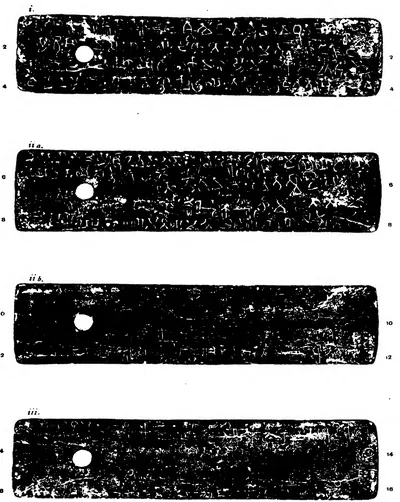 "Ipur Plates of Madhavavarman II": plates i, ii a, ii b and iii, lines 1-16 (Epigraphia Indica XVII, plate between pp. 338 and 339 (PDF p. 394 of scan in.ernet.dli.2015.180697))Inscription rubbing · 1924
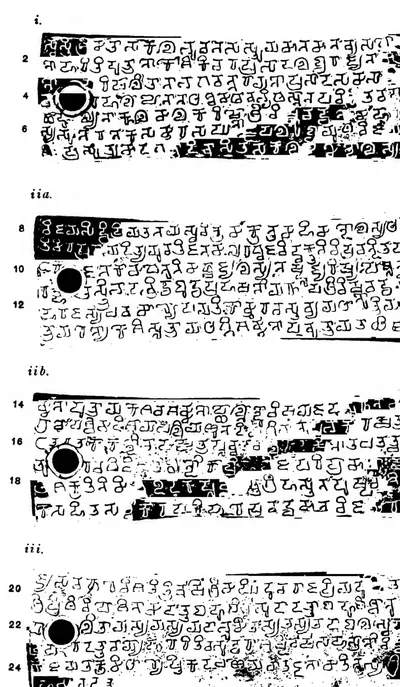 "Ipur plates of Vishnuvardhana III.", plates i, ii a, ii b and iii (Epigraphia Indica XVIII, plate between pp. 60 and 61 (PDF p. 94))Inscription rubbing · 1926
References
Notes (0)
Sources (2)
Spotted an error on this page? Tell us
Last updated: