Madhavavarman II (Vishnukundin)
Vishnukundin king, son of Devavarman and grandson of the great Madhavavarman. He is known from the second set of Ipur plates, issued from [Ama]rapura. The grant calls him lord of the Trikuta and Malaya mountains. Scholars have read this claim as an empty boast, as evidence of a western Vishnukundin realm, or as the name of a local hill. His place in the line and his date are disputed.
The king of the second Ipur grant
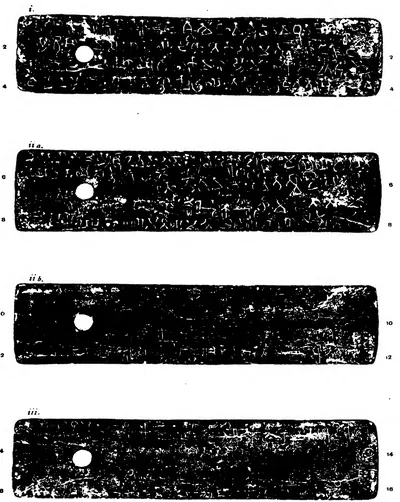
Madhavavarman II is known only from the second of two sets of copper plates found at Ipur, in the Tenali taluk of Guntur district.12 E. Hultzsch edited them in 1924.2 See the Ipur plates (set II). The grant was issued from a place whose name is damaged, and Hultzsch read it as [Ama]rapura.34
The epigraphical report for 1919–20 first described the plates.13 It judged their letters to be “almost similar” to those of the early Pallava inscriptions, and not later than the 5th century.13 Hultzsch compared them with the British Museum plates of the Pallava queen Charudevi.13
Family
Madhavavarman II was the son of Devavarman, “who displayed matchless, well-known valour in attacking warriors”.4 He was the grandson of the Maharaja Madhavavarman, the performer of eleven horse sacrifices.4 Devavarman was a son of Madhavavarman I, according to the same grant.34
D. C. Sircar noticed that Devavarman bears no royal title, and concluded that Devavarman probably died before his father and never reigned.5 Sircar thought that Madhavavarman II then succeeded his grandfather directly, before his uncle Vikramendravarman I.56
Lord of Trikuta and Malaya
The grant calls Madhavavarman II “the lord of the Trikuta and Malaya (mountains)” and a worshipper of the lord of Sriparvata, of the family of the Vishnukundins.4 The meaning of the title is disputed:
- Hultzsch (1924) took Trikuta to be a mountain on the Bombay side and Malaya the Western Ghats, “both of which were at a safe distance from the dominions” of the king.3 Yet the king claimed to rule them.3
- The epigraphical report for 1919–20 looked for Trikuta-Malaya north of the Godavari, perhaps the Trikuta of the Balaghat plates of the Vakataka king Prithivishena II. It took this as support for the view that the Vishnukundins were “a distinctly northern family”.7
- V. V. Mirashi (1956) used the Khanapur plates, which grant a village in Satara district. He argued from them that Maharashtra really belonged to the empire of Madhavavarman I.89 In his view the western part of that empire, including Maharashtra and Karnataka, passed to Madhavavarman II after his grandfather’s death.89
- K. R. Subramanian (1932) placed Trikuta and Malaya in the hills of the Srisailam region, with [Ama]rapura close by.1011 He rejected identifications of the three names with Tagara, Mahendragiri and Amraoti in the Central Provinces.1011
- D. C. Sircar (1939) could not justify the claim. He suggested that the king had only fought in those regions, perhaps in the army of a more powerful king. He reported B. V. Krishna Rao’s suggestion that Madhavavarman II was a viceroy at a place called Trikutamalaya, identified with Kotappakonda near Narasaraopet.1213 Sircar found it attractive, though he had not been able to examine the argument.1213
Sircar also thought [Ama]rapura could probably be identified with Amaravati on the Krishna.12
The grant
The grant seems to give a village to two Brahmins, Agnisharman and Indrasharman.4 Hultzsch could not read the village’s name, but Sircar read it as Murotukaliki.413
The executor’s clause says that the command was given under the attention of “the overlord of the Vishnukundins”.4 Sircar thought this overlord was Madhavavarman II himself, unless the king was a viceroy under his grandfather.13 He also suggested that Agnisharman might be the man of that name who received the first set of Ipur plates.5
A side branch, or the next king?
R. S. Panchamukhi, writing in 1936, thought eight kings could not be fitted into the time available. In his view this could only be done if Devavarman and Madhavavarman II formed a side branch (a collateral branch), ruling a small principality inside the Vishnukundin kingdom.1415 He identified them with the “claimants” (dayadas) whom Indravarman is said to have scattered.1415
Robert Sewell and S. Krishnaswami Aiyangar printed the pedigree of K. V. Lakshman Rao in 1932.16 It instead made Madhava II a king of the main line, the third of the family and the one who married a Vakataka princess.16
Hultzsch thought it possible that Madhavavarman II was the grandfather of the Madhavavarman of the first Ipur plates, who would then be Madhavavarman III.3 Sircar rejected this, because the Polamuru plates name the latter king’s grandfather as Vikramahendra.317
Date
The date of the grant is partly lost. Three readings have been offered:
- Hultzsch read the year as [4]7, with the first figure injured and uncertain
- the report for 1919–20 offered [30]7, “extremely doubtful”
- Sircar read 17316
Sewell and Aiyangar, citing this grant, gave Madhava II a reign of at least 37 years.16
| Source | Date proposed |
|---|---|
| K. V. Lakshman Rao, in Sewell (1932)16 | About 407–444 |
| Panchamukhi (1936)18 | Grandson of Madhavavarman I (about 500); no date given |
| Sircar (1939)19 | About 585–615 |
Subramanian placed the grant first among the Vishnukundin records on grounds of script.20 The reign chart on the Vishnukundins page follows Sircar.
Footnotes
-
Annual Report on Epigraphy, Madras, for 1919–20 (1920), Part II, para. 7, p. 97 (archive.org (opens in a new tab)). ↩ ↩2 ↩3 ↩4 ↩5
-
E. Hultzsch, “Ipur Plates of Madhavavarman II”, Epigraphia Indica XVII (1924), p. 337 (archive.org (opens in a new tab)). ↩ ↩2
-
E. Hultzsch, “Ipur Plates of Madhavavarman II”, Epigraphia Indica XVII (1924), p. 338 (archive.org (opens in a new tab)). ↩ ↩2 ↩3 ↩4 ↩5 ↩6 ↩7 ↩8 ↩9 ↩10
-
Hultzsch, “Ipur Plates of Madhavavarman II” (1924), p. 339, translation (archive.org (opens in a new tab)). ↩ ↩2 ↩3 ↩4 ↩5 ↩6 ↩7 ↩8
-
Sircar, Successors of the Satavahanas (1939), p. 106 (archive.org (opens in a new tab)). ↩ ↩2 ↩3
-
Sircar, Successors of the Satavahanas (1939), p. 107 (archive.org (opens in a new tab)). ↩ ↩2
-
Annual Report on Epigraphy, Madras, for 1919–20 (1920), Part II, para. 10, p. 99 (archive.org (opens in a new tab)). ↩
-
V. V. Mirashi and Y. R. Gupte, “Khanapur Plates of Madhavavarman”, Epigraphia Indica XXVII (1956), p. 315 (archive.org (opens in a new tab)). ↩ ↩2
-
Mirashi and Gupte, “Khanapur Plates” (1956), p. 316 (archive.org (opens in a new tab)). ↩ ↩2
-
K. R. Subramanian, Buddhist Remains in Andhra and the History of Andhra between 225 and 610 A.D. (1932), p. 111 (archive.org (opens in a new tab)). ↩ ↩2
-
Subramanian, Buddhist Remains in Andhra (1932), p. 112 (archive.org (opens in a new tab)). ↩ ↩2
-
Sircar, Successors of the Satavahanas (1939), p. 133 (archive.org (opens in a new tab)). ↩ ↩2 ↩3
-
Sircar, Successors of the Satavahanas (1939), p. 134 (archive.org (opens in a new tab)). ↩ ↩2 ↩3 ↩4
-
R. S. Panchamukhi, “Tandivada Grant of Prithivi-Maharaja: 46th Year”, Epigraphia Indica XXIII (1936), p. 92 (archive.org (opens in a new tab)). ↩ ↩2
-
Panchamukhi, “Tandivada Grant” (1936), p. 93 (archive.org (opens in a new tab)). ↩ ↩2
-
Robert Sewell and S. Krishnaswami Aiyangar, The Historical Inscriptions of Southern India (1932), p. 404 (archive.org (opens in a new tab)). ↩ ↩2 ↩3 ↩4
-
D. C. Sircar, The Successors of the Satavahanas in Lower Deccan (1939), p. 100 (archive.org (opens in a new tab)). ↩
-
Panchamukhi, “Tandivada Grant” (1936), p. 95, genealogical table (archive.org (opens in a new tab)). ↩
-
Sircar, Successors of the Satavahanas (1939), p. 112, chronological table (archive.org (opens in a new tab)). ↩
-
Subramanian, Buddhist Remains in Andhra (1932), pp. 113, 115 (archive.org (opens in a new tab)). ↩
Photos
Related
Dynasties
References
Notes (0)
Sources (7)
Spotted an error on this page? Tell us
Last updated: