Ipur plates (set I) of Govindavarman's son Madhavavarman
Sanskrit copper-plate grant of the Vishnukundin king Madhavavarman, son of Govindavarman. He issued it from his camp at Kudavada in his 37th year, giving the village of Vilembali in the Guddadi district to a Brahmin. It is one of two Vishnukundin sets found at Ipur in Tenali taluk, and E. Hultzsch edited it in 1924. Whether its king is the great Madhavavarman I or a later Madhavavarman III is disputed.
The first set of Ipur plates is a grant of the Vishnukundin king Madhavavarman, son of the Maharaja Govindavarman. It is one of only two grants that name Govindavarman’s son.12 The other is the Polamuru plates.12 The identity of its king is the main open question in the dynasty’s genealogy (family tree).12 See Madhavavarman.
Discovery
A. Rangaswamy Sarasvati was touring in the Tenali taluk of Guntur district.3 There he secured a number of old copper-plate grants.3 Some had been kept in a Vishnu temple at Kodi-Tadiparru, others in the house of Brindavanam Gopalacharlu of Ipur.3 Two of the Ipur sets proved to be Vishnukundin.3 They are Nos. 11 and 12 of Appendix A of the epigraphical report for 1919–20.3
This set is No. 11.41 E. Hultzsch edited both in Epigraphia Indica XVII in 1924, from impressions supplied by H. Krishna Sastri.41
Description
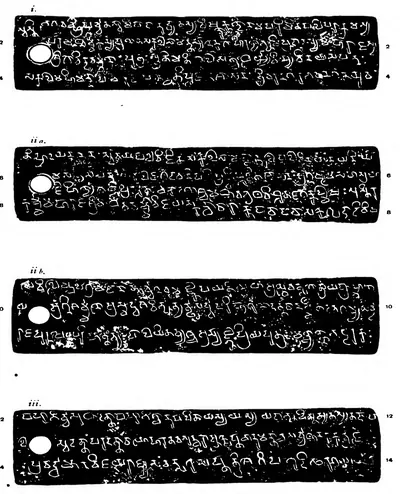
There are three thin copper plates without raised rims.14 The outer faces of the first and last are blank.14 They hang on a copper ring 3 inches across, which had not been cut when the plates reached the office.14
The round seal is divided by a line into two parts.14 The lower part bears the legend Śrī-Mādhavavarmā in two lines.14 Above it is what Hultzsch took to be a figure of Lakshmi or a svastika on a pedestal.14 Two lamp-stands stand on either side, with the sun (?) and the crescent moon above.14 With ring and seal the plates weigh 30 tolas.14
D. C. Sircar thought the worn upper part might once have shown a lion.56 The seals of the Chikkulla and Ramatirtham plates show one.56
Script and language
Hultzsch found the alphabet of an earlier southern type than that of the Ramatirtham and Chikkulla plates.1 The report for 1919–20 judged it “somewhat later” than that of the second Ipur set.4 It placed it in about the 6th century.4
The language is Sanskrit prose with two quoted verses.7 The short form di in the date assumes the Prakrit word for “day”.7 The grant uses the number signs for 5, 7 and 10.7
Content
The grant opens with the son of the glorious Maharaja Govindavarman.8 Govindavarman meditated on the feet of the holy lord of Sriparvata and belonged to the family of the Vishnukundins.8 He made many gifts of cows, gold and land.8
That son is the Maharaja Madhavavarman.8 He is praised as one “who delights the hearts of the young women standing on (the top of) the palaces of Trivaranagara”.8 He “has performed thousands of Agnishṭōma sacrifices”.8 He “has removed the stains of the world by bathing at the end of eleven Aśvamēdhas” (horse sacrifices).8
From his camp of victory at Kudavada he addresses the people of the village of Vilembali, in the district (vishaya) of Guddadi.8 He tells them that he has given the village, with all exemptions, to the Brahmin Agnisarman of the Vatsa gotra (clan).8 The gift is “for the sake of the prosperity of Our family”.8 Royal officers are to exempt and protect it.8
The executor (ajna) was the king’s “dear son, Mañchyaṇṇa-bhaṭṭāraka”.8 The date is the 15th day of the 7th fortnight of the hot season, in the 37th year of the reign.8
Places
Hultzsch could not identify Vilembali, Kudavada or Trivaranagara.7 He did not know whether the Guddadi district had anything to do with the Guddavadi district.7 Draksharama and Chellur in Godavari district belonged to Guddavadi.7
Sircar thought Guddadi might be the same as Guddavadi, the later Ramachandrapuram taluk.5 In his view it was not the Gudrahara district round Gudivada.5 K. R. Subramanian also placed the grant in East Godavari, round Draksharama.9
Whose grant?
On grounds of script, Hultzsch was tempted to identify its king with the Madhavavarman who was grandfather of the donor of the Ramatirtham plates.710 He also thought it possible that the king was a grandson of Madhavavarman II of the second Ipur set, and so Madhavavarman III.710
The report for 1919–20 put this grant at least a century after the second set.11 It thought its king might be the same as the Madhavavarman of the Chikkulla plates.11 Sircar argued from the matching titles of the Ipur and Polamuru grants that both belonged to one king, the great Madhavavarman I.2
R. S. Panchamukhi agreed that the two grants had one donor.1213 He made that donor a later Madhavavarman III, whose 37th year he put about 610.1213 Subramanian also ranked the grant second in time, after the second Ipur set.14
Edition
- E. Hultzsch, “Ipur Plates of Govindavarman’s Son Madhavavarman”, Epigraphia Indica XVII (1923–24), No. 20, pp. 334–337, with a plate.1
Footnotes
-
E. Hultzsch, “Ipur Plates of Govindavarman’s Son Madhavavarman”, Epigraphia Indica XVII (1924), p. 334 (archive.org (opens in a new tab)). ↩ ↩2 ↩3 ↩4 ↩5 ↩6 ↩7 ↩8 ↩9 ↩10 ↩11 ↩12 ↩13 ↩14 ↩15
-
D. C. Sircar, The Successors of the Satavahanas in Lower Deccan (1939), p. 101 (archive.org (opens in a new tab)). ↩ ↩2 ↩3 ↩4
-
Annual Report on Epigraphy, Madras, for 1919–20 (1920), Part II, paras. 6–7, p. 97 (archive.org (opens in a new tab)). ↩ ↩2 ↩3 ↩4 ↩5
-
Annual Report on Epigraphy, Madras, for 1919–20 (1920), Part II, para. 8, p. 98 (archive.org (opens in a new tab)). ↩ ↩2 ↩3 ↩4 ↩5 ↩6 ↩7 ↩8 ↩9 ↩10 ↩11 ↩12
-
Sircar, Successors of the Satavahanas (1939), p. 130 (archive.org (opens in a new tab)). ↩ ↩2 ↩3 ↩4
-
Sircar, Successors of the Satavahanas (1939), p. 131 (archive.org (opens in a new tab)). ↩ ↩2
-
Hultzsch, “Ipur Plates of Govindavarman’s Son Madhavavarman” (1924), p. 335 (archive.org (opens in a new tab)). ↩ ↩2 ↩3 ↩4 ↩5 ↩6 ↩7 ↩8
-
Hultzsch, “Ipur Plates of Govindavarman’s Son Madhavavarman” (1924), p. 337, translation (archive.org (opens in a new tab)). ↩ ↩2 ↩3 ↩4 ↩5 ↩6 ↩7 ↩8 ↩9 ↩10 ↩11 ↩12 ↩13
-
Subramanian, Buddhist Remains in Andhra (1932), p. 116 (archive.org (opens in a new tab)). ↩
-
E. Hultzsch, “Ipur Plates of Madhavavarman II”, Epigraphia Indica XVII (1924), p. 338 (archive.org (opens in a new tab)). ↩ ↩2
-
Annual Report on Epigraphy, Madras, for 1919–20 (1920), Part II, para. 10, p. 99 (archive.org (opens in a new tab)). ↩ ↩2
-
R. S. Panchamukhi, “Tandivada Grant of Prithivi-Maharaja: 46th Year”, Epigraphia Indica XXIII (1936), p. 91 (archive.org (opens in a new tab)). ↩ ↩2
-
Panchamukhi, “Tandivada Grant” (1936), p. 92 and note 1 (archive.org (opens in a new tab)). ↩ ↩2
-
K. R. Subramanian, Buddhist Remains in Andhra and the History of Andhra between 225 and 610 A.D. (1932), p. 113 (archive.org (opens in a new tab)). ↩
Photos
References
Notes (0)
Sources (5)
Spotted an error on this page? Tell us
Last updated: