Kaluchumbarru grant of Amma II
Five Sanskrit copper plates, with a closing passage in Telugu, of the Eastern Chalukya king Amma II, also called Vijayaditya VI (crowned 945, reigned 25 years). At the request of Chamekamba, a lady of the Pattavardhika family and a lay disciple of the Jain teacher Arhanandin, the king gives the village of Kaluchumbarru in the Attilinandu district to Arhanandin. The gift was for repairs to the dining-hall of the Jain temple called Sarvalokasraya-Jinabhavana. The plates were Sir Walter Elliot's and are in the British Museum, and where they were found is not known.
This charter is the record of a royal gift to a Jain institution in the Eastern Chalukya kingdom.12 A courtesan of a family long in the dynasty’s service had the gift made.12 The gift fed and repaired the dining-hall of a Jain temple.12 The charter also preserves an unusual list of the enemies overthrown by Amma II’s father, Chalukya-Bhima II.34
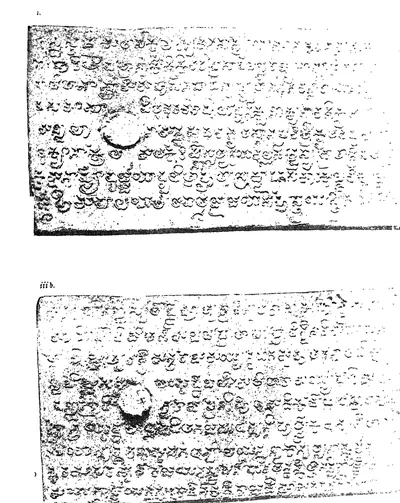
The plates
J. F. Fleet edited the grant in 1902–03 from the original plates.5 They had belonged to Sir Walter Elliot and were by then in the British Museum.5 “There is no information as to where they were obtained.”5 The name Kaluchumbarru therefore comes from the village granted, not from a findspot. Fleet had first seen the plates in 1877 or 1878, and had already used the record in his papers on Eastern Chalukya chronology.56
There are five plates, each about 8¼ by 4³⁄₁₆ inches.56 The first is inscribed on one side only, and the others on both sides.56 The edges, except on the last, were raised into rims to protect the writing.56 The ring has been cut.56
The ring’s circular seal, about 3 inches across, carries in relief a boar standing to the right and the legend Sri-Tribhuvanankusah.56 It also shows an elephant-goad with the sun and moon above, and a floral device below.56 Fleet explained the legend as “a motto of the kings of the dynasty” meaning “the glorious elephant-goad of the three worlds”.56 Apart from a few worn letters on the last plate, the text is “in a state of very excellent preservation”.6
Language and script
The language is Sanskrit throughout, with two exceptions.6 There is a Telugu passage in lines 73–74, translated for Fleet by E. Hultzsch.6 There are also a few Telugu words in lines 65–66.6
The characters are of the southern class, and of the regular type of their place and period.6 Fleet noted a peculiar form of the initial i, which he thought “plainly intended”, not a mistake.6 The record spells the family name Chālukya, with a long first vowel, in prose, and Chalukya, with a short one, in verse.7
It contains seventeen ordinary verses and two of the usual benedictive and imprecatory verses (blessings and curses).1 One more verse names the officer who conveyed the grant (ajnapti), the writer and the composer.1
The genealogy
The record traces the line from “the victorious Kubja-Vishnu” down to Amma II.8 It compares Kubja-Vishnu with the dwarf incarnation of Vishnu.8 Of Vijayaditya III it says that he was “a veritable champion”.8 It says that “great honour was paid by the Vallabha king” to his arm, and that he enjoyed the earth for 44 years.8
Fleet admitted that when he first used the record he had misread it as also giving a reign of 48 years.87 The true reading has only 44.87 The record says that Vikramaditya II reigned nine months, where other records give eleven months or a year.3 Its prose calls Yuddhamalla II “born from an elder brother of king Talapa”.3 Fleet judged this “certainly wrong”, since all other records make him Talapa’s son.3
In Fleet’s translation, Chalukya-Bhima II guarded the world for twelve years.4 He did so “having unaided, indeed, slain the glorious Rajamayya, and Dhalaga …, and the fierce Tatabikki, and Bijja …, and the excessively powerful Ayyapa”.4 He had also slain “the extremely great army sent by king Govinda, and Lovabikki the ruler of the Cholas, and the valorous Yuddhamalla”.4
Fleet identified Govinda with the Rashtrakuta king Govinda IV, and Yuddhamalla with the Eastern Chalukya Yuddhamalla II.32 He suggested that Ayyapa was a Nolamba prince and Bijja the Dantivarman of the Sudi plates.32 He knew nothing more of Lovabikki or of Dhalaga and Tatabikki.32
The grant
The king, “the glorious Vijayaditya-(Amma II.)”, Maharajadhiraja, Paramesvara and Paramabhattaraka, addresses the headmen and cultivators of the Attilinandu district.49
The grant names the Addakali gachchha of the Valahari gana.9 It then introduces Chamekamba of the Pattavardhika lineage, “which belongs to the retinue of the lineage of the glorious royal Chalukyas”.9 She was a lay disciple (sravaki) devoted to “the religion of Jina”.9 Her teacher’s line ran from the saint Sakalachandrasiddhanta to his disciple Ayyapoti, and then to Ayyapoti’s disciple Arhanandin.9
The grant was made “While king Amma (II.), the high lord of Vengi, is reigning”.9 Chamekamba “has, with great pleasure, caused to be given the excellent village of Kaluchumbarru”.9 The gift was “for the purposes of the renowned dining-hall of the holy and famous Jain temple called Sarvalokasraya-Jinabhavana”.9 It was made on the winter solstice, free of all taxes, “for the purpose of the restoration of whatever may be broken or torn”.9
Fleet summarised it as a grant to Arhanandin “for the purpose of providing for repairs to the charitable dining-hall” of the temple.1 The office of village headman (gramakuta) was given in perpetuity to Kusumayudha, son of Kattalamba.9 The composer of the verses was the poet Kavichakravarti.9 The closing Telugu passage records a present that Arhanandin himself made to the writer of the record.1
Chamekamba
Fleet thought line 53 clearly marks Chamekamba as a courtesan.29 It calls her “the lustre of a sun to the water-lilies … which are the faces of courtesans”.29 He concluded that “she was a favourite mistress of the king”.29 He compared Vinapoti, mistress of the Western Chalukya king Vijayaditya, who made grants to a temple at Mahakuta.29
He linked her family to the Pattavardhini race of the Ederu plates of Amma I.2 The ancestor of that family, Kalakampa, had served Kubja-Vishnuvardhana.2
The places
Fleet located the grant through the Attilinandu district, which “evidently took its appellation from a town named Attili”.1 In 1902 Attili was in the Tanuku taluk of Godavari district, seven miles “south-west-half-west” from Tanuku.1
He identified Kaluchumbarru, also called Pedda-Kaluchuvubarru in the record, with the village shown as “Kunsamurroo” on the Indian Atlas sheet.1 This village is about three miles south-by-west of Attili.1 He also identified three of its four boundary villages on the same sheet.1 He had at first read the district’s name as Mattilinandu, before he knew that the modern Attili existed.1
Date
The grant is not dated.1 Fleet placed it in the reign of Amma II.1 Amma II, he wrote, “we know, from other sources”, was crowned on Friday, 5 December 945 and reigned for twenty-five years.1
Footnotes
-
Fleet, “Kaluchumbarru Grant” (1903), p. 179 (archive.org (opens in a new tab)). ↩ ↩2 ↩3 ↩4 ↩5 ↩6 ↩7 ↩8 ↩9 ↩10 ↩11 ↩12 ↩13 ↩14 ↩15 ↩16
-
Fleet, “Kaluchumbarru Grant” (1903), p. 182 (archive.org (opens in a new tab)). ↩ ↩2 ↩3 ↩4 ↩5 ↩6 ↩7 ↩8 ↩9 ↩10 ↩11 ↩12
-
Fleet, “Kaluchumbarru Grant” (1903), p. 181 (archive.org (opens in a new tab)). ↩ ↩2 ↩3 ↩4 ↩5 ↩6 ↩7
-
Fleet, “Kaluchumbarru Grant” (1903), p. 190, translation (archive.org (opens in a new tab)). ↩ ↩2 ↩3 ↩4 ↩5
-
J. F. Fleet, “Kaluchumbarru Grant of Vijayaditya-Amma II”, Epigraphia Indica VII (1902–03), p. 177 (archive.org (opens in a new tab)). ↩ ↩2 ↩3 ↩4 ↩5 ↩6 ↩7 ↩8 ↩9 ↩10 ↩11
-
Fleet, “Kaluchumbarru Grant” (1903), p. 178 (archive.org (opens in a new tab)). ↩ ↩2 ↩3 ↩4 ↩5 ↩6 ↩7 ↩8 ↩9 ↩10 ↩11 ↩12 ↩13 ↩14
-
Fleet, “Kaluchumbarru Grant” (1903), p. 180 (archive.org (opens in a new tab)). ↩ ↩2 ↩3
-
Fleet, “Kaluchumbarru Grant” (1903), p. 189, translation (archive.org (opens in a new tab)). ↩ ↩2 ↩3 ↩4 ↩5 ↩6
-
Fleet, “Kaluchumbarru Grant” (1903), p. 191, translation (archive.org (opens in a new tab)). ↩ ↩2 ↩3 ↩4 ↩5 ↩6 ↩7 ↩8 ↩9 ↩10 ↩11 ↩12 ↩13 ↩14 ↩15
Photos
References
Notes (0)
Sources (2)
Spotted an error on this page? Tell us
Last updated: