Kanukollu plates of Nandivarman I
Prakrit copper-plate grant of the 14th year of the Salankayana king Nandivarman I, issued from Vengipura and found at Kanukollu in the Krishna delta. It gives a village as an agrahara (Brahmin village) to a Brahmin learned in the four Vedas of the Rathakara community. Its editor dated it to the close of the 3rd century, and D. C. Sircar to about the middle of the 4th.
This is the only grant of the Salankayana king Nandivarman I.1 In the view of its editor it is also the earliest of the dynasty’s grants.1 It was found with the Kanukollu plates of Skandavarman.2
Discovery and description
Villagers were digging old earth on the former village site at Kanukollu, in the Gudivada taluk of Krishna district.2 There they found the two sets of plates together.2 The spot lay outside the ramparts of the village’s ruined mud fort.2 The villagers first took the plates for precious metal and divided them.2 The ring and seal of the second set were melted down to test the metal, but none of the plates was lost.2
The village accountant (karanam), Vinnakota Durga Varaprasada Rao, saved them.2 He obtained them for B. V. Krishna Rao in 1946.2 Krishna Rao sent them to the Government Epigraphist, who had impressions made.2 Krishna Rao published them in Epigraphia Indica in 1960.2
There are eight plates on a ring whose ends had been fixed under an oval seal.23 The ring had already been cut before the plates reached Krishna Rao, and the seal was too corroded to read.23 The plates are numbered with old numerals.23
Script and language
The writing belongs to the early southern alphabet.3 Krishna Rao compared it with the Hirahadagalli and Mayidavolu plates of the Pallava Sivaskandavarman.3 He also compared it with the Kondamudi plates of the Brihatphalayana Jayavarman.3 He noted that some of its vowel signs differ from those of the Ellore plates of Devavarman.3 The language is Prakrit prose, except for two Sanskrit curse verses in lines 30–37.3
Content
The order is issued from Vijaya-Vengipura by the Maharaja Nandivarman, favoured by the feet of his royal father.45 It is addressed to the officials and to the villagers of Pidiha, headed by their mutyadas (village heads).45 Sircar preferred the reading muluda.45
The king gives the village of Pidiha as an agrahara (village granted to Brahmins) to a Brahmin learned in the four Vedas (chatuvejja) of the Rathakara community.35 He does so to increase his own merit, long life and strength.35 He also does it for the fame and fortune of the young prince (balaka-maharajakumara) Khandapotta.35 The gift is made according to the rites proper to an agrahara of the Rathakaras.35
The village is freed from the entry of royal officers, from salt-digging and from the district police.5 It is also freed from duties to supply these goods:5
- water-pots, cooked rice, cots and grass5
- vegetables, flowers and fruit5
- curds, milk, ghee and buttermilk5
The grant is dated in year 14, in the second fortnight of the rainy season, on the first day.165 The executor was Hatthisami (Hastisvamin).165 The last line seems to name a local officer, Hadappa, son of a Maharaja Punakomgala, as protector of the grant.16 Sircar, as editor, suggested a different reading of that line, naming a second officer called Vara.16
The family name Salankayana does not occur in the grant.1 But Krishna Rao had little doubt that the king belonged to the Salankayanas of Vengi.1
The chariot-makers (Rathakaras)
Krishna Rao thought the gift to a Vedic scholar of the Rathakara (chariot-maker) community the most interesting feature of the grant.14 He cited Vedic texts that allowed Rathakaras a part in certain rites.14 He also compared the Visva-Brahmanas of the Krishna and Godavari districts.14 These were artisans who called themselves Rathakaras and claimed the right to study the Vedas.14
Sircar, as editor, disagreed.345 He read chatuvejja as a community of Brahmins of many gotras (clans), not a single person.345 He pointed to the second Kanukollu grant, which shows that Rathakara was the name of a village where its donee lived.345 He found it hard to believe that carpenters had ever held so high a place.345
Date
Krishna Rao thought the dating by year, season-fortnight and day older than the dating by month in Devavarman’s Ellore grant.1 He placed the grant at about the same time as, or slightly later than, the Prakrit grants of the Pallava Sivaskandavarman.1 He took Nandivarman I to be a later contemporary of that king.1 So he dated the grant, as a first guess, to the close of the 3rd century.1
Sircar wrote that, on grounds of script and language, the grant belonged to the same age as the Ellore grant of Devavarman.1 He placed it about the middle of the 4th century and found Krishna Rao’s dates too early.1
Footnotes
-
Krishna Rao, “Two Salankayana Charters from Kanukollu” (1960), p. 3, with D. C. Sircar’s editorial notes (archive.org (opens in a new tab)). ↩ ↩2 ↩3 ↩4 ↩5 ↩6 ↩7 ↩8 ↩9 ↩10 ↩11 ↩12 ↩13 ↩14 ↩15 ↩16 ↩17 ↩18
-
B. V. Krishna Rao, “Two Salankayana Charters from Kanukollu”, Epigraphia Indica XXXI (1955–56, publ. 1960), p. 1 (archive.org (opens in a new tab)). ↩ ↩2 ↩3 ↩4 ↩5 ↩6 ↩7 ↩8 ↩9 ↩10 ↩11 ↩12 ↩13
-
Krishna Rao, “Two Salankayana Charters from Kanukollu” (1960), p. 2 and note 7 (archive.org (opens in a new tab)). ↩ ↩2 ↩3 ↩4 ↩5 ↩6 ↩7 ↩8 ↩9 ↩10 ↩11 ↩12 ↩13 ↩14 ↩15 ↩16
-
Krishna Rao, “Two Salankayana Charters from Kanukollu” (1960), p. 4 and note 1 (archive.org (opens in a new tab)). ↩ ↩2 ↩3 ↩4 ↩5 ↩6 ↩7 ↩8 ↩9 ↩10 ↩11
-
Krishna Rao, “Two Salankayana Charters from Kanukollu” (1960), p. 7, translation and notes (archive.org (opens in a new tab)). ↩ ↩2 ↩3 ↩4 ↩5 ↩6 ↩7 ↩8 ↩9 ↩10 ↩11 ↩12 ↩13 ↩14 ↩15 ↩16 ↩17 ↩18
-
Krishna Rao, “Two Salankayana Charters from Kanukollu” (1960), p. 6, text lines 38–40 and note 9 (archive.org (opens in a new tab)). ↩ ↩2 ↩3 ↩4
Photos
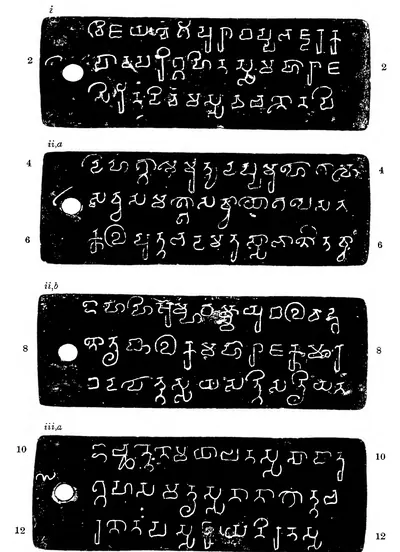 "Two Salankayana Charters from Kanukollu-Plate I. A.-Plates of Nandivarman (I), Year 14": plates i to iii a (Epigraphia Indica XXXI, Plate I, left half, between pp. 4 and 5 (PDF p. 24))Inscription rubbing · 1960
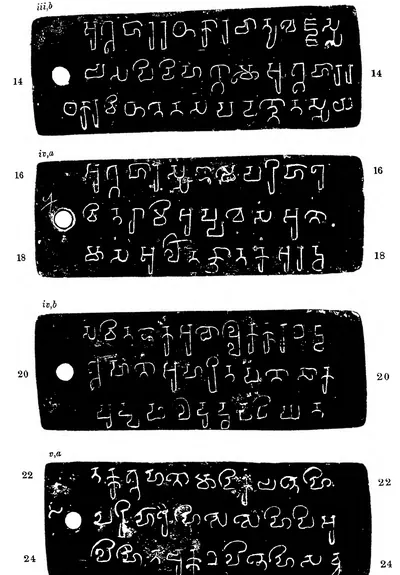 "Two Salankayana Charters from Kanukollu-Plate I. A.-Plates of Nandivarman (I), Year 14": plates iii b to v a (Epigraphia Indica XXXI, Plate I, right half, between pp. 4 and 5 (PDF p. 25))Inscription rubbing · 1960
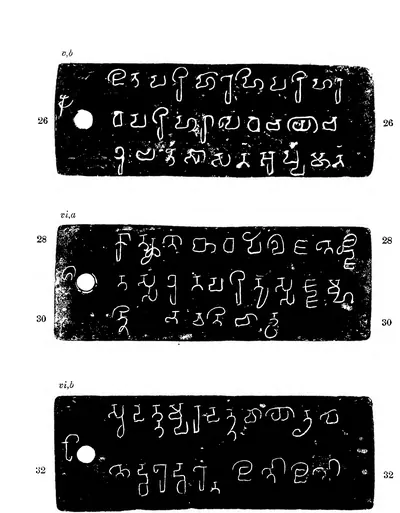 "Two Salankayana Charters from Kanukollu-Plate II. A.-Plates of Nandivarman (I), Year 14": plates v b to vi b (Epigraphia Indica XXXI, Plate II, left half, between pp. 6 and 7 (PDF p. 28))Inscription rubbing · 1960
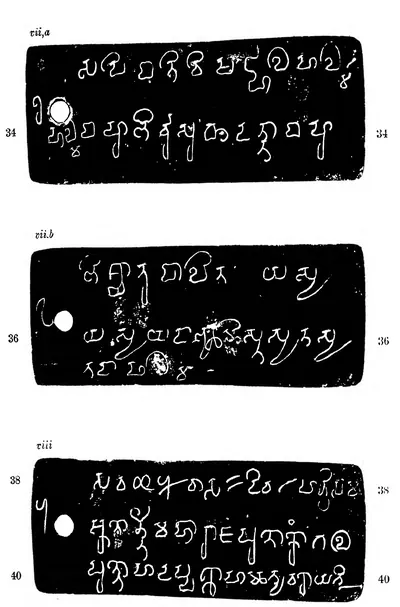 "Two Salankayana Charters from Kanukollu-Plate II. A.-Plates of Nandivarman (I), Year 14": plates vii a to viii (Epigraphia Indica XXXI, Plate II, right half, between pp. 6 and 7 (PDF p. 29))Inscription rubbing · 1960
References
Notes (0)
Sources (1)
Spotted an error on this page? Tell us
Last updated: