Aliya Rama Raya
Chief of the Aravidu family and son-in-law (aliya) of Krishnadeva Raya. After Achyuta Raya's death, he and his brothers Tirumala and Venkatadri overthrew the regent Salakam Timma. He placed Sadasiva on the throne in 1542 and ruled the empire in his name until 1565. His family's lands lay around Kurnool, Adoni and Gooty, and his governors held Kondavidu. He played the Deccan sultans against each other until they joined against him. He was captured and beheaded in the battle of January 1565.
Rama Raya was called Aliya, “son-in-law”, because he married a daughter of Krishnadeva Raya.12 He was the eldest of three Aravidu brothers who ruled the Vijayanagara empire in the name of King Sadasiva from 1542 until his death in 1565.12
Sewell wrote that Sadasiva was “virtually a prisoner in the hands of Rama Raya”.23 Rama Raya was at first in name his minister and later independent.23 The Muslim historians treated Rama Raya as king.23 See Vijayanagara.
Family
The Aravidu family traced its history to Somadeva Raja, who is credited with capturing seven forts.4 His descendant Pinnama is called lord of Aravidu.4 Pinnama’s son was Aravidu Bukka, a general of Saluva Narasimha.4
The Ramarajiyamu says that Aravidu Bukka had a son, Rama Raja, by his wife Balla Devi.5 This Rama Raja besieged and took Kurnool and made it his capital, and drove the chief of Adoni from his fort.5 He married Lakkamamba and had three sons, Timma, Konda and Sriranga.6 The first two governed Owk and Adoni.6
According to the Vasucharitramu, Sriranga and his wife Timmamba had five sons: Kona, Timma, Rama, Tirumala and Venkata.7 Rama was the most famous of them.7 Sewell’s later family tree calls Sriranga’s wife Tirumalamba.8
The Ramarajiyamu says that Rama Raya married Tirumalamba, the daughter of the Emperor Krishna Raya.9 By her he had two sons, Krishnapa and Pedda Timma.9 He also married Appalamba, Kondamma and Lakshmamma, and Lakshmamba bore him Sriranga Raya.9
Krishnaswami Aiyangar summed up the annals of Hande Anantapuram.10 According to his summary, Rama Raya’s brother Tirumala married a daughter of Krishnadeva Raya’s other queen, Chinna Devi.10 See Krishnadeva Raya and Tirumala.
The struggle of 1542
After Achyuta’s death his brothers-in-law, the Salakam Tirumalas, held power.11 Krishnaswami Aiyangar wrote that Rama Raya and his brothers were unhappy with Salakam Timma’s management, and they withdrew to Gooty.11 They raised forces in Adoni, Gooty, Penukonda, Gandikota and Kurnool, “where they found the most support”.11 They defeated Timma outside the capital and put Sadasiva on the throne.11
The annals of Hande Anantapuram add more.10 Krishnadeva Raya’s queens wished Rama Raya to rule as son-in-law.10 Salakam Timmaya called in the Deccan sultans.10 His own troops deserted him, thinking him “only a Golla (shepherd)”, and he was killed.10
Ferishta tells the story differently.121314 In his version Rama Raya is the heir of a minister he calls Heemraj, and a “Hoje” Tirumala is his rival.121314 Sewell thought that Ferishta had confused the minister Saluva Timma with the kings he served, “and made all three one person”.121314 See Achyuta Raya.
The real ruler
Krishnaswami Aiyangar wrote that the three brothers, the sons of the elder brothers and their nephews all appear in the wars against the sultans told in the Ramarajiyamu.11 He judged these Telugu accounts “of very great value read in combination with Ferishta”.11
Sewell traces how Rama Raya allied in turn with Ahmadnagar against Bijapur, and with Bijapur against Ahmadnagar.15 In 1551 he and the Nizam Shah took Raichur and Mudkal, which gave the doab back to Vijayanagara.15 He sheltered the future sultan of Golconda, Ibrahim Qutb Shah, and gave him an estate taken from one of his own officers.1617
In the early 1560s there was a joint campaign against Ahmadnagar.1819 After it, Golconda and Bijapur gave up land to him, and he won Ghanpur and Pangal from Golconda.1819 Sewell wrote: “It was the last Hindu success.”1819 See the Qutb Shahis.
The Ramarajiyamu lists his titles.209 They include:209
- ruler of the fort of Kondavidu
- ruler of the fort of Chandragiri
- protector of Udayagiri
- capturer of Kondapalli
- protector of Vinukonda
- builder of new fortifications at Nagarjunakonda
- protector of the city of Warangal
- “Hero who reduced the king of Rajmundri with his bow”209
Krishnaswami Aiyangar collected extracts that name his governors at Kondavidu.212223 They included Ramayamatya, who wrote the Sanskrit book on music Svaramelakalanidhi at Rama Raya’s order.212223 They also included his nephew Siddhiraju Timma Raju, author of a Telugu poem on the Alvars, and Pemmasani Timma.212223 See Kondavidu and Warangal.
Court and religion
Chenchiah and Bhujanga Rao wrote that the poet Bhattu Murti “adorned the court of Ramaraya”.247 He was called Ramarajabhushana, “jewel of the court of Rama Raja”.247 The Svaramelakalanidhi describes Rama Raya in his palace, which his minister Ramayamatya built.21 There he spent his time among scholars of literature and music.21
The Srivaishnava teacher Tatacharya was his guru.2526 The Madhva teacher Vijayindra received from him a “bathing in jewels” for his learning.2526 His cousins Rama Raju Vitthala and Chinna Timma led an expedition into the far south.1127 There they set up a pillar of victory on the Tamraparni.1127
The battle of 1565
Sewell follows Ferishta and blames the final war on Rama Raya’s pride.1828 He shamed the sultans’ envoys and refused them seats.1828 During the campaign against Ahmadnagar he let his troops dishonour mosques.1828
The sultans of Bijapur, Ahmadnagar, Golconda and Bidar joined together and met him south of the Krishna.293031 Sewell notes that Couto made him “ninety-six years old, but as brave as a man of thirty”.293031 He directed the battle from a litter.293031 He was seized when his bearers fled from an elephant.293031 He was beheaded on the order of Husain Nizam Shah, and his head was raised on a spear for the Hindu troops to see.293031
Sewell dates the battle to 23 January 1565, and his later work to 25 January.3233 In 1928 Krishnaswami Aiyangar summed up the policy of Sadasiva’s government under the brothers.34 It was a policy of alliances with the sultans in turn, “gratuitous insults offered to the Muhammadan religion”.34 It also showed “the foolish arrogance which united against him those by whose differences he might long have continued to prosper”.34 See Vijayanagara.
Footnotes
-
Sewell, A Forgotten Empire (1900), p. 181 and note (archive.org (opens in a new tab)). ↩ ↩2
-
Robert Sewell, A Forgotten Empire (Vijayanagar) (1900), p. 110 (archive.org (opens in a new tab)). ↩ ↩2 ↩3 ↩4 ↩5
-
Sewell, A Forgotten Empire (1900), p. 193 and note (archive.org (opens in a new tab)). ↩ ↩2 ↩3
-
Krishnaswami Aiyangar, Sources of Vijayanagar History (1919), p. 80, extract 28, the Ramarajiyamu (Narapativijayamu) (archive.org (opens in a new tab)). ↩ ↩2 ↩3
-
Krishnaswami Aiyangar, Sources of Vijayanagar History (1919), p. 102, extract 34, the Ramarajiyamu (archive.org (opens in a new tab)). ↩ ↩2
-
Krishnaswami Aiyangar, Sources of Vijayanagar History (1919), p. 103, the Ramarajiyamu (archive.org (opens in a new tab)). ↩ ↩2
-
Krishnaswami Aiyangar, Sources of Vijayanagar History (1919), p. 216, extract 66, the Vasucharitramu of Bhattu Murti (archive.org (opens in a new tab)). ↩ ↩2 ↩3 ↩4
-
Robert Sewell, ed. S. Krishnaswami Aiyangar, The Historical Inscriptions of Southern India (1932), p. 402 (archive.org (opens in a new tab)). ↩
-
Krishnaswami Aiyangar, Sources of Vijayanagar History (1919), p. 184, the Ramarajiyamu (archive.org (opens in a new tab)). ↩ ↩2 ↩3 ↩4 ↩5 ↩6
-
Krishnaswami Aiyangar, Sources of Vijayanagar History (1919), p. 178, extract 56, the annals of Hande Anantapuram (archive.org (opens in a new tab)). ↩ ↩2 ↩3 ↩4 ↩5 ↩6
-
S. Krishnaswami Aiyangar (ed.), Sources of Vijayanagar History (1919), introduction, p. 16 (archive.org (opens in a new tab)). ↩ ↩2 ↩3 ↩4 ↩5 ↩6 ↩7 ↩8
-
Sewell, A Forgotten Empire (1900), p. 113 (archive.org (opens in a new tab)). ↩ ↩2 ↩3
-
Sewell, A Forgotten Empire (1900), pp. 168–169 (archive.org (opens in a new tab)). ↩ ↩2 ↩3
-
Sewell, A Forgotten Empire (1900), pp. 169–170 and notes (archive.org (opens in a new tab)). ↩ ↩2 ↩3
-
Sewell, A Forgotten Empire (1900), p. 190 (archive.org (opens in a new tab)). ↩ ↩2
-
Sewell, A Forgotten Empire (1900), pp. 188–189 (archive.org (opens in a new tab)). ↩
-
Sewell, A Forgotten Empire (1900), p. 189, quoting Ferishta (archive.org (opens in a new tab)). ↩
-
Sewell, A Forgotten Empire (1900), pp. 196–197, quoting Ferishta (archive.org (opens in a new tab)). ↩ ↩2 ↩3 ↩4 ↩5 ↩6
-
Sewell, A Forgotten Empire (1900), p. 198 (archive.org (opens in a new tab)). ↩ ↩2 ↩3
-
Krishnaswami Aiyangar, Sources of Vijayanagar History (1919), pp. 182–183, extract 57, the Ramarajiyamu (archive.org (opens in a new tab)). ↩ ↩2 ↩3
-
Krishnaswami Aiyangar, Sources of Vijayanagar History (1919), p. 190, extract 58, the Svaramelakalanidhi of Ramayamatya (archive.org (opens in a new tab)). ↩ ↩2 ↩3 ↩4 ↩5
-
Krishnaswami Aiyangar, Sources of Vijayanagar History (1919), p. 211, extract 63, the Paramayogivilasamu of Siddhiraju Timma Raju (archive.org (opens in a new tab)). ↩ ↩2 ↩3
-
Krishnaswami Aiyangar, Sources of Vijayanagar History (1919), p. 112, note (archive.org (opens in a new tab)). ↩ ↩2 ↩3
-
P. Chenchiah and Raja M. Bhujanga Rao, A History of Telugu Literature (1928), p. 80 (archive.org (opens in a new tab)). ↩ ↩2
-
Krishnaswami Aiyangar, Sources of Vijayanagar History (1919), p. 202, extract 60, the Prapannamritam (archive.org (opens in a new tab)). ↩ ↩2
-
Krishnaswami Aiyangar, Sources of Vijayanagar History (1919), p. 252, extract 84, the Raghavendravijaya (archive.org (opens in a new tab)). ↩ ↩2
-
Krishnaswami Aiyangar, Sources of Vijayanagar History (1919), p. 205, extract 61, the Balabhagavatam of Konerunatha (archive.org (opens in a new tab)). ↩ ↩2
-
Sewell, A Forgotten Empire (1900), p. 197 (archive.org (opens in a new tab)). ↩ ↩2 ↩3
-
Sewell, A Forgotten Empire (1900), p. 203 (archive.org (opens in a new tab)). ↩ ↩2 ↩3 ↩4 ↩5
-
Sewell, A Forgotten Empire (1900), p. 204 (archive.org (opens in a new tab)). ↩ ↩2 ↩3 ↩4 ↩5
-
Sewell, A Forgotten Empire (1900), p. 205 (archive.org (opens in a new tab)). ↩ ↩2 ↩3 ↩4 ↩5
-
Sewell, A Forgotten Empire (1900), p. 202 (archive.org (opens in a new tab)). ↩
-
Sewell, Historical Inscriptions (1932), p. 403, notes to the pedigrees (archive.org (opens in a new tab)). ↩
-
S. Krishnaswami Aiyangar, “Hindu States in Southern India”, in Wolseley Haig (ed.), The Cambridge History of India, Vol. III (1928), p. 499 (archive.org (opens in a new tab)). ↩ ↩2 ↩3
Photos
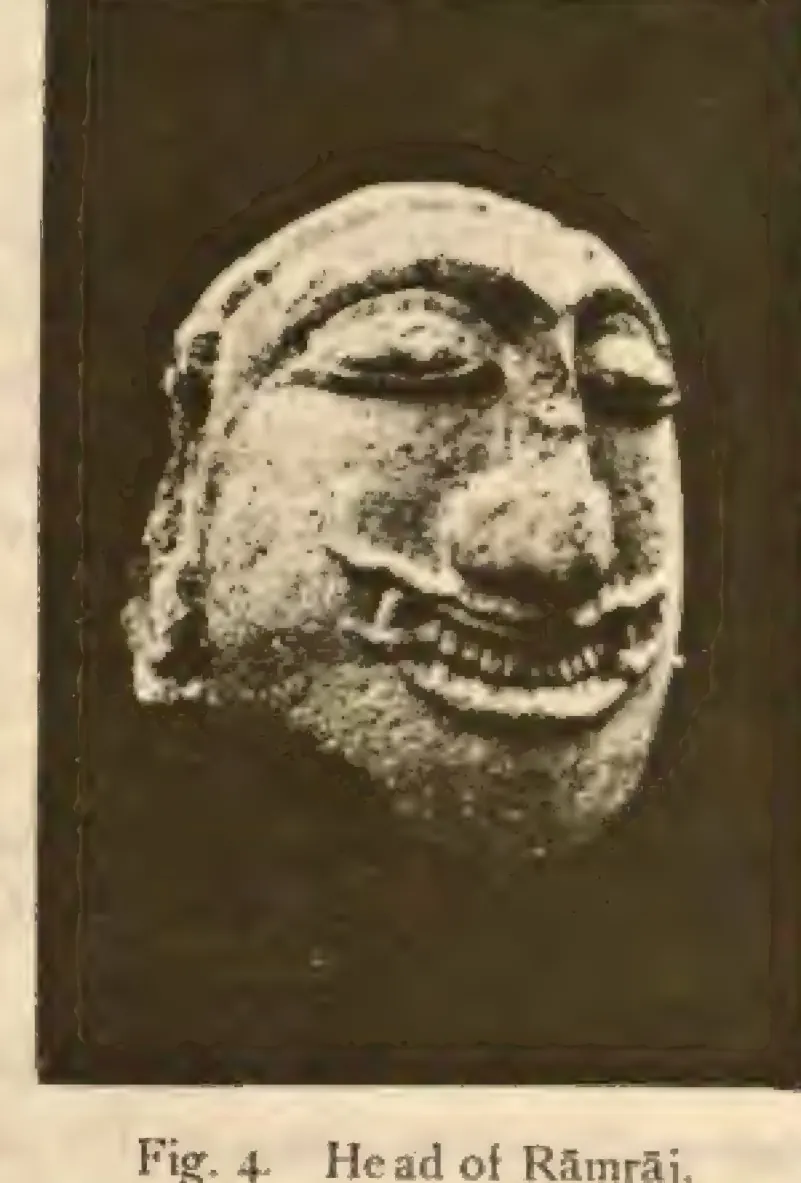
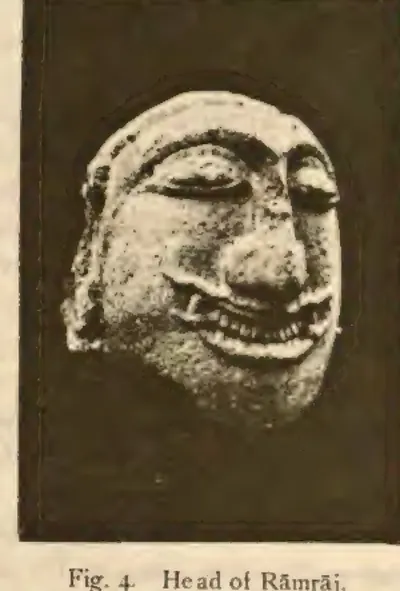 "Head of Ramraj": stone head found in the Taj Bauri at Bijapur, by tradition the effigy of Rama Raya set in the citadel wall (Cousens 1916, p. 9, fig. 4)Photograph · 1916
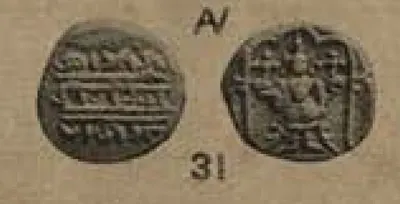 Gold coin attributed to Rama Raja, the "Gandikota pagoda": Vishnu standing under a canopy (V. A. Smith, Catalogue of the Coins in the Indian Museum, Vol. I, 1906, plate XXX, 31 (PDF p. 427))Coin · 1906
Related
Dynasties
References
Notes (0)
Sources (5)
Spotted an error on this page? Tell us
Last updated: