Kazipet Dargah pillar inscription
A damaged Sanskrit and Kannada pillar inscription, now in the Dargah at Kazipet near Hanamkonda. It records a Kakatiya grant of 1090 to a Kalamukha teacher of Srisailam. It also records that Beta II's son Dugga-Tribhuvanamalla set up the pillar in 1098. Its verses are the main source for the earliest Kakatiya chiefs, Beta I, Prola I and Beta II.
The pillar
The inscription is cut on a stone pillar that now stands in the Dargah of Hazrat Syed Shah Afzal Biyabani at Kazipet.1 Kazipet is in the old Warangal taluk near Hanamkonda, and the Dargah is not far from the railway station.1
The pillar is damaged, and part of each of its four sides is lost.21 The opening lines were already missing when the record was edited.21 But a copy in the Mackenzie manuscripts had preserved a few of them.21
P. Sreenivasachar published the record in 1940 as No. 7 of his Corpus of Inscriptions in the Telingana Districts.1 He thought the pillar probably carries two separate records, made within a few years of each other.1 He noted that the letters, in the transitional Telugu-Kannada script of the period, have the angular tops of modern Kannada letters.3
The Sanskrit verses
The first part is in Sanskrit verse, composed by the poet Devanabhatta, chief of Odikonda.4 It opens with Beta, lord of the city of Kakati.5 It says that he was born in a family called Samanta-visti, and credits him with churning the ocean of the Chola army.5
His son Prola is said to have set the Chakrakuta district in order, put a chief called Bhadranga to flight and conquered the Konkana country.4 He is also said to have defeated a son of Dugga of Kadparti and killed Gonna, lord of Purakuta.4 He received from the Chalukya king Trailokyamalla a charter that gave him the Anmakonda (Hanamkonda) district permanently.4
Prola’s son, king Beta, is praised as a lion to the Malava and Chola kings.4 At Anmakonda he laid out a garden and a tank called Sivapura and built a temple named after himself.4 A king with the title Chalamartiganda set up the pillar for the merit of his parents and himself, as a pillar of his family’s fame.4
The Kannada record
The second part is in Kannada prose.46 It names the Western Chalukya emperor Tribhuvanamalla (Vikramaditya VI) as the reigning king.46 It names the mahamandaleshvara (great provincial lord) Kakatiya Betarasa, lord of Anmakonda, as his feudatory.46 It locates Sivapura south-west of Anmakonda.46
On a solar eclipse in Saka 1012 (Saka is an Indian way of counting years), the year Pramoda, the village was given to Rameshvara Pandita of Appa-parvata, after the donee’s feet had been washed.6 He was a Kalamukha ascetic and head of the Mallikarjuna Sila-matha at Sriparvata.6 The grant extended to his line of disciples.6
The text then praises the mahamandaleshvara Dugga-Tribhuvanamalla.6 It says that the pillar was set up in the year Bahudhanya at the winter solstice (Uttarayana-sankranti).6 A last clause records that the merchant body (nakara) of Anmakonda gave one mana (a measure) of oil a day for a perpetual lamp to the god Uma-Beteshvara.7
Dates
Sreenivasachar worked out the eclipse of Saka 1012 as Sunday, 24 November 1090.81 He worked out the Bahudhanya solstice as probably Saturday, 25 December 1098.81 Epigraphia Telanganica repeats the first date.9
Who made the grant
Sreenivasachar’s translation attributes the grant of 1090 to Betarasa’s son, that is, to Dugga.6 P. V. Parabrahma Sastry read the record differently. In his reading, Beta II founded the village of Sivapura and its Beteshvara temple in 1090.1011 He took the temple’s later endowments to have been recorded when Beta’s son Durgaraja set up the pillar, which he dated to 1097–98.1011
Parabrahma Sastry used the pillar to show that Beta II had a son named Durgaraja, besides Prola II.12 This son also bore the title Tribhuvanamalla.12 Before the Sanigaram inscription of 1107 was found, scholars took this record to show that Beta II lived only until about 1090.13
Readings of the verses
The verses are the main source for the career of Prola I, and the readings differ. Sreenivasachar took Prola to have driven the son of Dugga of Kadparti into the forest.4 Parabrahma Sastry read the same words as a victory over a neighbouring chief, Annaya of the great forest, son of Durga of Kadparti.10 He took the charter from Trailokyamalla to be the moment when the Kakatiyas first held the Anumakonda district as a permanent fief (land held from an overlord).10
The family name Samanta-visti has also been discussed. Parabrahma Sastry took visti to be a corrupt form of Vrishni, a clan from which some Rashtrakuta families claimed descent.14 He saw in it a sign of the family’s Rashtrakuta origin.14
Epigraphia Telanganica discussed the Mangallu grant of about 956, which names the earliest known Kakatiya chiefs.15 It proposed that the grant’s doubtful family name, read as Voddi or Votti, is a corrupt form of the same word.15
The claim that Beta I churned the Chola army has been dated in different ways. N. Venkataramanayya and M. Somasekhara Sarma linked it to the Chalukya Someshvara I’s first campaign against Kanchi in 1052, as Epigraphia Telanganica reports.16 Parabrahma Sastry pointed out that the Chalukyas and Cholas fought many times before then.17 He added that Beta could have earned the epithet in any of those wars.17
Editions
The record was edited, with a plate, as No. 7 in Sreenivasachar’s Corpus, Part II (1940), pp. 25–31.281 The date is worked out on p. 178, and the entry in the list of inscriptions is on p. 185.281 Epigraphia Telanganica, vol. 2 (2023), reprints the Corpus translation.918 It also summarises the entries in the government Catalogue of Inscriptions copied up to 1964 (pp. 108–109) and in Inscriptions of Warangal District (2016), pp. 30–35.918
Footnotes
-
P. Sreenivasachar (ed.), A Corpus of Inscriptions in the Telingana Districts, Part II (1940), p. 185, list of inscriptions, No. 7 (archive.org (opens in a new tab)). Paraphrased. ↩ ↩2 ↩3 ↩4 ↩5 ↩6 ↩7 ↩8 ↩9 ↩10 ↩11
-
Sreenivasachar, Corpus, Part II (1940), p. 25 (archive.org (opens in a new tab)). Paraphrased. ↩ ↩2 ↩3 ↩4 ↩5
-
P. Sreenivasachar (ed.), A Corpus of Inscriptions in the Telingana Districts, Part I: Introduction (1942), p. 1 (archive.org (opens in a new tab)). Paraphrased. ↩
-
Sreenivasachar, Corpus, Part II (1940), p. 29, verses 2–6 and lines 33–50 (archive.org (opens in a new tab)). Paraphrased. ↩ ↩2 ↩3 ↩4 ↩5 ↩6 ↩7 ↩8 ↩9 ↩10 ↩11 ↩12
-
Sreenivasachar, Corpus, Part II (1940), p. 28, verse 1 (archive.org (opens in a new tab)). Paraphrased. ↩ ↩2
-
Sreenivasachar, Corpus, Part II (1940), p. 30, lines 42–82 (archive.org (opens in a new tab)). Paraphrased. ↩ ↩2 ↩3 ↩4 ↩5 ↩6 ↩7 ↩8 ↩9 ↩10
-
Sreenivasachar, Corpus, Part II (1940), p. 31, lines 83–87 (archive.org (opens in a new tab)). Paraphrased. ↩
-
Sreenivasachar, Corpus, Part II (1940), p. 178, appendix of dates, No. 5 (archive.org (opens in a new tab)). Paraphrased. ↩ ↩2 ↩3 ↩4
-
Gajjala Vasanta Lakshmi (ed.), Epigraphia Telanganica, vol. 2 (2023), p. 41, No. 14. ↩ ↩2 ↩3
-
Parabrahma Sastry, The Kakatiyas of Warangal (1978), p. 45. ↩ ↩2 ↩3 ↩4
-
P. V. Parabrahma Sastry, The Kakatiyas of Warangal (1978), p. 49. ↩ ↩2
-
Parabrahma Sastry, The Kakatiyas of Warangal (1978), p. 32. ↩ ↩2
-
Epigraphia Telanganica, vol. 2 (2023), p. 27, reprinting P. V. Parabrahma Sastry, “Sanigaram Epigraphs of the Early Kakatiyas”, Epigraphia Andhrica IV (1975). ↩
-
Parabrahma Sastry, The Kakatiyas of Warangal (1978), p. 20. ↩ ↩2
-
Epigraphia Telanganica, vol. 2 (2023), p. 324. ↩
-
Epigraphia Telanganica, vol. 2 (2023), p. 26, reprinting Parabrahma Sastry, “Sanigaram Epigraphs” (1975). ↩ ↩2
Photos
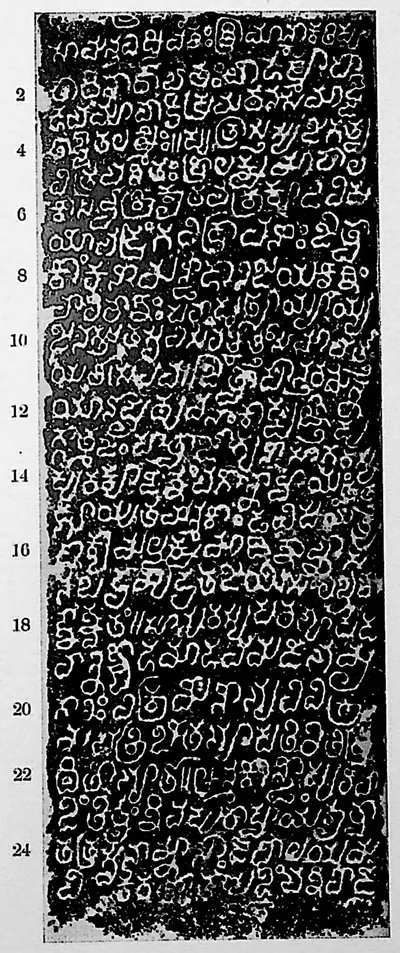 "Kāzipet inscription in the Dargāh", face I (Sreenivasachar, Corpus of Inscriptions in the Telingana Districts II, Plate 9 (PDF p. 238))Inscription rubbing · 1940
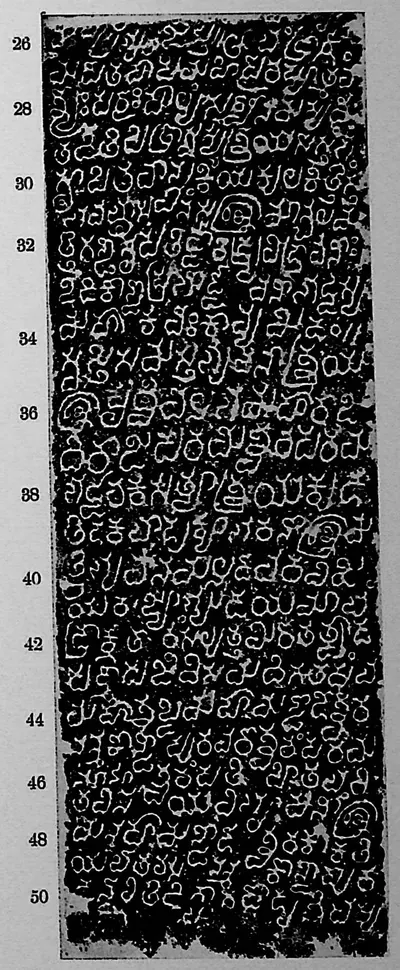 "Kāzipet inscription in the Dargāh", face II (Sreenivasachar, Corpus of Inscriptions in the Telingana Districts II, Plate 9 (PDF p. 238))Inscription rubbing · 1940
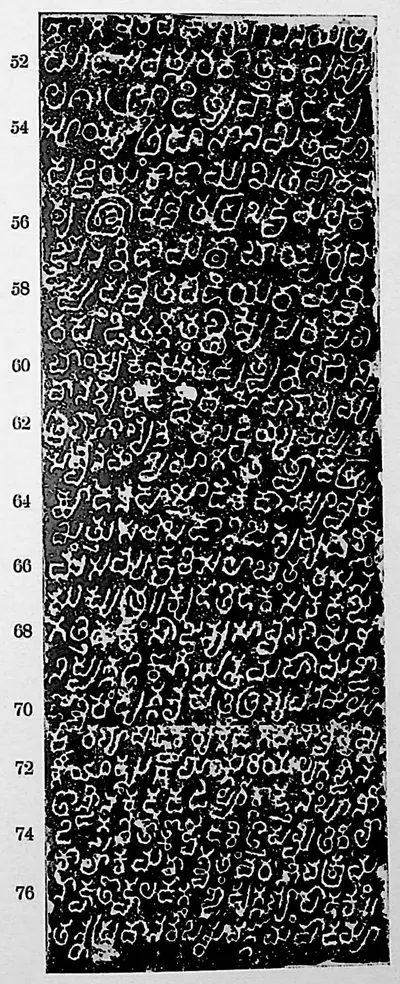 "Kāzipet inscription in the Dargāh", face III (Sreenivasachar, Corpus of Inscriptions in the Telingana Districts II, Plate 10 (PDF p. 240))Inscription rubbing · 1940
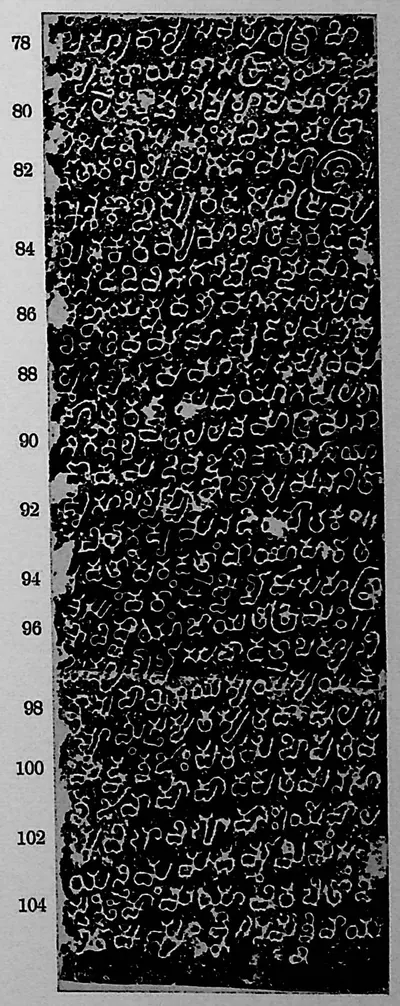 "Kāzipet inscription in the Dargāh", face IV (Sreenivasachar, Corpus of Inscriptions in the Telingana Districts II, Plate 10 (PDF p. 240))Inscription rubbing · 1940
References
Notes (0)
Sources (4)
Spotted an error on this page? Tell us
Last updated: