Kopparam plates of Pulakesin II
A Sanskrit copper-plate grant of the 21st year of the Chalukya king Pulakesin II, probably 631, found near Kopparam in the Narasaraopet taluk of the Guntur district. It gives a field of 800 nivartanas in Karmarashtra to a Brahmana of Mugamur. E. Hultzsch read its 'Prithividuvaraja' as Pulakesin's brother Vishnuvardhana, still a subordinate in that year. Its first editor, K. V. Lakshmana Rao, identified him with another Chalukya prince.
The Kopparam plates are a grant of Pulakesin II found on the Telugu coast. They show the Chalukyas of Badami granting land in Karmarashtra, in the Guntur country, about 631.123 Their executor may have been his brother Vishnuvardhana, the founder of the Eastern Chalukya line.123
Discovery and editions
The plates were found near Kopparam in the Narasaraopet taluk of the Guntur district.1 K. V. Lakshmana Rao of the Telugu Encyclopaedia Office, Madras, first described and edited them in the Annals of the Bhandarkar Institute.1 E. Hultzsch re-edited them in Epigraphia Indica XVIII (1926) from ink impressions sent to him by H. Krishna Sastri.1 He did so because he believed he could improve a few of the readings.1 Hultzsch’s text runs over three plates: the first, both sides of the second, and the third.24
Hultzsch thought that “the composer of the text knew so little Sanskrit that in some places it is difficult to divine what he really wanted to express”.1 He gave one example.1 The text calls Pulakesin the “dear grandson” of Kirtivarman I.1 As Lakshmana Rao had said, this “must be a stupid error” for “dear son”.1
The grant
The king is “the glorious Pulakesi-Prithivivallabha-Maharaja”, like his father a hero and the “abode of truth” (Satyasraya).15 He informs the officials of the district of the grant.15 A field of eight hundred nivartanas in the village of Irbuli in Karmarashtra was given to the Brahmana Vedasarman.15 He was of the Sandilyayana gotra (clan), a follower of the Apastamba sutra, and lived at Mugamur.15
The field had these boundaries:15
- east of the Balaka pond15
- west of the Karmakara tank15
- south of the road to Kondaverupur15
- north of the road to Virparu15
Lakshmana Rao identified Kondaverupur with Kondavidu and Virparu with Vipparla, both in the Narasaraopet taluk.2 He identified Mugamur with Mungamur in the Kandukur taluk of the Nellore district.2
Prithividuvaraja
The grant was made with “Vallabha” (Pulakesin) “being present in person”.5 Its execution was entrusted to “Prithividuvaraja”.5 This warrior had defeated the circle of enemies by his arm and “secured the kingdom to the lineage of his son”.5 Lakshmana Rao identified him with Satyasraya-Dhruvaraja-Indravarman of the Goa plates.2
Hultzsch proposed instead that duvaraja is a Dravidian form of yuvaraja, “heir-apparent”.2 In his view “Prithiviyuvaraja” was Vishnuvardhana, the younger brother of Pulakesin II and founder of the Eastern Chalukya dynasty.2 If so, Hultzsch concluded, Vishnuvardhana “continued to be dependent on Pulakesin II” in the 21st year of his reign.2
This sits uneasily with other evidence. A grant of Vishnuvardhana’s own 18th year, which Fleet dated to 632, already gives him the title Maharaja.26 Fleet held that he had become an independent king before 632.26
Date
The grant is dated in the 21st year of the reign, in the month of Karttika, on “the great ninth” (mahanavami), a Thursday.2 In a postscript Robert Sewell checked the years 628 to 631.53 He found that only 631 fits: the ninth of the bright half of Karttika fell on Thursday, 10 October 631.53 That would put Pulakesin’s accession on or after 11 October 610.53 Sewell noted that Fleet had dated the accession to 610–11, R. G. Bhandarkar to 610 or 611, and Jouveau-Dubreuil to 609.53
Footnotes
-
E. Hultzsch, “Kopparam Plates of Pulakesin II”, Epigraphia Indica XVIII (1926), p. 257 (archive.org (opens in a new tab)). ↩ ↩2 ↩3 ↩4 ↩5 ↩6 ↩7 ↩8 ↩9 ↩10 ↩11 ↩12 ↩13 ↩14 ↩15 ↩16 ↩17 ↩18 ↩19
-
Hultzsch, “Kopparam Plates” (1926), p. 258 (archive.org (opens in a new tab)). ↩ ↩2 ↩3 ↩4 ↩5 ↩6 ↩7 ↩8 ↩9 ↩10 ↩11 ↩12
-
R. Sewell, postscript to Hultzsch, “Kopparam Plates”, Epigraphia Indica XVIII (1926), p. 261 (archive.org (opens in a new tab)). ↩ ↩2 ↩3 ↩4 ↩5 ↩6
-
Hultzsch, “Kopparam Plates” (1926), p. 259 (archive.org (opens in a new tab)). ↩
-
Hultzsch, “Kopparam Plates” (1926), p. 260, translation and R. Sewell’s postscript (archive.org (opens in a new tab)). ↩ ↩2 ↩3 ↩4 ↩5 ↩6 ↩7 ↩8 ↩9 ↩10 ↩11 ↩12 ↩13 ↩14 ↩15 ↩16
-
J. F. Fleet, “Dynasties of the Kanarese Districts”, Gazetteer of the Bombay Presidency I, pt. II (1896), p. 352 (archive.org (opens in a new tab)). ↩ ↩2
Photos
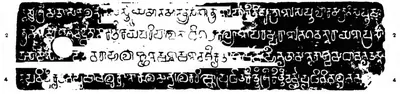 "Kopparam Plates of Pulakesin II", plate i (Epigraphia Indica XVIII, plate between pp. 258 and 259 (PDF p. 325))Inscription rubbing · 1926
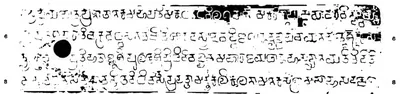 "Kopparam Plates of Pulakesin II", plate ii a (Epigraphia Indica XVIII, plate between pp. 258 and 259 (PDF p. 325))Inscription rubbing · 1926
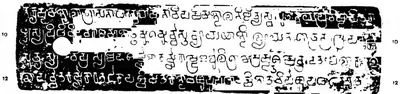 "Kopparam Plates of Pulakesin II", plate ii b (Epigraphia Indica XVIII, plate between pp. 258 and 259 (PDF p. 325))Inscription rubbing · 1926
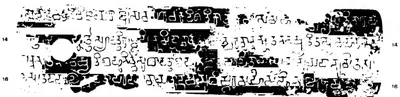 "Kopparam Plates of Pulakesin II", plate iii (Epigraphia Indica XVIII, plate between pp. 258 and 259 (PDF p. 325))Inscription rubbing · 1926
References
Notes (0)
Sources (2)
Spotted an error on this page? Tell us
Last updated: