Kubja Vishnuvardhana
Younger brother of the Chalukya king Pulakesin II of Badami and founder of the Eastern Chalukya dynasty of Vengi. He served his brother as heir-apparent and governed the newly conquered east coast. He became an independent king there by 632 at the latest. His reign is usually dated 615–633, but scholars have put the start of his rule in Vengi anywhere from about 605 to after 631.
Vishnuvardhana, known in the later records of his family as Kubja-Vishnuvardhana, founded the line of kings that ruled Vengi for some four and a half centuries. Vengi is the coastal country between the Krishna and the Godavari. J. F. Fleet called it the Eastern Branch of the Chalukya family, “which held that part of the country for five centuries at least”.1 See Eastern Chalukyas.
Family and names
Kubja Vishnuvardhana was the younger brother of the Chalukya king Pulakesin II of Badami.1 Like his brother, Kubja Vishnuvardhana was a son of Kirtivarman I.1 The Timmapuram plates trace his descent one step further back. They make him the grandson of Ranavikrama, that is Pulakesin I, and the great-grandson of Ranaraga.2
His own grants call him simply Vishnuvardhana, and later records of the dynasty call him Kubja-Vishnuvardhana.1 Fleet noted that kubja means “hump-backed”, but also “a curved sword, a scimitar”.1
The seal of his earliest grant names him Bittarasa, “king Bitti or Bitta”.1 Fleet thought this Prakrit name was the one given at birth.1 In his view it was turned into the Sanskrit Vishnuvardhana when he was made heir-apparent (yuvaraja).1
His grants give him the title Vishamasiddhi.3 One of them explains it as “success against fortresses, difficult of access, on the plains, in the water, in the woods, and on hills”.3 The grants of his son Jayasimha I add a second surname, Makaradhvaja (“Cupid”).4 He was said to surpass Cupid in beauty.4
Ayyana-mahadevi was a queen of Kubja Vishnuvardhana.5 A grant of the time of his great-grandson Vishnuvardhana III gave a village to a Jain temple at Bijavada (Vijayawada, then Bezwada).5 It named her as its executor (ajnapti). The epigraphist who examined it in 1917 thought the charter renewed an older grant made by her, which bore her husband’s seal.5 See Vishnuvardhana III.
Heir-apparent in the west
Pulakesin II came to the Chalukya throne in 609 or 610.6 According to his Aihole inscription, he took the strong fortress of Pishtapura (Pithapuram) on the east coast.6 He also drove the Pallava king back behind the walls of Kanchi.6 Robert Sewell describes the same campaign as driving the Pallava Mahendravarman I out of the northern Telugu country.7
Fleet argued that a king campaigning so far from home needed someone with full authority there.6 In his view Vishnuvardhana was made yuvaraja for this purpose in 615.6
A grant he issued as yuvaraja was found at Satara.8 It gives a village on the south bank of the Bhima river.8 It is dated in the eighth year of “the glorious Maharaja” Pulakesin, 616 or 617.8 It shows him still acting in the western Chalukya country.8
The Godavari district gazetteer tells a similar story.9 In its account Vishnuvardhana was regent at Badami while his brother was away, and was then sent to govern the newly conquered land.9
From governor to king
How he became independent is not recorded. Fleet left open whether the kingdom was divided by agreement or whether the younger brother rebelled.1 But he held that it happened before 632.1 Three grants show stages of the change.
- The Timmapuram plates were found in the Sarvasiddhi taluk of the Visakhapatnam (then Vizagapatam) district and were issued from Pishtapura. E. Hultzsch noticed that they give Pulakesin II the boast of having subdued “the circle of the whole earth”. Vishnuvardhana only claims to have humbled “the circle of all the vassals”. Hultzsch concluded that Vishnuvardhana was still his brother’s dependant when they were issued.2
- The Kopparam plates come from the Narasaraopet taluk of the Guntur district. They are a grant of Pulakesin II himself in the Karmarashtra district, dated in his 21st year.10 Their executor is a Prithividuvaraja, who had “secured the kingdom to the lineage of his son”.10 Hultzsch read the name as Prithivi-yuvaraja, “heir-apparent of the earth”, and identified him with Vishnuvardhana.10 On this reading Vishnuvardhana was still dependent on Pulakesin in that year.10 K. V. Lakshmana Rao, the first editor of the plates, had identified the warrior with another Chalukya prince, Dhruvaraja Indravarman of the Goa plates.10 In a postscript, Sewell calculated that the date fell on Thursday, 10 October 631. Pulakesin’s accession must then have fallen on or after 11 October 610.11
- The Chipurupalle grant comes from the Visakhapatnam district. It is dated in Vishnuvardhana’s own 18th year, on a day Fleet calculated as 7 July 632.128 In it he uses the royal title Maharaja. The village granted lay in the Dimila district, near modern Dimile. For Fleet this showed that his rule now lay on the east coast, far from the western Chalukya lands.128
His regnal years were counted from his appointment as yuvaraja, not from his independence.113 So the dynasty’s records give him eighteen years.113 The gazetteer places his capital at Pedda Vegi near Eluru (then Ellore).9
Sewell credited him with crushing the old kingdom of Kalinga about 615.14 Sewell also followed the view that the Vishnukundin king Madhava III lost his kingdom about 610.15 In this view he lost it to the Chalukyas Mangalesha, Kubja Vishnuvardhana and Pulakesin II.15
Buddha, the first known chief of the Kondapadumati family, is said to have received his territory from Kubja Vishnuvardhana.16 A later record names one of his followers, Kalakampa of the Pattavardhini family.1 With the king’s permission, Kalakampa killed a king named Daddara in battle.1
Religion and coins
In the Timmapuram plates Vishnuvardhana calls himself a worshipper of Bhagavat, that is of Vishnu.2 Hultzsch noted that his surname Vishamasiddhi also forms the legend of certain copper coins found in the Visakhapatnam district.2
The Chinese pilgrim Hiuen Tsang visited the kingdom of Vengi in this period.17 The gazetteer sums up his account.17 It describes a country nearly 1,000 miles round, with a capital about seven miles round.17 The country was thinly peopled, perhaps because of the recent conquest, and its many Buddhist monasteries lay deserted.17
Death and successors
The Pithapuram pillar inscription of 1202 lists the reigns of the whole dynasty.13 It says that Kubja-Vishnuvardhana “ruled over the country of Vengi for eighteen years”.13 Sewell, following Fleet, dates his reign 615–633.1819 He dates his death to 633, when his son Jayasimha I succeeded.1819
Indra-Bhattaraka was a younger son of Kubja Vishnuvardhana.20 His own grant, the Kondanaguru plates, names him Indravarman, son of Vishnuvardhana and grandson of Kirtivarman.20 It gives him the surname Tyagadhenu.20
He is remembered as reigning for only seven days, after his brother.21 Sewell suggested that he had governed the Godavari tract for his father.21 Fleet thought that Indra-Bhattaraka never actually took the throne.22 In Fleet’s view a coalition of chiefs stopped him, perhaps led by the Ganga king Indravarman of Kalinga.22
When did his reign begin?
The dynasty’s grants give the length of each reign, but no fixed date until the coronation of Amma II in 945.23 So the founder’s starting year has to be worked out by counting back, and scholars have reached different results.23
| Source | Start of Vishnuvardhana’s years |
|---|---|
| A. C. Burnell (1878)24 | About 620, in his table of the dynasty |
| Gordon Mackenzie, Kistna manual (1883)25 | Vengi given to him about 605 |
| E. Hultzsch (1890)26 | About Saka 526–27, that is about 604–605 |
| J. F. Fleet (1891)276 | March–April 615, his installation as yuvaraja; independent before 632 |
| F. R. Hemingway, Godavari gazetteer (1907)9 | Conquest about 615; independent by 632 |
| E. Hultzsch, Kopparam plates (1926)10 | Still dependent on Pulakesin II in the latter’s 21st year (631 by Sewell’s calculation) |
| V. Rangacharya (1928)28 | Follows Fleet: on the throne from between 21 March and 19 April 615, ruling till at least July 632 |
| Robert Sewell (1932)7 | Ruler of Vengi from 615, in effect king from the year after 8 July 614 |
Fleet rejected the earlier dates because they would place the start of Vishnuvardhana’s years before the accession of his elder brother Pulakesin II.2930 Before that accession, Fleet argued, he could only have been yuvaraja for his uncle Mangalesha.2930 Mangalesha was trying to secure the throne for his own son.2930 Fleet found that only the eclipse of 7 July 632 fitted both the Chipurupalle grant and two dated grants of Vishnuvardhana II.30
Footnotes
-
Fleet, “Chronology of the Eastern Chalukya Kings” (1891), p. 95 (archive.org (opens in a new tab)). ↩ ↩2 ↩3 ↩4 ↩5 ↩6 ↩7 ↩8 ↩9 ↩10 ↩11 ↩12 ↩13 ↩14
-
E. Hultzsch, “Timmapuram Plates of Vishnuvardhana I. Vishamasiddhi”, Epigraphia Indica IX (1907–08), p. 317 and note 2 (archive.org (opens in a new tab)). ↩ ↩2 ↩3 ↩4
-
Fleet, “Chipurupalle Copper-plate Grant” (1891), p. 17, translation (archive.org (opens in a new tab)). ↩ ↩2
-
E. Hultzsch, “Niduparu Grant of Jayasimha I”, Epigraphia Indica XVIII (1925–26), p. 55 (archive.org (opens in a new tab)). ↩ ↩2
-
Annual Report on Epigraphy, Southern Circle, for 1916–17 (G.O. No. 1035, Home (Education), 10 August 1917), p. 116, paragraph 21 (archive.org (opens in a new tab)). ↩ ↩2 ↩3
-
Fleet, “Chronology of the Eastern Chalukya Kings” (1891), p. 94 (archive.org (opens in a new tab)). ↩ ↩2 ↩3 ↩4 ↩5 ↩6
-
Robert Sewell and S. Krishnaswami Aiyangar, The Historical Inscriptions of Southern India (1932), p. 22 (archive.org (opens in a new tab)). ↩ ↩2
-
Fleet, “Chronology of the Eastern Chalukya Kings” (1891), p. 96 (archive.org (opens in a new tab)). ↩ ↩2 ↩3 ↩4 ↩5 ↩6
-
F. R. Hemingway, Madras District Gazetteers: Godavari (1907), p. 19 (archive.org (opens in a new tab)). ↩ ↩2 ↩3 ↩4
-
E. Hultzsch, “Kopparam Plates of Pulakesin II”, Epigraphia Indica XVIII (1925–26), pp. 257–258 (archive.org (opens in a new tab)). ↩ ↩2 ↩3 ↩4 ↩5 ↩6
-
Robert Sewell, postscript to Hultzsch, “Kopparam Plates of Pulakesin II”, Epigraphia Indica XVIII (1925–26), pp. 260–261 (archive.org (opens in a new tab)). ↩
-
J. F. Fleet, “Chipurupalle Copper-plate Grant of Vishnuvardhana I”, Indian Antiquary XX (1891), p. 16 (archive.org (opens in a new tab)). ↩ ↩2
-
E. Hultzsch, “Pithapuram Pillar Inscription of Mallapadeva”, Epigraphia Indica IV (1896–97), p. 239 (archive.org (opens in a new tab)). ↩ ↩2 ↩3 ↩4
-
Sewell and Aiyangar, Historical Inscriptions of Southern India (1932), p. 357 (archive.org (opens in a new tab)). ↩
-
Sewell and Aiyangar, Historical Inscriptions of Southern India (1932), p. 404 (archive.org (opens in a new tab)). ↩ ↩2
-
Sewell and Aiyangar, Historical Inscriptions of Southern India (1932), p. 362 (archive.org (opens in a new tab)). ↩
-
Hemingway, Godavari (1907), p. 20 (archive.org (opens in a new tab)). ↩ ↩2 ↩3 ↩4
-
Sewell and Aiyangar, Historical Inscriptions of Southern India (1932), p. 336, table of the Eastern Chalukya dynasty (archive.org (opens in a new tab)). ↩ ↩2
-
Sewell and Aiyangar, Historical Inscriptions of Southern India (1932), p. 23 (archive.org (opens in a new tab)). ↩ ↩2
-
E. Hultzsch, “Kondanaguru Grant of Indravarman”, Epigraphia Indica XVIII (1925–26), pp. 1–2 (archive.org (opens in a new tab)). ↩ ↩2 ↩3
-
Sewell and Aiyangar, Historical Inscriptions of Southern India (1932), p. 25 (archive.org (opens in a new tab)). ↩ ↩2
-
Fleet, “Chronology of the Eastern Chalukya Kings” (1891), p. 97 (archive.org (opens in a new tab)). ↩ ↩2
-
J. F. Fleet, “The Chronology of the Eastern Chalukya Kings”, Indian Antiquary XX (1891), p. 1 (archive.org (opens in a new tab)). ↩ ↩2
-
A. C. Burnell, Elements of South-Indian Palaeography (2nd ed., 1878), p. 21, note 1 (archive.org (opens in a new tab)). ↩
-
Gordon Mackenzie, A Manual of the Kistna District (1883), p. 6 (archive.org (opens in a new tab)). ↩
-
E. Hultzsch, South-Indian Inscriptions, Vol. I (1890), p. 32, pedigree of the Eastern Chalukya dynasty (archive.org (opens in a new tab)). ↩
-
Fleet, “Chronology of the Eastern Chalukya Kings” (1891), p. 12, list of the kings (archive.org (opens in a new tab)). ↩
-
V. Rangacharya, “The Pulibumra Plates of the Eastern Chalukya King Jayasimha I”, Epigraphia Indica XIX (1927–28), p. 255 (archive.org (opens in a new tab)). ↩
-
Fleet, “Chronology of the Eastern Chalukya Kings” (1891), p. 4 (archive.org (opens in a new tab)). ↩ ↩2 ↩3
-
Fleet, “Chronology of the Eastern Chalukya Kings” (1891), p. 10 (archive.org (opens in a new tab)). ↩ ↩2 ↩3 ↩4
Photos
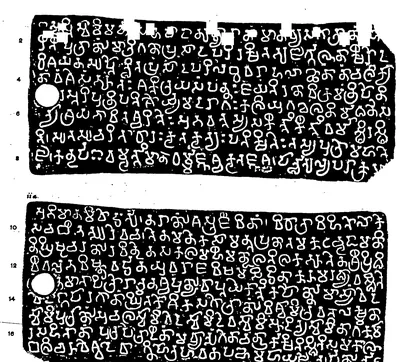 "Satara Plates of Vishnuvardhana I.", plates i and ii a, full size (Indian Antiquary XIX, plate at p. 310 (PDF p. 329))Inscription rubbing · 1890
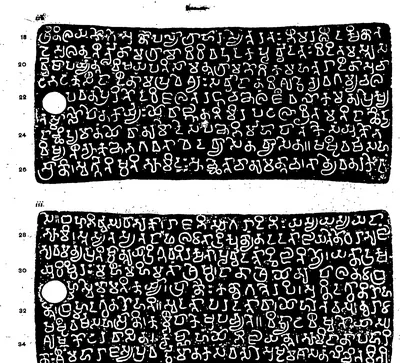 "Satara Plates of Vishnuvardhana I.", plates ii b and iii, full size (Indian Antiquary XIX, plate at p. 310 (PDF p. 330))Inscription rubbing · 1890
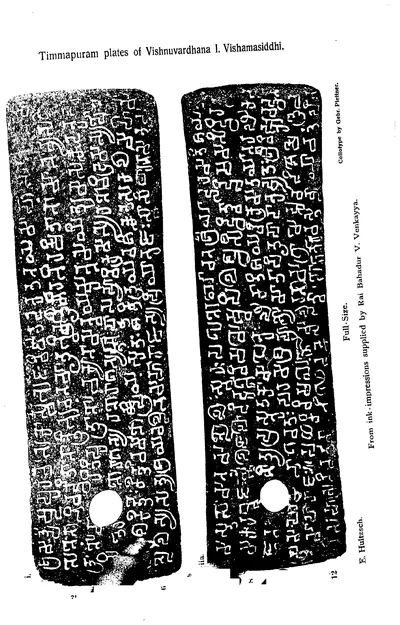 "Timmapuram plates of Vishnuvardhana I. Vishamasiddhi" (Epigraphia Indica IX)Book plate · 1908
Related
Dynasties
Chalukyas of Badami
c. 550–757 CE
Dynasty of the western Deccan that ruled from Vatapi (Badami) from about 550 to 757. Pulakesin II took Pishtapura (Pithapuram) and the Kolleru lake country about 615. He left his brother Vishnuvardhana in Vengi, where the Eastern Chalukya line began. Their grants and inscriptions show them holding the Guntur country in 631, the Kurnool and Alampur country under Vikramaditya I and his successors, and land in Nellore in 660. The Rashtrakuta Dantidurga overthrew the last king, Kirtivarman II, in the 750s.

Eastern Chalukyas of Vengi
c. 615–1077 CE
A branch of the Chalukyas of Badami that ruled Vengi, the coastal country between the lower Godavari and Krishna, from the early 7th century. Its founder, Kubja Vishnuvardhana, was a younger brother of Pulakesin II. The kings fought the Rashtrakutas for two centuries. After about 1000 they were bound to the Cholas by marriage, and in 1070 their heir became the Chola emperor Kulottunga I. Their copper-plate grants record the length of every reign. The first Telugu literary work, Nannaya's Mahabharata, was written at their court in Rajahmundry.
References
Notes (0)
Sources (11)
Spotted an error on this page? Tell us
Last updated: