Tippaluru inscription of Punyakumara
An early Telugu stone record at Tippaluru in the Kamalapuram country. It was issued while Erikalla-Mutturaju Punyakumara ruled Renandu from his capital Chirpali. Its ornamental letters look like those of the Pallava Mahendravarman I's Vallam rock inscription. It names the weekday and the hora (planetary hour), the earliest mention of the hora then known in south Indian inscriptions.
The stone
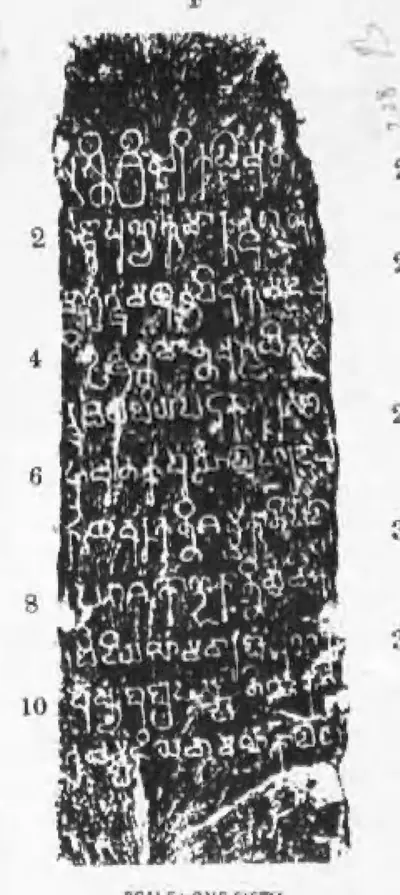
The inscription is deeply cut on a red stone in the village of Tippaluru, in the Kamalapuram taluk of the Kadapa (then Cuddapah) district.1 Its letters are well formed and ornamental.1 M. Venkataramayya took estampages (ink copies) of it, and later the epigraphy department did too (No. 283 of 1937–38).1 K. A. Nilakanta Sastri and Venkataramayya edited it in 1956, as inscription F of their Telugu Chola records.1
Script
The editors called it unique for its letters as well as its contents.1 In general appearance it looks more like the so-called Pallava-Grantha script than the usual Telugu-Kannada script of the place and period.1 It closely resembles the Vallam rock inscription of the Pallava king Mahendravarman I.1 They assigned it to the first half of the 7th century.1 This likeness is one of the chief grounds on which they dated Punyakumara about 625.2
Contents
The record names the ruler as Erikalla-Mutturaju Punyakumara, who bore the titles Marunrapidugu, Madamuditu and Uttamottama.34 He was then ruling Renandu from his capital (palu) at Chirpali.34 At that time one Chimanakalu gave fifty units of land at Tirpaluru to Kattisarmma of Kilevuru, a paradaya of Tarkkapulolu.34 The land was given as a panasa.34
The editors identified Chirpali with Chippili in the Madanapalle taluk.53 They identified Tirpaluru with Tippaluru itself, and Tarkkapulolu with Takkolu in the Sidhout taluk.53 They traced the Telugu word prolu (a settlement) back to the older form pulolu.53
The date by weekday and hora
The grant is dated on the second day of the dark fortnight of Karttika, a Monday.3 The nakshatra (lunar mansion) was Punarvasu, and the hora (planetary hour) was that of Brihaspati.3 The details are too few to give a date in the Christian era.3 But the editors worked out that so unusual a combination could fall only in a narrow set of circumstances.3
They noted that south Indian records rarely name weekdays before about the 9th century.6 Weekdays appear first in Western Chalukya grants of about the time of Pulakesin II.6 This was the earliest mention of the hora then known in south Indian epigraphy.6
A prince before he was king
Here Punyakumara carries only the rank of Mutturaju, with the singular ending of his name.6 For this reason the editors concluded that he had not yet become supreme ruler.6 In the Malepadu plates and the Ramesvaram pillar he bears the supreme titles.6 Even as Mutturaju, they noted, he held a string of titles modelled on those of Mahendravarman I.6 See Punyakumara and the Telugu Cholas of Renadu.
Footnotes
-
Nilakanta Sastri and Venkataramayya, “Telugu Chola Records” (1956), p. 231 and notes (archive.org (opens in a new tab)). Paraphrased. ↩ ↩2 ↩3 ↩4 ↩5 ↩6 ↩7 ↩8
-
Nilakanta Sastri and Venkataramayya, “Telugu Chola Records” (1956), p. 251 (archive.org (opens in a new tab)). Paraphrased. ↩
-
Nilakanta Sastri and Venkataramayya, “Telugu Chola Records” (1956), p. 232 (archive.org (opens in a new tab)). Paraphrased. ↩ ↩2 ↩3 ↩4 ↩5 ↩6 ↩7 ↩8 ↩9 ↩10 ↩11
-
Nilakanta Sastri and Venkataramayya, “Telugu Chola Records” (1956), p. 234, translation (archive.org (opens in a new tab)). Paraphrased. ↩ ↩2 ↩3 ↩4
-
K. A. Nilakanta Sastri and M. Venkataramayya, “Telugu Chola Records from Anantapur and Cuddapah”, Epigraphia Indica XXVII (1956), p. 225 (archive.org (opens in a new tab)). Paraphrased. ↩ ↩2 ↩3
-
Nilakanta Sastri and Venkataramayya, “Telugu Chola Records” (1956), p. 233 (archive.org (opens in a new tab)). Paraphrased. ↩ ↩2 ↩3 ↩4 ↩5 ↩6 ↩7
Photos
References
Notes (0)
Sources (1)
Spotted an error on this page? Tell us
Last updated: