Vinayaditya-Yuddhamalla I (Chalukya of Vemulavada)
Founder of the Chalukya family of Vemulavada in the 8th century. The family's records say that he ruled the Sapadalaksha country, bathed his elephants in tanks filled with oil at Podana (Bodhan) and took the fort of Chitrakuta. N. Venkataramanayya dated him to about 750–775, and thought he served the Rashtrakuta Dantidurga in his northern wars. His sons were Arikesari I, who conquered Vengi, and Biragriha, named in the Kuruvagatta inscription.
Vinayaditya, known above all by his title Yuddhamalla, is the king with whom the records of the Chalukyas of Vemulavada begin their family line.12 All the family’s sources except the doubtful Kollipara plates start with him.12
What the records say
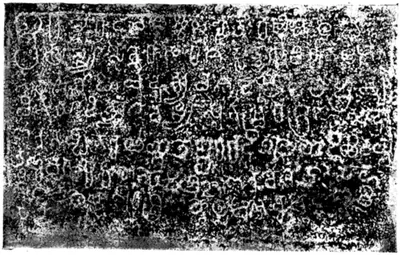
The Vemulavada inscription of his descendant Arikesari II makes three claims for Yuddhamalla:34
- he ruled the Sapadalaksha country, which others could not govern34
- he had his elephants bathed in a tank filled with oil at Podana34
- he took the fort of Chitrakuta, which no one could reach34
Pampa, in Rice’s translation, says that he “ruled over a 1¼ lakh territory”.5 It adds that, “filling ponds with oil”, he had five hundred elephants bathed daily.5 The Parbhani plates mention Sapadalaksha and the oil tank at Podana but not Chitrakuta.36
Sapadalaksha, Chitrakuta and Podana
N. Venkataramanayya identified Sapadalaksha with the Sakambhari or Sambhar country in eastern Rajputana.78910 He argued that a southern prince could rule there only as the subordinate of a greater conqueror.78910 So in his view Yuddhamalla served the Rashtrakuta Dantidurga in his northern campaigns.78910 On this view Chitrakuta was Chitorgarh, captured during the same wars.78910
N. Lakshminarayana Rao had held instead that Sapadalaksha lay near the Karimnagar district.11 The editors of The Early History of the Deccan (1960) found his evidence inconclusive and followed the Rajputana identification.11
Venkataramanayya thought that Podana, which he placed in the Nizamabad district, was probably Yuddhamalla’s capital.9 He thought Yuddhamalla came back to rule there after Dantidurga’s death.9 The Early History of the Deccan identified Podana with Bodhan.1213 It suggested that Yuddhamalla received a fief (land held from an overlord) near it as a reward for his services.1213
The Kollipara plates
The Kollipara copper plates claim to be a grant of his son Arikesari I.141516 They trace Yuddhamalla’s descent through four earlier kings: Satyasraya-Ranavikrama, Prithivipati, Maharaja and Rajaditya.141516 They list among the kings who bowed to him those of the Turushkas, Yavanas, Kashmir, Magadha, Malava, Kalinga and the far south.141516
Venkataramanayya doubted the record.14171518 He thought that a verse in it points to a date of 1019–20, after the dynasty had ended.14171518 In his view the four earlier names were invented to link the family to Pulakesin I of Badami.14171518 He treated the conquests as mythical.14171518
Others had tried to connect Yuddhamalla with the Chalukyas of Gujarat. Venkataramanayya noted the proposal to identify him with Mangalarasa, a son of the Gujarat Chalukya Jayasimha, who bore the titles Vinayaditya and Yuddhamalla.17 He rejected it, because Mangalarasa died before 739, about half a century before Yuddhamalla’s sons.17 J. F. Fleet, writing in 1896, could not fit the line into either the western or the eastern Chalukya family tree.19
Sons and descendants
Vinayaditya-Yuddhamalla had two sons, Arikesari I and Biragriha.2021 Arikesari I succeeded him.2022 Biragriha is known from the Kuruvagatta inscription, which calls him a friend of the Rashtrakuta king Govinda III.2022
The later records credit Arikesari I with conquering the kingdom of Vengi, with Trikalinga, in the time of the Rashtrakuta king Nirupama Dhruva (780–793).2023 Venkataramanayya thought that Dhruva sent him against the Eastern Chalukya Vishnuvardhana IV, whose lands bordered his own.2023
Arikesari I had two sons, Narasimha I and Bhadradeva.2425 Arikesari I was succeeded by his son Narasimha I, and Narasimha I by his son Yuddhamalla II.2625 Venkataramanayya wrote that little more than their names is known.26
Dates
Venkataramanayya dated Yuddhamalla I to about 750–775.2715 He counted back from the dated records of his descendants, and from his sons’ links with Dhruva and Govinda III.2715
Footnotes
-
N. Venkataramanayya, The Chalukyas of L(V)emulavada (1953), p. 5 (archive.org (opens in a new tab)). Paraphrased. ↩ ↩2
-
K. A. Nilakanta Sastri and N. Venkataramanayya, “The Chalukyas of Vemulavada”, appendix C to “The Eastern Chalukyas”, in G. Yazdani (ed.), The Early History of the Deccan, Parts VII–XI (1960), p. 504. Cite-only; paraphrased. ↩ ↩2
-
Venkataramanayya, Chalukyas of L(V)emulavada (1953), p. 14 (archive.org (opens in a new tab)). Paraphrased. ↩ ↩2 ↩3 ↩4 ↩5
-
Venkataramanayya, Chalukyas of L(V)emulavada (1953), p. 83, introduction to the Lemulavada inscription (archive.org (opens in a new tab)). Paraphrased. ↩ ↩2 ↩3 ↩4
-
B. Lewis Rice (ed.), The Pampa Bharata or Vikramarjuna Vijaya of Pampa (1898), introduction, p. 2 (archive.org (opens in a new tab)). ↩ ↩2
-
Venkataramanayya, Chalukyas of L(V)emulavada (1953), p. 92, introduction to the Parabhani plates (archive.org (opens in a new tab)). Paraphrased. ↩
-
Venkataramanayya, Chalukyas of L(V)emulavada (1953), p. 16 (archive.org (opens in a new tab)). Paraphrased. ↩ ↩2 ↩3 ↩4
-
Venkataramanayya, Chalukyas of L(V)emulavada (1953), p. 17 and note 35 (archive.org (opens in a new tab)). Paraphrased. ↩ ↩2 ↩3 ↩4
-
Venkataramanayya, Chalukyas of L(V)emulavada (1953), p. 18 (archive.org (opens in a new tab)). Paraphrased. ↩ ↩2 ↩3 ↩4 ↩5 ↩6
-
Venkataramanayya, Chalukyas of L(V)emulavada (1953), p. 50 (archive.org (opens in a new tab)). Paraphrased. ↩ ↩2 ↩3 ↩4
-
Nilakanta Sastri and Venkataramanayya, “The Chalukyas of Vemulavada” (1960), p. 506 and note 1. Cite-only; paraphrased. ↩ ↩2
-
Nilakanta Sastri and Venkataramanayya, “The Chalukyas of Vemulavada” (1960), p. 507. Cite-only; paraphrased. ↩ ↩2
-
Nilakanta Sastri and Venkataramanayya, “The Chalukyas of Vemulavada” (1960), p. 508. Cite-only; paraphrased. ↩ ↩2
-
Venkataramanayya, Chalukyas of L(V)emulavada (1953), p. 7 (archive.org (opens in a new tab)). Paraphrased. ↩ ↩2 ↩3 ↩4 ↩5 ↩6 ↩7
-
Venkataramanayya, Chalukyas of L(V)emulavada (1953), p. 13 (archive.org (opens in a new tab)). Paraphrased. ↩ ↩2 ↩3 ↩4 ↩5 ↩6 ↩7 ↩8 ↩9
-
Venkataramanayya, Chalukyas of L(V)emulavada (1953), p. 74, introduction to the Kollipara plates (archive.org (opens in a new tab)). Paraphrased. ↩ ↩2 ↩3
-
Venkataramanayya, Chalukyas of L(V)emulavada (1953), p. 8 (archive.org (opens in a new tab)). Paraphrased. ↩ ↩2 ↩3 ↩4 ↩5 ↩6
-
Venkataramanayya, Chalukyas of L(V)emulavada (1953), p. 75 (archive.org (opens in a new tab)). Paraphrased. ↩ ↩2 ↩3 ↩4
-
J. F. Fleet, “Dynasties of the Kanarese Districts”, Gazetteer of the Bombay Presidency I, pt. II (1896), p. 381 (archive.org (opens in a new tab)). ↩
-
Venkataramanayya, Chalukyas of L(V)emulavada (1953), p. 19 (archive.org (opens in a new tab)). Paraphrased. ↩ ↩2 ↩3 ↩4 ↩5
-
Venkataramanayya, Chalukyas of L(V)emulavada (1953), p. 9 (archive.org (opens in a new tab)). Paraphrased. ↩
-
Venkataramanayya, Chalukyas of L(V)emulavada (1953), p. 81, introduction to the Kuruvagatta inscription (archive.org (opens in a new tab)). Paraphrased. ↩ ↩2
-
Venkataramanayya, Chalukyas of L(V)emulavada (1953), p. 20 (archive.org (opens in a new tab)). Paraphrased. ↩ ↩2
-
Venkataramanayya, Chalukyas of L(V)emulavada (1953), p. 93 (archive.org (opens in a new tab)). Paraphrased. ↩
-
Rice, Pampa Bharata (1898), “Analysis of the Poem”, p. 1, stanzas 19–23 (archive.org (opens in a new tab)). ↩ ↩2
-
Venkataramanayya, Chalukyas of L(V)emulavada (1953), p. 21 (archive.org (opens in a new tab)). Paraphrased. ↩ ↩2
-
Venkataramanayya, Chalukyas of L(V)emulavada (1953), p. 12 (archive.org (opens in a new tab)). Paraphrased. ↩ ↩2
Photos
Related
Dynasties
References
Notes (0)
Sources (5)
Spotted an error on this page? Tell us
Last updated: