Govinda III (Rashtrakuta)
Rashtrakuta king (about 793–814), son of Dhruva, under whom the dynasty's power reached from the Vindhyas to the Tungabhadra. His Radhanpur plates of 808 say that the lord of Vengi, the Eastern Chalukya Vijayaditya II, came at his command and built an enclosure for him like a servant. An undated inscription at Kuruvagattu in the Mahbubnagar district names him as the friend of a Chalukya prince. A shrine of the Sun at Alampur was built for the prosperity of a king Prabhutavarsha who may be Govinda III.
Govinda III was the Rashtrakuta king under whom, in J. F. Fleet’s words, the dynasty’s power was first placed “on a really firm and wide footing”. His records claim the submission of the Eastern Chalukya king of Vengi.12 Two inscriptions of his time, or his father’s, have been found in the Telangana country.12
Family
Krishna I left two sons, Govinda II and Dhruva.3 Dhruva set aside his elder brother and became king. The Paithan grant says that Govinda II, trying to secure the throne, called to his help the hostile kings of Malava, Kanchi, Vengi and the Ganga country.3
Govinda III was a son of Dhruva, who gave him the necklet (necklace) of the heir-apparent.4 A later record says that he was chosen for the succession from among several brothers.4 Indraraja, the brother to whom Govinda III gave the Lata country of southern Gujarat, founded a feudatory branch of the family there.56
Govinda III’s queen, named in a Kanarese record of 804, was Gamundabbe.4 His son and successor was Amoghavarsha I.1
Dates and campaigns
The Jain Harivamsa of Jinasena says that a king Srivallabha was reigning in the south in 783–84.415 Fleet took this king to be Govinda III.415 His earliest dated grant, from Paithan, is of 4 May 794, and he was still reigning in 813.415
The Radhanpur and Wani grants of 807–08 describe his reign in a series of verses:1
- On his father’s death he put down an alliance of twelve kings, led by one Stambha.1
- He released a captive Ganga king and imprisoned him again.1
- The Gurjara king fled before him, the lord of Malava submitted, and he marched to the Vindhya mountains.1
- After passing the rains at Sribhavana, he marched to the Tungabhadra and drew tribute from the Pallavas.1
A Kanarese grant of 4 April 804 was made while he was encamped on the Tungabhadra, after conquering Dantiga, the ruler of Kanchi.5 Fleet concluded that his dominions stretched from the western coast far towards the east.2 They reached from the Vindhyas and Malava to at least the Tungabhadra.2
The lord of Vengi
The Radhanpur plates say that while Govinda was staying on the Tungabhadra, the lord of Vengi came “when (the king’s) letter-carrier had only half uttered the command”.7 He toiled “like a servant without ceasing” on an enclosure that seemed to touch the sky.7 This is F. Kielhorn’s translation of 1901, in which the enclosure was built “for His camp”.7 Kielhorn dated the grant to 27 July 808.8
Fleet had already identified the lord of Vengi with the Eastern Chalukya Vijayaditya II.2 Vijayaditya II reigned from 799 to 843.2 The records of his own family describe him as having fought a hundred and eight battles in twelve years with the Gangas and the Rashtrakutas.2 Fleet took the walled place to be Manyakheta (Malkhed), which he thought Govinda was making his capital.2
A grant of 811–12 records Govinda’s capture of the emblems of the rivers Ganga and Yamuna.2 Fleet thought this “was doubtless done in his wars with the Eastern Chalukya Vijayaditya II”.2 Robert Sewell summarised the Manne plates of 802.9 In his summary, Govinda reduced the Eastern Chalukyas so far that their king came and built the walls of a fortress for him.9
Records in the Telugu country
- Kuruvagattu (Mahbubnagar district). An undated Kannada and Sanskrit inscription says that Govinda-vallabha was the son of Kali-vallabha of the Rashtrakuta family. It praises the warrior Viragriha, son of Vinayaditya of the Chalukya family, as his friend. P. B. Desai noted that Kalivallabha was a title of Dhruva, whose son was Govinda III.10 The editors of Epigraphia Telanganica identify Vinayaditya with the founder of the Chalukya family of Vemulavada.1112 This family later ruled in Telangana as a Rashtrakuta feudatory (see the Rashtrakutas).1112
- Alampur. A damaged inscription at Alampur seems to record that one Srimara built a shrine of the Sun in the temple of Uttaresvara for the prosperity of the king Prabhutavarsha. Desai noted that three Rashtrakuta kings named Govinda bore this title, and thought this was probably Govinda III. The editors of Epigraphia Telanganica list one version of the record under Govinda II and another under Govinda III.131411
Footnotes
-
Fleet, “Dynasties of the Kanarese Districts” (1896), p. 395 (archive.org (opens in a new tab)). ↩ ↩2 ↩3 ↩4 ↩5 ↩6 ↩7 ↩8 ↩9 ↩10 ↩11
-
Fleet, “Dynasties of the Kanarese Districts” (1896), p. 396 (archive.org (opens in a new tab)). ↩ ↩2 ↩3 ↩4 ↩5 ↩6 ↩7 ↩8 ↩9 ↩10
-
J. F. Fleet, “Dynasties of the Kanarese Districts”, Gazetteer of the Bombay Presidency I, pt. II (1896), p. 393 (archive.org (opens in a new tab)). ↩ ↩2
-
Fleet, “Dynasties of the Kanarese Districts” (1896), p. 394 (archive.org (opens in a new tab)). ↩ ↩2 ↩3 ↩4 ↩5 ↩6
-
Fleet, “Dynasties of the Kanarese Districts” (1896), p. 397 (archive.org (opens in a new tab)). ↩ ↩2 ↩3 ↩4 ↩5
-
Fleet, “Dynasties of the Kanarese Districts” (1896), p. 400 (archive.org (opens in a new tab)). ↩
-
Kielhorn, “Radhanpur Plates of Govinda III” (1901), p. 250, translation of verses 18–20 (archive.org (opens in a new tab)). ↩ ↩2 ↩3
-
F. Kielhorn, “Radhanpur Plates of Govinda III; Saka-Samvat 730”, Epigraphia Indica VI (1901), p. 242 (archive.org (opens in a new tab)). ↩
-
Robert Sewell, The Historical Inscriptions of Southern India (1932), p. 33 (archive.org (opens in a new tab)). Paraphrased. ↩ ↩2
-
P. B. Desai (introduction), Kannada Inscriptions of Andhra Pradesh (Andhra Pradesh Government Archaeological Series 3, 1961), p. 11, No. 29 (archive.org (opens in a new tab)). Paraphrased. ↩
-
Epigraphia Telanganica I (2023), p. 76, Nos. 5–6. Cite-only; paraphrased. ↩ ↩2 ↩3
-
Epigraphia Telanganica I (2023), p. 77, Nos. 5–7, summarising Inscriptions of Andhra Pradesh, Mahabubnagar District I (2003), pp. 24–25. Cite-only; paraphrased. ↩ ↩2
-
Kannada Inscriptions of Andhra Pradesh (1961), p. 35, No. 93 (archive.org (opens in a new tab)). Paraphrased. ↩
-
Gajjala Vasanta Lakshmi (ed.), Epigraphia Telanganica I: Pre-Kakatiya Telangana (2023), p. 75, Rashtrakuta No. 1. Cite-only; paraphrased. ↩
Photos
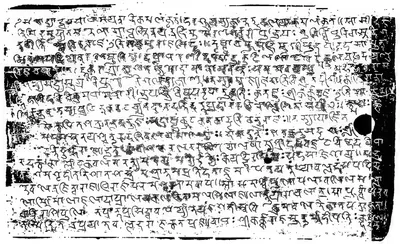 "Paithan Plates of Govinda III.—Saka-Samvat 716." side i, lines 1–17 (Epigraphia Indica III, plate with No. 17; PDF p. 154 of the archive.org scan in.ernet.dli.2015.108298)Inscription rubbing · 1895
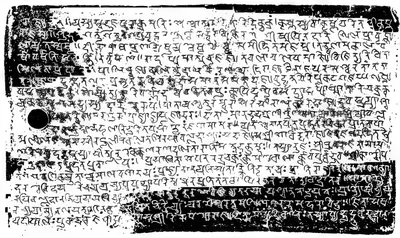 "Paithan Plates of Govinda III.—Saka-Samvat 716." side iia, lines 18–35 (Epigraphia Indica III, plate with No. 17; PDF p. 154 of the archive.org scan in.ernet.dli.2015.108298)Inscription rubbing · 1895
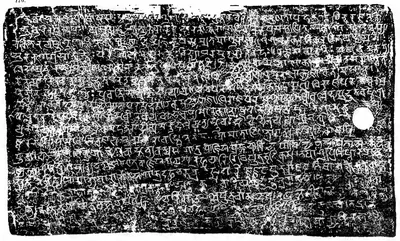 "Paithan Plates of Govinda III.—Saka-Samvat 716." side iib, lines 36–53 (Epigraphia Indica III, plate with No. 17; PDF p. 155 of the archive.org scan in.ernet.dli.2015.108298)Inscription rubbing · 1895
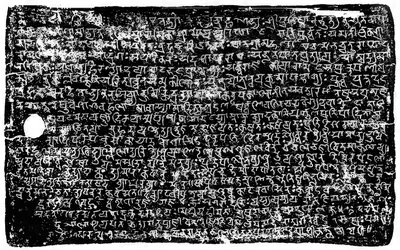 "Paithan Plates of Govinda III.—Saka-Samvat 716." side iii, lines 54–73 (Epigraphia Indica III, plate with No. 17; PDF p. 155 of the archive.org scan in.ernet.dli.2015.108298)Inscription rubbing · 1895
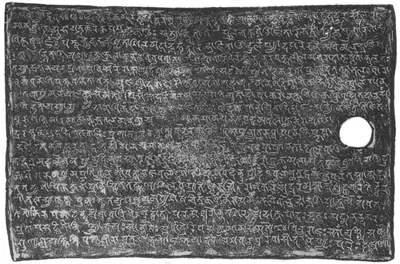 "Radhanpur Plates of Govinda III.—Saka-Samvat 730." side i (Epigraphia Indica VI, plate with No. 23; PDF p. 307 of the archive.org scan EpigraphiaIndicaVol6)Inscription rubbing · 1901
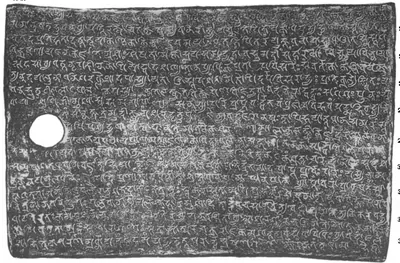 "Radhanpur Plates of Govinda III.—Saka-Samvat 730." side iia (Epigraphia Indica VI, plate with No. 23; PDF p. 307 of the archive.org scan EpigraphiaIndicaVol6)Inscription rubbing · 1901
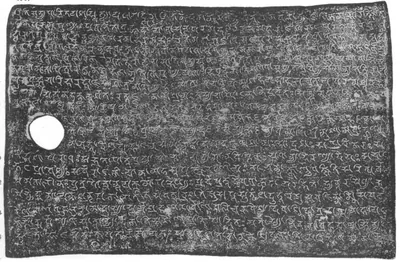 "Radhanpur Plates of Govinda III.—Saka-Samvat 730." side iib (Epigraphia Indica VI, plate with No. 23; PDF p. 308 of the archive.org scan EpigraphiaIndicaVol6)Inscription rubbing · 1901
Related
Dynasties
References
Notes (0)
Sources (5)
Spotted an error on this page? Tell us
Last updated: