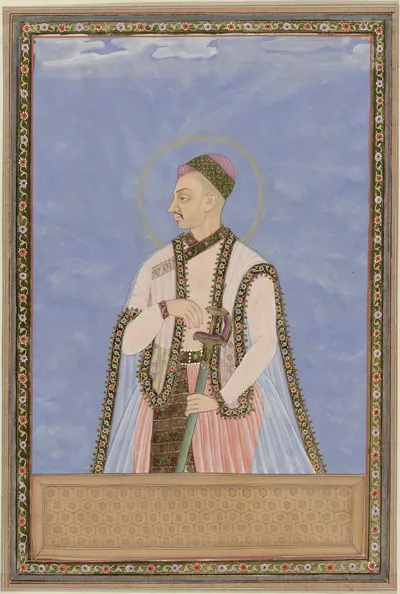
Sultan Muhammad Qutb Shah
Sixth Qutb Shahi sultan of Golconda (1611/12–1626), nephew and son-in-law of Muhammad Quli. He was a scholarly and peaceful king. He founded the Mecca Masjid in Hyderabad, began a new town called Sultannagar, sheltered the rebel Mughal prince Khurram (Shah Jahan) and had the first history of his dynasty written. His queen, Hayat Bakhsh Begum, was the mother of Abdullah Qutb Shah.
Sultan Muhammad was the sixth king of the Qutb Shahi dynasty of Golconda. Sultan Muhammad was the son of Mirza Muhammad Amin, the youngest son of Ibrahim Qutb Shah.12 So he was the nephew of his predecessor, Muhammad Quli.12
Sha Rocco’s short history of the dynasty was published by the Hyderabad government press in 1929.3 It gives his birth as April 1593 and his accession as 17 December 1611.3
Coming to the throne
Bilgrami, writing in 1927, says Muhammad was placed on the throne by Mir Momin of Astarabad “in accordance with the last injunctions of the deceased King”.1 Mir Momin was a Persian scholar and poet whom Muhammad Quli had made peshwa (chief minister) and minister.4 The new king was also his predecessor’s son-in-law: in AH 1016 (1607; AH is the Islamic way of counting years) he had married Hayat Bakhsh Begum, a daughter of Muhammad Quli.1
The English merchant Peter Floris recorded the old king’s death in January 1612, in a journal that the editor W. H. Moreland quotes.5 Floris had high hopes of the young new king.5 He thought the king would turn against the Persians who had controlled the administration under his uncle.5 Moreland judged that any change was one of persons rather than of methods.5
Reign
Rocco describes the reign of fourteen years as “uneventful”.3 He calls the king “a historian and philosopher” who spent most of his time “in study and intercourse with the learned men whom he encouraged at his court”.3
Bilgrami records embassies from Shah Abbas of Persia, which came in AH 1023 (1614) and returned in 1616.1 He also records the first embassy from the Mughal emperor Jahangir.1 Its envoys, Mir Makki and Jadoo Rao, reached Hyderabad in AH 1027 (1617) and took back a peshkash (tribute offering) of fifteen lakhs.1
Jahangir’s son Prince Khurram, the future Shah Jahan, rebelled against his father.1 He passed through Machilipatnam (then Masulipatam) in AH 1030 (1622), “when he was forsaken by many of his nobles”.1 Muhammad received him kindly and helped him with money.1 The Kistna district manual of 1883 suggests that the prince’s unopposed march through the Golconda country “disclosed the weakness of the Golconda State”.6
The European factories (trading posts) on the coast grew in his reign. The Kistna manual says that “the king appears to have encouraged this European trade”.7 See Machilipatnam.
The Mecca Masjid and Sultannagar
Muhammad began the great mosque near the Charminar that came to be called the Mecca Masjid. Bilgrami says the king named it Bait-ul-Atiq, a name for the shrine at Mecca.8 The letters of this name, read as numbers, give AH 1023 (1614).8 The mosque took its present name in Aurangzeb’s time.8
Rocco tells the legend of its foundation.3 In the legend, the king decided that only a man who had never missed the midnight prayers should lay the first stone.3 When no doctor of religion could claim this, he laid it himself.3 The Imperial Gazetteer records that the building was continued after his death and completed by Aurangzeb.9
In AH 1034 (1624) he laid the foundations of a fort and town called Sultannagar, about six miles east of Hyderabad.1 It was abandoned at his death.1 Rocco says the remains of a mosque and other buildings could still be seen there, “but even the name is forgotten”.3
The first history of the dynasty
Bilgrami says that the first Qutb Shahi history, the Tarikh-i Sultan Muhammad Qutb Shahi, was compiled in his reign.1 John Briggs translated a Golconda chronicle in 1829, which he called “The History of Mahomed Koolly Kootb Shah”.10 It ends with the reign of Muhammad Quli.10 Briggs thought it was written about the time Ferishta lived, and he did not know its author.10
Death and family
Muhammad died on 13 Jumada I AH 1035. Bilgrami converts the date as 1625, and Rocco gives 11 February 1626.13 Abdullah Qutb Shah was the only son of Sultan Muhammad and his queen Hayat Bakhsh Begum, according to Bilgrami and Jadunath Sarkar.111
Sarkar describes Hayat Bakhsh Begum as “the imperious daughter of one king, wife of another and mother of a third”.11 She ran the government for more than forty years of her son’s reign.11
The French traveller Thevenot, who was at Golconda in 1666, heard a different story.12 He heard that the king was “the Son of a Bramen Lady”, and that the late king had left the crown to an elder son.12 In this story the queen had that son imprisoned because she loved Abdullah more.12
Rocco found no other evidence for Thevenot’s account.13 The Imperial Gazetteer dates Muhammad’s death to about 1635, nine years after the date given by Bilgrami and Rocco.14
Footnotes
-
Bilgrami, Landmarks of the Deccan (1927), pp. 200–201 (archive.org (opens in a new tab)). ↩ ↩2 ↩3 ↩4 ↩5 ↩6 ↩7 ↩8 ↩9 ↩10 ↩11 ↩12 ↩13 ↩14 ↩15
-
Golconda chronicle, in Briggs, Rise of the Mahomedan Power, Vol. III (1829), p. 445 (archive.org (opens in a new tab)). ↩ ↩2
-
Sha Rocco, Golconda and the Qutb Shahs (1929), pp. 15–16 (archive.org (opens in a new tab)). ↩ ↩2 ↩3 ↩4 ↩5 ↩6 ↩7 ↩8 ↩9
-
Bilgrami, Landmarks of the Deccan (1927), p. 49 (archive.org (opens in a new tab)). ↩
-
W. H. Moreland (ed.), Relations of Golconda in the Early Seventeenth Century (1931), p. xvii (archive.org (opens in a new tab)). ↩ ↩2 ↩3 ↩4
-
Mackenzie, Kistna District (1883), p. 35 (archive.org (opens in a new tab)). ↩
-
Gordon Mackenzie, A Manual of the Kistna District (1883), p. 34 (archive.org (opens in a new tab)). ↩
-
Syed Ali Asgar Bilgrami, Landmarks of the Deccan (1927), p. 41 (archive.org (opens in a new tab)). ↩ ↩2 ↩3
-
Imperial Gazetteer: Hyderabad (1909), p. 116 (archive.org (opens in a new tab)). ↩
-
Muhammad Qasim Ferishta, tr. John Briggs, History of the Rise of the Mahomedan Power in India, Vol. III (1829), p. 337, prefatory notice to the appendix (archive.org (opens in a new tab)). ↩ ↩2 ↩3
-
Jadunath Sarkar, History of Aurangzib, Vol. IV (2nd ed., 1930), p. 395 (archive.org (opens in a new tab)). ↩ ↩2 ↩3
-
Jean de Thevenot, The Travels of Monsieur de Thevenot into the Levant, Part III (English tr., 1687), p. 100 (archive.org (opens in a new tab)). ↩ ↩2 ↩3
-
Rocco, Golconda and the Qutb Shahs (1929), pp. 26–27 (archive.org (opens in a new tab)). ↩
-
Imperial Gazetteer of India: Hyderabad State (1909), p. 14 (archive.org (opens in a new tab)). ↩
Photos
Related
Dynasties
References
Notes (0)
Sources (8)
Spotted an error on this page? Tell us
Last updated: