Timmapuram plates of Vishnuvardhana I
A short undated Sanskrit copper-plate grant of the Eastern Chalukya founder Vishnuvardhana I Vishamasiddhi. It was dug up in a house site at Timmapuram in Vizagapatam district in 1907. Issued from Pishtapura (Pithapuram), it gives 4,000 nivartanas (a land measure) of land to forty Brahmins. E. Hultzsch read its wording as showing that Vishnuvardhana was still a dependant of his brother Pulakesin II. It is the only record to name Pishtapura as his residence.
When found, these three plates were one of only three known grants of Kubja-Vishnuvardhana, founder of the Eastern Chalukyas.12 They are the only one of the three that names his residence.12 They were issued from Pishtapura, the modern Pithapuram.12
Discovery
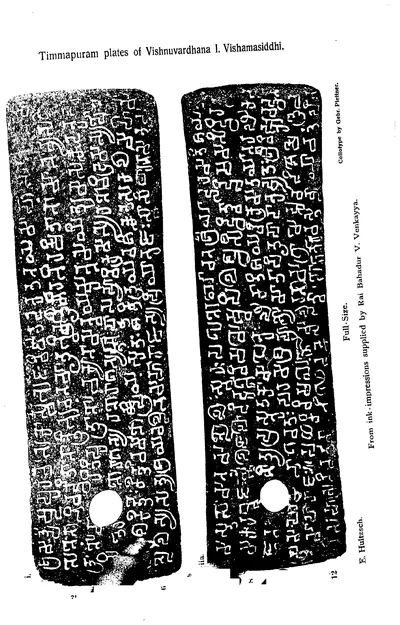
In October 1907 one Sukuru Ramasvami found the plates in the ground while digging a hole in his vacant house site.13 The site was in the village of Timmapuram, in the Sarvasiddhi taluk of Visakhapatnam (then Vizagapatam) district.13 The Collector sent the plates to V. Venkayya.13 E. Hultzsch edited them from Venkayya’s ink impressions in Epigraphia Indica IX.13 They were registered as copper-plate No. 2 of 1907–08.4
Description, script and language
Venkayya described the plates as measuring 2⅛ by 7⅞ inches.1 They are strung on an oval ring whose ends are fixed in a nearly circular seal.1 The seal bears the legend Vishamasiddhi, in the same alphabet as the grant.1 The third plate is blank, and the grant ends in the second line of the second side of the second plate.1
Hultzsch thought the alphabet and spelling called for no special remark.1 The language is Sanskrit prose.1 The opening eulogy, lines 1 to 11, is fairly correct, probably because it was copied from a form kept at the royal secretariat.1
But the grant itself “must have been drafted by a person who knew very little Sanskrit”.1 It uses the Prakrit word chattalisa, “forty”, and has several grammatical blunders.1 Hultzsch noted that the surname Vishamasiddhi also appears on some copper coins found in Visakhapatnam district.1
Content
The grant is issued “from (his) residence in the prosperous Pishtapura”.5 It traces the king’s descent from his great-grandfather Ranaraga of the Chalukya family.5 The line runs through his grandfather Ranavikrama (Pulakesin I) and his father Kirtivarman.5 The grant calls him “the dear younger brother of Satyashraya-Vallabha-Maharaja, who had subdued the circle of the whole earth”.5
The king, Sri-Vishnuvardhana-Maharaja, is a devout worshipper of Bhagavat (Vishnu).5 He is described as one “who by the edge of his own sword humbled the circle of all the vassals”.5 He was called Vishamasiddhi “because he had obtained success in impassable straits on land, on sea, etc.”.5
He grants four thousand nivartanas (land measures) to forty Brahmins of the Chhandoga (Samaveda) school, of various gotras (clans).5 The land lay in the fields on the eastern side of the village of Kumilura, in the Palaki district.5 Hultzsch reckoned this at a hundred nivartanas for each of the forty.5 The usual imprecations (curses) and other closing particulars are missing.1
Hultzsch found the mention of the great-grandfather Ranaraga of some interest.1 The name was otherwise known only from a few records of the western Chalukyas.1
A dependant of Pulakesin II?
Both brothers are called Maharaja. But Hultzsch pointed out that the elder is said to have subdued “the circle of the whole earth”.1 Vishnuvardhana claims only to have humbled “the circle of all the vassals”.1 Hultzsch concluded that at the time of the grant Vishnuvardhana “was still a dependant of his elder brother, the Western Chalukya king Pulakesin II”.1
The epigraphical report for 1907–08 drew a different inference from the same title.2 Vishnuvardhana is called Yuvaraja (crown prince) in the Satara grant.2 He is called Maharaja here and in the Chipurupalle grant.2 So the report supposed that the Timmapuram grant was later than the Satara grant’s eighth year, which it equated “apparently” with 622–23.2 The plates themselves carry no date.1
Pishtapura
Hultzsch identified Pishtapura with Pithapuram in Godavari district.1 The Aihole inscription credits the capture of this fortress to Vishnuvardhana’s elder brother and sovereign, Pulakesin II.1
J. F. Fleet wrote before the plates were found.6 He placed the conquest of Pishtapura in the campaign of the years around 615, when Vishnuvardhana was made yuvaraja.6 After that, in Fleet’s view, Pulakesin II would have left Vishnuvardhana to govern the new territory.6
The 1907–08 report noted that Pishtapura had been an important stronghold since the 4th century.2 At that time Mahendra of Pishtapura was among the southern kings defeated by Samudragupta.2 The report thought it likely that Vishnuvardhana was put in charge of the fortress and the country round it soon after Pulakesin II’s eastern campaign.2
The Eastern Ganga kings of Kalinga named their capital at the head of their grants.2 The report suggested that Vishnuvardhana, ruling country taken from them, followed their practice.2 V. Rangacharya, summarising the plates in 1919, wrote that Pulakesin II made his brother viceroy at Pishtapura “about A.D. 634”.4
A second Timmapuram set
The same report described another set of three plates from Visakhapatnam district, registered as No. 1 of 1907–08.24 Rangacharya listed it under Timmapuram as well.24
It is an unfinished grant, apparently of Mangi-yuvaraja.2 It was cut over an older inscription that the engraver had tried to erase.2 Its seal reads Sri-Vijayasiddhi, a surname of Mangi-yuvaraja.2 Its text breaks off after naming Vishnuvardhana, son of Indra-Bhattaraka.2
The report noted that the name of the village to be granted would have settled a question, had the record been finished.7 It would have shown whether the king’s territory really reached Visakhapatnam district, or whether the plates had only been taken there later.7
Edition
E. Hultzsch, “Timmapuram Plates of Vishnuvardhana I Vishamasiddhi”, Epigraphia Indica IX (1907–08), No. 50, pp. 317–319, with text, translation and plate.1
Footnotes
-
E. Hultzsch, “Timmapuram Plates of Vishnuvardhana I Vishamasiddhi”, Epigraphia Indica IX (1907–08), p. 317 (archive.org (opens in a new tab)). ↩ ↩2 ↩3 ↩4 ↩5 ↩6 ↩7 ↩8 ↩9 ↩10 ↩11 ↩12 ↩13 ↩14 ↩15 ↩16 ↩17 ↩18 ↩19 ↩20 ↩21 ↩22 ↩23 ↩24 ↩25 ↩26 ↩27
-
Annual Report on Epigraphy, Southern Circle, for 1907–08 (G.O. No. 574, Public, 17 July 1908), Part II, paras. 11–13, p. 49 (archive.org (opens in a new tab)). ↩ ↩2 ↩3 ↩4 ↩5 ↩6 ↩7 ↩8 ↩9 ↩10 ↩11 ↩12 ↩13 ↩14 ↩15 ↩16 ↩17 ↩18
-
Hultzsch, “Timmapuram Plates” (1908), p. 318, text and note 3 (archive.org (opens in a new tab)). ↩ ↩2 ↩3 ↩4
-
V. Rangacharya, A Topographical List of the Inscriptions of the Madras Presidency, Vol. III (1919), p. 1671, Vizagapatam district, Timmapuram Nos. 35-A and 35-B (archive.org (opens in a new tab)). ↩ ↩2 ↩3 ↩4
-
Hultzsch, “Timmapuram Plates” (1908), p. 319, translation and notes (archive.org (opens in a new tab)). ↩ ↩2 ↩3 ↩4 ↩5 ↩6 ↩7 ↩8 ↩9 ↩10
-
J. F. Fleet, “The Chronology of the Eastern Chalukya Kings”, Indian Antiquary XX (1891), p. 94 (archive.org (opens in a new tab)). ↩ ↩2 ↩3
-
Annual Report on Epigraphy for 1907–08 (1908), Part II, para. 14, p. 50 (archive.org (opens in a new tab)). ↩ ↩2
Photos
References
Notes (0)
Sources (4)
Spotted an error on this page? Tell us
Last updated: