Bezwada plates of Chalukya-Bhima I
Five Sanskrit copper plates of the Eastern Chalukya king Chalukya-Bhima I (reigned about 888–918). They were found on 25 June 1897 in a rock-cut chamber in the quarry compound at Bezwada (Vijayawada). Issued at his coronation, they give the village of Kukiparru to a Vedic scholar. They were the first record found of this king, and the earliest then known to give the full line of Eastern Chalukya kings with the length of each reign.
These plates were the first record found of the Eastern Chalukya king Chalukya-Bhima I. F. Kielhorn edited them in 1899.12 He noted that the grant was also, up to that time, “the earliest record which gives the full historical genealogy, with the lengths of the reigns”.12 Their findspot, Bezwada, was already the home of a writer of Eastern Chalukya charters in the reign of Vijayaditya II.3
Discovery
The plates “were found on the 25th June 1897 in the rock-hewn chamber of the quarry-compound at Bezvada”.1 J. K. Batten, the Acting Collector of Kistna district, sent them to E. Hultzsch.1 Kielhorn edited them from Hultzsch’s impression.1 A second set of plates was found with them, claiming to be a grant of Vishnuvardhana III.1 Kielhorn considered it false.1
Description
There are five copper plates, each about 7 inches broad and 3 inches high, with high rims.1 Plates 2–5 are written on both sides, though the second side of the fifth has less than half a line.1 The first plate is written only on its second side.1 Its first side shows a conch-shell, the sun and a club.1
The ring is about 4½ inches across, and was uncut when it reached Hultzsch.1 It is fixed in a round seal about 2¼ inches across.1 On the seal are the legend Sri-Tribhuvanankusah and a flower below it.1 Above it is a couchant (lying) boar facing left, with the sun and crescent moon over it and an elephant-goad behind.1
The plates, perhaps except the first, are what Kielhorn called “quasi-palimpsests”.1 An earlier text had been beaten in, and on the fifth plate it can still be read.1 Its letters are very like the later writing, and its last words name a king Vishnuvardhana.1 Kielhorn concluded that “these plates originally were used for another grant of Bhima I., which either was not completed or for some reason or other was cancelled”.1
Script and language
The letters are of the southern class of their time and region, mostly in the later cursive (running) forms.1 The language is Sanskrit, but some proper names are Telugu.1 The boundaries, for example, are tanks with Telugu names:4
- the Potaryangari-cheruvu4
- the Paruvula-gunta4
- the Cheki-cheruvu4
- the Chintareni-cheruvu4
- the Juvvi-gunta4
- the Airiviya-gunta4
Apart from five verses of blessing and curse, there is one verse on the donor and one naming the ajnapti (executor).1 The rest is prose, which Kielhorn found “full of minor mistakes”.1 J. Ramayya Pantulu, writing in 1920, found the script of this grant very like that of the Bezwada pillar inscription of Yuddhamalla.5 He used it to date that record.5
Content
The grant opens with the full line of kings and their reigns.6 It begins with “Kubja-Vishnuvardhana … the brother of Satyasraya-vallabhendra”, who reigned eighteen years.6 It runs to Vijayaditya III, who reigned 44 years.6 Among them it says that Vijayaditya II “built a hundred and eight temples of (Siva) Narendresvara” and reigned forty years.6 Kielhorn pointed out that most records give him 48 years.6 The grant names Bhima as the son of Vijayaditya III’s brother, the crown prince (yuvaraja) Vikramaditya.6 See Kubja Vishnuvardhana and Gunaga Vijayaditya III.
A verse then states that king Bhima, “at the time of his coronation, well pleased, has given a village in perpetuity, requested to do so”.6 As Maharajadhiraja, Paramesvara and Paramabhattaraka, under his second name Vishnuvardhana, he speaks to the cultivators of the Uttarakanderuvadi district.6 He announces the gift of Kukiparru, free of all taxes, to Potamayya.6 Potamayya was a student of the kramapatha (a method of reciting the Veda), son of Dronabhatta and grandson of Revamayya of the Kaundinya gotra (clan), of Ummarakanthibol.6
Kielhorn noted that this grant gave Bhima I the second name Vishnuvardhana.2 The places have not been identified.2
The ajnapti was Kadeyaraja, “whose grandfather was Pandaranga”, and the writer was Kondacharya.4 Pandaranga had conveyed a grant of Bhima’s uncle Vijayaditya III (see Masulipatam (?) plates of Vijayaditya III).27 He is the hero of the Addanki inscription.27
Date
The grant is not dated. Its verse ties it to Bhima’s coronation.26 Kielhorn headed it with Fleet’s dates for the reign, 888–918.1 Fleet gave Bhima I a reign of thirty years, from 888.8 He noted that after Vijayaditya III’s death the Rashtrakutas overran Vengi, which Bhima had to win back.8
Footnotes
-
Kielhorn, “Six Eastern Chalukya Copper-plate Inscriptions” (1899), p. 127 (archive.org (opens in a new tab)). ↩ ↩2 ↩3 ↩4 ↩5 ↩6 ↩7 ↩8 ↩9 ↩10 ↩11 ↩12 ↩13 ↩14 ↩15 ↩16 ↩17 ↩18 ↩19 ↩20 ↩21 ↩22 ↩23 ↩24
-
Kielhorn, “Six Eastern Chalukya Copper-plate Inscriptions” (1899), p. 128 (archive.org (opens in a new tab)). ↩ ↩2 ↩3 ↩4 ↩5 ↩6 ↩7
-
J. F. Fleet, “The Chronology of the Eastern Chalukya Kings”, Indian Antiquary XX (1891), p. 101 (archive.org (opens in a new tab)). ↩
-
Kielhorn, “Six Eastern Chalukya Copper-plate Inscriptions” (1899), p. 131 (archive.org (opens in a new tab)). ↩ ↩2 ↩3 ↩4 ↩5 ↩6 ↩7 ↩8
-
J. Ramayya Pantulu, “The Bezwada Pillar Inscription of Yuddhamalla”, Epigraphia Indica XV (1919–20), p. 151 (archive.org (opens in a new tab)). ↩ ↩2
-
Kielhorn, “Six Eastern Chalukya Copper-plate Inscriptions” (1899), p. 130, text and abstract of contents (archive.org (opens in a new tab)). ↩ ↩2 ↩3 ↩4 ↩5 ↩6 ↩7 ↩8 ↩9 ↩10 ↩11
-
F. Kielhorn, “Six Eastern Chalukya Copper-plate Inscriptions”, Epigraphia Indica V (1898–99), p. 123 (archive.org (opens in a new tab)). ↩ ↩2
-
Fleet, “The Chronology of the Eastern Chalukya Kings” (1891), p. 103 (archive.org (opens in a new tab)). ↩ ↩2
Photos
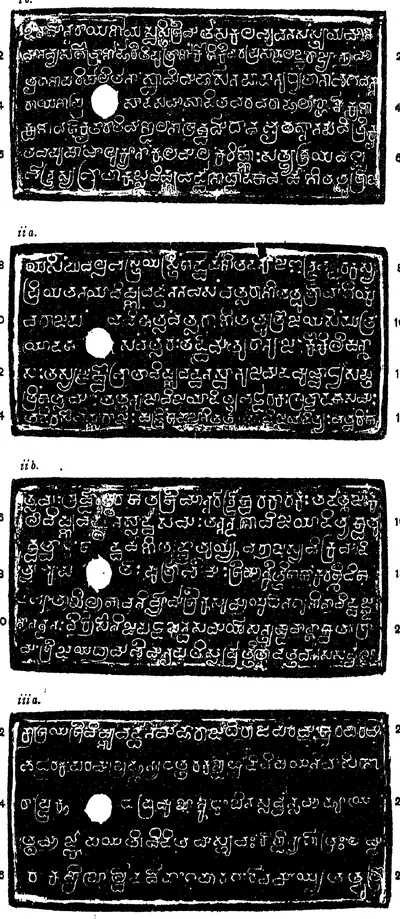 "Bezvada Plates of Bhima I.", plates i b, ii a, ii b and iii a (Epigraphia Indica V, plate between pp. 128 and 129 (PDF p. 178))Inscription rubbing · 1899
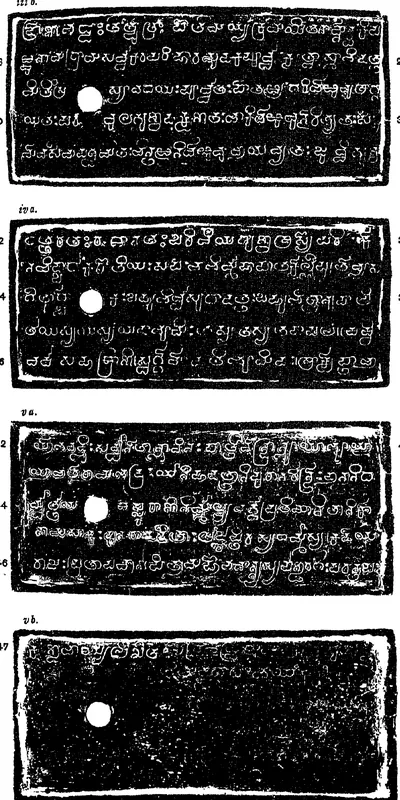 "Bezvada Plates of Bhima I.", plates iii b, iv a, v a and v b (Epigraphia Indica V, plate between pp. 128 and 129 (PDF p. 179))Inscription rubbing · 1899
References
Notes (0)
Sources (3)
Spotted an error on this page? Tell us
Last updated: