Pachchanitandiparru grant of Anavema (1374)
Five copper plates of 22 August 1374 that record Anavema Reddi's gift of the village of Pachchani-Tandiparru to the astronomer Peddi. They were composed by the court poet Balasarasvati. They were published in Epigraphia Indica XXI (1931–32) with two other Reddi copper plates: a plate of Vema from Chimakurti, and the Pinapadu grant of Komati Vema written by Srinatha.
By these copper plates, the Reddi king Anna-Vema gave the village of Pachchani-Tamdiparru to Peddi-Vidvan, an astronomer.1 The editors dated the gift to Tuesday, 22 August 1374.1 The edict was composed by Bala-Sarasvati, the court poet of Anna-Vema.1
The plates
The grant is registered as copper plate No. 6 of the epigraphy report for 1919–20.2 The set was borrowed in 1919 from Devi Hanumacharlu of Koditadiparru, in the Tenali taluk (sub-district) of the Guntur district.2
It is written on five oblong plates with slightly raised rims.2 There are holes for a ring, but the ring and seal are lost.2 The plates weigh 88 tolas, and four of their second sides are marked with the numerals 2 to 5.2
The script is Telugu and the language Sanskrit.2 Only the description of the village boundaries is in Telugu.2 The editors noted that its letters look older than those of the Chimakurti plate of Vema, published with it.2 Yet that plate claims to be earlier.2
Contents
The donor is Anna-Vema, son of Prolaya-Vema.21 The grant opens with prayers to the boar incarnation and to the sun and moon.21 It then describes the fourth caste, born from Vishnu’s feet.21 In this caste was Prolaya Vema, who built the steps to Srisailam and made all the gifts listed by Hemadri.21
His two sons were Anna-Vota and Anna-Vema.1 Anna-Vota, the elder, is said to have ruled the Andhra country from the eastern side of Srisailam to the eastern sea.1 His younger brother is said to have ruled after his death.1
The donee, Peddi-Vidvan, came from a family of the Harita gotra (clan), and was known as an astronomer.1 The king gave him the village Pachchani-Tamdiparru, and the boundaries of the village follow.1 A closing verse says that the edict was composed by Bala-Sarasvati, the court poet of Anna-Vema.1 The inscription ends with the king’s signature, Pallava-Trinetra.1
Date
The date is given as Saka 1296 (Saka is an Indian way of counting years), on the full moon of Bhadrapada, a Tuesday, at a lunar eclipse.1 The editors equated it with Tuesday, 22 August 1374.1
They noted that the same astronomer Peddi received villages from Peda Komati Vema in Saka 1329 and 1333.1 They also noted that Balasarasvati wrote a Srisailam inscription of Anavema.1
The two other plates
The same article published a single plate from Chimakurti, in the Ongole taluk.342 It grants the village of Ramatirtham to a Brahman, with shares of the produce of five villages.342 A descendant of this Brahman, the village accountant, still held some of the gifts.342
Its date reads Saka 1257 (about 1336).342 But the editors thought it a later copy of an original of Prolaya Vema.342 Its list of titles claims the taking of the forts of Gingee and Raichur, and victories over the kings of Kalinga, Orissa and the Pandyas.342 The editors took these claims to refer to wars of the family’s ancestors under the Kakatiyas.342
The third record is the last plate of a grant of Komati Vema, found at Pinapadu near Tenali.5 It names “the poet Srinatha-Bhattaraka” as its composer, and Sivaratri at Srisailam as the occasion of the gift.5 It is signed Sri-Viranarayanasya.5 See Peda Komati Vema and Srinatha.
Footnotes
-
Rangaswami Saraswati and Lakshminarayan Rao, Three Copper-plate Inscriptions of the Reddis (1931–32), p. 270 (archive.org (opens in a new tab)). ↩ ↩2 ↩3 ↩4 ↩5 ↩6 ↩7 ↩8 ↩9 ↩10 ↩11 ↩12 ↩13 ↩14 ↩15 ↩16 ↩17 ↩18
-
Rangaswami Saraswati and Lakshminarayan Rao, Three Copper-plate Inscriptions of the Reddis (1931–32), p. 269 (archive.org (opens in a new tab)). ↩ ↩2 ↩3 ↩4 ↩5 ↩6 ↩7 ↩8 ↩9 ↩10 ↩11 ↩12 ↩13 ↩14 ↩15 ↩16 ↩17 ↩18 ↩19 ↩20
-
A. Rangaswami Saraswati and N. Lakshminarayan Rao, Three Copper-plate Inscriptions of the Reddis, Epigraphia Indica XXI (1931–32), p. 267 (archive.org (opens in a new tab)). ↩ ↩2 ↩3 ↩4 ↩5 ↩6 ↩7
-
Rangaswami Saraswati and Lakshminarayan Rao, Three Copper-plate Inscriptions of the Reddis (1931–32), p. 268 (archive.org (opens in a new tab)). ↩ ↩2 ↩3 ↩4 ↩5 ↩6 ↩7
-
Rangaswami Saraswati and Lakshminarayan Rao, Three Copper-plate Inscriptions of the Reddis (1931–32), p. 271 (archive.org (opens in a new tab)). ↩ ↩2 ↩3
Photos
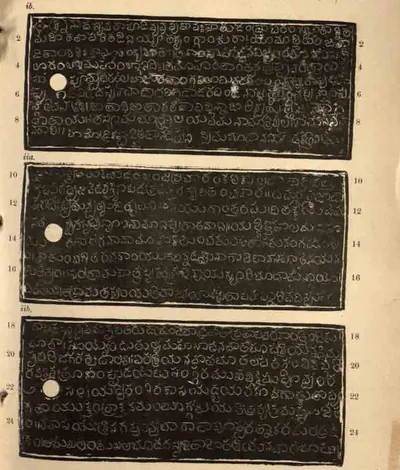 Pachchanitandiparru grant of Anna-Vema, Saka 1296 (A.D. 1374): ink impressions of plates i b, ii a and ii b (lines 1-25) (Epigraphia Indica XXI, No. 41 B, plates between pp. 274 and 275)Inscription rubbing · 1933
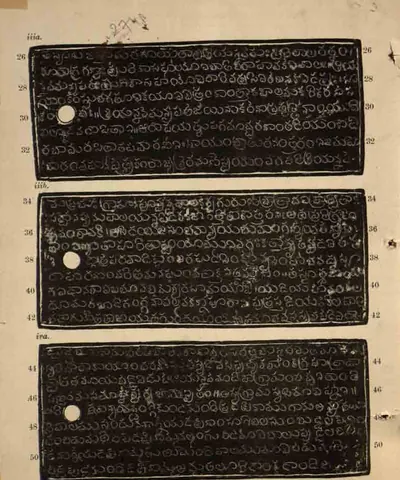 Pachchanitandiparru grant of Anna-Vema, Saka 1296 (A.D. 1374): ink impressions of plates iii a, iii b and iv a (lines 26-51) (Epigraphia Indica XXI, No. 41 B, plates between pp. 274 and 275)Inscription rubbing · 1933
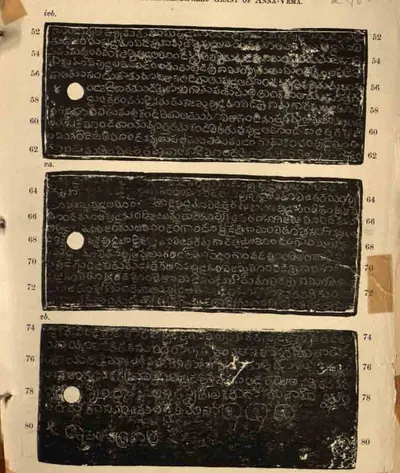 Pachchanitandiparru grant of Anna-Vema, Saka 1296 (A.D. 1374): ink impressions of plates iv b, v a and v b (lines 52-80) (Epigraphia Indica XXI, No. 41 B, plates between pp. 274 and 275)Inscription rubbing · 1933
References
Notes (0)
Sources (1)
Spotted an error on this page? Tell us
Last updated: