Srinatha
Telugu poet of the late 14th and early 15th centuries, often ranked with the three translators of the Mahabharata. He served Peda Komati Vema of Kondavidu as vidyadhikarin and composed his grants and inscriptions. He then wrote for the Reddis of Rajahmundry. His Sringaranaishadham, Bhimakhandam and Kasikhandam are dedicated to Reddi kings and ministers, and they are a main source for their history.
Srinatha was the leading Telugu poet of the Reddi period. The History of Telugu Literature of 1928 calls him “the poet who overshadows all others of his age”.1 It says that “impartial criticism assigns to him a position equal to that of the Kavitraya” (the three translators of the Mahabharata), and it dates him about 1365–1440.1 He spent most of his working life at the courts of the Reddis of Kondavidu and the Reddis of Rajahmundry.23 His dedications are among the main sources for their history.23
Life
According to J. Ramayya, writing in 1912, the introduction to the Bhimakhandam shows that Srinatha was a Brahman of the Pakanati sect.2 This sect is found mostly in the Nellore district.2 Ramayya calls him “a much travelled man for his times”.2
A stray verse ascribed to Srinatha says he visited the courts of Harihara II of Vijayanagara and of Sarvajna Singama of the Velama family.2 The same verse says that he was supported by Saluva Telungu Raya.2 But Ramayya adds that “he spent, however, the best part of his life at the courts of the Reddi chiefs of Kondavidu and Rajahmundry”.2 He “dedicated most of his works either to those chiefs or to their officers”.2
The Kistna manual of 1883 says that Srinatha “with his brother-in-law Bommara Pota raja flourished at their Court and sang their praises”.4 On that brother-in-law, the poet Bammera Potana, and on the dispute over the Bhoginidandakamu, see Potana’s page.
At the court of Kondavidu
Ramayya thought that Srinatha “seems to have first flourished at the court of Anavema”.56 H. Krishna Sastri thought that his connection with the Reddis “probably began in the reign of Ana-Vema to whose minister he dedicated his Sringaranaishadham”.56 Under Peda Komati Vema he held the office of vidyadhikarin.6 Krishna Sastri compared it to that of a “President” of the board of examiners.6
He composed the king’s records:789
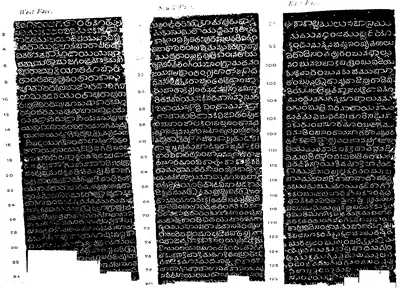
- the Phirangipuram pillar inscription of 1410, whose last verse says that it “was composed by Srinatha”789
- the Alapadu grant of 1413789
- the Telugu verse of 1415 at Aminabad, which ends with the words Srinatha kriti, “Srinatha’s composition”789
The Pinapadu grant of Komati Vema names “the poet Srinatha-Bhattaraka” as its composer.10 It names the festival of Sivaratri at Srisailam as its occasion.10 N. Ramesan says that Srinatha drafted all of Peda Komati Vema’s grants, from the Ponupalli grant to the Rudravaram grant.11
At Rajahmundry
After the end of the Kondavidu line, Ramayya wrote, Srinatha “seems to have gone to Rajahmundry where he was patronised by Vema-Reddi and Virabhadra-Reddi”.6 G. V. Ramamurti listed his dedications:3
- the Panditaradhyacharitam to Mamidi Praggadayya, commander of Vema Reddi’s forces3
- the Naishadham to Mantri Singana, Praggadayya’s brother3
- the Bhimakhandam to Bendapudi Annayya, minister of Virabhadra3
- the Kasikhandam to Virabhadra himself3
V. Appa Rao dated the Bhimakhandam to about Saka 1355 (1433; Saka is an Indian way of counting years).12 The opening verses of these poems, Ramamurti noted, “contain numerous references to incidents in the lives of the Reddi chiefs”.3
The Velama chronicle tells that when Lingama Nayaka killed Vema Reddi of Rajahmundry and took his sword, Virabhadra sent Srinatha to recover it.2 According to the chronicle, the poet won it back by praising Lingama in three verses.2
Works
Ramayya listed eight works:6
- the Marudratcharitramu6
- the Salivahana-Saptasati6
- the Sringaranaishadhamu6
- the Bhimakhandamu6
- the Kasikhandamu6
- the Haravilasamu6
- the Panditaradhyacharitramu6
- the Vithi-Natakamu6
The 1928 history adds the Sivaratri Mahatmya, the Vallabhabhyudaya and the Sringara Dipika.113 The last claims to be the work of Kumaragiri Reddi, but it “is held by many to be by Srinatha”.113 His Naishada is a translation of Sriharsha’s difficult Sanskrit poem.113 The history calls it “a crown set with dazzling diamonds on the brow of Sarasvati”.113
His Vidhinataka, the history says, “contains mostly descriptions of street scenes of Rajahmundry”.1314 Ramayya added that Srinatha “is also the reputed author of the ballad Palnativiracharitramu”.2 But, Ramayya wrote, “some dispute his authorship and the point requires investigation”.2 The Haravilasam is the source for the merchant Avachi Devaya and his son Tippa, who supplied the courts of Vema and Kumaragiri.155
Reputation
The 1928 history contrasts him with his brother-in-law Potana: “Srinatha basked in the sunshine of royal favour; Potana avoided kings and courts”.1617 It adds that “Srinatha dedicated every one of his poems to a king or a rich man”.1617
It also says that “Srinatha’s character seems to have been as full of faults as his style is free from them”.18 But it thought the traditional stories about him largely exaggerated.18 The Kurnool district manual records a tradition about the local chief of Dupad, who was expelled by the Gajapatis of Orissa.19 The tradition says this chief was “a descendant of Srinatha”.19
Footnotes
-
P. Chenchiah and Raja M. Bhujanga Rao, A History of Telugu Literature (1928), pp. 59–60 (archive.org (opens in a new tab)). ↩ ↩2 ↩3 ↩4 ↩5 ↩6
-
Ramayya, Three Inscriptions of the Reddis of Kondavidu (1911–12), p. 316 (archive.org (opens in a new tab)). ↩ ↩2 ↩3 ↩4 ↩5 ↩6 ↩7 ↩8 ↩9 ↩10 ↩11 ↩12 ↩13
-
G. V. Ramamurti, Konkuduru Plates of Allaya-Dodda, Saka-Samvat 1352, Epigraphia Indica V (1898–99), p. 55 (archive.org (opens in a new tab)). ↩ ↩2 ↩3 ↩4 ↩5 ↩6 ↩7 ↩8
-
Gordon Mackenzie, A Manual of the Kistna District (1883), p. 10 (archive.org (opens in a new tab)). ↩
-
Ramayya, Madras Museum Plates of Vema (1905–06), p. 12 (archive.org (opens in a new tab)). ↩ ↩2 ↩3
-
Ramayya, Three Inscriptions of the Reddis of Kondavidu (1911–12), p. 315 (archive.org (opens in a new tab)). ↩ ↩2 ↩3 ↩4 ↩5 ↩6 ↩7 ↩8 ↩9 ↩10 ↩11 ↩12 ↩13 ↩14
-
J. Ramayya, Three Inscriptions of the Reddis of Kondavidu, Epigraphia Indica XI (1911–12), p. 314 (archive.org (opens in a new tab)). ↩ ↩2 ↩3 ↩4
-
Ramayya, Three Inscriptions of the Reddis of Kondavidu (1911–12), p. 317 (archive.org (opens in a new tab)). ↩ ↩2 ↩3 ↩4
-
Ramayya, Madras Museum Plates of Vema (1905–06), p. 13 (archive.org (opens in a new tab)). ↩ ↩2 ↩3 ↩4
-
A. Rangaswami Saraswati and N. Lakshminarayan Rao, Three Copper-plate Inscriptions of the Reddis, Epigraphia Indica XXI (1931–32), p. 271 (archive.org (opens in a new tab)). ↩ ↩2
-
N. Ramesan, Copper Plate Inscriptions of Andhra Pradesh Government Museum, Hyderabad, Vol. I (1962), p. 170 (archive.org (opens in a new tab)). ↩
-
V. Appa Rao, “Rajahmundry Museum Plates of Annadeva Choda”, Journal of the Andhra Historical Research Society I, No. 4 (1927), p. 177 (archive.org (opens in a new tab)). ↩
-
Chenchiah and Bhujanga Rao, History of Telugu Literature (1928), p. 60 (archive.org (opens in a new tab)). ↩ ↩2 ↩3 ↩4 ↩5
-
Chenchiah and Bhujanga Rao, History of Telugu Literature (1928), p. 61 (archive.org (opens in a new tab)). ↩
-
J. Ramayya, Madras Museum Plates of Vema, A.D. 1345, Epigraphia Indica VIII (1905–06), p. 11 (archive.org (opens in a new tab)). ↩
-
Chenchiah and Bhujanga Rao, History of Telugu Literature (1928), p. 63 (archive.org (opens in a new tab)). ↩ ↩2
-
Chenchiah and Bhujanga Rao, History of Telugu Literature (1928), p. 64 (archive.org (opens in a new tab)). ↩ ↩2
-
Chenchiah and Bhujanga Rao, History of Telugu Literature (1928), p. 62 (archive.org (opens in a new tab)). ↩ ↩2
-
Narahari Gopalakristnamah Chetty, A Manual of the Kurnool District (1886), p. 24 (archive.org (opens in a new tab)). ↩ ↩2
Photos
References
Notes (0)
Sources (10)
Spotted an error on this page? Tell us
Last updated: