Anavema Reddi
Third Reddi king (c. 1364–1386), younger son of Prolaya Vema, who ruled from Kondavidu and carried the kingdom's grants into the Godavari delta. He is known from five copper-plate grants (Pachchanitandiparru 1374, Nadupuru, Pedapalakaluru 1378, Vanapalli 1380 and others) and from records at Srisailam and Draksharama. He was surnamed Vasantaraya for his spring festival. The poet Srinatha's connection with the Reddis probably began under him.
Anavema was the third king of the Reddis of Kondavidu.12 He was the younger son of Prolaya Vema, and succeeded his elder brother Anavota.12 He is the first Reddi king whose grants name Kondavidu as the capital.1
The Vanapalli plates describe him “seated on the lion-throne in (his) capital, the prosperous city of Kontoviti”.1 J. Ramayya concluded that the capital moved there from Addanki only in his reign.3
Coming to the throne, and dates
Robert Sewell thought Anavema took the throne after Anavota was defeated by the Recherla Velamas at Dharanikota in 1361.4 M. Somasekhara Sarma found Anavema joining in his brother’s Kolluru grant of Saka 1286 (Saka is an Indian way of counting years).56 He dated Anavema’s accession to 1364, and his last record, the Manyamapuram grant, to 1382.56 N. Ramesan adopted 1364 to 1386.7
The Dandakavili gives him Saka 1284–1295, and Ramayya preferred Saka 1284–1299 (about 1362–1377).8 The Kistna manual calls the third king “Aliya Vema Reddi”, a brother of the founder, from 1370.9
Grants in the delta
Anavema’s grants carried the family’s name into the Godavari delta. The Nadupuru grant is dated in Saka 1296 (1374–75).1011 It was made “in the temple of Vijayesvara on the bank of the Gautami (i.e. Godavari) river”, for the spiritual benefit of his sister Vemasani, the queen of Nallanunka.1011 The village was renamed Vemapura after her.1011
The Vanapalli plates of 6 February 1380 gave Immadilanka, alias Anna-Vemapura, on the Gautami in the Amalapuram taluk.1213 The receiver was his minister and preceptor (teacher) Immadi, son of the minister Mallaya.1213
A servant of his gave land at Palivela in 1378.1114 An inscription of 1381 at Draksharama records buildings put up by an Ana-Vema.1114 Rangacharya calls him the Kondavidu king, but Hultzsch thought it uncertain that he was the same man.1114 N. Ramesan, following Somasekhara Sarma, describes an eastern campaign in which Anavema took Nidadavolu and Rajahmundry.1516 In this account he went on to Pithapuram and Simhachalam.1516
South of the Krishna, the Pachchanitandiparru grant of 22 August 1374 is kept by a family in the Tenali taluk.2 It gave the village of Pachchani-Tandiparru to the astronomer Peddi.2 It was composed by his court poet Balasarasvati.2
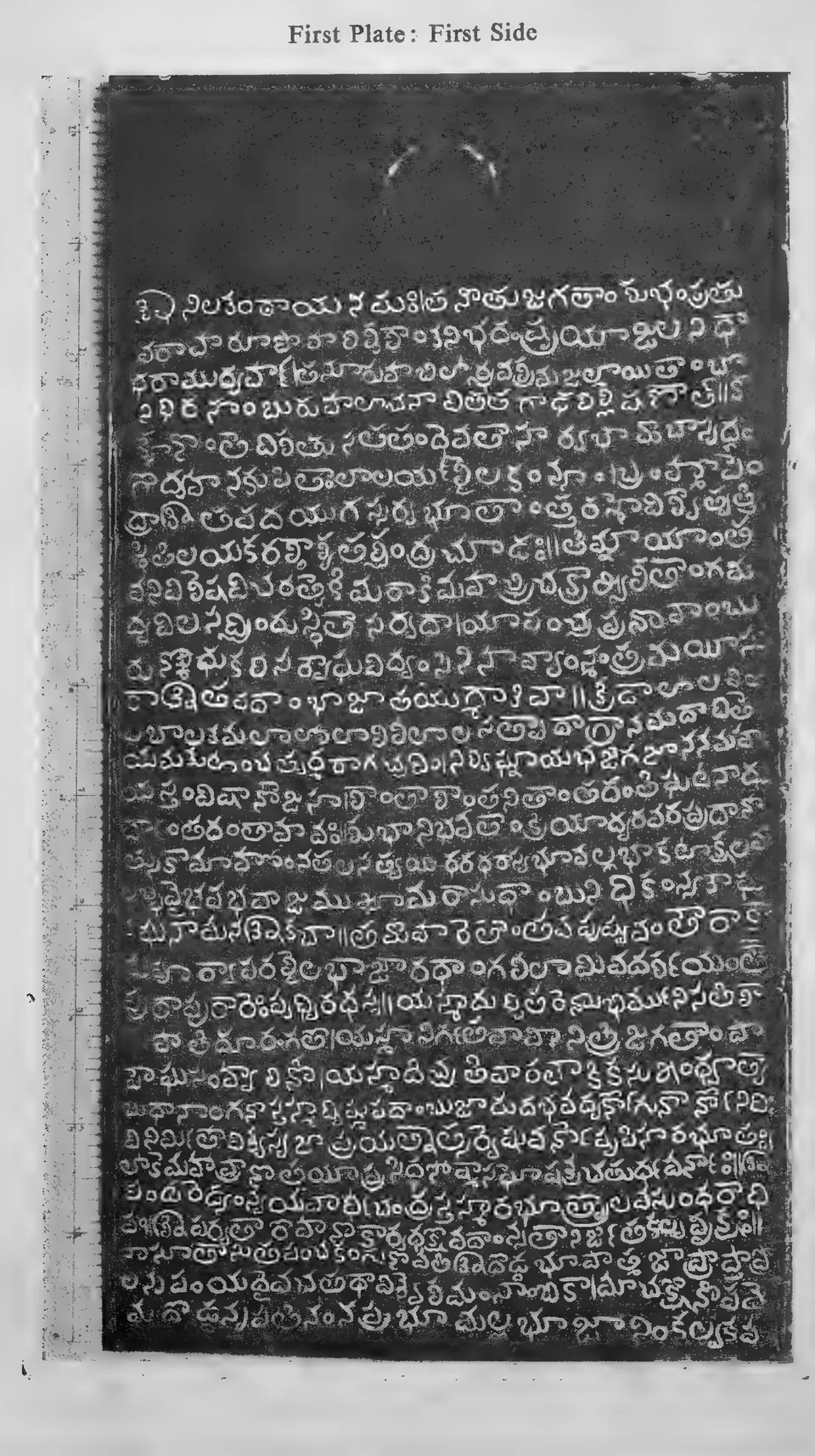
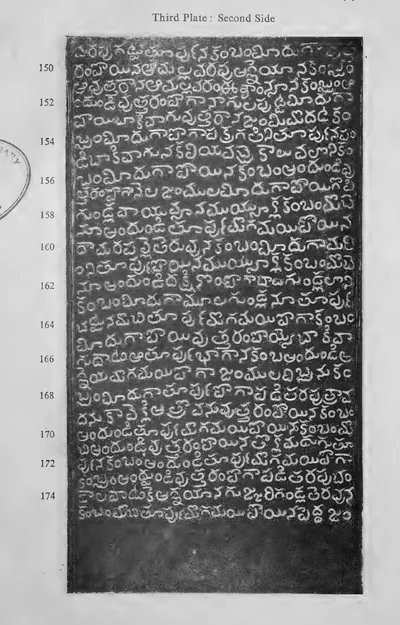
The Pedapalakaluru plates of 4 December 1378 were discovered by Ramesan near Guntur.171819 They gave Pedapalakaluru, between Kondavidu and Mangalagiri, to a scholar named Ahobala Pandita and eight other Brahmans.171819 About half of its 212 lines describe the village boundaries in Telugu.171819 See the Vanapalli plates, the Nadupuru grant, the Pachchanitandiparru grant and the Pedapalakaluru plates.
Srisailam
At Srisailam, an inscription of January 1378 records that Anavema built the Viramantapa for the merit of his uncle Annaya.20 It gives a long list of his titles.20 It adds that “in this mantapa many heroes voluntarily cut off their heads and tongues”.20 Ramesan read one of the titles in his Srisailam records as a claim to have destroyed fortresses such as Rajamahendravaram and Niravadya.15
Later tradition credited Anavema with the steps at Srisailam that the family’s own grants give to his father.2122 An inscription listed at Srisailam says that he “erected the steps to the Srisailam hill”.21 The Kurnool district manual credits him with “the causeway on Srisailam”.22
Titles and the spring festival
The Vanapalli plates give him the surnames Jaganobbaganda, Kshurika-Kali-Vetala and Karpura-Vasantaraya.12 E. Hultzsch explained the second as one who resembles a Vetala, a battlefield demon, fighting with a dagger.13 He took the third as a sign that “the king used to take part in the celebration of the spring-festival (holi), at which camphor and other substances are scattered about”.13 Kataya Vema’s Tottaramudi plates also call him Vasantaraya, “the king of spring”.23
The Vanapalli plates describe his court.13 While he sat on his jewelled throne, “some people receive the sovereignty over a country (desa)”.13 Others received “the distinction of a palanquin, a chauri, and a parasol” (a chauri is a fly-whisk), others “their (confiscated) kingdom”, and others agraharas (villages granted to Brahmans).13
Court poets
His grants name two court poets.212 Balasarasvati composed his grants and a Srisailam inscription until 1377.2 Trilochanacharya wrote the Vanapalli plates of 1380.12
Ramayya thought the poet Srinatha “seems to have first flourished at the court of Anavema, in whose praise there are several verses extant” (still surviving).3 H. Krishna Sastri added that Srinatha’s connection with the Reddis “probably began in the reign of Ana-Vema to whose minister he dedicated his Sringaranaishadham”.24
Family
His sister Vemasani married Nallanunka.11 Sewell’s pedigree makes their daughter Hemambika a queen of Deva Raya I of Vijayanagara.25 Anavema’s grants do not name a son.323 On his death the crown passed to his nephew Kumaragiri.323
Footnotes
-
Hultzsch, Vanapalli Plates of Anna-Vema (1894–95), p. 64 (archive.org (opens in a new tab)). ↩ ↩2 ↩3 ↩4
-
A. Rangaswami Saraswati and N. Lakshminarayan Rao, Three Copper-plate Inscriptions of the Reddis, Epigraphia Indica XXI (1931–32), p. 270 (archive.org (opens in a new tab)). ↩ ↩2 ↩3 ↩4 ↩5 ↩6 ↩7
-
J. Ramayya, Madras Museum Plates of Vema, A.D. 1345, Epigraphia Indica VIII (1905–06), p. 12 (archive.org (opens in a new tab)). ↩ ↩2 ↩3 ↩4
-
Robert Sewell, The Historical Inscriptions of Southern India (1932), p. 195 (archive.org (opens in a new tab)). ↩
-
M. Somasekhara Sarma, History of the Reddi Kingdoms (1948), p. 43 (archive.org (opens in a new tab)). ↩ ↩2
-
Somasekhara Sarma, History of the Reddi Kingdoms (1948), p. 44 (archive.org (opens in a new tab)). ↩ ↩2
-
N. Ramesan, Copper Plate Inscriptions of Andhra Pradesh Government Museum, Hyderabad, Vol. I (1962), p. 165 (archive.org (opens in a new tab)). ↩
-
Ramayya, Madras Museum Plates of Vema (1905–06), p. 13 (archive.org (opens in a new tab)). ↩
-
Gordon Mackenzie, A Manual of the Kistna District (1883), p. 10 (archive.org (opens in a new tab)). ↩
-
E. Hultzsch, Nadupuru Grant of Anna-Vema, Saka-Samvat 1296, Epigraphia Indica III (1894–95), p. 286 (archive.org (opens in a new tab)). ↩ ↩2 ↩3
-
Hultzsch, Nadupuru Grant of Anna-Vema (1894–95), p. 287 (archive.org (opens in a new tab)). ↩ ↩2 ↩3 ↩4 ↩5 ↩6 ↩7
-
E. Hultzsch, Vanapalli Plates of Anna-Vema, Saka-Samvat 1300, Epigraphia Indica III (1894–95), p. 60 (archive.org (opens in a new tab)). ↩ ↩2 ↩3 ↩4 ↩5
-
Hultzsch, Vanapalli Plates of Anna-Vema (1894–95), p. 65 (archive.org (opens in a new tab)). ↩ ↩2 ↩3 ↩4 ↩5 ↩6 ↩7
-
V. Rangacharya, A Topographical List of the Inscriptions of the Madras Presidency, Vol. II (1919), p. 744, Godavari No. 352 (archive.org (opens in a new tab)). ↩ ↩2 ↩3
-
Ramesan, Copper Plate Inscriptions, Vol. I (1962), p. 167 (archive.org (opens in a new tab)). ↩ ↩2 ↩3
-
Ramesan, Copper Plate Inscriptions, Vol. I (1962), p. 168 (archive.org (opens in a new tab)). ↩ ↩2
-
Ramesan, Copper Plate Inscriptions, Vol. I (1962), p. 185 (archive.org (opens in a new tab)). ↩ ↩2 ↩3
-
Ramesan, Copper Plate Inscriptions, Vol. I (1962), p. 186 (archive.org (opens in a new tab)). ↩ ↩2 ↩3
-
Ramesan, Copper Plate Inscriptions, Vol. I (1962), pp. 190–191 (archive.org (opens in a new tab)). ↩ ↩2 ↩3
-
Rangacharya, Topographical List, Vol. II (1919), p. 954, Kurnool No. 456 (archive.org (opens in a new tab)). ↩ ↩2 ↩3
-
Rangacharya, Topographical List, Vol. II (1919), p. 959, Kurnool No. 489-L (archive.org (opens in a new tab)). ↩ ↩2
-
Narahari Gopalakristnamah Chetty, A Manual of the Kurnool District (1886), p. 24 (archive.org (opens in a new tab)). ↩ ↩2
-
J. Ramayya, Tottaramudi Plates of Kataya-Vema, Saka-Samvat 1333, Epigraphia Indica IV (1896–97), p. 319 (archive.org (opens in a new tab)). ↩ ↩2 ↩3
-
J. Ramayya, Three Inscriptions of the Reddis of Kondavidu, Epigraphia Indica XI (1911–12), p. 315, note by H. Krishna Sastri (archive.org (opens in a new tab)). ↩
-
Sewell, Historical Inscriptions (1932), p. 385 (archive.org (opens in a new tab)). ↩
Photos
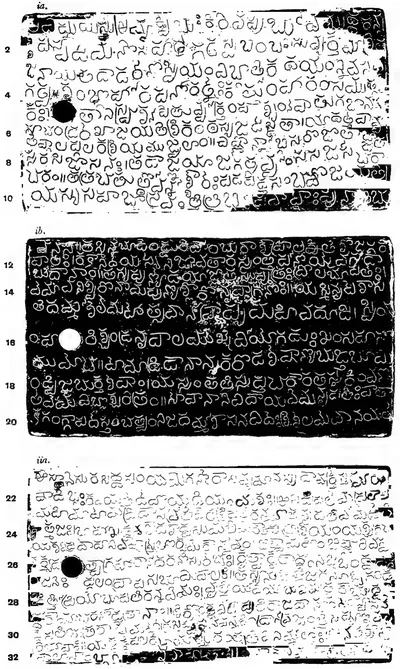 "Vanapalli Plates of Anna-Vema.—Saka-Samvat 1300", plates i a, i b and ii a (lines 1-32) (Epigraphia Indica III, plates between pp. 62 and 63, PDF p. 100)Inscription rubbing · 1895
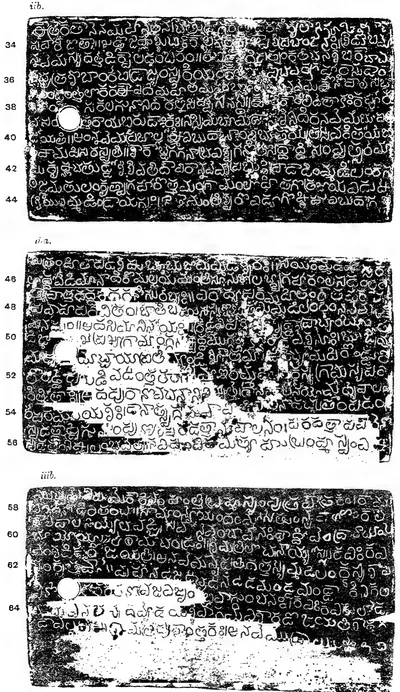 "Vanapalli Plates of Anna-Vema.—Saka-Samvat 1300", plates ii b, iii a and iii b (lines 33-65) (Epigraphia Indica III, plates between pp. 62 and 63, PDF p. 101)Inscription rubbing · 1895
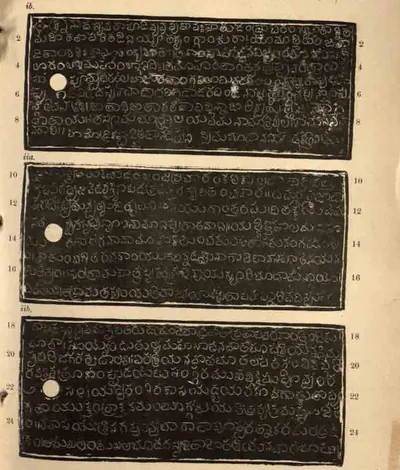 Pachchanitandiparru grant of Anna-Vema, Saka 1296 (A.D. 1374): ink impressions of plates i b, ii a and ii b (lines 1-25) (Epigraphia Indica XXI, No. 41 B, plates between pp. 274 and 275)Inscription rubbing · 1933
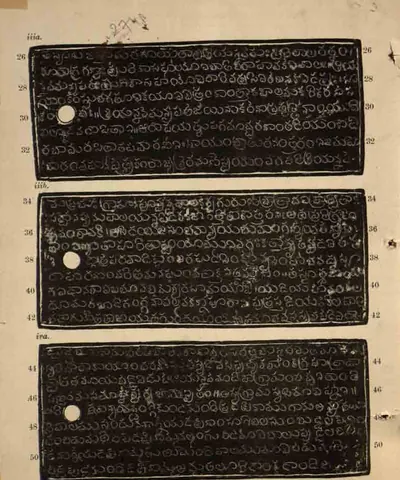 Pachchanitandiparru grant of Anna-Vema, Saka 1296 (A.D. 1374): ink impressions of plates iii a, iii b and iv a (lines 26-51) (Epigraphia Indica XXI, No. 41 B, plates between pp. 274 and 275)Inscription rubbing · 1933
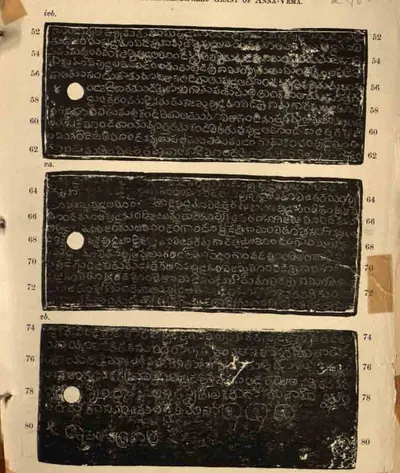 Pachchanitandiparru grant of Anna-Vema, Saka 1296 (A.D. 1374): ink impressions of plates iv b, v a and v b (lines 52-80) (Epigraphia Indica XXI, No. 41 B, plates between pp. 274 and 275)Inscription rubbing · 1933
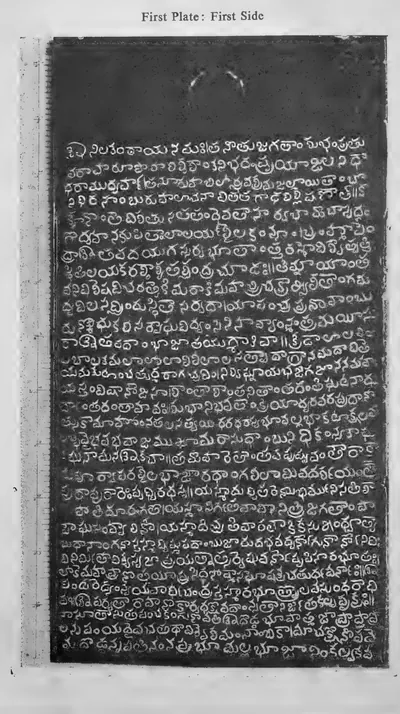 Pedapalakaluru plates of Anavema Reddi, Saka 1300 (A.D. 1378): photograph of the first plate, first side (lines 1-31) (Ramesan 1962, Plate XII (a), PDF p. 249)Photograph · 1962
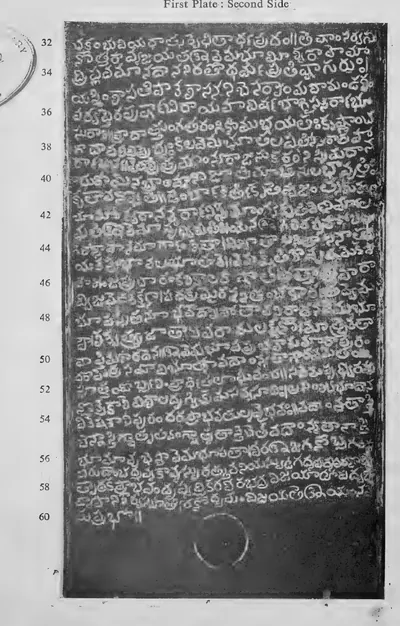 Pedapalakaluru plates of Anavema Reddi, Saka 1300 (A.D. 1378): photograph of the first plate, second side (lines 32-60) (Ramesan 1962, Plate XII (b), PDF p. 250)Photograph · 1962
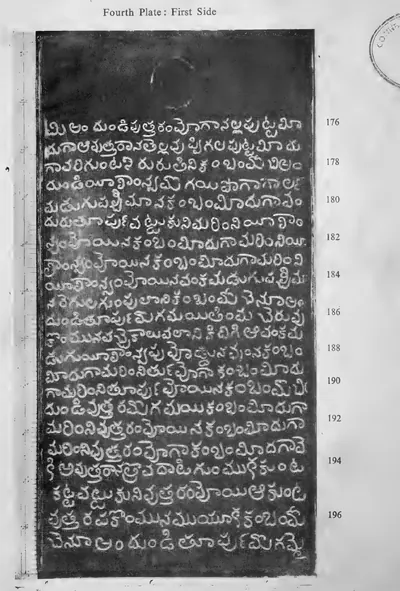 Pedapalakaluru plates of Anavema Reddi, Saka 1300 (A.D. 1378): photograph of the fourth plate, first side (lines 176-197) (Ramesan 1962, Plate XII (g), PDF p. 261)Photograph · 1962
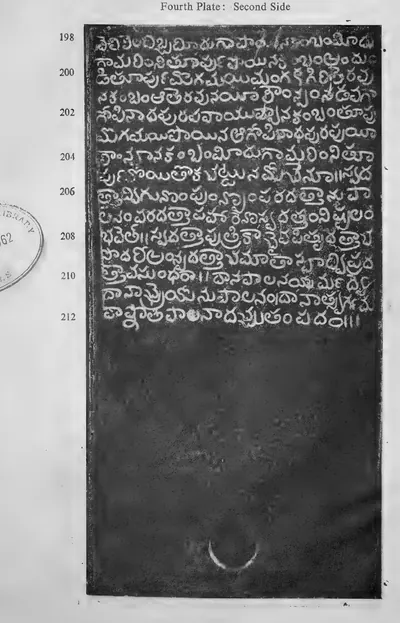 Pedapalakaluru plates of Anavema Reddi, Saka 1300 (A.D. 1378): photograph of the fourth plate, second side (lines 198-212) (Ramesan 1962, Plate XII (h), PDF p. 262)Photograph · 1962
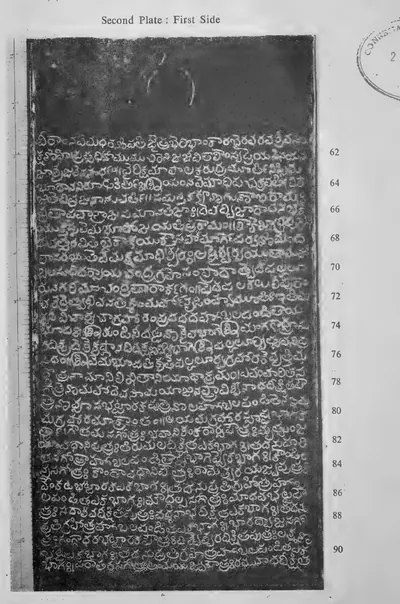 Pedapalakaluru plates of Anavema Reddi, Saka 1300 (A.D. 1378): photograph of the second plate, first side (lines 61-91) (Ramesan 1962, Plate XII (c), PDF p. 253)Photograph · 1962
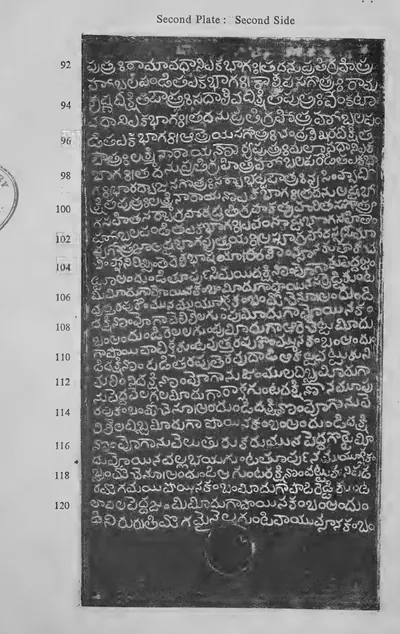 Pedapalakaluru plates of Anavema Reddi, Saka 1300 (A.D. 1378): photograph of the second plate, second side (lines 92-121) (Ramesan 1962, Plate XII (d), PDF p. 254)Photograph · 1962
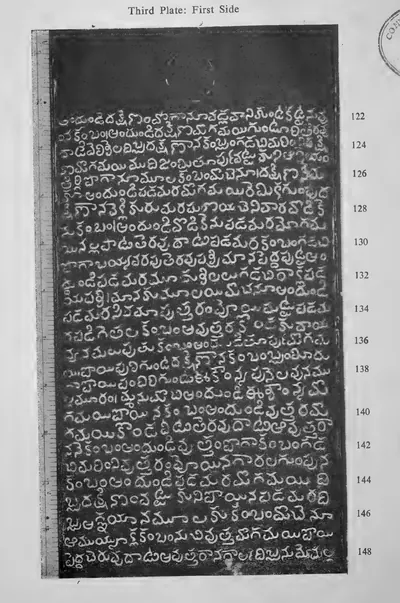 Pedapalakaluru plates of Anavema Reddi, Saka 1300 (A.D. 1378): photograph of the third plate, first side (lines 122-148) (Ramesan 1962, Plate XII (e), PDF p. 257)Photograph · 1962
Related
Dynasties
References
Notes (0)
Sources (11)
Spotted an error on this page? Tell us
Last updated: