Peda Komati Vema
Fifth Reddi king of Kondavidu (c. 1402–1420), a grandson of Prolaya Vema's elder brother Macha, known as a scholar-king. The Sringaradipika commentary on the Amarusataka and other works are ascribed to him, and the poet Srinatha served him as vidyadhikarin and composed his grants. His reign was spent in wars with the Rajahmundry Reddis, Vijayanagara and the Recherla Velamas.
Peda Komati Vema was the fifth king of the Reddis of Kondavidu and the most learned of them. J. Ramayya wrote in 1912 that he “seems to have been both a scholar and a patron of scholars”.1 He was the reputed author of the Sringaradipika.1 His court, Ramayya wrote, “was the resort of poets among whom was the great Sanskrit poet Vamanabhatta Bana”.1
Family
Peda Komati Vema was the son of Peda Komati, one of the three sons of Macha, the elder brother of Prolaya Vema.23 The Phirangipuram pillar inscription calls Macha’s sons Reddivota, Komatindra and Naga.2 It says that “Ped[d]a-Komati begot a son named Vema as great as Karna in charities”.2
His queen was Suramamba, a daughter of Ganna of Dhanyavati (Dharanikota).21 An inscription of 1415 at Aminabad shows that his son Racha Vema dug a channel to feed the tank that his mother had built.45 The Kistna manual calls him “Komati Venka Reddi” and makes him a son of Kumaragiri.6
Coming to the throne
Ramayya thought the crown passed to him peacefully on the death of Kumaragiri, the last of Prolaya Vema’s line.3 M. Somasekhara Sarma dated his first record to August 1402.789 He argued that Peda Komati Vema seized Kondavidu by force from the ailing Kumaragiri, with the help of some nobles.789 In his account Peda Komati Vema defeated Kumaragiri’s minister Kataya Vema in battle, and N. Ramesan follows this account.789
Somasekhara Sarma says that Peda Komati Vema gave the country north of the Krishna to his brother Macha.10 Macha fortified Kondapalli and made it his seat.10
The scholar-king and his poet
He signed as Viranarayana.1 Rangacharya calls him “the author of the Sringaradipika, a commentary on Amarusataka”.1112 Ramesan, following Somasekhara Sarma, credits him with a work on poetics, the Sahitya Chintamani, and one on music, the Sangita Chintamani.1314
Ramesan also records a Telugu verse that praised his generosity.1314 But the verse complained that a minister named Turaga Rama stood near him like a snake by a wishing-tree.1314 The History of Telugu Literature of 1928 instead treats the Sringaradipika as attributed to Kumaragiri.15
Srinatha held under him the office of vidyadhikarin.1 H. Krishna Sastri compared this office to a “President” of examiners.1 The poet composed his patron’s records:21613
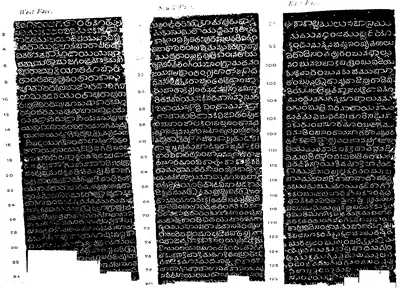
- the Phirangipuram inscription of 14102
- the Pinapadu grant made at Srisailam on the night of Sivaratri16
- according to Ramesan, all his grants from the Ponupalli grant to the Rudravaram grant of 141913
See the Phirangipuram inscription.
Grants and the tank at Phirangipuram
Grants of Saka 1329 (Saka is an Indian way of counting years) and 1333 gave the villages of Kalvavamulu and Nandamuru to the astronomer Peddi.17 Peddi had already received a village from Anavema.17
On the night of Sivaratri in Saka 1334 (1413) he gave Alapadu to Visvesvara-bhatta.18 Alapadu is on the Tungabhadra branch of the Krishna in the Velanadu district.18 Visvesvara-bhatta divided the village, renamed Vemavaram, into sixty shares.18 The grant was composed by Srinatha and signed “of the glorious Viranarayana”.18
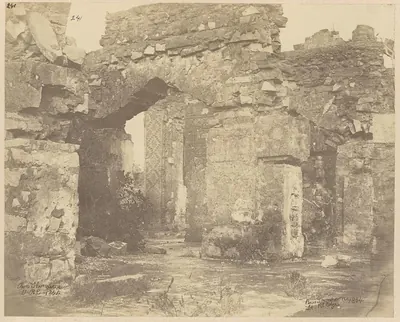
In February 1410 his queen Suramamba completed a tank named Santana-sagara at Phirangipuram.2 A pillar inscription in half Sanskrit and half Telugu verse praises the tank.2 It describes the king as “a seventh emperor” whose charities reached from Srisailam to Kasi.2 A record of his on the Kondavidu hill, in a ruined hall called Varahalakottu, is badly damaged.1912
Wars
Somasekhara Sarma found that Peda Komati Vema never secured the obedience of Kataya Vema at Rajahmundry.202122 In his account Peda Komati Vema helped the Telugu Choda chief Annadeva against Kataya Vema.202122 Kataya Vema in turn drew in Deva Raya I of Vijayanagara.202122 An inscription of Deva Raya of 1412 at Inkollu in the Bapatla taluk marks an invasion of the Reddi coast, which Peda Komati Vema later threw back.202122
After Kataya Vema’s death he fought Allada Reddi, the new ruler of Rajahmundry.2324 In the Vemavaram grant of 1434, Allada claimed to have “defeated Komati Vema at Ramesvaram”.2324 L. D. Barnett identified this Komati Vema with Peda Komati Vema.24 Somasekhara Sarma connected the war with Firuz Shah Bahmani’s march towards Rajahmundry in 1417.2526 He thought the march was made as Peda Komati Vema’s ally.2526
The Alapadu grant itself shows, Ramayya noted, that Peda Komati Vema had a younger brother named Macha.18 This Macha “is known to have been killed in battle by Kumara-Vedagiri-Nayudu of the Velugoti family”.18 The chronicle of the Velugoti family tells of a feud with the Recherla chiefs: Macha killed by Kumara Vedagiri, Vedagiri killed in turn, and Peda Komati Vema captured and finally slain by Vedagiri’s young brother Lingama and a cousin. Somasekhara Sarma noted that no other evidence supports these stories.2728
J. Ramayya, reading the same chronicle in 1906, used it to argue that the last king Racha Vema was Peda Komati Vema’s son, not his brother.4
Death
His last known grant, from Rudravaram, was made in December 1419.728 Somasekhara Sarma placed the end of his reign in 1420.728 Ramayya, using the Dandakavili and the inscriptions, gave him Saka 1321–1337 (about 1399–1415).4 Sewell, in 1884, gave him 1395 to 1423.29
Footnotes
-
Ramayya, Three Inscriptions of the Reddis of Kondavidu (1911–12), p. 315 (archive.org (opens in a new tab)). ↩ ↩2 ↩3 ↩4 ↩5 ↩6 ↩7
-
J. Ramayya, Three Inscriptions of the Reddis of Kondavidu, Epigraphia Indica XI (1911–12), p. 314 (archive.org (opens in a new tab)). ↩ ↩2 ↩3 ↩4 ↩5 ↩6 ↩7 ↩8 ↩9
-
J. Ramayya, Madras Museum Plates of Vema, A.D. 1345, Epigraphia Indica VIII (1905–06), p. 12 (archive.org (opens in a new tab)). ↩ ↩2
-
Ramayya, Madras Museum Plates of Vema (1905–06), p. 13 (archive.org (opens in a new tab)). ↩ ↩2 ↩3
-
Rangacharya, Topographical List, Vol. II (1919), p. 835, Guntur No. 766 (archive.org (opens in a new tab)). ↩
-
Gordon Mackenzie, A Manual of the Kistna District (1883), p. 10 (archive.org (opens in a new tab)). ↩
-
M. Somasekhara Sarma, History of the Reddi Kingdoms (1948), p. 46 (archive.org (opens in a new tab)). ↩ ↩2 ↩3 ↩4 ↩5
-
Somasekhara Sarma, History of the Reddi Kingdoms (1948), pp. 157–159 (archive.org (opens in a new tab)). ↩ ↩2 ↩3
-
N. Ramesan, Copper Plate Inscriptions of Andhra Pradesh Government Museum, Hyderabad, Vol. I (1962), p. 169 (archive.org (opens in a new tab)). ↩ ↩2 ↩3
-
Somasekhara Sarma, History of the Reddi Kingdoms (1948), p. 158 (archive.org (opens in a new tab)). ↩ ↩2
-
Rangacharya, Topographical List, Vol. II (1919), p. 821, Guntur No. 604-A (archive.org (opens in a new tab)). ↩
-
Rangacharya, Topographical List, Vol. II (1919), p. 772 (archive.org (opens in a new tab)). ↩ ↩2
-
Ramesan, Copper Plate Inscriptions, Vol. I (1962), p. 170 (archive.org (opens in a new tab)). ↩ ↩2 ↩3 ↩4 ↩5
-
Ramesan, Copper Plate Inscriptions, Vol. I (1962), p. 171 (archive.org (opens in a new tab)). ↩ ↩2 ↩3
-
P. Chenchiah and Raja M. Bhujanga Rao, A History of Telugu Literature (1928), p. 60 (archive.org (opens in a new tab)). ↩
-
A. Rangaswami Saraswati and N. Lakshminarayan Rao, Three Copper-plate Inscriptions of the Reddis, Epigraphia Indica XXI (1931–32), p. 271 (archive.org (opens in a new tab)). ↩ ↩2
-
A. Rangaswami Saraswati and N. Lakshminarayan Rao, Three Copper-plate Inscriptions of the Reddis, Epigraphia Indica XXI (1931–32), p. 270 (archive.org (opens in a new tab)). ↩ ↩2
-
Ramayya, Three Inscriptions of the Reddis of Kondavidu (1911–12), p. 317 (archive.org (opens in a new tab)). ↩ ↩2 ↩3 ↩4 ↩5 ↩6
-
V. Rangacharya, A Topographical List of the Inscriptions of the Madras Presidency, Vol. II (1919), p. 771, Guntur No. 217 (archive.org (opens in a new tab)). ↩
-
Somasekhara Sarma, History of the Reddi Kingdoms (1948), p. 159 (archive.org (opens in a new tab)). ↩ ↩2 ↩3 ↩4
-
Somasekhara Sarma, History of the Reddi Kingdoms (1948), p. 160 (archive.org (opens in a new tab)). ↩ ↩2 ↩3 ↩4
-
Somasekhara Sarma, History of the Reddi Kingdoms (1948), p. 161 (archive.org (opens in a new tab)). ↩ ↩2 ↩3 ↩4
-
L. D. Barnett, Vemavaram Grant of Allaya-Vema Reddi: Saka 1356, Epigraphia Indica XIII (1915–16), p. 238 (archive.org (opens in a new tab)). ↩ ↩2
-
Barnett, Vemavaram Grant of Allaya-Vema Reddi (1915–16), p. 239 (archive.org (opens in a new tab)). ↩ ↩2 ↩3
-
Somasekhara Sarma, History of the Reddi Kingdoms (1948), p. 162 (archive.org (opens in a new tab)). ↩ ↩2
-
Somasekhara Sarma, History of the Reddi Kingdoms (1948), p. 163 (archive.org (opens in a new tab)). ↩ ↩2
-
Somasekhara Sarma, History of the Reddi Kingdoms (1948), p. 166 (archive.org (opens in a new tab)). ↩
-
Somasekhara Sarma, History of the Reddi Kingdoms (1948), p. 167 (archive.org (opens in a new tab)). ↩ ↩2 ↩3
-
Robert Sewell, Lists of Inscriptions, and Sketch of the Dynasties of Southern India (1884), p. 187 (archive.org (opens in a new tab)). ↩
Photos
Related
Dynasties
References
Notes (0)
Sources (11)
Spotted an error on this page? Tell us
Last updated: