Padamkaluru grant of Amma II
Five Sanskrit copper plates of the Eastern Chalukya king Amma II Vijayaditya, formerly in Sir Walter Elliot's collection. They give the village of Padamkaluru in the Pennatavadi district to a Brahmin pilgrim on a lunar eclipse. J. F. Fleet edited them in 1878. They are the grant that dates Amma II's coronation, in Saka 867 (December 945). Where they were found is not recorded.
These plates record a grant of Amma II, the Eastern Chalukya king who reigned for twenty-five years from 945.1 J. F. Fleet called it “the record that gives the date of the coronation of Amma II”.12 That coronation, in Saka 867 (Saka is an Indian way of counting years), is the first event in the dynasty’s history that the grants date in an era.12 The reigns before it can only be counted back from it.12
Fleet edited the plates in 1878.3 He selected them from several grants of the dynasty in Sir Walter Elliot’s collection of facsimiles (exact copies).3 He noted that, apart from A. C. Burnell’s remarks, no account of the eastern branch of the Chalukyas had yet been published.3
Where the plates came from
Fleet edited the grant from Elliot’s facsimile and from the original plates.3 Burnell had already printed its first eighteen lines as Plate XXV of his South-Indian Palaeography.3 Fleet did not know where the plates had been found.3 Nor did he know in what part of the country the granted village and its district lay.3
In 1891 Fleet still listed the grant as “from an unknown locality”.1 Kielhorn’s list of 1903 enters it as plates in the British Museum, with a query, formerly Elliot’s.4
Kielhorn noted in 1899 that the Pennatavadi district appears again in the Masulipatam plates of Amma I.5 Robert Sewell had identified the village granted there, Drujjuru, with Zuzzuru in the Nandigama taluk of the Krishna (then Kistna) district.5 Kielhorn thought Sewell might be right, but could not trace the other places named there.5
So the site of Padamkaluru itself remained unknown to all of them. Fleet named the grant after this village in 1903.6
Description
There are five plates, each about 7¼ inches long by 3¾ inches broad.3 The writing runs from the inside of the first plate to the inside of the fifth.3 The ring is about ⅜ inch thick and 4¾ inches across.3
The round seal, about 2½ inches across, shows a boar facing left.3 The moon is on its right, the sun above it and an elephant-goad on its left.3 Across the centre is the legend Sri-Tribhuvanankusa, “the elephant-goad of Sri-Tribhuvana”, and an ornamental device is at the bottom.3
Fleet found the letters radically the same as those of the Kadamba and early Western Chalukya grants.3 By this period, he noted, the two Chalukya scripts had grown far apart.3 Burnell found no real palaeographic connection between them beyond their common origin.3
The genealogy
The grant lists the reigns from Kubja-Vishnuvardhana, who “ruled over the country of Vengi for eighteen years”, down to Amma II.7 It gives Jayasimha I thirty years, and Kielhorn marked this figure as wrong.74 Most grants give thirty-three.74 Vijayaditya II, “a very lion of a king”, is given forty-eight years.7
For the civil war after 925, the grant says that Talapa (Tadapa) expelled Amma I’s son Vijayaditya, “while he was a child”.8 Talapa reigned for one month.8 Vikramaditya, son of Chalukya-Bhima I, conquered him and reigned for eleven months.8 Then “king Yuddhamalla, — the son of king Talapa”, reigned for seven years.8
Bhima, the younger brother of king Amma, then drove him out, overcame the other claimants and reigned for twelve years.8 Fleet later cited the grant as one that calls Yuddhamalla the son of king Talapa.6 He also cited it as specifically mentioning Yuddhamalla’s overthrow and expulsion by Bhima II.6 See Chalukya-Bhima II and Yuddhamalla II.
The coronation of Amma II
Amma II was the son of Bhima and Lokamahadevi.8 The grant compares his birth to that of Kumara from Shiva and Uma.8
It says that he took the crown in the twelfth year from his birth.84 The Saka year is expressed by the words for mountains (7), flavours (6) and Vasus (8), that is 867.84 The day was Friday, the thirteenth day of the dark fortnight of Margasirsha, under the nakshatra (lunar mansion) Maitra.84
Readings of the zodiacal details differ. Fleet’s translation of 1878 has the date “under the zodiacal sign of the bow, while the sun was in the sign of the watering-pot”.8 In 1891 he gave the same words as the sun in Dhanus (the bow) and the rising sign Kumbha (the water-pot).1 He equated the date with Friday, 5 December 945.1 Kielhorn gave the same day.4
The grant
Fleet’s 1878 edition notes that the grant is made by “a certain Vijayaditya”, whom the text does not explain.3 He suggested two possibilities.3 It might have been made by Kollabhiganda-Vijayaditya, Amma II’s grandfather, before his death, and written down at Amma’s accession.3 Or Vijayaditya might be a second name taken by Amma II.3
By 1891 Fleet described the charter as issued by Amma II himself, whose other name was Vijayaditya VI.914 Kielhorn’s list calls the donor Ammaraja II Vijayaditya VI, son of Chalukya-Bhima II and Lokamahadevi.914
The king, called Sri-Vijayaditya, “the asylum of the universe”, addresses the householders of the Pennatavadi district, headed by the Rashtrakutas.8
The donee was Pandiya, of the Bharadvaja gotra (clan) and the Vajasaneya school, which followed the domestic ritual of Yajnavalkya.810 He was the son of Gundasarman and grandson of Paliyapeddiya, an inhabitant of Kalvatoru.810 The grant calls him a religious student and a pilgrim “who has devoted himself to conciliating my feet”.810
The village of Padamkaluru was given to him on an eclipse of the moon, as an agrahara free of all dues.10 It was given “in order to free him from (the necessity of continuing) his pilgrimages”.10
Its boundaries were:
- Marupaduva on the east10
- Endaluru on the south10
- Kandruru on the west10
- Alapuru and Drinthamapundi on the north10
- Nandigama on the north-east10
The executor (ajnapti) was Katakaraja.101 Madhavabhatta composed the verses, and Jontacharya wrote them.101
Footnotes
-
Fleet, “The Chronology of the Eastern Chalukya Kings” (1891), p. 271 (archive.org (opens in a new tab)). ↩ ↩2 ↩3 ↩4 ↩5 ↩6 ↩7 ↩8 ↩9 ↩10 ↩11
-
J. F. Fleet, “The Chronology of the Eastern Chalukya Kings”, Indian Antiquary XX (1891), p. 1 (archive.org (opens in a new tab)). ↩ ↩2 ↩3
-
J. F. Fleet, “Sanskrit and Old Canarese Inscriptions, No. XXXIV”, Indian Antiquary VII (1878), p. 15 (archive.org (opens in a new tab)). ↩ ↩2 ↩3 ↩4 ↩5 ↩6 ↩7 ↩8 ↩9 ↩10 ↩11 ↩12 ↩13 ↩14 ↩15 ↩16 ↩17 ↩18 ↩19 ↩20
-
F. Kielhorn, “A List of the Inscriptions of Southern India”, Appendix to Epigraphia Indica VII (1902–03), p. 95, No. 563 and notes 7–8 (archive.org (opens in a new tab)). ↩ ↩2 ↩3 ↩4 ↩5 ↩6 ↩7 ↩8 ↩9
-
F. Kielhorn, “Six Eastern Chalukya Copper-plate Inscriptions”, D: Masulipatam plates of Amma I, Epigraphia Indica V (1898–99), p. 132 (archive.org (opens in a new tab)). ↩ ↩2 ↩3
-
J. F. Fleet, “Kaluchumbarru Grant of Vijayaditya-Amma II”, Epigraphia Indica VII (1902–03), p. 181 (archive.org (opens in a new tab)). ↩ ↩2 ↩3
-
Fleet, “Sanskrit and Old Canarese Inscriptions, No. XXXIV” (1878), p. 17, translation (archive.org (opens in a new tab)). ↩ ↩2 ↩3 ↩4
-
Fleet, “Sanskrit and Old Canarese Inscriptions, No. XXXIV” (1878), p. 18, translation (archive.org (opens in a new tab)). ↩ ↩2 ↩3 ↩4 ↩5 ↩6 ↩7 ↩8 ↩9 ↩10 ↩11 ↩12 ↩13 ↩14 ↩15
-
Fleet, “The Chronology of the Eastern Chalukya Kings” (1891), p. 270 (archive.org (opens in a new tab)). ↩ ↩2
-
Fleet, “Sanskrit and Old Canarese Inscriptions, No. XXXIV” (1878), p. 19, translation (archive.org (opens in a new tab)). ↩ ↩2 ↩3 ↩4 ↩5 ↩6 ↩7 ↩8 ↩9 ↩10 ↩11 ↩12
Photos
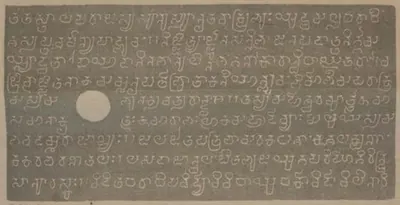 "Copper-plate grant of the Eastern Chalukya dynasty. Dated about Saka 867", plate ii b (Indian Antiquary VII, folding plate to face p. 16 (PDF p. 28))Inscription rubbing · 1878
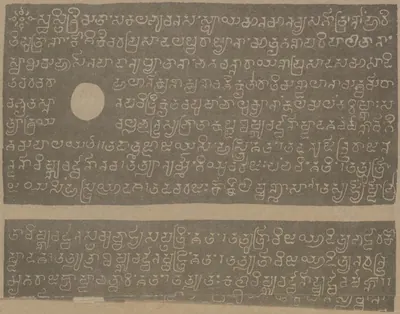 "Copper-plate grant of the Eastern Chalukya dynasty. Dated about Saka 867", plates i and ii a (Indian Antiquary VII, plate to face p. 16 (PDF p. 27))Inscription rubbing · 1878
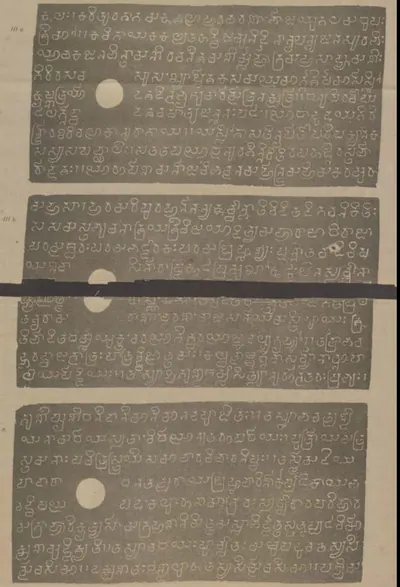 "Copper-plate grant of the Eastern Chalukya dynasty. Dated about Saka 867", plates iii a, iii b and iv a (Indian Antiquary VII, folding plate (PDF p. 29))Inscription rubbing · 1878
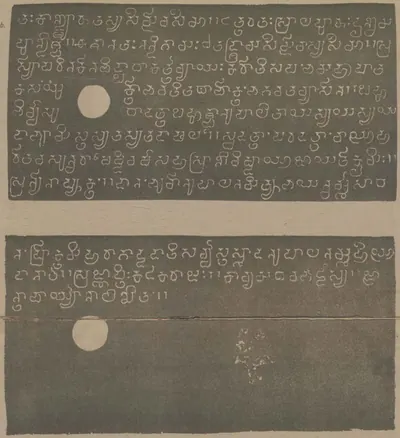 "Copper-plate grant of the Eastern Chalukya dynasty. Dated about Saka 867", plates iv b and v (Indian Antiquary VII, plate (PDF p. 30))Inscription rubbing · 1878
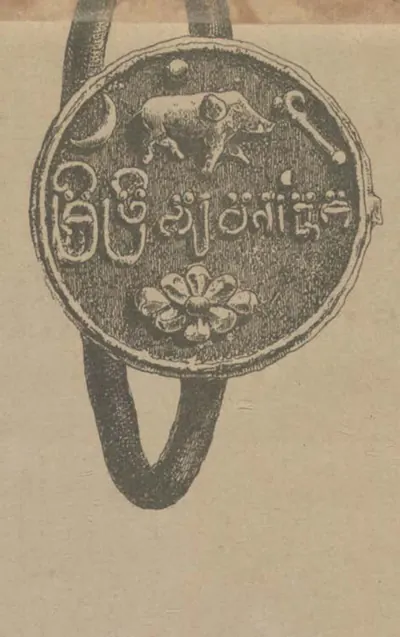 "Seal" of the copper-plate grant of the Eastern Chalukya dynasty dated about Saka 867 (Indian Antiquary VII, plate (PDF p. 31))Drawing · 1878
References
Notes (0)
Sources (4)
Spotted an error on this page? Tell us
Last updated: