Masulipatam plates of Amma II
An undated Sanskrit copper-plate charter of the Eastern Chalukya king Amma II (crowned 945), found in the record room of the Kistna District Court at Masulipatam. It gives the village of Pedda-Galidiparru in Velanadu to two Jaina temples that two feudatory brothers had built at Vijayavatika (Vijayawada). B. V. Krishna Rao edited it in 1938. It names a Jaina family of chiefs and their teacher, and its editor used it to argue against parts of J. F. Fleet's chronology of the dynasty.
This is one of several copper-plate charters of Amma II, the Eastern Chalukya king of Vengi who came to the throne in 945.12 Its subject is unusual for the dynasty.12 It records a gift of a village for two Jaina temples at Vijayavatika, the modern Vijayawada.12
Discovery and description
Robert Sewell first noticed the plates lying in the record room of the District Court of Krishna (then Kistna) at Masulipatam.3 J. F. Fleet examined them for Sewell.3 He found five plates, each a little over 11 inches long, with an elephant-goad among the emblems on the seal.3 But the whole inscription was badly corroded and very hard to read.3
The plates were later entered in the epigraphical collection as No. 8 of 1908–09.3 H. Krishna Sastri reported that the seal bore the legend Sri-Tribhuvanankusa, with a standing boar, an elephant-goad, two fly-whisks, the sun, the moon and a lotus.3 He found the rust so firmly settled in the letters that boiling the plates in tamarind and salt did not remove it.3 B. V. Krishna Rao edited the text from ink impressions and photographs supplied by N. P. Chakravarti.3
Another set of Masulipatam plates of Amma II records a gift of fields at a village called Pambarru.4 It had been found in the vernacular record room of the Collector’s office at Machilipatnam (then Masulipatam), some twenty years before Kielhorn wrote in 1898–99.4 F. Kielhorn re-edited it in Epigraphia Indica V.4 It is a different record from the one described here.4
Script and language
The letters are Telugu characters of the 10th century and are finely engraved.3 Krishna Rao thought the plates were perhaps the largest used for any charter of Amma II.3 Much of the writing is poorly preserved.3
The text is in Sanskrit prose and verse, with twenty-one stanzas, including the usual imprecatory verses (curses) at the end.3 The boundary description contains some old Telugu words whose exact meaning was not clear to the editor.3
Content
The charter has two parts.35 Although it records a gift to the Jaina faith, it opens with an invocation to Vishnu, the bearer of the Sarnga bow.35 Krishna Rao contrasted this with the Maliyapundi grant of the same king, which opens with a Jaina invocation.35
The first part gives the usual family tree of the dynasty, from Kubja-Vishnuvardhana down to the donor.5 Krishna Rao calls Kubja-Vishnuvardhana “the brother of Satyasraya Vallabhendra”.5 J. F. Fleet names Vishnuvardhana I as the younger brother of the Badami king Pulakesin II.6
The charter says that Amma II, on being crowned, defeated a rival Vijayaditya, who wore the fillet (headband) of an heir-apparent.7 He also defeated a group of disloyal kinsmen.7 Krishna Rao identified this rival with Kanthika-Vijayaditya, a son of Amma I.7 This prince appears to have contested the throne when the boy Amma II succeeded Chalukya-Bhima II.7 The charter is not dated and does not name the occasion of the gift.7
The second part describes a Jaina family of feudatory chiefs.71 A nobleman named Naravahana, of a family called the great Trinayana-kula, served the Chalukya kings.71 His eldest son Melaparaja, also called Manavadeva, worshipped the Jina, as did Melaparaja’s wife Mendamba.71
Their two sons were Bhima (or Raja-Bhima) and Naravahana II.71 These two received the insignia of feudal chiefs from Chalukya-Bhima II.71 The insignia included a parasol, a fly-whisk, a peacock’s tail and musical instruments.71
Their teacher was the Jaina pontiff Jayasena, surnamed Nathasena, a disciple of Chandrasena.1 For his benefit the brothers built two Jaina temples (Jina-bhavana) at Vijayavatika.1 For these temples, Amma II granted the village of Pedda-Galidiparru as temple property, free of all burdens and taxes.1 The record also names several orders of Jaina lay people and ascetics, which Krishna Rao explained with help from a Jaina scholar.1
The king issued his order to the Rashtrakutas and householders of the district of Velanandu.2 He did so in the presence of his whole circle of vassals and of his officials.2 These officials included the purohita (family priest), the ministers, the sreshthin (chief merchant), the commander of the army, the dharmadhyaksha and the twelve sthanadhipatis.2
The executor was the official called Katakaraja.2 From the Maliyapundi grant, Krishna Rao knew that this office was held under Amma II by the general Duggaraja.2 Duggaraja was a descendant of Pandaranga, the commander of Gunaga-Vijayaditya III (see the Addanki inscription).2 The engraver was Jayantacharya.2
The places
Krishna Rao placed Velanandu between the sea and the Krishna, in what were then the Repalle and Tenali taluks of Guntur district.2 He identified Pedda-Galidiparru with Peda-Gadelavarru in Tenali taluk.2 He identified most of the neighbouring villages named in the boundaries with villages still found around it.2 He took Vijayavatika to be Vijayawada (then Bezwada) on the Krishna, but could not locate the site of the two temples.2
Date and chronology
The charter itself is undated, so it can only be placed in Amma II’s reign. Kielhorn’s list gives the date of his coronation, recorded in another of his grants, as Friday, 5 December 945.8
Krishna Rao used the record’s family tree to dispute Fleet’s chronology.5 Fleet had reduced the reign of Jayasimha I from 33 years to 30.5 But Krishna Rao noted that only one charter gives 30 years.5 He thought it a scribe’s slip, since the other charters of the family agree on 33.5 He also accepted this record’s figure of 40 years for Vijayaditya II.5
A record dates the coronation of Chalukya-Bhima I to 17 April 892.9 Citing it, Krishna Rao argued that Fleet’s date of 888 for that king’s accession could not stand.9 An editorial note added that Bhima’s regnal years might have been counted from an earlier accession, a custom common in South India.9
Edition
B. V. Krishna Rao, “Masulipatam Plates of Ammaraja II”, Epigraphia Indica XXIV (1937–38), No. 38, pp. 268 ff., with text and plates.3
Footnotes
-
Krishna Rao, “Masulipatam Plates of Ammaraja II” (1938), p. 272 (archive.org (opens in a new tab)). ↩ ↩2 ↩3 ↩4 ↩5 ↩6 ↩7 ↩8 ↩9 ↩10 ↩11 ↩12 ↩13
-
Krishna Rao, “Masulipatam Plates of Ammaraja II” (1938), p. 273 (archive.org (opens in a new tab)). ↩ ↩2 ↩3 ↩4 ↩5 ↩6 ↩7 ↩8 ↩9 ↩10 ↩11 ↩12 ↩13 ↩14
-
B. V. Krishna Rao, “Masulipatam Plates of Ammaraja II”, Epigraphia Indica XXIV (1937–38), p. 268 (archive.org (opens in a new tab)). ↩ ↩2 ↩3 ↩4 ↩5 ↩6 ↩7 ↩8 ↩9 ↩10 ↩11 ↩12 ↩13 ↩14 ↩15 ↩16 ↩17
-
F. Kielhorn, “Six Eastern Chalukya Grants”, F, Epigraphia Indica V (1898–99), p. 139 (archive.org (opens in a new tab)). ↩ ↩2 ↩3 ↩4
-
Krishna Rao, “Masulipatam Plates of Ammaraja II” (1938), p. 269 (archive.org (opens in a new tab)). ↩ ↩2 ↩3 ↩4 ↩5 ↩6 ↩7 ↩8 ↩9 ↩10
-
Fleet, “Dynasties of the Kanarese Districts” (1896), p. 352 (archive.org (opens in a new tab)). ↩
-
Krishna Rao, “Masulipatam Plates of Ammaraja II” (1938), p. 271 (archive.org (opens in a new tab)). ↩ ↩2 ↩3 ↩4 ↩5 ↩6 ↩7 ↩8 ↩9 ↩10 ↩11
-
F. Kielhorn, “A List of the Inscriptions of Southern India”, appendix to Epigraphia Indica VII (1902–03), p. 95, No. 563 (archive.org (opens in a new tab)). ↩
-
Krishna Rao, “Masulipatam Plates of Ammaraja II” (1938), p. 270, with the editor’s note (archive.org (opens in a new tab)). ↩ ↩2 ↩3
Photos
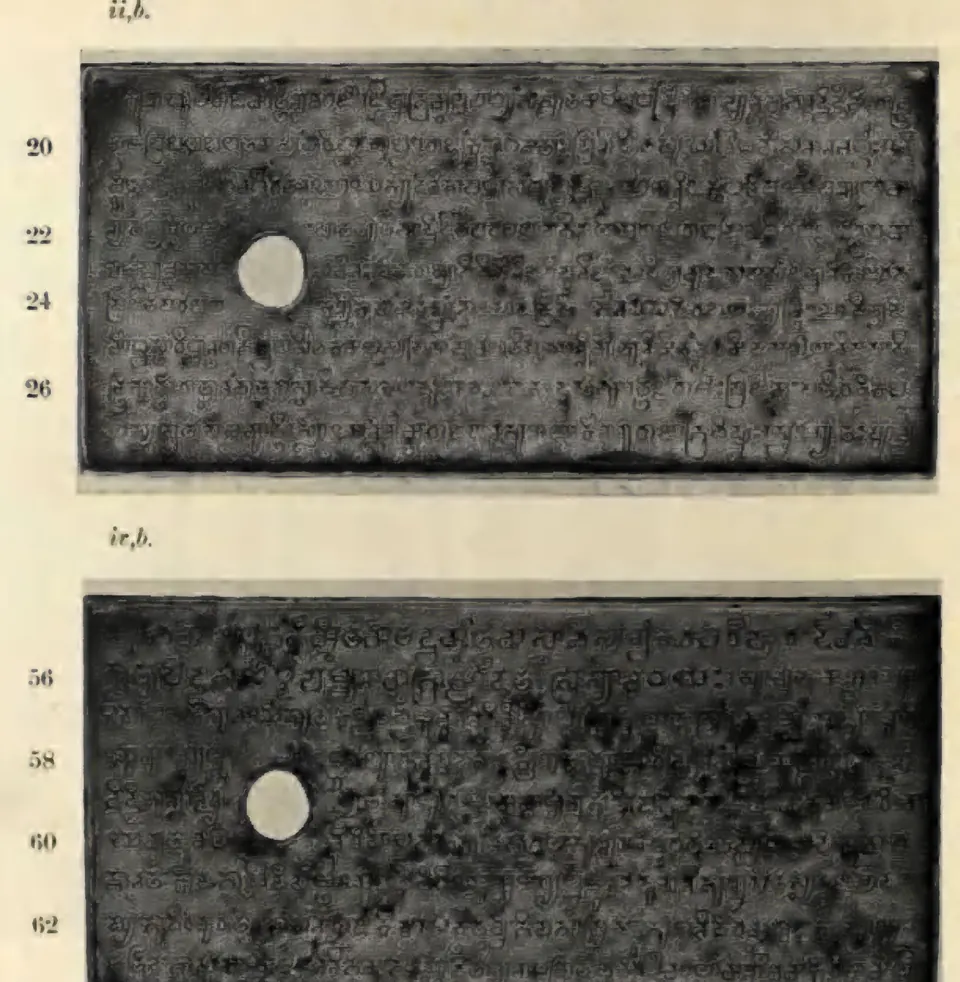
 "Masulipatam Plates of Ammaraja II.—(I). (From Photographs)", plates ii b and iv b (Epigraphia Indica XXIV, plate between pp. 274 and 275 (PDF p. 345))Historic photograph · 1938
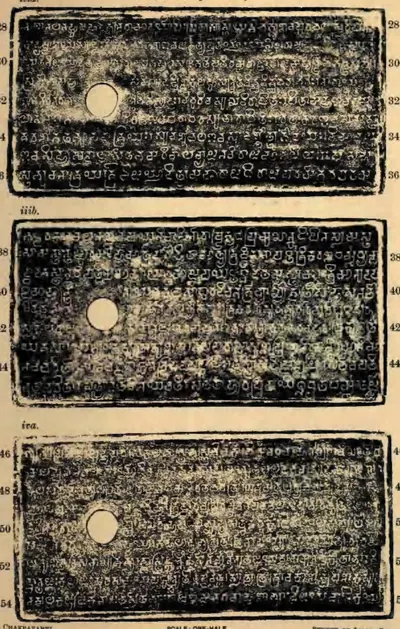 "Masulipatam Plates of Ammaraja II.—(II). (From impressions)", plates iii a, iii b and iv a (Epigraphia Indica XXIV, plate between pp. 276 and 277 (PDF p. 348))Inscription rubbing · 1938
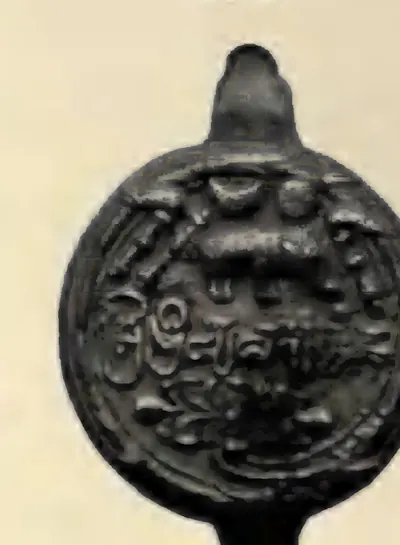 "Seal", seal of the Masulipatam plates of Ammaraja II (Epigraphia Indica XXIV, plate between pp. 274 and 275 (PDF p. 345))Historic photograph · 1938
References
Notes (0)
Sources (4)
Spotted an error on this page? Tell us
Last updated: