Vandram plates of Amma II
Five worn Sanskrit copper plates of the Eastern Chalukya king Amma II (crowned 945), found in a backyard at Vandram in the Bhimavaram taluk. E. Hultzsch edited them in 1908. They grant a village, Tanderu or Betipundi, as an agrahara (Brahmin village) to Kuppanayya, a minister who had founded a shrine of Shiva at Draksharama. Their opening repeats the Yelavarru grant almost word for word, and one plate is engraved over another grant of the same king.
This is a grant of Amma II, the Eastern Chalukya king crowned in 945. Its donee was a minister who had built a Shiva shrine at Draksharama.12 E. Hultzsch, who edited it in 1908, could read only part of it.31 The plates are badly worn, and much of the verse in praise of the donee is in poor Sanskrit.31
Discovery and description
The plates were found in the backyard of Buddharaju Venkataraju of Vandram, a village in the Bhimavaram taluk of the Krishna (then Kistna) district.3 The Head Assistant Collector of Narsapur sent them through the Collector of Kistna to V. Venkayya.3 Venkayya sent Hultzsch ink impressions and, later, the plates themselves.3 See Vandram.
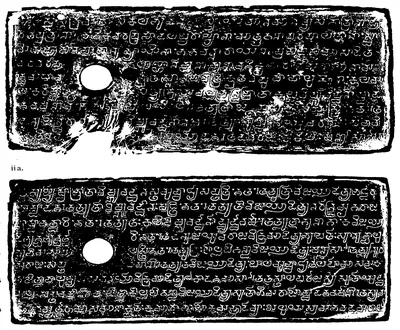
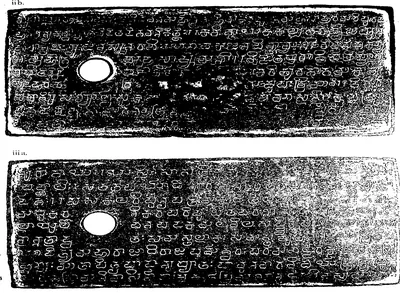
Venkayya described five plates, about 7¾ by 3⅝ inches, with high rims.3 He cut the oval ring for the first time and soldered it again.3 Its ends are fixed in an eight-petalled lotus at the bottom of a round seal.3 The seal is much damaged, but shows the legend Sri-Tribhuvanankusa with a boar facing left above it and a floral device below.3 Traces of the sun, the crescent moon and an elephant-goad can also be seen.3
Hultzsch found the plates in a bad state.3 Part of the first plate is missing, and several lines on the third and fourth are corroded.3 The alphabet is “ancient Telugu of the usual type”.3 The language is Sanskrit, in prose and verse, but the first four lines of the last plate contain some Telugu words.3
One grant cut over another
The greater part of the second side of the second plate, which carries verses 3 to 6, is cut over another grant of Amma II.1 Hultzsch thought the writer had only partly rubbed out the older text.1 He printed the lines of it that he could still read.1 Both sides of the last plate also show traces of erased writing.1 The Yelavarru plates of the same king are likewise engraved in part over older grants.4
Content
The inscription opens with Amma II’s family line.1 Hultzsch found its first seventeen lines “practically identical” with the first twenty-three lines of the Elavarru (Yelavarru) grant.1 He noted two differences:1
- Vikramaditya I is given the title Yuvaraja (crown prince)1
- the name Kollabiganda is spelt without the aspirate1
Seven verses in praise of Amma II follow, all of which occur, in a different order, in his Padamkaluru grant.1 Two of them, giving the date of his coronation, are also in the Maliyapundi grant.1
The king is styled Samastabhuvanasraya, the glorious Vijayaditya, Maharajadhiraja, Paramesvara and Paramabhattaraka.1 He then speaks to the ryots (cultivators), headed by the rashtrakutas, of the twelve villages of which Prandoru is the chief, in the Pavunavara district.1
A long passage in verse describes the donee.1 A descendant of the Mitrayu family, Torkkaya-Peddiya, lived in the large village of Raviparru.1 His son was Vijayaditya, and his grandson Turkkiya-Yajvan.1 Turkkiya-Yajvan’s son by Kandamamba was Kuppanayya.1 Kuppanayya seems to have held the titles of minister (amatya) and vassal (samanta).1 He bore the surname Vipranarayana and founded a shrine of Shiva at Draksharama.1
The grant reads, in Hultzsch’s translation: “To this Kuppan[a]matya, who is devoted to Me, the village named Tanderu has been given by Us, having made (it) an Agrahara”.12 It goes on to a village named Betipundi near Prandoru, given with the share of gold.12
Hultzsch found the passage so oddly worded that he could not tell whether the grant was of Tanderu, of Betipundi or of both.2 He also could not read the boundaries.2 The end of the inscription follows the Elavarru grant closely.2 The executor (ajnapti) was the Kataka-raja, and the poet apparently Maha[ka]bhatta.2 The writer was Jontacharya, who also wrote the Elavarru grant and the Padamkaluru grant.2
Places
Hultzsch took the Pavunavara district to be probably the same as the Pagunavara district of a grant of Chalukya-Bhima II.2 He could not identify Prandoru, Betipundi, Tanderu or Raviparru.2 V. Rangacharya, in his list of 1919, suggested with a query that Prandoru was Vandram itself.5
The man who received the grant
Rangacharya called the donee Kuppanamatya, “grandson of Torki Yajvan or Torkayya”.51 In Hultzsch’s reading, Turkkiya-Yajvan was his father and Torkkaya-Peddiya his great-grandfather.51
Rangacharya also cross-referred him to a Kuppanayya of the Pallavamalla family, a grandson of Kalivarma.6 A grant of Tala II, son of Yuddhamalla II, gave this Kuppanayya a village in Velanandu.6 It is registered as copper plate No. 5 of 1908–09.6 The sources used here do not show that the two were the same man.
The king’s name and number
Hultzsch called the donor Ammaraja II and numbered his second name Vijayaditya VI.1 E. Hultzsch’s own pedigree of 1890 had counted it as Vijayaditya V.7
Footnotes
-
Hultzsch, “Vandram Plates of Ammaraja II” (1908), p. 132 (archive.org (opens in a new tab)). ↩ ↩2 ↩3 ↩4 ↩5 ↩6 ↩7 ↩8 ↩9 ↩10 ↩11 ↩12 ↩13 ↩14 ↩15 ↩16 ↩17 ↩18 ↩19 ↩20 ↩21 ↩22 ↩23 ↩24 ↩25 ↩26 ↩27
-
Hultzsch, “Vandram Plates of Ammaraja II” (1908), p. 133 and note 8 (archive.org (opens in a new tab)). ↩ ↩2 ↩3 ↩4 ↩5 ↩6 ↩7 ↩8 ↩9 ↩10
-
E. Hultzsch, “Vandram Plates of Ammaraja II”, Epigraphia Indica IX (1907–08), p. 131 (archive.org (opens in a new tab)). ↩ ↩2 ↩3 ↩4 ↩5 ↩6 ↩7 ↩8 ↩9 ↩10 ↩11 ↩12 ↩13 ↩14
-
J. F. Fleet, “Sanskrit and Old-Canarese Inscriptions, No. CXXVI”, Indian Antiquary XII (1883), p. 91 (archive.org (opens in a new tab)). ↩
-
V. Rangacharya, A Topographical List of the Inscriptions of the Madras Presidency, Vol. II (1919), p. 888, Kistna district, Bhimavaram taluk, No. 127 (archive.org (opens in a new tab)). ↩ ↩2 ↩3
-
Rangacharya, Topographical List, Vol. II (1919), p. 984, No. 195 (archive.org (opens in a new tab)). ↩ ↩2 ↩3
-
E. Hultzsch, South-Indian Inscriptions, Vol. I (1890), p. 32, pedigree of the Eastern Chalukya dynasty (archive.org (opens in a new tab)). ↩
Photos
References
Notes (0)
Sources (4)
Spotted an error on this page? Tell us
Last updated: