Peddavegi plates of Nandivarman II
A Sanskrit copper-plate grant of the 10th year of the Salankayana king Nandivarman II, found near Pedavegi north of Ellore and first published in 1924. It gives land in four villages to a temple of Vishnu. Its four-generation family line, beginning with Hastivarman of Vengi, is the backbone of the dynasty's history.
The Peddavegi plates give the longest family line of any Salankayana grant. They name four generations of the kings of Vengi.12 They made the first link between the Salankayanas and the Hastivarman of Vengi who appears in the Allahabad inscription of Samudragupta.12
Discovery and editions
The plates were found near Pedavegi, eight miles north of Eluru (then Ellore).3 V. Viswanatha Sarma of the Government Training College, Rajahmundry, sent them to the Telugu journal Bharati.3 M. Somasekhara Sarma edited them in Telugu in Bharati in August 1924.3 R. Subba Rao published them in English in the Journal of the Andhra Historical Research Society in 1926, with the editor’s permission.3
B. V. Krishna Rao later cited the Bharati edition as Vol. I, No. 8, pp. 110–22.4 D. C. Sircar re-read the text from the plates published with Subba Rao’s article.5 He printed it as an appendix to his book of 1935.5
There are five plates, each about 6⅘ by 2⅒ inches, held on a ring 2½ inches across.3 The first plate is written on its second side only, and the last plate has a single line on its second side.3 In all there are 25 lines in good condition.3 The seal was said to be unclear.3 Subba Rao took its figure for the bull Nandi, because a bull had been seen on the seal of the Kanteru plates.3
Content
Subba Rao’s translation opens with “Hail!” and the king’s family line.6 The donor is the “great grandson of Maharaja Hastivarma, lord of the victorious Vengipura”, who won victories in several battles.6 He is the “grand-son of Maharaja Nandivarma”, who performed several kinds of gifts.6 He is the “eldest son of Maharaja Chandavarma”, who by his prowess controlled several vassals.6
The donor is “the Salankayana Maharaja Sri Nandivarman, who was the worshipper of the feet of God Chitraradhaswami”.6 He was devoted to the feet of Bappa Bhattaraka (revered Father), and was “Parama Bhagavata himself”.6
The king speaks to the villagers of Pralura.6 For the increase of his merit and fame, he gives cultivable temple land (devahala) to the god Vishnugrihasvamin, “the Lord of the three worlds”.768 The cowherds of Arutore are to work it.768 The land is:768
- ten nivartanas (a land measure) there768
- ten at Munduru768
- six each at Chencheruvu and Kamburancheruvu768
The gifts are to be kept free of all obligations by “the vassal rulers of the country, revenue officers, Lords and Royal servants”.6 The grant is dated on the first day of the bright fortnight of Sravana in the tenth year of the reign.6 The executor was the Bhojaka of Mulakura.968 The writer was Katikuri, a privy officer (rahasyadhikrita).968
The village is Pralura in Subba Rao’s transcript and in Sircar’s reading. Subba Rao suggested that it might be the “Paulaura” of Ptolemy’s Geography, in the Machilipatnam (then Masulipatam) taluk.1011 Sircar reported that the epigraphy office of Madras had identified three of the places.8 It took Mundura to be Munduru and Kamburanceruva to be Kommera, both in the Eluru taluk.8 It placed Arutora at a village in the Gudivada taluk.8 Subba Rao had already noted that Munduru and Kamburancheruvu still existed in the Eluru taluk.12
Significance
Before 1924 Hastivarman was known only from the Allahabad inscription.1 Subba Rao observed that his name had not been found in any other Salankayana grant.12 He identified the two kings.12 Sircar and K. R. Subramanian accepted the identification.1314 See Hastivarman.
The plates also settled who issued the Kolleru plates, another Salankayana grant of a king named Nandivarman.15 Both grants call their donor the eldest son of Chandavarman.15 Both also name the Bhojaka of Mulakura as executor.9 Sircar and Subramanian therefore took the donor of the two grants to be one king, Nandivarman II.1514
The gift of land to Vishnugrihasvamin, with the title parama-bhagavata (devout worshipper of Vishnu), convinced Sircar that Nandivarman II was a Vaishnava.161718 Subba Rao, too, thought that the later Salankayanas had probably turned to the worship of Vishnu.161718
Footnotes
-
Subba Rao, “Pedavegi Copper-plates” (1926), p. 93 (archive.org (opens in a new tab)). ↩ ↩2 ↩3 ↩4 ↩5
-
Subba Rao, “Pedavegi Copper-plates” (1926), p. 94 (archive.org (opens in a new tab)). ↩ ↩2 ↩3 ↩4
-
R. Subba Rao, “Pedavegi Copper-plates of Nandivarman II”, Journal of the Andhra Historical Research Society I, pt. 2 (1926), p. 92 (archive.org (opens in a new tab)). ↩ ↩2 ↩3 ↩4 ↩5 ↩6 ↩7 ↩8 ↩9
-
B. V. Krishna Rao, “Two Salankayana Charters from Kanukollu”, Epigraphia Indica XXXI (1955–56, publ. 1960), p. 8, note 1 (archive.org (opens in a new tab)). ↩
-
D. C. Sircar, The Successors of the Satavahanas in the Eastern Deccan (1935), p. 81, Appendix B (archive.org (opens in a new tab)). ↩ ↩2
-
Subba Rao, “Pedavegi Copper-plates” (1926), p. 105, translation (archive.org (opens in a new tab)). ↩ ↩2 ↩3 ↩4 ↩5 ↩6 ↩7 ↩8 ↩9 ↩10 ↩11 ↩12 ↩13 ↩14 ↩15 ↩16 ↩17
-
Subba Rao, “Pedavegi Copper-plates” (1926), p. 103, text (archive.org (opens in a new tab)). ↩ ↩2 ↩3 ↩4 ↩5 ↩6
-
Sircar, Successors of the Satavahanas (1939), p. 95 (archive.org (opens in a new tab)). ↩ ↩2 ↩3 ↩4 ↩5 ↩6 ↩7 ↩8 ↩9 ↩10 ↩11
-
Subba Rao, “Pedavegi Copper-plates” (1926), p. 104, text and note 11 (archive.org (opens in a new tab)). ↩ ↩2 ↩3
-
Subba Rao, “Pedavegi Copper-plates” (1926), p. 102, text and note 3 (archive.org (opens in a new tab)). ↩
-
Sircar, Successors of the Satavahanas (1939), p. 94 (archive.org (opens in a new tab)). ↩
-
Subba Rao, “Pedavegi Copper-plates” (1926), p. 95 (archive.org (opens in a new tab)). ↩
-
Sircar, Successors of the Satavahanas (1939), p. 70 (archive.org (opens in a new tab)). ↩
-
K. R. Subramanian, Buddhist Remains in Andhra and the History of Andhra between 225 and 610 A.D. (1932), p. 90 (archive.org (opens in a new tab)). ↩ ↩2
-
D. C. Sircar, The Successors of the Satavahanas in Lower Deccan (1939), p. 68 (archive.org (opens in a new tab)). ↩ ↩2 ↩3
-
Sircar, Successors of the Satavahanas (1939), p. 84 (archive.org (opens in a new tab)). ↩ ↩2
-
Sircar, Successors of the Satavahanas (1939), p. 85 (archive.org (opens in a new tab)). ↩ ↩2
-
Subba Rao, “Pedavegi Copper-plates” (1926), p. 97 (archive.org (opens in a new tab)). ↩ ↩2
Photos
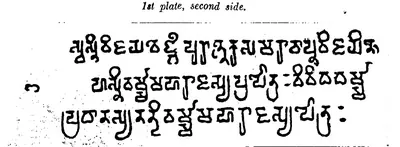 "Pedavegi Copper-plates of Nandivarman II": "1st plate, second side" (eye-copy) (Journal of the Andhra Historical Research Society I, pt. 2, Oct. 1926, p. 101 (PDF p. 122))Drawing · 1926
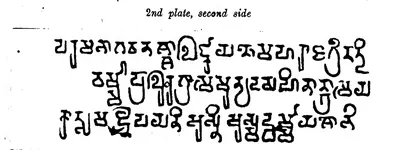 "Pedavegi Copper-plates of Nandivarman II": "2nd plate, second side" (eye-copy) (Journal of the Andhra Historical Research Society I, pt. 2, Oct. 1926, p. 102 (PDF p. 123))Drawing · 1926
References
Notes (0)
Sources (5)
Spotted an error on this page? Tell us
Last updated: