Omgodu grant of Simhavarman (No. 2)
A Sanskrit copper-plate grant of the Pallava king Simhavarman, son of the crown prince Vishnugopa, made in the fourth year of his reign. It gives the village of Omgodu in Karmarashtra, bounded by Kodikim, Narachadu, Kadakuduru and Penukaparru, to the Brahman Devasarman of Kundur. Its editor, H. Krishna Sastri, thought it a 7th-century copy of an earlier grant. Its date became part of the debate over the Lokavibhaga date of 436 for Simhavarman.
The second Omgodu grant is one of four surviving grants of the Pallava king Simhavarman, son of the crown prince Vishnugopa.12 It came to light with the first Omgodu grant of his grandfather Skandavarman II, which gives the same village.12
Discovery and description
Like the first grant, it was said to have been found in the Narasaraopet taluk.1 It was owned by the village munsiff (headman) of Santaravuru, who gave both grants to the Madras Museum.1 There are five thin plates without rims on a plain ring with no seal.2 They are not numbered, and the first and last plates are blank outside.2
The letters are much more developed than those of the first grant, “at least a hundred years later”.2 They resemble those of a grant of a Vijaya-Vishnugopavarman assigned to the beginning of the 7th century.2
Krishna Sastri concluded that the record “must have been a copy of a grant of the 5th–6th century A.D., put into writing in the 7th century”.2 He thought the engraver’s many mistakes supported this.2 D. C. Sircar argued from this that the Chura grant of Vijaya-Vishnugopavarman might be such a copy too.3
Content
The grant was issued from “the victorious royal camp”, not from a named place.24 The donor was the dharma-maharaja (righteous great king) Simhavarman, of the Bharadvaja gotra.24 He was the son of the crown prince Vishnugopa, grandson of the Maharaja Skandavarman and great-grandson of the Maharaja Viravarman.24
He gave the village of Omgodu in Karmarashtra to Devasarman of Kundur, of the Kasyapa gotra and the Chhandoga sutra.24 Its boundaries were Kodikim to the east, Narachadu to the south, Kadakuduru to the west and Penukaparru to the north.24 Earlier holdings within it were excluded.24
The gift was made “on the occasion of an eclipse (?)”.4 It is dated on the fifth day of the bright fortnight of Vaisakha in the fourth year of the reign.4 It was engraved at the king’s own command.4
Krishna Sastri placed Omgodu in the north of the Nellore district, perhaps at Ongole itself.5 He identified Kodikim with Kodiki, near Ongole.5 He could not find Narachadu, Kadakuduru or Penukaparru.5 Sircar noted that Kundur, the donee’s home, was also the home of the donees of the Chura grant and of a Vishnukundin grant from Polamuru.6
The eclipse and the date
The grant names an eclipse as its occasion, but its date falls in the month of Vaisakha.4 Krishna Sastri joined the two in this way.4 He supposed that the gift was made on the new-moon day of Chaitra, a possible day for a solar eclipse.4 The plates were then engraved five days later, on the fifth day of the bright half of Vaisakha.4
The Jain work Lokavibhaga implies that Simhavarman came to the throne in 436.4 If so, his fourth year was 440, and a solar eclipse should have fallen in Chaitra that year.4 Krishna Sastri found that none did.4 He saw in this a difficulty for the Lokavibhaga date.4
R. Gopalan replied that the word Krishna Sastri read as “on account of the eclipse” probably meant “for the sake of acceptance”.78 In his view, the grant was not made on an eclipse at all.78
C. R. Krishnamacharlu found a solar eclipse on 17 May 440 in R. Schram’s tables.9 He argued that in some years Chaitra overlaps May.9 He concluded that 436 could stand.9
Footnotes
-
H. Krishna Sastri, “Two Pallava Copper-plate Grants”, Epigraphia Indica XV (1919–20), p. 246 (archive.org (opens in a new tab)). ↩ ↩2 ↩3 ↩4
-
Krishna Sastri, “Two Pallava Copper-plate Grants” (1920), p. 252 (archive.org (opens in a new tab)). ↩ ↩2 ↩3 ↩4 ↩5 ↩6 ↩7 ↩8 ↩9 ↩10 ↩11 ↩12 ↩13 ↩14
-
D. C. Sircar, The Successors of the Satavahanas in Lower Deccan (1939), p. 173 (archive.org (opens in a new tab)). ↩
-
Krishna Sastri, “Two Pallava Copper-plate Grants” (1920), p. 253 (archive.org (opens in a new tab)). ↩ ↩2 ↩3 ↩4 ↩5 ↩6 ↩7 ↩8 ↩9 ↩10 ↩11 ↩12 ↩13 ↩14 ↩15 ↩16 ↩17
-
Krishna Sastri, “Two Pallava Copper-plate Grants” (1920), p. 254 (archive.org (opens in a new tab)). ↩ ↩2 ↩3
-
Sircar, Successors of the Satavahanas (1939), p. 209 (archive.org (opens in a new tab)). ↩
-
R. Gopalan, History of the Pallavas of Kanchi (1928), p. 67 (archive.org (opens in a new tab)). ↩ ↩2
-
Gopalan, History of the Pallavas of Kanchi (1928), p. 68 (archive.org (opens in a new tab)). ↩ ↩2
-
C. R. Krishnamacharlu, “Vilavatti Grant of Pallava Simhavarman”, Epigraphia Indica XXIV (1937–38), p. 301 (archive.org (opens in a new tab)). ↩ ↩2 ↩3
Photos
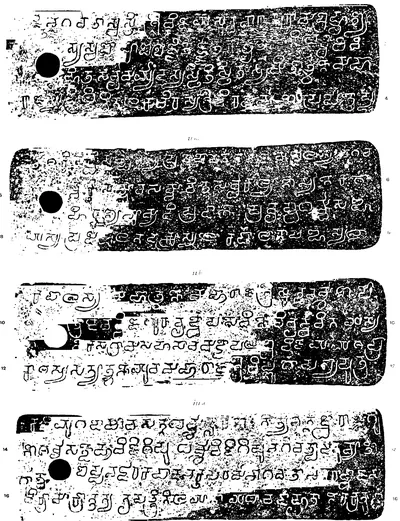 "Omgodu Grant of the Pallava Simhavarman II: the 4th year", first page, lines 1-16 (Epigraphia Indica XV, plate with No. 11 (PDF p. 304))Inscription rubbing · 1920
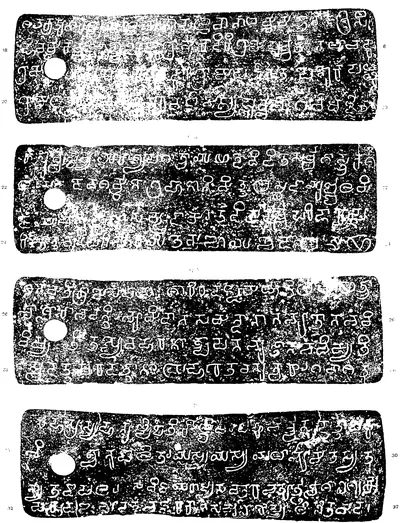 "Omgodu Grant of the Pallava Simhavarman II: the 4th year", second page, lines 17-32 (Epigraphia Indica XV, plate with No. 11 (PDF p. 305))Inscription rubbing · 1920
References
Notes (0)
Sources (4)
Spotted an error on this page? Tell us
Last updated: