Kolleru plates of Nandivarman II
Sanskrit copper-plate grant of the 7th year of the Salankayana king Nandivarman, eldest son of Chandavarman. He issued it from Vengipura, giving a village in the Kuduhara country to 157 Brahmins. It was reported found in the Kolleru lake before 1840. It was the first record of the dynasty to be known, and A. C. Burnell and J. F. Fleet edited it in the 1870s.
The Kolleru plates were the first record of the Salankayanas to come to light.12 Walter Elliot saw from them that a dynasty had ruled Vengi before the Eastern Chalukyas.12
Discovery
Walter Elliot first described the grant in the Madras Journal, volume xi, pages 302–306.2 A. C. Burnell quoted that account.2 He wrote that the plates were “found in the kol or (read koleru) lake near Masulipatam, some years ago (i.e. prior to 1840)”.2 They “had been laid aside as utterly unintelligible”.2 Burnell worked from an impression and could learn nothing of the original plates.2
Elliot recalled in 1886 that the plates had been found in the Kolleru lake.1 So an inquiry in that part of the country led to a group of villages near Eluru (then Ellore).1 These were then identified as the site of Vengipura.1
Robert Sewell’s list of antiquities of 1882 says instead that a copper-plate grant of the dynasty “was obtained at this place”, that is, at Pedda Vegi.3 E. Hultzsch in 1908 followed the Kolleru account and called the lake “neighbouring” to Pedda-Vegi.4
Editions
Burnell published a transcript and a facsimile (exact copy) in his Elements of South-Indian Palaeography, as Plate XXIV.52 Fleet edited it again in the Indian Antiquary in 1876, from Burnell’s facsimile and one in Elliot’s collection.5 There are four plates, numbered, with the writing on the inside of the first and last plates.5
Content
In Fleet’s translation the grant is issued “from the victorious city of Vengipura”.6 The issuer is “the Great King Sri-Vijayanandivarma, who meditates on the feet of the holy Chitrarathasvami”.6 He is also “the disciple of the venerable Bappa” and “a most excellent worshipper of the holy one”.6 He “belongs to the family of the Salankayanas” and is “the eldest son of the great king Chandavarma”.6
The grant commands the villagers and officials of Videnurapallika in the country of Kuduhara.6 The village is given, free of all taxes, to 157 Brahmins of various gotras (clans) and charanas (Vedic schools).6 They live in the excellent agrahara (Brahmin village) of Kuravaka.6 The grant is dated on the eighth day of the dark fortnight of Pausha in the seventh year of the reign.6
Later readings
Later scholars changed several of Fleet’s readings:
- Fleet took bappa for the name of a teacher.6 Burnell wondered whether bappa-bhattaraka was “some local deity”.2 Later editors read the phrase as “the revered father”.78
- Fleet read mutyada as “ministers and others”.9 Hultzsch compared it with muluda in the Ellore plates.7 Sircar thought it probably meant the head of the village.10
- Fleet understood the last words to give “the enjoyment of the original royal dues”.6 Sircar read them as naming the executor of the grant, the Bhojaka of Mulakura.1112 The Peddavegi plates name the same officer.1112
Kuduhara
Dubreuil identified Kuduhara with the Kudrahara or Gudrahara of later inscriptions, the country around Machilipatnam (then Masulipatam).1314 This country had earlier belonged to the Brihatphalayanas.1314 Sircar repeated this identification.1516 He also used the officials named in the grant, the desadhipatis, ayuktakas, vallabhas and royal agents, as evidence.1516 In his view they show that the kingdom was divided into provinces (desas) under governors.1516
A grant wrongly linked to it
Fleet added that Elliot’s facsimiles contained a second grant, in Prakrit.59 He described it as a grant of “Vijayanandivarma and his Yuvamaharaja, whose name seems to be Vijayatungavarma or Vijayabuddhavarma”.59 Sewell repeated this in 1884.17 Dubreuil and later writers took it as evidence of a Salankayana prince Buddhavarman.14
Sircar showed in 1939 that Fleet himself had later published this second grant in the Indian Antiquary.181920 It is the Prakrit grant of the Pallava queen Charudevi, wife of the crown prince Buddhavarman.181920 It has nothing to do with the Salankayanas.181920
As early as 1884 Sewell had noted a Pallava grant naming Vijaya-Buddhavarman, of the Bharadvaja gotra.21 He saw that it could not be related to the Salankayana Vijaya-Nandivarman of the Kolleru plates.21
Date
Fleet quoted Burnell as placing the grant, on grounds of script, about the 4th century.9 Sewell reported Burnell as giving the 5th century.17 Bühler wrote in 1904 that the Salankayana plates “used to be assigned to the 4th century” but that their date was uncertain.22 Dubreuil, in 1920, thought the grant later than Devavarman’s and placed the kings between about 350 and 450.14
Sircar compared its letters with those of the early Eastern Chalukyas and the Vishnukundins.23 He rejected so early a date.23 He placed the grants of Nandivarman II in about the middle of the 5th century.23 See Nandivarman II.
Footnotes
-
Walter Elliot, Coins of Southern India (1886), p. 39 (archive.org (opens in a new tab)). ↩ ↩2 ↩3 ↩4 ↩5
-
A. C. Burnell, Elements of South-Indian Palaeography (2nd ed., 1878), p. 135, Appendix C, Plate XXIV and note 1 (archive.org (opens in a new tab)). ↩ ↩2 ↩3 ↩4 ↩5 ↩6 ↩7 ↩8 ↩9
-
Robert Sewell, Lists of the Antiquarian Remains in the Presidency of Madras, Vol. I (1882), p. 36 (archive.org (opens in a new tab)). ↩
-
E. Hultzsch, “Plates of Vijaya-Devavarman”, Epigraphia Indica IX (1907–08), p. 58 (archive.org (opens in a new tab)). ↩
-
J. F. Fleet, “Sanskrit and Old-Canarese Inscriptions, No. XVIII”, Indian Antiquary V (1876), p. 175 (archive.org (opens in a new tab)). ↩ ↩2 ↩3 ↩4 ↩5
-
Fleet, “Sanskrit and Old-Canarese Inscriptions, No. XVIII” (1876), p. 177, translation (archive.org (opens in a new tab)). ↩ ↩2 ↩3 ↩4 ↩5 ↩6 ↩7 ↩8 ↩9 ↩10
-
Hultzsch, “Plates of Vijaya-Devavarman” (1908), p. 59, translation and note 4 (archive.org (opens in a new tab)). ↩ ↩2
-
R. Subba Rao, “Pedavegi Copper-plates of Nandivarman II”, Journal of the Andhra Historical Research Society I, pt. 2 (1926), p. 101, note 2 (archive.org (opens in a new tab)). ↩
-
Fleet, “Sanskrit and Old-Canarese Inscriptions, No. XVIII” (1876), p. 176 and notes (archive.org (opens in a new tab)). ↩ ↩2 ↩3 ↩4
-
Sircar, Successors of the Satavahanas (1939), p. 90 (archive.org (opens in a new tab)). ↩
-
Sircar, Successors of the Satavahanas (1939), p. 94 and note 2 (archive.org (opens in a new tab)). ↩ ↩2
-
Sircar, Successors of the Satavahanas (1939), p. 95 (archive.org (opens in a new tab)). ↩ ↩2
-
G. Jouveau-Dubreuil, Ancient History of the Deccan (1920), pp. 84–85 (archive.org (opens in a new tab)). ↩ ↩2
-
Jouveau-Dubreuil, Ancient History of the Deccan (1920), p. 89 (archive.org (opens in a new tab)). ↩ ↩2 ↩3 ↩4
-
Sircar, Successors of the Satavahanas (1939), p. 92 (archive.org (opens in a new tab)). ↩ ↩2 ↩3
-
Sircar, Successors of the Satavahanas (1939), p. 93 (archive.org (opens in a new tab)). ↩ ↩2 ↩3
-
Sewell, Lists of Inscriptions, and Sketch of the Dynasties (1884), p. 240 (archive.org (opens in a new tab)). ↩ ↩2
-
D. C. Sircar, The Successors of the Satavahanas in Lower Deccan (1939), p. 63 (archive.org (opens in a new tab)). ↩ ↩2 ↩3
-
Sircar, Successors of the Satavahanas (1939), pp. 66–67 (archive.org (opens in a new tab)). ↩ ↩2 ↩3
-
Sircar, Successors of the Satavahanas (1939), p. 68 (archive.org (opens in a new tab)). ↩ ↩2 ↩3
-
Robert Sewell, Lists of Inscriptions, and Sketch of the Dynasties of Southern India (1884), p. 211 (archive.org (opens in a new tab)). ↩ ↩2
-
Georg Bühler, Indian Paleography (1904), p. 65 (archive.org (opens in a new tab)). ↩
-
Sircar, Successors of the Satavahanas (1939), p. 72 (archive.org (opens in a new tab)). ↩ ↩2 ↩3
Photos
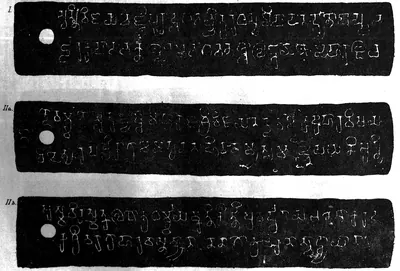 "Copper-plate grant of the kings of the Vengi country": Kollair (Kolleru) grant of the Salankayana Maharaja Vijaya-Nandivarman, plates I, IIa and IIb (Indian Antiquary V, 1876, plate at p. 176 (PDF p. 214))Inscription rubbing · 1876
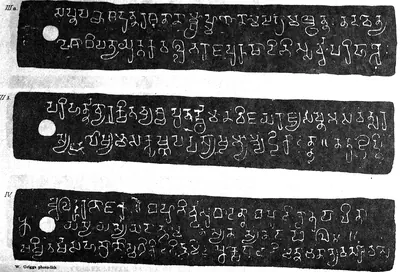 "Copper-plate grant of the kings of the Vengi country": Kollair (Kolleru) grant of the Salankayana Maharaja Vijaya-Nandivarman, plates IIIa, IIIb and IV (Indian Antiquary V, 1876, plate at p. 177 (PDF p. 215))Inscription rubbing · 1876
References
Notes (0)
Sources (10)
Spotted an error on this page? Tell us
Last updated: