Phirangipuram pillar inscription of Peda Komati Vema (1410)
A verse inscription on a stone pillar in front of the Virabhadra temple at Phirangipuram near Guntur, composed by the poet Srinatha. It records the dedication in February 1410 of a tank, Santana-sagara, built by Suramamba, queen of the Reddi king Peda Komati Vema. Half of it is in Sanskrit and half in Telugu. It gives the king's descent from Macha, the elder brother of Prolaya Vema.
The pillar
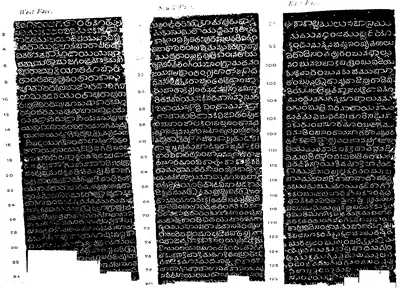
The inscription “is engraved on three sides of a stone pillar planted in front of the temple of Virabhadra-svamin”.1 The temple is “in the village of Phirangipuram in the Sattenapalli taluka of the Guntur District”.1 J. Ramayya first copied it in April 1897.1 He edited it in 1912 from an estampage (ink copy).1 Its letters “are cut deep and the inscription is in an excellent state of preservation”.1
The characters are like those of the Tottaramudi plates of Kataya Vema.12 But here the aspirated letters are marked with a stroke at the bottom.12 The Telugu verses use the full circle for the half-anusvara (a nasal sign), and Ramayya discussed this feature at length.12
Contents
The inscription is all in verse, partly Sanskrit and partly Telugu.2 Two of its verses also appear in the Sringaradipika, which is ascribed to Komati Vema.2 Its thirteenth verse is taken, with small changes, from the Madras Museum plates of Vema.2
It opens with praise of Vishnu’s boar incarnation, the sun and moon, and Vinayaka.2 It then praises king Vema, “a seventh emperor, as it were, and an eleventh incarnation of Vishnu”.2 Vema built the flight of steps from the Patalaganga to the top of Srisailam.2
Vema’s elder brother Macha had three sons, Reddivota, Komatindra and Naga.2 The record says that “Ped[d]a-Komati begot a son named Vema as great as Karna in charities”.2 The queen of this king, Suramamba, dedicated a tank called Santana-payonidhi.2 She did this on the second day of the dark half of Phalguna, in the year Virodhi, Saka 1331 (Saka is an Indian way of counting years).2
Three Telugu verses describe the tank.3 Its waters were “as purifying as those of Ganga, Yamuna, and all other sacred rivers”.3 The verses say that Suramamba was the daughter of king Ganna of Dhanyavati (Dharanikota).3
Date and author
L. D. Swamikannu Pillai worked out the date for Ramayya as February 1410.3 The last Sanskrit verse says that this “pure dharmasasana was composed by Srinatha”.2 (A dharmasasana is a charitable edict.) Srinatha was the king’s vidyadhikarin (officer of learning).2
Ramayya wrote that “special interest attaches to this inscription as well as to the two following ones from the fact that they were composed by the great Telugu poet Srinatha”.3
The tank and the Aminabad inscription
There is a Telugu verse inscription of 1415 on a small hill at Aminabad, about two miles away.45 It was also composed by Srinatha.45 It records that Racha Vema, son of Vema, dug a channel to feed a tank that his mother Suramba had dug.45 Ramayya calls the tank in this record Santana-sagara.4 Rangacharya’s list gives its name as Santana-varidhi.5 Ramayya noted that the two inscriptions are about two miles apart, and concluded that they “no doubt, refer to the same tank”.4
Ramayya used the two inscriptions together to show that Racha Vema, the last king of Kondavidu, was Peda Komati Vema’s son and not his brother.45 See Peda Komati Vema, Srinatha and Phirangipuram.
Footnotes
-
J. Ramayya, Three Inscriptions of the Reddis of Kondavidu, Epigraphia Indica XI (1911–12), p. 313 (archive.org (opens in a new tab)). ↩ ↩2 ↩3 ↩4 ↩5 ↩6 ↩7 ↩8
-
Ramayya, Three Inscriptions of the Reddis of Kondavidu (1911–12), p. 314 (archive.org (opens in a new tab)). ↩ ↩2 ↩3 ↩4 ↩5 ↩6 ↩7 ↩8 ↩9 ↩10 ↩11 ↩12 ↩13 ↩14 ↩15
-
Ramayya, Three Inscriptions of the Reddis of Kondavidu (1911–12), p. 315 (archive.org (opens in a new tab)). ↩ ↩2 ↩3 ↩4 ↩5
-
J. Ramayya, Madras Museum Plates of Vema, A.D. 1345, Epigraphia Indica VIII (1905–06), p. 13 (archive.org (opens in a new tab)). ↩ ↩2 ↩3 ↩4 ↩5 ↩6
-
V. Rangacharya, A Topographical List of the Inscriptions of the Madras Presidency, Vol. II (1919), p. 835, Guntur No. 766 (archive.org (opens in a new tab)). ↩ ↩2 ↩3 ↩4 ↩5
Photos
References
Notes (0)
Sources (3)
Spotted an error on this page? Tell us
Last updated: