Vanapalli plates of Anavema (1380)
Three copper plates of 6 February 1380, found at Vanapalli in the Amalapuram taluk of the Godavari district and now in the Madras Museum. They record Anavema Reddi's gift of the village of Immadilanka, renamed Anna-Vemapura, to his minister and preceptor (religious teacher) Immadi. They name Kondavidu as the king's capital and describe his court.
Discovery and the plates
The plates were “found by a workman while excavating some earth in an old site” at Vanapalli, in the Amalapuram taluk of the Godavari district.1 P. V. S. Gopalam, a pleader (lawyer) of Kakinada (then Cocanada), reported them to the Archaeological Survey in May 1892.1 Their owner, Vissapragada Krishnayya, presented them to the government.1 E. Hultzsch edited them in 1894–95 from the originals, which were then in the Madras Museum.1
The three plates have slightly raised rims and hang on a copper ring.1 The ring, “instead of the usual seal”, bears “a well-carved recumbent figure of the sacred bull Nandi”.1 The alphabet is Telugu and the language Sanskrit.1 Apart from a few words the text is in verse, and the king’s signature at the end is in Telugu.1
Contents
The inscription opens with invocations of Vishnu as the boar, of Ganapati and of the moon on Siva’s head.12 It refers to the Shudra caste, born like the Ganges from Vishnu’s foot.12 In it was born king Prola, whose son Vema built a flight of steps and a hall at Srisailam.12 Vema’s sons were Anna-Vota and Anna-Vema.12
Anavema lived at “Kontoviti”, that is Kondavidu.3 He bore the surnames (titles) Jaganobbaganda, Kshurika-Kali-Vetala and Karpura-Vasantaraya.3
One verse describes his court.4 It says that while he sat on the jewelled throne, “some people receive the sovereignty over a country (desa), others the distinction of a palanquin, a chauri, and a parasol”.4 Others receive “their (confiscated) kingdom, (and) others agraharas, full of wealth”.4 Hultzsch called it “an account of the daily transactions in the king’s court”.4
The grant gave the village of Immadilanka, also called Anna-Vemapura, as an agrahara (village granted to Brahmans) to Immadi.34 Immadi was of the Lohita gotra (clan) and was the son of the minister Mallaya.34 He seems to have been the king’s minister and spiritual preceptor.34 Immadi gave half of the village to other Brahmans.34
The western boundary of the village was the Gautami branch of the Godavari.3 The composer, Trilochanarya, praises his own poetry in two verses at the end.3
Date and place
The date is given as the fourteenth day of the dark half of Magha, in the cyclic year Siddharthin and Saka 1300 (Saka is an Indian way of counting years).3 Hultzsch noted that Siddharthin corresponds to Saka 1301 expired.3 S. B. Dikshit gave the date as Monday, 6 February 1380.3
Gopalam reported a hamlet called Immadivarilanka, north of Vanapalli.3 But Hultzsch could not decide whether it was the granted village, since some of the boundary villages seemed to lie above the Godavari anicut (dam).3 Rangacharya listed the plates under the Amalapuram taluk.5
Importance
The plates show the Reddis of Kondavidu making grants in the Godavari delta.326 With the Nadupuru grant, they are among the first Reddi records to place the king at Kondavidu.326 J. Ramayya used them, with the Amaravati inscription of 1361, to argue that the capital moved from Addanki to Kondavidu in Anavema’s reign.7 See the Nadupuru grant and Kondavidu.
Footnotes
-
E. Hultzsch, Vanapalli Plates of Anna-Vema, Saka-Samvat 1300, Epigraphia Indica III (1894–95), p. 59 (archive.org (opens in a new tab)). ↩ ↩2 ↩3 ↩4 ↩5 ↩6 ↩7 ↩8 ↩9 ↩10 ↩11 ↩12
-
Hultzsch, Vanapalli Plates of Anna-Vema (1894–95), p. 64 (archive.org (opens in a new tab)). ↩ ↩2 ↩3 ↩4 ↩5 ↩6
-
Hultzsch, Vanapalli Plates of Anna-Vema (1894–95), p. 60 (archive.org (opens in a new tab)). ↩ ↩2 ↩3 ↩4 ↩5 ↩6 ↩7 ↩8 ↩9 ↩10 ↩11 ↩12 ↩13 ↩14 ↩15
-
Hultzsch, Vanapalli Plates of Anna-Vema (1894–95), p. 65 (archive.org (opens in a new tab)). ↩ ↩2 ↩3 ↩4 ↩5 ↩6 ↩7 ↩8
-
V. Rangacharya, A Topographical List of the Inscriptions of the Madras Presidency, Vol. II (1919), p. 714, Godavari No. 18 (archive.org (opens in a new tab)). ↩
-
E. Hultzsch, Nadupuru Grant of Anna-Vema, Saka-Samvat 1296, Epigraphia Indica III (1894–95), p. 286 (archive.org (opens in a new tab)). ↩ ↩2
-
J. Ramayya, Madras Museum Plates of Vema, A.D. 1345, Epigraphia Indica VIII (1905–06), p. 12 (archive.org (opens in a new tab)). ↩
Photos
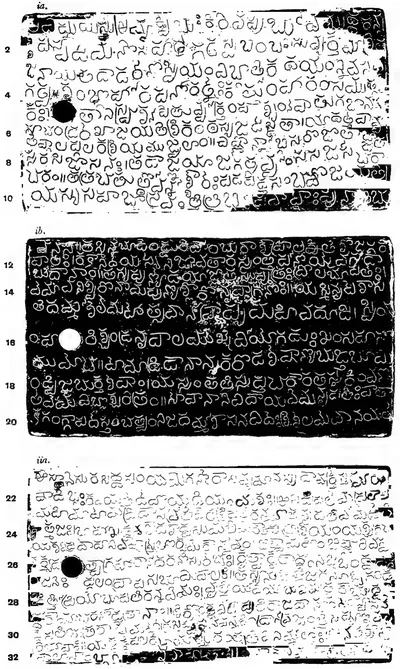 "Vanapalli Plates of Anna-Vema.—Saka-Samvat 1300", plates i a, i b and ii a (lines 1-32) (Epigraphia Indica III, plates between pp. 62 and 63, PDF p. 100)Inscription rubbing · 1895
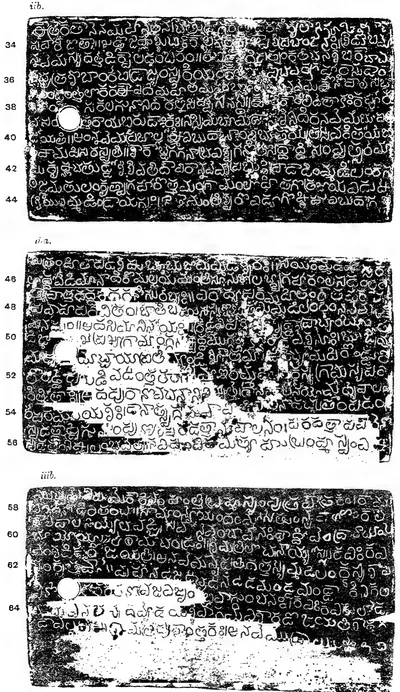 "Vanapalli Plates of Anna-Vema.—Saka-Samvat 1300", plates ii b, iii a and iii b (lines 33-65) (Epigraphia Indica III, plates between pp. 62 and 63, PDF p. 101)Inscription rubbing · 1895
References
Notes (0)
Sources (3)
Spotted an error on this page? Tell us
Last updated: