Pillalamarri inscription of the reign of Kapaya Nayaka
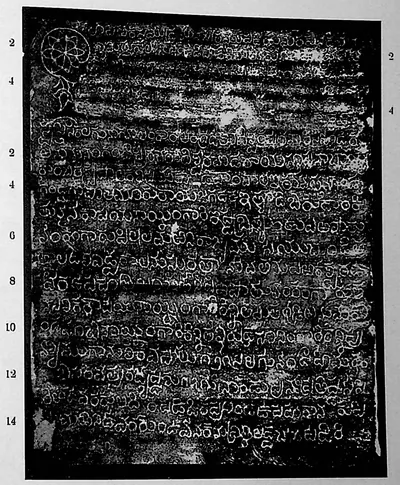
A Telugu inscription of 1357 at Pillalamarri, near Suryapet. In it Era-Potu-lemka, servant of Kapaya Nayaka, 'lord of the Andhra country' and lord of the city of Anumanamgallu, records that he set up again the image of the god Erakesvara. 'Sultan Alavadin' had damaged the image in the disturbances of the time. Era-Potu-lemka also gives land for its offerings.
The record
P. Sreenivasachar published the inscription in 1940, in the second part of the Corpus of Inscriptions in the Telingana Districts.1 He gave a transliterated Telugu text and an English translation.1 On the same surface, before it, is a short record of three lines in small characters.1 It assigns land under the Eraka-samudram tank for a feeding house for fifteen people, for students’ food and clothing, and for those who serve water at a water-shed.1
The village of Pillalamarri has several other inscriptions in the same volume.12 Among them are records of the Recherla chief Nami-Reddi of 1195 and 1202.12 See Kapaya Nayaka.
Contents
The record opens with the titles of Kapaya-nayaka.12 He is called “the Lord of the Andhra country” and the lord of the excellent city of Anumanamgallu.12 He is also called the master who established the Coda king and the protector of the security of Kanci, among other titles.12
His favoured servant Era-Potu-lemka was then governing Pillalamarri.2 The god Erakesvara had been damaged by “Sultan Alavadin” during the disturbances of that time and place.2 Era-Potu-lemka set up the god again, for the merit of his ruler Kapaya-nayaka and of his own parents, Anumakonda Maci-nayaka and Rudrasani.2 For a daily light meal offered to the god, he gave half a dry field behind the temple tank, the Devara-kunta of Pillalamarri.2
Date
The date is Saka 1279 (Saka is an Indian way of counting years), the cyclic year Hemalambi, the thirteenth day of the bright half of Jyeshtha, a Thursday, which falls in 1357.2 The editors of the Vilasa grant cite the record as the latest dated inscription of Kapaya’s reign.3 They list it beside his Ganapesvaram inscription of Saka 1268.3
Evidence and disagreements
- Reading. Before the Corpus edition, the inscription had been published in the Hyderabad journal Sujata.45 There the chief’s name was read as Kachaya.45 As Somasekhara Sarma reported in 1931, the year was read there as Saka 1275.45 Sarma took Kachaya for a misreading of Kapaya.45 The Corpus reads Kapaya-nayaka and Saka 1279.12
- Sultan Alavadin. The record does not say when the damage was done, or which sultan of that name is meant.2
Footnotes
-
P. Sreenivasachar (ed.), A Corpus of Inscriptions in the Telingana Districts, Part II (1940), p. 113, Nos. 39–40 (archive.org (opens in a new tab)). Paraphrased. ↩ ↩2 ↩3 ↩4 ↩5 ↩6 ↩7 ↩8 ↩9 ↩10
-
Sreenivasachar, Corpus, Part II (1940), p. 114, No. 40, text and translation (archive.org (opens in a new tab)). Paraphrased. ↩ ↩2 ↩3 ↩4 ↩5 ↩6 ↩7 ↩8 ↩9 ↩10 ↩11 ↩12
-
N. Venkataramanayya and M. Somasekhara Sarma, “Vilasa Grant of Prolaya-nayaka”, Epigraphia Indica XXXII (1957–58), p. 256 (archive.org (opens in a new tab)). Paraphrased. ↩ ↩2
-
M. Somasekhara Sarma, “Kapaya Nayaka”, Journal of the Andhra Historical Research Society V (1931), p. 218 (archive.org (opens in a new tab)). Cite-only; paraphrased. ↩ ↩2 ↩3 ↩4
-
Somasekhara Sarma, “Kapaya Nayaka” (1931), p. 219, note 8 (archive.org (opens in a new tab)). Cite-only; paraphrased. ↩ ↩2 ↩3 ↩4
Photos
References
Notes (0)
Sources (3)
Spotted an error on this page? Tell us
Last updated: